
spec sheet7 rows
Unithiol, better known as DMPS, is a water soluble dithiol chelator used as an antidote for poisoning with arsenic, mercury and several other heavy metals.
- Established antidote for arsenic and mercury poisoning
- Water soluble dithiol chelator, better known as DMPS
- Two thiol groups that grip heavy metals tightly
- Covers several heavy metals beyond arsenic and mercury
- A legitimate job with real clinical standing
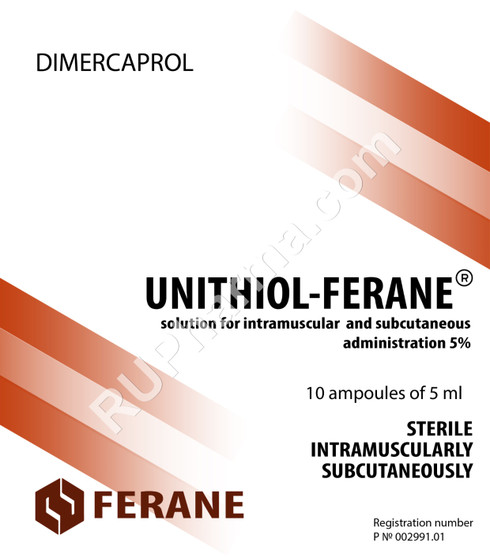
- Unithiol (DMPS, sodium 2,3-dimercapto-1-propanesulfonate) is a water-soluble dithiol chelator developed in the Soviet Union in the 1950s; it is licensed in Germany as Dimaval and in Russia as Unithiol, but has never been approved by the FDA in the United States.
- Unlike the older lipophilic chelator dimercaprol (BAL), unithiol is highly polar, largely extracellular and actively secreted by renal OAT1, so it increases urinary metal excretion without redistributing mercury or lead into the brain (PMID 12391276, PMID 8619252).
- Its best clinical evidence is a small randomised placebo-controlled trial in chronic arsenicosis from contaminated groundwater in West Bengal, which found improvement in clinical symptom scores with DMPS [6].
- Human studies established the DMPS mercury challenge as a research tool by showing post-challenge urinary mercury tracks amalgam and occupational exposure in dental workers [3] and after mercurous chloride exposure [4].
- The same body of work showed unithiol non-selectively increases urinary excretion of essential trace elements including zinc and copper [5], which is the principal argument against casual or repeated use.
- The commercially promoted 'DMPS challenge test' or 'provoked urine test' for diagnosing heavy-metal toxicity is not a validated diagnostic; a raised post-challenge urine metal level is the expected pharmacological result of giving a chelator, not evidence of poisoning, and major clinical toxicology bodies reject its use.
Mechanism
Its two thiol groups bind soft heavy metal ions to form a complex the kidney can excrete, and the sulfonate group keeps the molecule water soluble so it distributes very differently from the older oily chelator dimercaprol. It also chelates essential metals such as copper and zinc, which is why an unsupervised course is a problem rather than merely useless.
receptor fingerprint
Soft heavy-metal cations (Hg2+, methylmercury, As3+, Pb2+, Cd2+, Cu2+)Vicinal dithiol chelation forming stable, water-soluble five-membered ring complexes
OAT1 (SLC22A6, organic anion transporter 1) in the renal proximal tubule basolateral membraneSubstrate; actively secreted, carrying the metal complex with it
Plasma albumin cysteine-34 residueForms a mixed disulfide; over 80% of circulating unithiol is albumin-bound in humans
Endogenous trace metals (zinc, copper, selenium)Non-selectively chelated and excreted
penetrationMinimal; unithiol is highly polar and largely extracellular
Safetyrisks and cautions, not medical advice
a parenteral chelator that belongs with a confirmed heavy metal exposure and laboratory monitoring; it also strips essential copper and zinc, so an unnecessary course does harm rather than nothing
Subjective profileweighing the evidence above
Unithiol has a legitimate job and is also one of the most misused molecules in alternative medicine, so the distinction is worth being blunt about. For confirmed arsenic or mercury poisoning, DMPS under supervision with monitoring is a proper treatment; for a provoked urine test sold as proof of heavy metal burden, it is a chelator treating a diagnosis the chelator itself manufactured. Those two thiol groups cannot tell a toxic metal from copper or zinc, so a course run without a confirmed exposure strips essential minerals and does harm rather than nothing. No exposure, no chelation.
Resources
No suppliers are provided for compounds like this. This entry is here for reference.
Research
- 1983first citedOptical isomers of 2,3-dimercapto-1-propanesulfonate: antidotal activity, in vitro and in vivo,…
- 2001controlled trialRandomized placebo-controlled trial of 2,3-dimercapto-1-propanesulfonate (DMPS) in therapy of c…
- 2002most recentInteraction of the metal chelator 2,3-dimercapto-1-propanesulfonate with the rabbit multispecif…
- 1.Optical isomers of 2,3-dimercapto-1-propanesulfonate: antidotal activity, in vitro and in vivo, against sodium arsenite
- 2.2,3-Dimercapto-1-propanesulphonate in heavy metal poisoning
- 3.Sodium 2,3-dimercaptopropane-1-sulfonate challenge test for mercury in humans: II. Urinary mercury, porphyrins and neurobehavioral changes of dental workers in Monterrey, Mexico
- 4.Sodium 2,3-dimercaptopropane-1-sulfonate challenge test for mercury in humans. III. Urinary mercury after exposure to mercurous chloride
- 5.Urinary excretion of trace elements in humans after sodium 2,3-dimercaptopropane-1-sulfonate challenge test
- 6.Randomized placebo-controlled trial of 2,3-dimercapto-1-propanesulfonate (DMPS) in therapy of chronic arsenicosis due to drinking arsenic-contaminated water.
- 7.Interaction of the metal chelator 2,3-dimercapto-1-propanesulfonate with the rabbit multispecific organic anion transporter 1 (rbOAT1)
7 listed here; entry last updated August 2026
Reviews
My notesprivate to this device
Notes and cautions
- Unithiol is not FDA-approved in the United States and therefore carries no US label or boxed warning; it is obtained as an unapproved or compounded product outside Germany and Russia, with the manufacturing-quality risks that implies.
- It is a non-selective chelator and increases urinary loss of essential trace elements including zinc, copper and selenium alongside the toxic metal, so repeated courses require monitoring and supplementation.
- Reported adverse effects include allergic and dermatologic reactions ranging from urticaria to Stevens-Johnson syndrome and erythema multiforme, nausea, dizziness, transient hypotension with rapid intravenous administration, hypocalcaemia and transient neutropenia.
- The most important practical caution is diagnostic rather than toxic: provoked or challenge urine testing with unithiol is not a validated way to diagnose heavy-metal poisoning, and courses of chelation begun on the strength of such a test expose patients to risk without evidence of benefit.