
spec sheet12 rows
Etifoxine (brand name Stresam; also called etafenoxine) is a benzoxazine anxiolytic (an anti-anxiety drug from a chemical family unrelated to the benzodiazepines like Valium). It has been prescribed for the anxious, tense, physical side of stress mainly in France and a handful of other countries since the late 1970s, and it is not approved by the US FDA. What makes it interesting is a dual mechanism: it calms the brain both by directly tuning up GABA-A receptors and by nudging the body to make more of its own calming neurosteroids. In head-to-head trials it eased anxiety comparably to some benzodiazepines while causing less sedation, less memory and psychomotor impairment, and little rebound or dependence when stopped. It has also been explored beyond anxiety for helping injured peripheral nerves heal and for damping neuroinflammation (inflammation inside nervous tissue). The important caveat is safety: rare but serious liver injury and severe skin reactions have been reported.
- benzo-level calm without the benzo fog
- matched alprazolam and buspirone in controlled trials
- leaves alertness, memory and coordination intact
- little rebound or dependence when you stop
- works two ways; tunes GABA-A and raises your own neurosteroids
- rodent data on nerve repair and neuroinflammation looks striking
- Drowsiness, especially early in treatment (most common)
- Skin rash and hypersensitivity reactions
- Rare severe skin reactions (DRESS, Stevens-Johnson syndrome, erythema multiforme)
Overview
A non-benzodiazepine benzoxazine anxiolytic that quiets the GABA-A receptor through its beta subunit while raising the brain's own allopregnanolone via the translocator protein; calming and non-addictive, but shadowed by rare serious liver and skin reactions.
- Despite being described as a translocator protein (TSPO) ligand, human pharmacokinetic modelling suggests that at the standard oral dose the free plasma level (around 0.31 nanomolar) sits far below etifoxine's roughly 7.8 micromolar affinity for human TSPO, implying low TSPO occupancy and a larger role for its direct GABA-A action at clinical doses.
- Etifoxine can switch on neurosteroid synthesis within about fifteen minutes through a route that survives blockade of TSPO, the benzodiazepine site and the GABA-A receptor, pointing to direct activation of steroidogenic enzymes rather than a purely receptor-mediated effect.
- Much of the neurosteroid surge after a dose is adrenal in origin; etifoxine raises adrenal pregnenolone, progesterone and corticosterone while lowering testicular testosterone.
- It binds the Ro5-4864 pocket of TSPO with an unusually long residence time, and this slow release, rather than binding strength, best predicts how strongly it drives neurosteroid production.
Mechanism
Etifoxine (6-chloro-2-ethylamino-4-methyl-4-phenyl-4H-3,1-benzoxazine) is a chiral benzoxazine that acts through two convergent, mutually reinforcing mechanisms. First, it is a direct positive modulator (a compound that enhances a receptor's response to its natural transmitter) of the -A receptor. Unlike benzodiazepines, its action is insensitive to the flumazenil and does not require the alpha/gamma benzodiazepine pocket; instead it is governed by the receptor's beta subunit, with markedly greater potentiation at beta2- and beta3-containing receptors than at beta1 (Hamon 2003).
Subunit mapping shows it preferentially increases potency at alpha2- and alpha3-containing receptors while sparing alpha1, the subtype most linked to sedation and motor impairment; at roughly 20 micromolar, the estimated brain concentration at anxiolytic doses, it maximally potentiates alpha3-beta3-gamma2 receptors (Mattei 2019).
This alpha2/alpha3 preference with beta1 sparing is thought to explain anxiolysis with minimal ataxia and sedation. Second, etifoxine is a of the 18 kDa translocator protein (TSPO, formerly the peripheral benzodiazepine receptor), an outer membrane protein that gates the rate-limiting import of cholesterol into the mitochondrion, the first committed step of steroidogenesis.
It binds the Ro5-4864 site of TSPO with low affinity but an unusually long residence time, and this slow dissociation predicts its neurosteroidogenic potency better than affinity itself (Costa 2017). Through this axis it raises pregnenolone, progesterone, 5-alpha-dihydroprogesterone and the potent -A-active 3-alpha-reduced steroids allopregnanolone (3-alpha,5-alpha-tetrahydroprogesterone) and THDOC (allotetrahydrodeoxycorticosterone), which feed back to the same GABA-A receptors, so the two mechanisms compound one another.
Blocking the final 5-alpha and 3-alpha reduction with finasteride abolishes part of the anti-conflict effect, confirming that allopregnanolone is required for the full anxiolytic action (Verleye 2005). The steroidogenic response is not purely TSPO-dependent: etifoxine also triggers a rapid, membrane-receptor-independent burst of neurosteroid synthesis within about fifteen minutes that resists blockade by the TSPO PK11195, by flumazenil and by the -A antagonist bicuculline, implying direct post-translational activation of steroidogenic enzymes (do Rego 2015). Much of the measured steroid surge is adrenal in origin, with adrenal pregnenolone, progesterone and corticosterone rising while testicular testosterone falls (Liere 2017).
Human pharmacokinetic modelling complicates the simple TSPO narrative: at the licensed oral dose the free plasma concentration is on the order of 0.31 nanomolar, far below the roughly 7.8 micromolar human TSPO affinity, so measurable TSPO occupancy is low and the direct -A action together with receptor-independent steroidogenesis likely dominate at clinical exposure (Owen 2022). A minor serotonergic component involving 5-HT2 receptors has also been described (Bourin 2010).
Etifoxine is metabolised to an active mono-desethyl derivative, and beyond the central nervous system its TSPO engagement drives anti-inflammatory, pro-myelinating and pro-regenerative effects that underlie its activity in models of nerve injury, neuropathic pain and . Notably, etifoxine is not the only clinical agent that raises allopregnanolone; at low doses certain selective reuptake inhibitors, including fluoxetine, fluvoxamine and sertraline, act as selective brain steroidogenic stimulants that similarly elevate brain allopregnanolone, a shared mechanism now of interest across anxiety and mood disorders.
receptor fingerprint
-A receptor (beta2/beta3 subunit)positive allosteric modulation (distinct from benzodiazepine site)
Neurosteroidogenesis (allopregnanolone and THDOC)Stimulates synthesis of 3-alpha-reduced neurosteroids
TSPO (18 kDa translocator protein)ligand; stimulates mitochondrial neurosteroid synthesis
Neurosteroids (allopregnanolone, progesterone)indirect increase in synthesis
-A receptor (alpha2/alpha3 subunit)Preferential potentiation of GABA potency, sparing alpha1
TSPO 18 kDa translocator protein (Ro5-4864 site)Low-affinity, long-residence-time ligand
Peripheral nerve regenerationpromotes axonal regrowth and damps neuroinflammation
5-HT2 receptorIndirect functional involvement
Safetyrisks and cautions, not medical advice
Etifoxine is generally well tolerated, with mild drowsiness or fatigue the most common complaint; unlike benzodiazepines it does not measurably impair alertness, vigilance, memory or psychomotor performance at therapeutic doses, including in elderly subjects. Its principal safety concern is a small number of rare but serious idiosyncratic reactions.
A French pharmacovigilance survey of 350 reports from 2000 to 2012 found 123 serious adverse reactions, of which about 59 percent were dermatological or acute hypersensitivity events, including 5 cases of DRESS syndrome (drug reaction with eosinophilia and systemic symptoms), 10 of erythema multiforme and 5 of Stevens-Johnson syndrome, alongside 34 liver disorders of which 25 were acute hepatitis, most cytolytic and reversible on withdrawal.
Rarer signals include lymphocytic (microscopic) colitis and unexpected uterine bleeding. These findings led the French regulator to reinforce its warnings and prompted the independent bulletin Prescrire to judge that the drug carries too many serious adverse effects for a simple anxiolytic. Treatment should be stopped immediately at the first sign of a skin eruption or hepatic disturbance, and the drug is contraindicated in severe hepatic or renal impairment, in shock states and in known hypersensitivity.
History
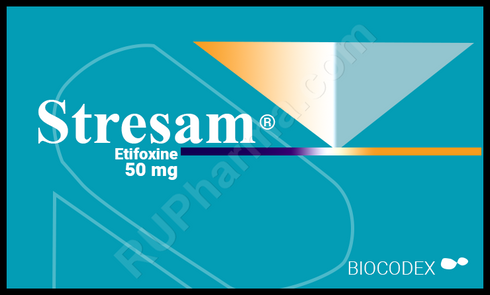
Etifoxine was synthesised by the German firm Hoechst in the 1960s under the code HOE 36-801 and belongs to the benzoxazine class rather than to any steroid or benzodiazepine family. It was introduced by Biocodex as Stresam and has been prescribed since 1979, chiefly in France and later widely in Russia, for anxiety and for psychosomatic and adjustment disorders with anxiety. For many years it was regarded simply as an atypical GABAergic sedative; a series of studies in the 2000s by Schlichter, Verleye, Hamon and colleagues redefined it, first characterising its direct beta-subunit action on GABA-A receptors and then its stimulation of neurosteroid synthesis through the translocator protein.
In 2008 a landmark report in the Proceedings of the National Academy of Sciences extended its biology beyond anxiolysis, showing that it accelerates peripheral nerve regeneration, which opened a decade of work on neuroprotection and neuroinflammation in models of multiple sclerosis, traumatic brain injury, stroke and neuropathic pain. Safety signals accumulating through French pharmacovigilance led to reinforced regulatory warnings from about 2012 onward, while more recent human studies have re-examined its translocator-protein pharmacokinetics and tested it as a proof-of-concept treatment for depression.
Reputation
Within the countries where it is licensed, etifoxine has a long-standing reputation as a gentler everyday anxiolytic, marketed as a way to relieve anxiety without the sedation, memory impairment, tolerance and dependence associated with benzodiazepines, and controlled trials broadly support that non-inferior efficacy with a cleaner discontinuation profile. In the nootropic and biohacker community it is valued as a non-sedating anxiolytic and putative neuroprotectant, though informed users weigh those benefits against the rare but serious hepatic and cutaneous risks and against the finding that its headline translocator-protein mechanism may be only partly engaged at oral doses. Academically it is treated as the prototype neurosteroidogenic anxiolytic and, alongside the more selective ligand XBD173 (emapunil), as a key tool compound for probing translocator-protein biology.
Subjective profileweighing the evidence above
A real alternative to benzodiazepines for the tense, physical side of anxiety, without the sedation, memory dulling or dependence. The catch is not trivial; rare but serious skin reactions including DRESS and Stevens-Johnson syndrome, plus occasional acute liver injury, mean any rash is a reason to stop and get checked.
Where to buy
Suppliers
Vendors carrying Etifoxine, with live product details and codes. Links are affiliate links that support the wiki at no cost to you.
RUPharma🌐
Etifoxine
RUPharma🌐
Etifoxine
RUPharma🌐
Etifoxine
Research
- 2000first citedModulation of GABAergic synaptic transmission by the non-benzodiazepine anxiolytic etifoxine.
- 2018controlled trialEtifoxine impairs neither alertness nor cognitive functions of the elderly: A randomized, doubl…
- 2022most recentHuman pharmacokinetics of XBD173 and etifoxine distinguish their potential for pharmacodynamic…
- 1.The modulatory effects of the anxiolytic etifoxine on GABA(A) receptors are mediated by the beta subunit
- 2.The Anxiolytic Etifoxine Binds to TSPO Ro5-4864 Binding Site with Long Residence Time Showing a High Neurosteroidogenic Activity
- 3.An update on the anxiolytic and neuroprotective properties of etifoxine: from brain GABA modulation to a whole-body mode of action
- 4.Etifoxine for pain patients with anxiety
- 5.Axonal regeneration and neuroinflammation: roles for the translocator protein 18 kDa
- 6.Etifoxine impairs neither alertness nor cognitive functions of the elderly: A randomized, double-blind, placebo-controlled crossover study
- 7.Safety profile of etifoxine: A French pharmacovigilance survey
- 8.Etifoxine-induced acute hepatitis: a case series
- 9.Human pharmacokinetics of XBD173 and etifoxine distinguish their potential for pharmacodynamic effects mediated by translocator protein
- 10.Pharmacotherapy of adjustment disorder: A review
- 11.Translocator Protein Ligand Etifoxine Attenuates MPTP-Induced Neurotoxicity
- 12.Involvement of the GABA(A) receptor α subunit in the mode of action of etifoxine.
27 listed here; entry last updated August 2026
Reviews
My notesprivate to this device
FAQ
How is etifoxine different from a benzodiazepine like Valium?
Both end up boosting GABA, the brain's calming signal, but they get there differently. Benzodiazepines lock onto one specific site on the GABA-A receptor. Etifoxine tunes the receptor up through its beta subunit at a separate site, and it also prompts the body to make more of its own calming neurosteroids. In practice that has meant similar anxiety relief in trials but less drowsiness, less memory fog, and far less of the dependence and withdrawal that benzodiazepines are known for.
Is etifoxine available in the US?
No. It is not approved by the FDA. It has been prescribed mainly in France and some other countries since the late 1970s under the brand name Stresam. Treat any online source claiming to sell it with caution.
What is the TSPO / neurosteroid part about?
TSPO is a protein on mitochondria (the cell's power plants) that helps kick off steroid production. Etifoxine binds it and is reported to raise neurosteroids like allopregnanolone, which themselves calm GABA-A receptors. It is a neat second mechanism, though how much it contributes at normal oral doses is still debated, since some human data suggest the drug may not reach TSPO in large amounts.
What are the most serious risks?
Rare but potentially severe skin reactions (including DRESS and Stevens-Johnson syndrome) and acute liver injury have been reported. These are uncommon, but they are the reason it is a monitored prescription drug. A new rash, fever, or signs of liver trouble means stop and see a doctor.
Does it cause dependence like benzodiazepines?
The evidence suggests a low dependence potential, with significantly less rebound anxiety after stopping compared with lorazepam or alprazolam, and it generally does not produce classic withdrawal syndromes. That is one of its main selling points, though it is still a prescription medicine to be used under supervision.
How is etifoxine different from a benzodiazepine?
Both enhance the GABA-A receptor, but etifoxine binds a site distinct from the benzodiazepine site, so its action is insensitive to the antagonist flumazenil, and it works through the receptor's beta subunit rather than the classical benzodiazepine pocket. It also raises the brain's own neurosteroids. In practice this yields anxiety relief with little sedation, minimal memory impairment, preserved coordination and low dependence liability.
Is etifoxine actually a neurosteroid?
No. Etifoxine is a synthetic benzoxazine, not a steroid. It is a neurosteroidogenic agent, meaning it stimulates the body's own production of neuroactive steroids such as allopregnanolone and THDOC, which then potentiate GABA-A receptors. It is grouped with neurosteroids here because of that downstream mechanism.
What are the most important safety concerns?
The main risks are rare but serious skin reactions, including DRESS syndrome and Stevens-Johnson syndrome, and drug-induced acute hepatitis. French pharmacovigilance data on these reactions prompted stronger regulatory warnings. The drug should be stopped at once at the first sign of a rash or liver disturbance and avoided in people with significant liver disease.
Where is etifoxine available?
It is sold as Stresam, originally by Biocodex, and has been used since the late 1970s, mainly in France and widely in Russia, with availability in parts of Asia, Africa and Latin America. It is not approved in the United States or the United Kingdom.
Does etifoxine help with nerve pain or nerve injury?
In animal studies it does; etifoxine eases neuropathic and inflammatory pain by boosting spinal allopregnanolone and accelerates peripheral nerve regeneration and functional recovery. These results are preclinical, and large human pain trials have not yet confirmed them.
Adverse effects
- Drowsiness, especially early in treatment (most common)
- Skin rash and hypersensitivity reactions
- Rare severe skin reactions (DRESS, Stevens-Johnson syndrome, erythema multiforme)
- Rare acute liver injury (hepatitis), occasionally serious
- Rare but serious cutaneous hypersensitivity reactions, including DRESS syndrome, erythema multiforme and Stevens-Johnson syndrome
- Drug-induced acute hepatitis, usually cytolytic and generally reversible after stopping the drug
- Mild drowsiness or fatigue in some patients
- Uncommon reports of lymphocytic (microscopic) colitis and unexpected uterine bleeding
- Short-term shifts in gut microbiome composition, including reduced beneficial commensal bacteria
Notes and cautions
- Should be avoided in severe liver or kidney impairment, in shock, and in known hypersensitivity