
spec sheet11 rows
Phenylpiracetam Hydrazide (fonturacetam hydrazide) is a structural variant of phenylpiracetam in which the racetam's amide group is replaced by a hydrazide, marketed as a next-generation twist on one of the most potent racetam nootropics [4]. Its appeal rests on the phenylpiracetam framework, a scaffold known for selective dopamine transporter inhibition and stimulant-like focus, endurance, and cold resistance [2][5]. It is sold strictly as a research chemical, and its own pharmacology has not been characterized in published human or animal studies, so its profile is inferred from the phenylpiracetam parent it is built upon [3][4].
- Built on the most potent racetam scaffold
- Smoother and gentler than phenylpiracetam itself
- Crosses the blood brain barrier fast
- Clean focus and alertness, users report
- Lifts drive without the jittery edge
- A next generation twist on fonturacetam
- As a phenylpiracetam-type compound, overstimulation, irritability, and insomnia are plausible class effects
- Headache is commonly reported across the racetam family
Overview
Phenylpiracetam Hydrazide, also marketed as fonturacetam hydrazide, is a chemically modified analogue of phenylpiracetam (phenotropil, carphedon), a potent member of the racetam family of nootropics [1][4]. Structurally it retains the 4-phenyl-2-pyrrolidinone core of phenylpiracetam but replaces the terminal acetamide group with a hydrazide functional group, meaning a carbonyl bound to a nitrogen-nitrogen moiety in place of the simple amide [4][6]. This is a deliberate medicinal-chemistry style modification of the parent scaffold, and it defines the compound's identity as a distinct research chemical rather than an established drug [4].
It is important to state plainly that phenylpiracetam hydrazide itself has essentially no dedicated peer-reviewed pharmacological or clinical literature; it has not been characterized in published human trials, and descriptions of its effects are extrapolated from the phenylpiracetam family to which it belongs rather than from direct study of the hydrazide [1][4]. What can be described is the pharmacology of the parent. Phenylpiracetam is a chiral racetam whose enantiomers act on the dopamine transporter, with the S-form identified as a selective DAT inhibitor and DAT the only significant molecular target in radioligand profiling [2][3]. In behavioral studies phenylpiracetam increases locomotor activity, produces antidepressant-like effects, and improves memory in a stereospecific manner, and it is credited with enhancing physical endurance and resistance to cold [1][5].
One relevant clue to how a hydrazide substitution changes racetam activity comes from older work on piracetam derivatives, which found that inserting a hydrazide group into the piracetam molecule shifted its immunological activity toward stimulation of antibody formation, in contrast to the immunosuppression seen when a phenyl radical was added [6]. Phenylpiracetam hydrazide is not an approved medicine anywhere and is sold internationally only as a research chemical or nootropic powder, placing it within the broad, loosely regulated category of unauthorized nootropic ingredients that regulators and anti-doping bodies have scrutinized [4]. It is typically encountered as a crystalline powder under the names phenylpiracetam hydrazide or fonturacetam hydrazide [4].
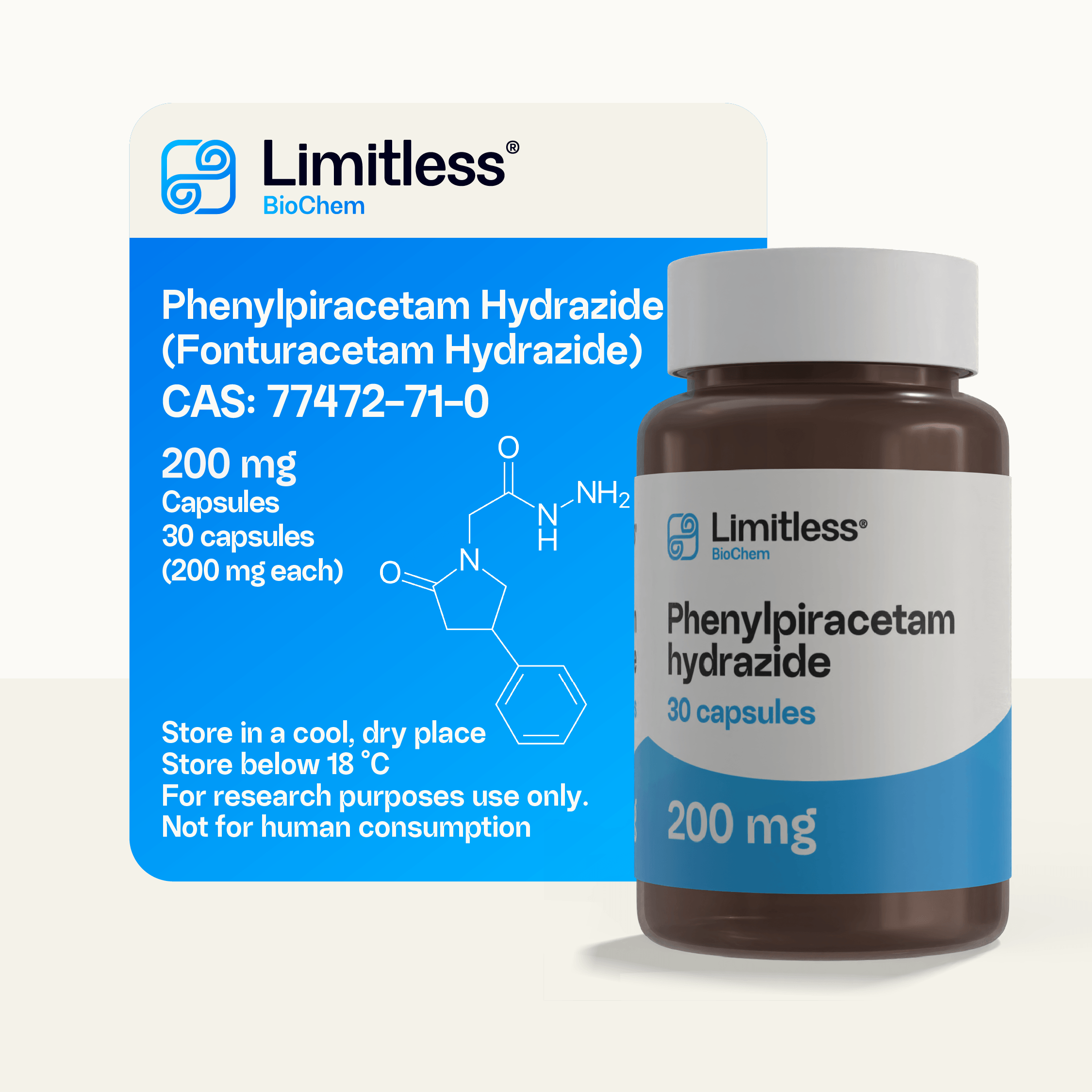
- Despite being marketed as a phenylpiracetam variant, phenylpiracetam hydrazide has no published pharmacology of its own; its profile is entirely inferred from the parent molecule.
- In studies of related piracetam derivatives, replacing the amide group with a hydrazide shifted immune activity in the opposite direction from phenyl substitution, a hint that the change is not pharmacologically silent.
Mechanism
Because phenylpiracetam hydrazide has not itself been studied in controlled pharmacology, its presumed mechanism is best understood through the phenylpiracetam scaffold it is derived from. The defining action of that scaffold is selective inhibition of the (): radioligand binding and target-profiling studies of phenylpiracetam enantiomers identified DAT as the only significant molecular target, with the S- acting as a selective DAT inhibitor that spares and transporters [2][3]. By blocking reuptake, the parent raises extracellular dopamine, which supports the stimulant-like focus, motivation, and drive that characterize phenylpiracetam and distinguish it from the milder, non-dopaminergic piracetam [2]. Pharmacokinetic data on the parent show rapid brain penetration, with R-phenylpiracetam reaching brain tissue within about 15 minutes of a 50 mg/kg dose and peaking near 28 micrograms per gram of tissue [3].
The behavioral profile expected of a phenylpiracetam-derived compound follows from this dopaminergic action. In the parent, both enantiomers increased locomotor activity and produced antidepressant-like effects, while memory enhancement in a passive avoidance task was specific to the R-form and significant at doses as low as 1 mg/kg [1]. Phenylpiracetam is further associated with improved physical endurance and cold resistance, effects that contributed to carphedon becoming the first banned in sport [5]. For the hydrazide these outcomes are a reasonable expectation based on structural similarity rather than a demonstrated fact, since no comparable studies of phenylpiracetam hydrazide exist [3][4].
The one direct hint that the hydrazide modification is not pharmacologically silent comes from research on piracetam derivatives, in which substituting a hydrazide group onto the piracetam molecule shifted immune activity toward stimulation of antibody formation, the opposite direction from the immunosuppression produced by phenyl substitution, an effect that was dose-dependent and most pronounced near 200 mg/kg in mice [6]. This indicates that changing the amide to a hydrazide can meaningfully alter biological activity, so phenylpiracetam hydrazide should not be assumed identical to phenylpiracetam; its true potency, dopaminergic activity, and safety in humans remain uncharacterized [4][6].
receptor fingerprint
penetrationRapid brain uptake shown for a radiolabeled version
Racetam pyrrolidinone corePresumed cholinergic and glutamatergic modulation by analogy to phenylpiracetam
Seizure thresholdWeak anticonvulsant activity in a 1980 electroshock screen
Dosingtypical ranges, not medical advice
interested in protocols and clinical dosages? make an account to see them! ^_^
Safetyrisks and cautions, not medical advice
Being honest, there is essentially no human safety data for phenylpiracetam hydrazide; it is sold as a research chemical with no clinical track record of its own. The hydrazide chemistry is worth a note of caution, since some hydrazides carry liver or nerve concerns, though that has not been studied for this compound specifically. Anecdotally the effects are mild, and the reported gripes are the usual stimulant style ones: possible insomnia if taken late, some irritability, or a light headache. As a close relative of phenylpiracetam it would also raise the same red flag in drug tested sport. With so little known, treat it as an obscure curiosity, keep doses conservative, and do not assume it is as benign as the parent.
History
Phenylpiracetam hydrazide, sometimes called fonturacetam hydrazide, is a structural variant of phenylpiracetam in which the racetam's amide group is replaced by a hydrazide. It arose from the research-chemical sphere as a next-generation twist on one of the most potent racetams rather than from a documented pharmaceutical development program, and there is no published record of its discovery, synthesis history, or clinical development. Its identity and rationale are inferred almost entirely from the phenylpiracetam parent it is built upon. It is sold strictly as a research chemical and has never been evaluated or approved as a drug.
Reputation
Interest in phenylpiracetam hydrazide flows directly from the respected phenylpiracetam framework, a scaffold known for selective dopamine transporter inhibition and stimulant-like focus, endurance, and cold resistance. Enthusiasts are drawn to the idea that a small structural change might tune that profile, and vendors present it as a novel iteration on a proven design. The essential and honest caveat is that its own pharmacology has not been characterized in any published human or animal study, so its potency, dopaminergic activity, and safety remain uncharacterized. Notably, work on other piracetam derivatives shows that swapping an amide for a hydrazide can meaningfully change biological activity, so it should not be assumed identical to its parent; it is best treated as a genuinely uncharted research compound.
Subjective profileweighing the evidence above
No pharmacology of its own has ever been published, so everything claimed for it is borrowed from phenylpiracetam plus user reports. Hydrazide chemistry is not a group to assume is benign, and plain phenylpiracetam is better characterised and easier to obtain. Not worth the trade.
Where to buy

1 other outlet
Suppliers
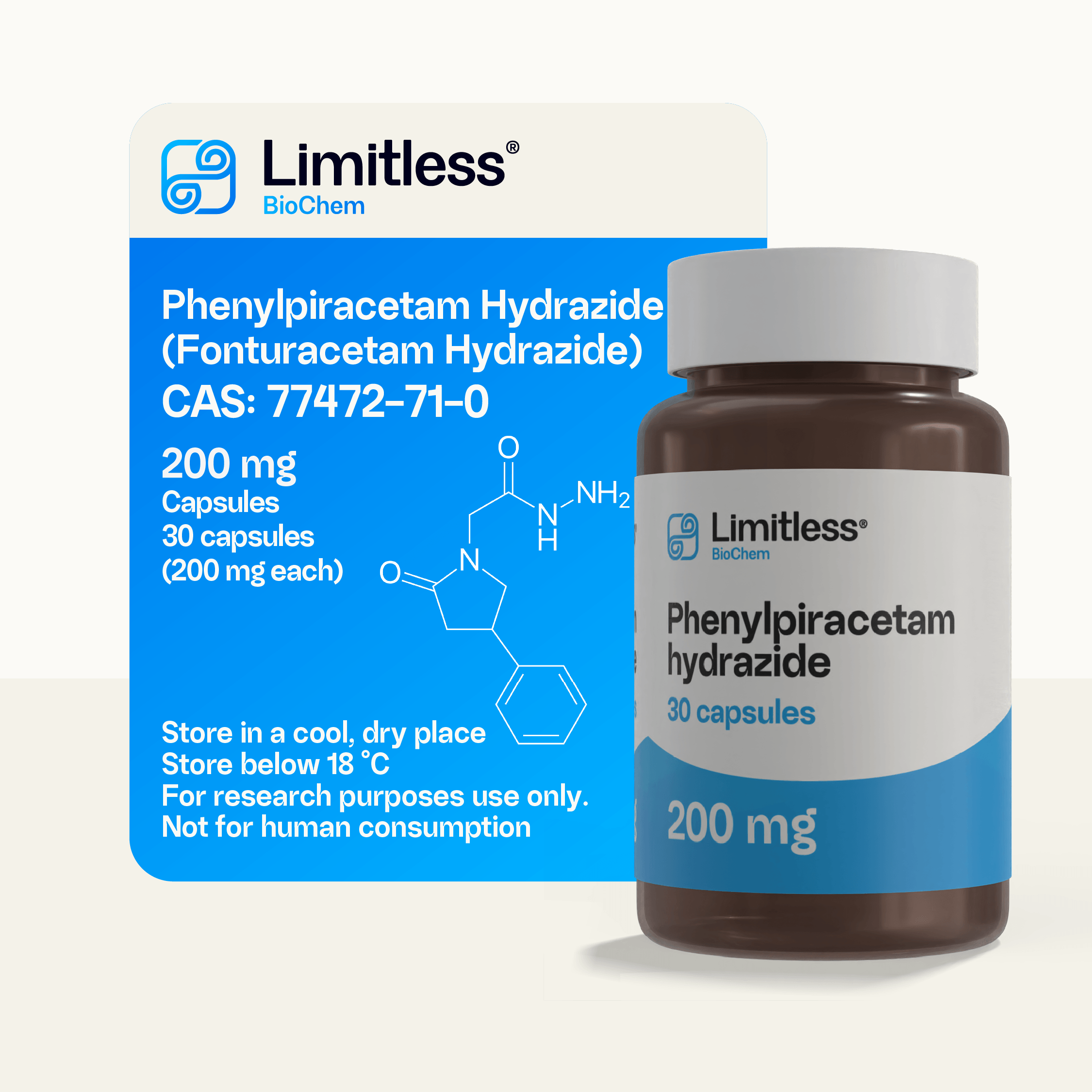
Vendors carrying Phenylpiracetam Hydrazide, with live product details and codes. Links are affiliate links that support the wiki at no cost to you.
Kimera Chems
Phenylpiracetam Hydrazide
Limitless Biochem🌐
Phenylpiracetam Hydrazide
Research
- 1985first cited[Effect of piracetam derivatives on antibody formation].
- 2023most recentUnauthorized ingredients in "nootropic" dietary supplements: A review of the history, pharmacol…
- 1.Investigation into stereoselective pharmacological activity of phenotropil.
- 2.S-phenylpiracetam, a selective DAT inhibitor, reduces body weight gain without influencing locomotor activity.
- 3.Neuroprotective and anti-inflammatory activity of DAT inhibitor R-phenylpiracetam in experimental models of inflammation in male mice.
- 4.Unauthorized ingredients in "nootropic" dietary supplements: A review of the history, pharmacology, prevalence, international regulations, and potential as doping agents.
- 5.Determination of carphedon in human urine by solid-phase microextraction using capillary gas chromatography with nitrogen-phosphorus detection.
- 6.[Effect of piracetam derivatives on antibody formation].
- 7.[Gender differences in action Fenotropil and its structural analog--compound RGPU-95 on anxiety-depressive behavior animals].
7 listed here; entry last updated August 2026
Reviews
My notesprivate to this device
FAQ
Is this just phenylpiracetam?
No; the amide group is replaced by a hydrazide, making it a separate molecule. Its effects and safety do not automatically match phenylpiracetam.
How strong is it?
Users generally describe it as milder and less reliably stimulating than phenylpiracetam, and effects are often subtle.
Is there real research on it?
Very little. It shows up in a 1980 anticonvulsant screen and a 2023 brain-imaging tracer study; there is no clinical, pharmacokinetic, or safety research on the compound itself.
Are vendor mechanism claims trustworthy?
Be cautious. Confident claims about AMPA modulation or Alzheimer's uses come from marketing and AI-generated pages, not primary studies on this molecule.
Limitations of the evidence
- Phenylpiracetam hydrazide has no established human safety profile
Adverse effects
- As a phenylpiracetam-type compound, overstimulation, irritability, and insomnia are plausible class effects
- Headache is commonly reported across the racetam family
Notes and cautions
- It is an unregulated research chemical, not an approved medicine, and product purity is not guaranteed
- Compounds on the phenylpiracetam scaffold are prohibited in competitive sport