
spec sheet11 rows
RGPU-95 is an experimental compound studied in Russian pharmacological research as a structural analog of fenotropil, better known as phenylpiracetam, a nootropic of the racetam family. In animal experiments it has shown anxiety-reducing and antidepressant-like effects, in some measures exceeding those of its parent compound. It is an obscure investigational substance with essentially no human data, and it is not an approved medicine or recognized supplement ingredient anywhere.
- Built on the phenylpiracetam blueprint, dialed up
- Sharper focus with racetam roots
- Mood lift and calm in animal work
- Outperformed its parent on some measures
- Anti fatigue drive for long days
Overview
RGPU-95 is a laboratory research compound belonging, by its chemical relationship, to the racetam family of nootropics [1]. It was designed as a structural analog of fenotropil, the Russian nootropic also known as phenylpiracetam or fonturacetam, and it comes from the same tradition of Russian medicinal-chemistry research that produced a series of experimental molecules identified by RGPU code numbers [1]. Published information on RGPU-95 is very limited and confined to Russian scientific literature; it has not entered mainstream international pharmacology.
The main published study of RGPU-95 examined its effects on anxiety and depression-related behaviour in rats, comparing it with fenotropil and with reference drugs [1]. Both fenotropil and RGPU-95 reduced anxious and depressive behaviour more strongly in male than in female animals [1]. In that work RGPU-95's anti-anxiety effect was reported to exceed that of fenotropil, though it remained weaker than the benzodiazepine diazepam, while its antidepressant effect was comparable to the classic antidepressant imipramine and greater than that of fenotropil [1]. These findings come from animal models only, and there is no published clinical evidence in humans.
Because RGPU-95 is defined by its relationship to phenylpiracetam, the better-characterized properties of that parent compound provide context [2]. Phenylpiracetam is a phenyl-substituted derivative of the original nootropic piracetam, credited with nootropic, anti-asthenic, anxiolytic, antidepressant, anticonvulsant, and anti-inflammatory actions in experimental and clinical studies, and it has been investigated in conditions such as cerebral ischemia, asthenia, and mental disorders [2]. Phenylpiracetam is a licensed medicine in Russia and some neighbouring countries but is not approved in most of the world, and it was the first nootropic banned in sport, prohibited under the name carphedon, later fonturacetam, in 1998 [2][3]. RGPU-95 has not undergone this kind of development and remains a preclinical curiosity.
RGPU-95 is not an approved drug in any country and is not an established dietary supplement ingredient; it exists essentially as an experimental substance described in a small body of Russian research [1]. Compounds of this type illustrate a broader pattern in which obscure nootropic molecules, some derived from Russian pharmacology, circulate at the margins of the supplement market despite lacking regulatory approval and adequate human safety data [3]. Anyone encountering RGPU-95 should treat it as an unstudied research chemical rather than a proven medicine [1][3].
Mechanism
The way RGPU-95 works has not been established in detail, and any account of its mechanism is necessarily provisional given how little has been published [1]. As a structural analog of phenylpiracetam it is presumed to share aspects of that compound's activity [1][2]. Phenylpiracetam and the racetams to which it belongs are thought to act on the brain in several ways, including effects on neurotransmitter systems and, for phenylpiracetam specifically, adaptogenic and mitochondria-protective actions, rather than through a single well-defined receptor [2].
In the one behavioural study available, RGPU-95 produced anxiolytic and antidepressant effects in rats that differed between the sexes, which the researchers interpreted as evidence of activity on the brain systems governing mood and anxiety, but the specific molecular targets were not identified [1]. Until further research is done, its mechanism should be regarded as largely unknown [1].
receptor fingerprint
()inhibits
/ receptorsmodulates
Limbic anxiety-depression circuitsdampens
cholinergic toneenhances
Dosingtypical ranges, not medical advice
interested in protocols and clinical dosages? make an account to see them! ^_^
Safetyrisks and cautions, not medical advice
Treat this as a true unknown. RGPU-95 is a novel research chemical with no human trials, no approvals anywhere, and no established dose; all the evidence is Russian animal work. Because it behaves like a stronger phenylpiracetam, expect stimulant-style risks; overstimulation, insomnia, headache, blood-pressure and heart-rate bumps, and fast tolerance if used daily. Being far more potent than phenylpiracetam, the margin for a heavy dose is smaller, so more is genuinely riskier here. Phenylpiracetam is banned in sport (WADA), and this analog would carry the same problem. Do not mix casually with stimulants, MAOIs or serotonergic drugs given the dopamine and mood activity. No pregnancy, cardiac or long-term data exists.
History
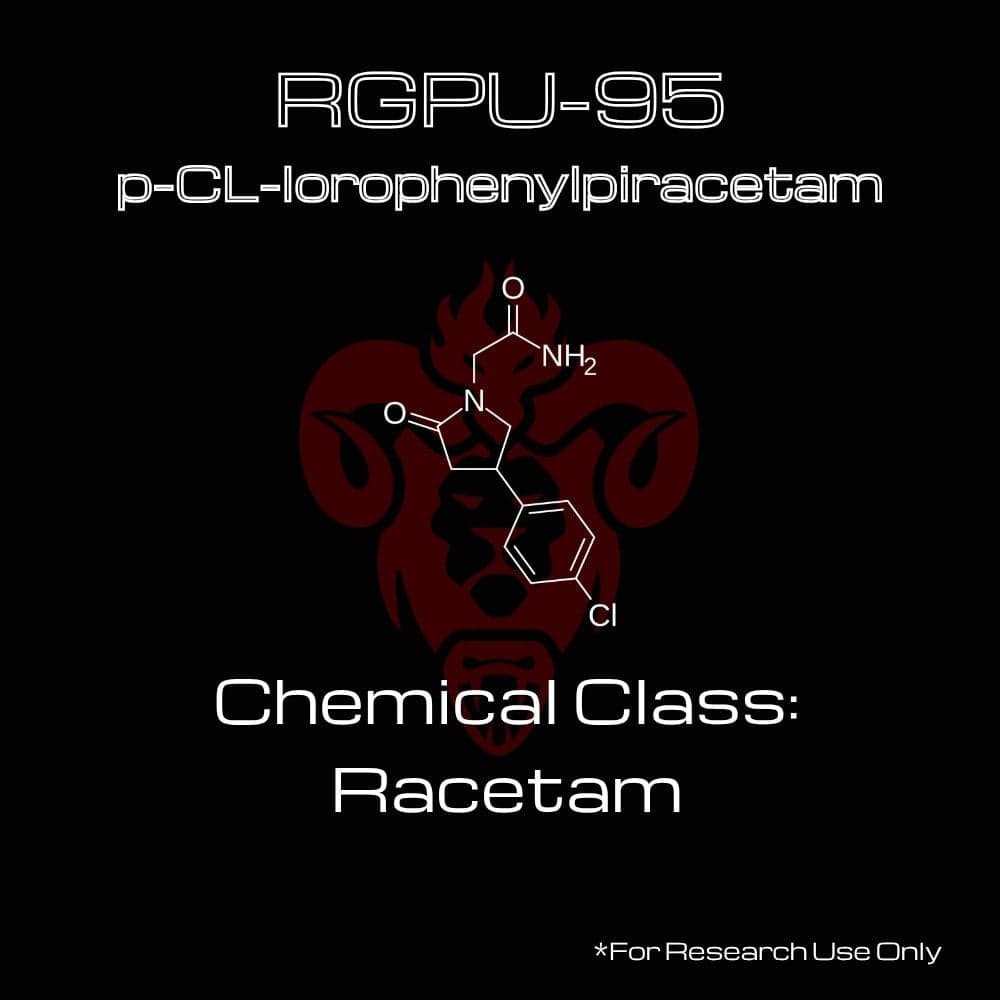
RGPU-95, also referred to as para-chlorophenylpiracetam or p-Cl-phenylpiracetam, is a synthetic analogue of phenylpiracetam bearing a chlorine substitution on the phenyl ring. It was developed by Russian pharmacologists at Volgograd State Medical University as part of a program investigating structural analogues of phenylpiracetam in the search for improved nootropic and psychotropic activity, and it was described in the scientific literature around 2010. The work situated RGPU-95 within a broader Russian tradition of racetam research aimed at compounds with combined cognitive and anxiolytic or antidepressant properties.
Reputation
RGPU-95 is a niche and experimental compound that is known mainly to nootropic enthusiasts and to a handful of research-chemical vendors who market it as a more potent relative of phenylpiracetam. Preclinical Russian studies reporting anxiolytic and antidepressant activity, and claims of greater potency than the parent compound, underpin much of its appeal, but it lacks the independent clinical research and long track record of established nootropics. As a result it is generally viewed as an intriguing but poorly validated option carrying the usual uncertainties of a compound characterized almost entirely in animal models.
Subjective profileweighing the evidence above
an interesting curiosity, but obscure for a reason; the human data just is not there. if you want the phenylpiracetam experience, the regular version is far better characterized, and if you want memory and mood with more evidence behind it, Nefiracetam is the smarter pick.
Where to buy
Suppliers
Vendors carrying RGPU-95, with live product details and codes. Links are affiliate links that support the wiki at no cost to you.
Kimera Chems
RGPU-95
Research
- 2010first cited[Gender differences in action Fenotropil and its structural analog--compound RGPU-95 on anxiety…
- 2025most recent[Efficacy and safety of fonturacetam in asthenia: a systematic review and meta-analysis].
- 1.[Gender differences in action Fenotropil and its structural analog--compound RGPU-95 on anxiety-depressive behavior animals].
- 2.Pharmacological effects of fonturacetam (Actitropil) and prospects for its clinical use.
- 3.Unauthorized ingredients in nootropic dietary supplements: A review of the history, pharmacology, prevalence, international regulations, and potential as doping agents.
- 4.[Asthenia, mental fatigue and cognitive dysfunction].
- 5.[Efficacy and safety of fonturacetam in asthenia: a systematic review and meta-analysis].
5 listed here; entry last updated August 2026
Reviews
My notesprivate to this device
FAQ
What is RGPU-95?
It is a Russian research chemical; the para-chloro analog of phenylpiracetam, reported to be 5-10x more potent and studied mostly for anxiety and depression in animals.
How is it different from phenylpiracetam?
Same backbone with a chlorine added to the phenyl ring. That makes it much stronger and shifts the profile toward anxiolytic and antidepressant effects rather than pure stimulation.
Is it safe?
Unknown. There are no human studies, no approvals and no established dose; everything comes from Russian animal research, so caution is warranted.
Will it fail a drug test?
For athletes, likely yes; phenylpiracetam is banned by WADA and this close analog would raise the same red flag.
Limitations of the evidence
- It is not an approved medicine or supplement, and its purity and content in any product would be unverified
Notes and cautions
- Human safety data are essentially nonexistent, since the compound has been studied only in animals
- Its effects in animal studies differed between males and females
- As a little-studied research chemical, its risks are not characterized