
spec sheet10 rows
CE-123 is a next-generation, thiazole-based modafinil analogue engineered for selective dopamine transporter inhibition and cognitive enhancement. In preclinical studies it sharpens memory and cognitive flexibility while crossing into the brain far more effectively than modafinil, and with less impulsivity. For research focused on motivation, focus, and cognition, CE-123 is a standout modern nootropic candidate.
- Next-generation modafinil analogue built for focus
- Sharpens attention and cognitive flexibility
- Lifts motivation in preclinical research
- Crosses into the brain better than modafinil
- Selective dopamine transporter inhibition
- Drive without heavy stimulation
- As a dopaminergic agent, potential for overstimulation or sleep disruption
Overview
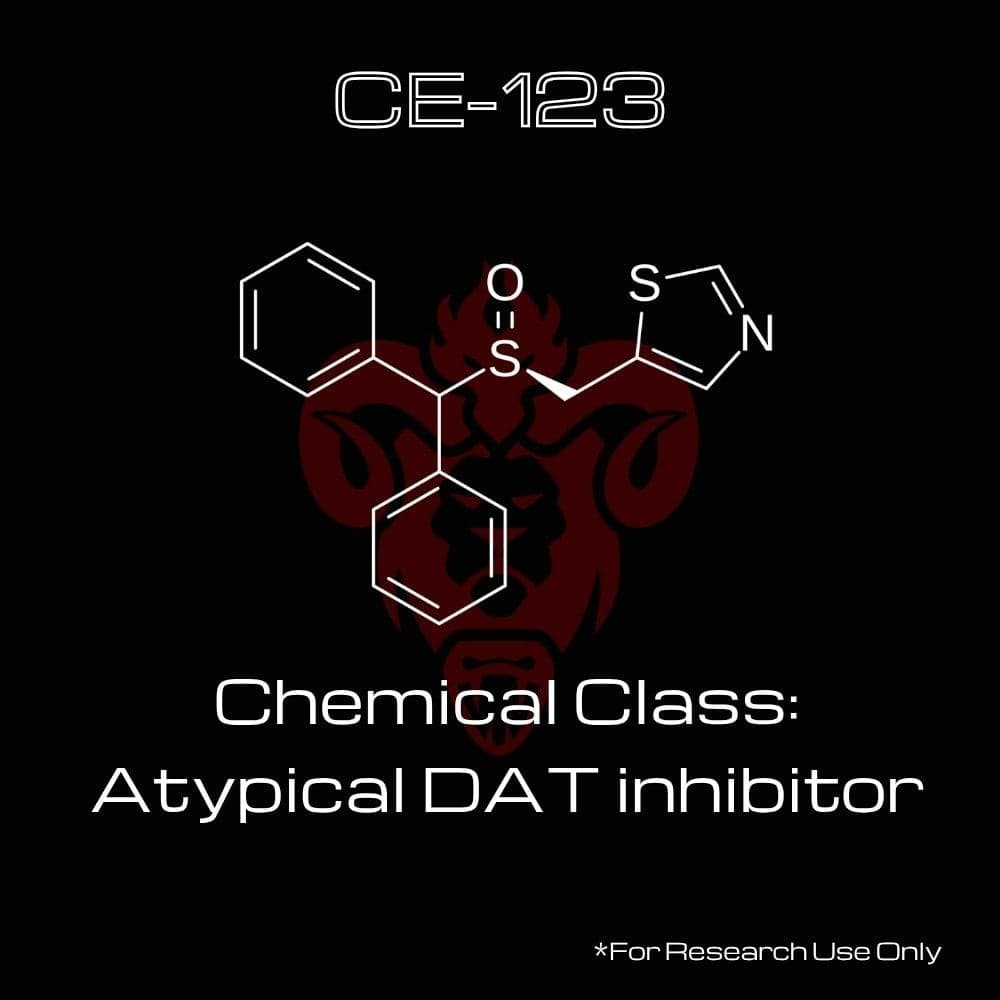
CE-123 is a synthetic dopamine reuptake inhibitor and modafinil analogue developed as a candidate cognitive enhancer [1]. Chemically it is 5-((benzhydrylsulfinyl)methyl)thiazole, a member of a series of thiazole-containing analogues of modafinil designed to achieve higher selectivity for the dopamine transporter (DAT) than the parent compound [5]. Much of the pharmacology has focused on its S-enantiomer, S-CE-123, which carries the highest activity and selectivity at the transporter [5].
The compound emerged from medicinal chemistry programs at the University of Vienna and collaborating institutions, which synthesized and screened modafinil-derived scaffolds (including CE-103, CE-111, CE-123, and CE-125) for atypical dopamine reuptake inhibition [5]. Interest in this class stems from the therapeutic value of modulating brain dopamine for disorders of attention, wakefulness, and cognition, while avoiding the broad off-target activity of older stimulants [3][5].
Research applications are centered on cognitive enhancement and the treatment of cognitive impairment, with preclinical studies examining memory, cognitive flexibility, attention, impulsivity, and dopaminergic signaling in reward and prefrontal circuits [1][2][3]. Pharmacokinetic work has characterized its distribution into the central nervous system relative to modafinil [4]. CE-123 is an investigational research compound and is not an approved medicine; it is used in laboratory and preclinical settings, typically supplied as a powder for research [4][5].
- CE-123 blocks dopamine reuptake with an IC50 of about 4.6 micromolar while its effects on the serotonin and norepinephrine transporters are negligible, a hallmark of its selectivity.
- Neuropharmacokinetic studies suggest it crosses the blood-brain barrier far more effectively than modafinil, with an unbound brain-to-plasma ratio roughly five times higher.
- Unlike R-modafinil, CE-123 improved performance on an attentional set-shifting task without increasing impulsive, premature responses.
Mechanism
CE-123's core benefits, seen in preclinical models, are enhanced memory, improved cognitive flexibility, and pro-motivational drive with a cleaner side-effect profile than classical stimulants. It works as a selective inhibitor of the , blocking reuptake and thereby acting as an indirect dopamine that raises extracellular dopamine in cognition-related circuits [1][3]. Its selectivity is a defining feature: in transporter assays CE-123 blocked uptake with an IC50 of about 4.606 micromolar while its effects on the and transporters were negligible, distinguishing it from broad-spectrum reuptake inhibitors [1].
Downstream of transporter inhibition, the compound engages receptor signaling. In rats, CE-123 enhanced both memory acquisition and memory retrieval in a spatial task and increased total and receptor protein levels in hippocampal subregions, implicating D1 receptor-mediated plasticity in its pro-cognitive action [1]. In an attentional set-shifting task it improved cognitive flexibility, and unlike R-modafinil it did so without increasing premature, impulsive responding, indicating a favorable balance of benefit to side effect [2]. Microdialysis work showed it raises in the infralimbic and prelimbic prefrontal with only a small, transient rise in the nucleus accumbens shell, consistent with a cognitive rather than strongly reward-driven profile [3].
A further advantage is brain penetration. Neuropharmacokinetic analysis found that CE-123 crosses the far more effectively than modafinil, with an unbound brain-to-plasma ratio of about 0.5 versus roughly 0.1 for R-modafinil, supporting greater central activity at a given exposure [4]. Together these properties describe a targeted dopaminergic enhancer built for cognition, motivation, and wakefulness with reduced off-target liability [3][5].
⚠️ THE POINT OF THIS MOLECULE IS SELECTIVITY, NOT POTENCY, and describing it as a potent inverts the design. The affinity at the human is 610 nanomolar, with a functional inhibition constant of 2.8 micromolar, roughly three orders of magnitude weaker than conventional transporter blockers [6]. The flagship paper is titled "Low-Affinity/High-Selectivity Transport Inhibition Sufficient to Rescue Cognitive Functions in the Aging Rat", and the argument is that weak but clean beats strong and dirty.
The cleanness is unusually well documented, as measured negatives rather than absent data. There is no binding to the or noradrenaline transporters at concentrations below 100 micromolar. There is no or activity across 168 receptors spanning sixty families at 2.8 micromolar, and no hit across a panel of roughly 450 kinases. Cortical neurons showed no change in viability or neurite outgrowth from 0.2 to 100 micromolar [6].
The behavioural signature is atypical in a way that matters. rises in the nucleus accumbens CORE rather than the shell, and shell activation is what carries the reinforcing properties of stimulants. The compound produces no 50-kilohertz ultrasonic vocalisations, the rodent marker of drug-induced positive affect, and does not alter firing of dopamine cells in the ventral tegmental area [3]. In a novel open field it produced no more movement than vehicle, and increased activity only in a familiar one, which is closer to the profile of novelty than of a stimulant [6]. In a task measuring impulsivity, modafinil increased premature responding at the same dose while CE-123 did not [2].
⚠️ ITS EFFICACY DEPENDS ON THE ANIMAL BEING OLD. In aged rats it improved a reward-motivated hole-board memory index at 1 and 10 milligrams per kilogram; in young rats there was no treatment effect at all, and even in aged rats it did nothing in the Morris water maze, which the authors note is a stressful task [6]. The pattern that emerges is that it needs both a compromised substrate and a low-stress, reward-motivated test.
Brain exposure is better than modafinil's and still not good. The unbound brain-to-plasma ratio is 0.46 against 0.097 for modafinil, so about five times better, but ⚠️ both values are below one, which means both drugs are actively pumped out of the brain [4]. It is also cleared about nine times faster than modafinil in human liver preparations, with 35 percent remaining at an hour against 90 percent [4].
receptor fingerprint
Nucleus accumbens core Raiser
()Inhibitor
transporter (SERT)No binding
Noradrenaline transporter (NET)No binding
168 G-protein-coupled receptorsNo activity
Dosingtypical ranges, not medical advice
interested in protocols and clinical dosages? make an account to see them! ^_^
Safetyrisks and cautions, not medical advice
Preclinical work is encouraging: in rats it did not trigger hyperlocomotion, anxiety-like behavior or stereotypy, and the selective atypical-DAT profile is the kind linked with lower abuse potential than stimulants. Still, there is no human safety data at all, long-term effects are unknown, and it can feel overstimulating or wreck sleep if taken late. Treat it as an experimental research chemical and mind sourcing and purity.
⚠️ No human has ever taken this compound, in any trial, and there is no chronic-dosing, tolerance or withdrawal data in any species. Its own authors write that adaptive changes from chronic transporter blockade cannot be ruled out, and neither can neurotoxicity from accumulated dopamine [6].
⚠️ The reduced-abuse-liability claim is an inference from mechanism, not a measurement. It rests on dopamine rising in the accumbens core rather than the shell, the absence of 50-kilohertz vocalisations, no hyperlocomotion in a novel environment and no change in ventral tegmental firing. The flagship paper states plainly that the reinforcing properties have not been addressed. There is no self-administration study, no drug-discrimination study and no conditioned place preference study for this compound.
One signal deserves recording because nobody quotes it. In healthy rats, CE-123 increased bone length and growth-plate size, particularly the proliferative and resting zones, and the authors raise the question of long-term skeletal effects, especially in younger populations [11].
A kilogram batch has been made at over 99 percent purity and 95 percent enantiomeric excess [10], which is what a compound looks like when someone intends to put it into humans.
History
CE-123 emerged from a medicinal-chemistry program at the University of Vienna aimed at improving on modafinil, a wakefulness-promoting drug with only modest selectivity for the dopamine transporter. Working with collaborators including Gert Lubec's neuroscience laboratory, chemists replaced part of the modafinil scaffold with a thiazole ring, generating a family of analogues of which CE-123, chemically 5-((benzhydrylsulfinyl)methyl)thiazole, was selected as the most promising.
Its pharmacology was first detailed in 2018 by Kristofova and colleagues, who reported selective dopamine-transporter inhibition together with improved memory acquisition and retrieval in rats. The broader structure-activity work, including the resolution of individual stereoisomers, was published by Kalaba and colleagues in 2019, and later neurochemical studies mapped its actions onto the prefrontal cortex with only minimal engagement of reward circuitry. CE-123 remains an experimental research compound; it has not undergone human clinical trials, and the documented evidence to date is entirely preclinical.
Reputation
Among the wave of next-generation modafinil analogues, CE-123 has earned a reputation as an especially clean and well-characterized candidate. Its defining virtue is selectivity; in transporter assays it targets the dopamine transporter while leaving the serotonin and norepinephrine transporters essentially untouched, which sets it apart from broad-spectrum stimulants and suggests a more focused cognitive action.
Preclinical work is genuinely encouraging, with the compound improving both memory and cognitive flexibility, and notably doing so without the impulsive, premature responding that often accompanies stimulants. A further advantage is its brain penetration, which appears markedly better than modafinil's, hinting at greater central activity at a given dose. These are compelling qualities for a nootropic candidate, yet it is important to be clear-eyed; all of this evidence comes from cells and rodents, and CE-123 has not yet been tested in humans, so its real-world profile remains to be established.
Subjective profileweighing the evidence above
The animal work is genuinely promising and the atypical dopamine transporter profile is the kind linked with lower abuse potential, but there is no human safety data at all. Strictly experimental; modafinil does the same job with decades of human record behind it.
Where to buy
Suppliers
Vendors carrying CE-123, with live product details and codes. Links are affiliate links that support the wiki at no cost to you.
Kimera Chems
CE-123
Research
- 2017first citedA Novel Dopamine Transporter Inhibitor CE-123 Improves Cognitive Flexibility and Maintains Impu…
- 2025most recentEvaluation of PTSD-Induced Alterations in Bone Biomechanics and the Protective Potential of CE-…
- 1.A daily single dose of a novel modafinil analogue CE-123 improves memory acquisition and memory retrieval
- 2.A Novel Dopamine Transporter Inhibitor CE-123 Improves Cognitive Flexibility and Maintains Impulsivity in Healthy Male Rats
- 3.Neurophysiological and Neurochemical Effects of the Putative Cognitive Enhancer (S)-CE-123 on Mesocorticolimbic Dopamine System
- 4.Pharmacokinetics of Novel Dopamine Transporter Inhibitor CE-123 and Modafinil with a Focus on Central Nervous System Distribution
- 5.Structure-Activity Relationships of Novel Thiazole-Based Modafinil Analogues Acting at Monoamine Transporters
- 6.Low-affinity/high-selectivity dopamine transport inhibition sufficient to rescue cognitive functions in the aging rat
- 7.The novel atypical dopamine uptake inhibitor (S)-CE-123 partially reverses the effort-related effects of the dopamine depleting agent tetrabenazine and increases progressive ratio responding
- 8.Cognitive profiling and proteomic analysis of the modafinil analogue S-CE-123 in experienced aged rats
- 9.Differential Effects of Novel Dopamine Reuptake Inhibitors on Interference With Long-Term Social Memory in Mice.
- 10.Process development and scale-up of a novel atypical DAT inhibitor (S)-CE-123
- 11.Evaluation of PTSD-Induced Alterations in Bone Biomechanics and the Protective Potential of CE-123 in a Wistar Rat Model.
11 listed here; entry last updated August 2026
Reviews
My notesprivate to this device
FAQ
How is CE-123 related to modafinil?
It is a modafinil-inspired compound that also targets dopamine reuptake, studied for focus and motivation.
Is there human research?
Most evidence is early animal research, so human effects and safety are not well established.
Does it act like a stimulant?
It has stimulant-like, wakefulness-promoting properties in research, though its exact profile differs from classic stimulants.
Is it approved?
No, CE-123 is an experimental research chemical, not an approved product.
Limitations of the evidence
- Low affinity by design; calling it potent inverts the point, and the functional constant is 2.8 micromolar
- Efficacy appears in aged or developmentally compromised animals and is null in healthy young ones, and null even in aged rats on a stressful task
- The reduced-abuse-liability claim is a mechanistic inference; no self-administration, drug-discrimination or place-preference study exists
- Brain penetration beats modafinil's fivefold but both are net-effluxed from brain
- No human data of any kind, and no chronic-dosing or tolerance data in any species
- Increased bone length and growth-plate size in healthy rats, with the long-term implication unstudied
- Easily confused with its siblings CE-103, CE-111, CE-125, CE-137 and especially CE-158, whose results are routinely attributed to it
Adverse effects
- As a dopaminergic agent, potential for overstimulation or sleep disruption
Notes and cautions
- Preclinical work suggests less impulsivity than modafinil
- Long-term effects are not yet characterized