
spec sheet13 rows
Oxiracetam is a synthetic compound from the racetam family and a close chemical relative of piracetam; it was developed in Italy in the 1980s as a prescription drug for memory and attention problems in dementia. Older European trials in dementia patients generally reported small improvements on cognitive test scores, but the modern evidence is split: a 590-patient Chinese trial in traumatic brain injury found a real benefit, while a 500-patient Korean trial found none for preventing cognitive decline after stroke, and South Korea then withdrew the drug. Nobody has established how it works; a standard 19-target receptor screen found no measurable binding at concentrations up to 30 micromolar, and no binding constant for oxiracetam at any brain receptor exists in the published literature. It remains in clinical use in China and is sold elsewhere as an unapproved powder, with a mild side-effect record but no trial evidence at all that it improves cognition in healthy people.
- Sharp focus and alertness
- Clear, logical thinking
- Solid memory support
- Clean, mild stimulation
- Backed by a large human trial in brain injury
- Neuroprotection through the alpha-7 nicotinic pathway
- Occasional headache
- Mild restlessness
- Trouble sleeping if taken late
Overview
Oxiracetam is a nootropic of the racetam class, a pyrrolidinone (2-oxo-pyrrolidine) derivative structurally related to piracetam. It has been studied for several decades as a cognition enhancer, with particular attention to memory, attention, and learning, and it is one of the racetams for which controlled human data exist. It is water-soluble and typically encountered in capsule or powder form.
The human literature is mixed but informative, which is a strength for an honest assessment. In a double-blind, placebo-controlled crossover study using the scopolamine model of amnesia in healthy volunteers, acute oral oxiracetam improved overall test performance, with a statistically significant benefit at 1600 mg on delayed recall of word lists and dose-related antagonism of scopolamine-induced deficits in semantic memory and attention [1]. By contrast, a double-blind, placebo-controlled trial in patients with probable Alzheimer's disease did not find improvement on a broad neuropsychological battery, indicating limited benefit in established dementia [2]. Reflecting continued clinical interest, a large multicenter Phase 3 randomized trial has been designed to test l-oxiracetam and oxiracetam for memory and cognitive impairment after traumatic brain injury [3].
Mechanistic and preclinical research has clarified how oxiracetam may support cognition and protect neural tissue. In a rat model of ischemic stroke, S-oxiracetam facilitated cognitive restoration by activating the alpha7 nicotinic acetylcholine receptor and the PI3K-mediated pathway, restoring synaptophysin function and increasing PSD-95 expression in the hippocampus [4]. Nanowired delivery of oxiracetam enhanced memory and functional recovery and induced neuroprotection after concussive head injury, reducing blood-brain barrier breakdown and edema [5].
Oxiracetam is used as a nootropic and research compound and is approved as a cognition-enhancing drug in some countries while remaining unapproved in others; its regulatory status varies by jurisdiction. Its combination of human and preclinical data, along with a generally favorable tolerability profile, keeps it among the more established racetams.
- In a double-blind study in healthy volunteers, a single 1600 mg dose of oxiracetam significantly improved delayed word-list recall after scopolamine-induced amnesia.
- Much of oxiracetam's cognitive activity is attributed to its (S)-enantiomer, which engages the alpha-7 nicotinic receptor and the PI3K/Akt pathway.
Mechanism
Oxiracetam is valued as a focus- and memory-oriented racetam, and its mechanism connects cholinergic and plasticity pathways in ways that fit those reported effects. A key insight comes from stroke research showing that S-oxiracetam facilitates cognitive recovery by activating the alpha7 receptor and the downstream signaling pathway; blocking either the alpha7 receptor or PI3K abolished the benefit [4]. Through this route oxiracetam restored normal synaptophysin function and raised PSD-95 expression in the , strengthening the architecture that supports learning and memory [4].
These and cholinergic actions align with the broader racetam profile of modulating and cholinergic transmission to enhance signal efficiency. The result reported in models is preserved neuronal integrity and improved memory performance under challenge, alongside neuroprotective effects; nanowired oxiracetam delivery after concussive head injury improved cerebral blood flow, reduced breakdown and edema, protected neurons, , and , and lowered markers such as phosphorylated tau and inflammatory cytokines [5].
Human findings give the picture quantitative and balanced grounding. In the scopolamine model of amnesia, an acute oral dose of oxiracetam significantly improved delayed recall at 1600 mg and showed dose-related reversal of scopolamine-induced impairments in attention and semantic memory in healthy volunteers [1], demonstrating measurable pro-cognitive activity in people. At the same time, a controlled trial in Alzheimer's disease found no significant cognitive improvement, indicating that its effects are more evident in acute or vascular and injury-related contexts than in advanced neurodegeneration [2]. Ongoing Phase 3 evaluation in traumatic brain injury reflects continued efforts to define where its benefit is clearest [3].
Users typically describe oxiracetam as promoting alertness, verbal fluency, and focus rather than sedation. That subjective character is consistent with a compound that enhances cholinergic and signaling and supports neuronal resilience, giving it a clean, attention-forward reputation among racetams [4][5].
receptor fingerprint
receptorspositive modulator
releaseincreases
Phospholipid metabolismboosts
Broad receptor safety panel (19 targets, including GRIN1, -A alpha1, M1 and M3, alpha4, , 5-HT2C, A1 and A3, mu- and kappa-opioid, alpha1A/alpha2B/beta1-, H1, , NET, hERG, ENT1)No measurable activity; this is a negative result and the best-supported target fact about the compound
-type ionotropic receptorPositive modulation (functional; increases agonist efficacy, not potency)
Cortical and hippocampal cholinergic transmission ( utilisation, high-affinity uptake)Indirect presynaptic enhancement
, glycine co- site (functional)Reversal of kynurenic acid antagonism
Protein kinase C (membrane translocation and activation)Transient activator followed by down-regulation
Depolarisation-evoked excitatory amino acid release ()Biphasic enhancement, with an inverted-U concentration response
alpha7 receptor / - signallingUpregulation (enantiomer-specific, indirect, protein-expression level)
(prefrontal)facilitates
Dosingtypical ranges, not medical advice
interested in protocols and clinical dosages? make an account to see them! ^_^
Safetyrisks and cautions, not medical advice
TOLERABILITY: consistently mild across five decades of trials. In the 289-patient dementia trial, 31 oxiracetam and 27 placebo patients reported minor unwanted effects, three withdrawals for poor tolerability in each arm, and no clinically or statistically significant routine laboratory changes (PMID 2693996). In a 65-patient trial, 4 oxiracetam patients reported 5 unwanted effects versus 1 placebo patient reporting 3; two oxiracetam patients were withdrawn for poor tolerability (PMID 1414239). Phase 1 oral: all AEs mild or moderate and dose-independent up to 2000 mg (PMID 37898393). Phase 1 intravenous: 1 mild possibly-related AE among 52 subjects, no serious AEs at up to 8 g (PMID 34549388). In the 590-patient phase 3 TBI trial the proportion of serious AEs did not differ between L-oxiracetam, oxiracetam and placebo (PMID 41381424). The class review concludes the racetams "possess a very low toxicity and lack serious side effects" (PMID 8061686), and a 194-trial network meta-analysis ranked oxiracetam among the five most favourable of 21 vascular-dementia drugs for adverse-reaction incidence (PMID 39239652).
ANIMAL TOXICOLOGY: in dogs, acute and 13-week repeated oral dosing produced loose stools as the main manifestation for both oxiracetam and S-oxiracetam; the proposed no-observed-adverse-effect level is 100 mg/kg (PMID 30351213).
RENAL CAUTION (pharmacokinetically grounded, not a documented adverse event): roughly 55 to 60% of an oral or intravenous dose is excreted unchanged in urine (PMIDs 37898393, 34549388). Clearance therefore depends on kidney function, and the dementia and stroke populations in which this drug is used are exactly the populations most likely to have reduced renal function. Dose reduction in renal impairment is a reasonable inference; no dedicated renal-impairment study was found.
DRUG INTERACTIONS: none characterised. No interaction study surfaced in this search, and the absence of measurable binding at CYP-relevant or receptor targets plus predominantly unchanged renal excretion makes major pharmacokinetic interactions unlikely on mechanistic grounds. This is an argument, not evidence; treat the interaction profile as unknown.
REGULATORY STATUS: - Italy: approved and marketed as Neuromet (400 mg and 800 mg tablets, SmithKline Beecham / GlaxoSmithKline S.p.A.), reportedly from 1984, for cognitive disorders of degenerative and multi-infarct dementia. Current AIFA marketing status could NOT be verified in this session. A 2010 review states flatly that "oxiracetam and aniracetam are no longer in clinical use" in the Western context (PMID 20166767). - China: approved and in active clinical use; registered preparations are 800 mg capsules and 1 g/5 mL injection. L-oxiracetam completed a phase 3 registration trial under China NMPA approval 2016L03521 (PMID 41381424). - South Korea: WITHDRAWN. The MFDS removed oxiracetam products after they failed clinical reassessment, and the government-commissioned 500-patient trial reports that its null result "support[s] the recent regulatory decision to suspend its use in South Korea" (PMID 41614470). This is the single most important regulatory fact and it is attested in the primary literature, not just press reporting. - United States: not FDA-approved for any indication, and not a lawful dietary-supplement ingredient. It is not a controlled substance; it circulates as a bulk "research chemical" powder with no manufacturing oversight, so identity and purity are not assured. - WADA: oxiracetam is NOT named on the Prohibited List. Phenylpiracetam (carphedon) is the only racetam named, under S6 stimulants, prohibited in-competition. The WADA S0 "non-approved substances" clause does not appear to reach oxiracetam because it holds real marketing approval in China. Verified against a secondary compilation of the WADA list only; the WADA PDF and GlobalDRO could not be fetched directly, so an athlete should confirm at GlobalDRO.com rather than rely on this line.
Interactionsdocumented pairs only, not exhaustive
The documented interaction is with antiepileptic drugs, and it runs in one direction. In a pilot study in patients with epilepsy, concurrent carbamazepine or valproic acid shortened oxiracetam's half-life enough that the authors judged it would need more frequent dosing than usual to hold the same levels [31]. Both of those drugs affect hepatic clearance, so a nootropic being cleared faster alongside them is the expected direction.
The reverse did not happen: oxiracetam left serum concentrations of the antiepileptics themselves unchanged, and the authors concluded that long-term concurrent use is not contraindicated [31]. That is the reassuring half, and it is the half that matters more, since a compound that destabilised anticonvulsant levels would be a genuine hazard rather than an inconvenience.
This is one small pilot study from 1990, and it is close to the whole documented record for oxiracetam. Nothing here should be read as covering the stimulants or other nootropics it is usually stacked with; those pairings have not been studied.
Checking a whole stack? Run it through interactions + stacks.
History
Oxiracetam is a water-soluble pyrrolidinone nootropic developed by the Italian pharmaceutical company ISF in the late 1970s as a structural analog of piracetam, the parent racetam introduced earlier that decade. It was subsequently evaluated in clinical studies for dementia of the Alzheimer and multi-infarct types, as well as in models of stroke and traumatic brain injury. Human pharmacodynamic work in the early 1990s, including scopolamine-amnesia studies in healthy volunteers, helped establish its pro-cognitive credentials. It has been marketed in some countries as a cognitive aid while remaining a research compound in others.
Reputation
Oxiracetam holds a favorable reputation as a clean, attention-forward racetam, with users reporting improved alertness, verbal fluency, and focus rather than sedation. It stands out for having one of the more substantial human evidence bases in its family, including a controlled study in which it counteracted scopolamine-induced amnesia and improved delayed recall. Mechanistic work points to the (S)-enantiomer acting through alpha-7 nicotinic receptors and PI3K/Akt signaling, with modulation of AMPA-receptor subunits. In fairness, a controlled trial in Alzheimer's disease found no significant benefit, suggesting its effects are clearest in acute, vascular, or injury-related contexts rather than advanced neurodegeneration.
Subjective profileweighing the evidence above
The racetam with the most human evidence behind it and the sensible first choice in the family; clean, mild, and well tolerated even at high doses across long trials. The effect is subtle rather than stimulant-like, and a late dose will cost you sleep.
Where to buy


Suppliers
Vendors carrying Oxiracetam, with live product details and codes. Links are affiliate links that support the wiki at no cost to you.
| supplier | size | price | $/mg |
|---|---|---|---|
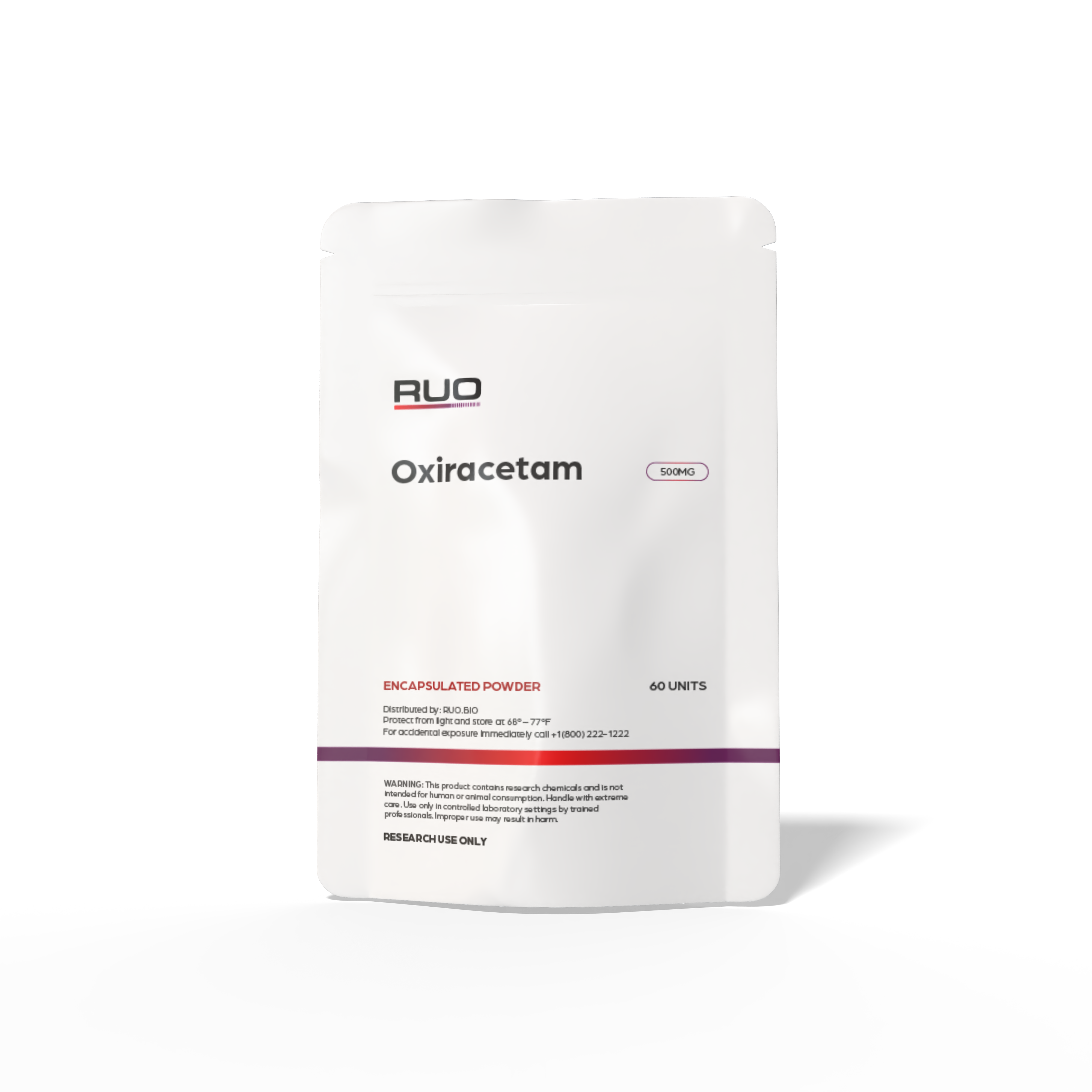
| RUOlowest | 500mg | $36.00 | $0.072/mg |
| Moglabs | 500mg | $38.00 | $0.076/mg |
RUO
Oxiracetam
Moglabs
Oxiracetam
Kimera Chems
Oxiracetam
Research
- 1986first citedEffect of oxiracetam and piracetam on central cholinergic mechanisms and active-avoidance acqui…
- 1990most active year4 papers
- 2024meta-analysisPharmacological treatments for vascular dementia: a systematic review and Bayesian network meta…
- 2026most recentOxiracetam Improves Cognitive Disorder in AD by Modulating AMPAR Subunits GluA1/GluA2 Kinetics
- 1.Effects of acute doses of oxiracetam in the scopolamine model of human amnesia
- 2.Treatment trial of oxiracetam in Alzheimer's disease
- 3.Effect of l-oxiracetam and oxiracetam on memory and cognitive impairment in mild-to-moderate traumatic brain injury patients: Study protocol for a randomized controlled trial
- 4.S-oxiracetam Facilitates Cognitive Restoration after Ischemic Stroke by Activating α7nAChR and the PI3K-Mediated Pathway.
- 5.Nanodelivery of oxiracetam enhances memory, functional recovery and induces neuroprotection following concussive head injury
- 6.[Oxiracetam].
- 7.Efficacy and safety of L-oxiracetam on cognitive function in patients with traumatic brain injury: a multicentre, randomised, double-blind, phase 3 clinical trial.
- 8.Oxiracetam alleviates anti-inflammatory activity and ameliorates cognitive impairment in the early phase of traumatic brain injury.
- 9.Oxiracetam and physical activity in preventing cognitive decline after stroke: A multicenter, randomized controlled trial.
- 10.Co-administration of Nanowired Oxiracetam and Neprilysin with Monoclonal Antibodies to Amyloid Beta Peptide and p-Tau Thwarted Exacerbation of Brain Pathology in Concussive Head Injury at Hot Environment.
- 11.Oxiracetam and Zinc Ameliorates Autism-Like Symptoms in Propionic Acid Model of Rats.
- 12.Oxiracetam or fastigial nucleus stimulation reduces cognitive injury at high altitude.
38 listed here; entry last updated August 2026
Reviews
- it's like a TAK-lite
it's like TAK but less, i'd say 1-2g of this is a really good dose. too much and it seems to cause me anxiety. pairs well with coluracetam or any anti-ampa racetam, super good. nefiracetam is like 200x better i can't lie, but oxirace is solid plus its cheap anyways
0
My notesprivate to this device
FAQ
How does oxiracetam feel compared with other racetams?
Many users describe it as mildly stimulating and helpful for clear, logical thinking.
Is a choline source useful with it?
Some racetam users pair choline to support cholinergic function, though this is a personal preference.
Why avoid taking it late?
Its mildly stimulating quality may interfere with sleep if taken too close to bedtime.
How well researched is it?
It is one of the more studied racetams, with research on memory and cognition.
Adverse effects
- Occasional headache
- Mild restlessness
- Trouble sleeping if taken late