
spec sheet12 rows
Aniracetam is a fat-soluble member of the racetam family and one of the original ampakines, a positive allosteric modulator of AMPA-type glutamate receptors used as a cognition enhancer. By slowing the desensitization of these excitatory receptors it strengthens the synaptic transmission tied to learning and memory, and it has been used clinically abroad for cognitive symptoms after stroke and in dementia. Its principal metabolite, 2-pyrrolidinone, has been reported to produce a longer-lasting enhancement of AMPA-receptor function through a CaMKII-dependent pathway. It is also noted for anxiolytic and mood effects in animal models.
- Bright, genuinely elevated mood
- Takes the edge off anxiety
- Smooth, creative, free flowing thinking
- Sharper memory and focus
- One of the original ampakines
- Fat soluble for strong uptake
- Occasional headache, often eased by adding choline
- Mild anxiety or restlessness in some people
- Occasional fatigue
Overview
Aniracetam (1-(4-methoxybenzoyl)-2-pyrrolidinone), also known by the code Ro 13-5057, is a pyrrolidinone-type nootropic and one of the earliest and most studied racetams after piracetam. Unlike the water-soluble piracetam, aniracetam is fat-soluble, a property that shapes its absorption and its rapid metabolism to compounds such as N-anisoyl-GABA. It is classified pharmacologically as an ampakine, a positive allosteric modulator of AMPA (alpha-amino-3-hydroxy-5-methyl-4-isoxazolepropionic acid) glutamate receptors, the receptors that carry most fast excitatory signaling in the brain [4].
Developed by Hoffmann-La Roche, aniracetam has been used clinically, chiefly in Europe and Japan, for behavioral and psychological symptoms of dementia and for cognitive impairment following stroke and in Alzheimer's disease [1]. Its research literature describes cognition-enhancing effects across numerous rodent models of impaired attention, memory, mood, and anxiety, and it has been studied specifically for reversing learning and memory deficits caused by prenatal ethanol exposure by restoring synaptic AMPA receptor function [1][2][3]. As a canonical AMPA receptor potentiator it appears throughout the literature alongside newer agents developed for cognitive deficits, depression, and Parkinson's disease [4][5].
Regulatory status varies; aniracetam is a prescription or licensed medicine in several countries but is not approved by the US Food and Drug Administration, where it is sold as an unregulated nootropic supplement. It is available as a powder or in capsules, is frequently paired with a choline source to support the cholinergic system it draws on, and is regarded as generally well tolerated in the nootropic community [1].
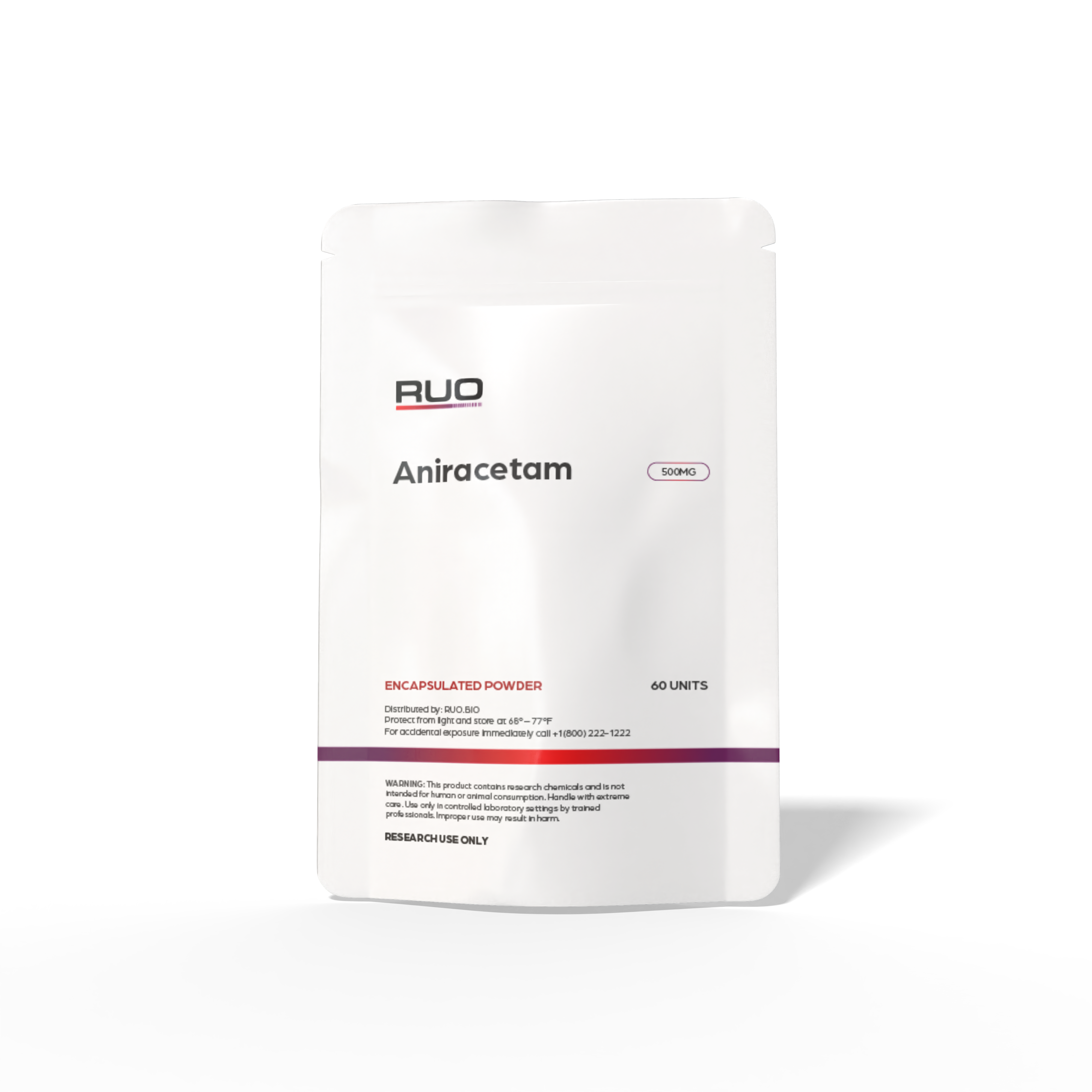
- Aniracetam is fat-soluble, unlike the water-soluble original racetam piracetam, a difference intended to help it reach the brain more easily.
- It is considered one of the first ampakines, working by slowing how quickly AMPA glutamate receptors switch off so each signal is larger and lasts longer.
Mechanism
Aniracetam is the prototypical ampakine, and its core mechanism is positive modulation of -type receptors. Glutamate acting at AMPA receptors carries most of the fast excitatory signaling in the brain, but the receptor rapidly desensitizes and deactivates after each pulse. Aniracetam binds an allosteric site and slows that desensitization and deactivation, so each glutamate release produces a larger and longer excitatory current; the practical result is strengthened transmission and enhanced , the cellular substrate of learning and memory [4].
This translates into measurable changes. In hippocampal recordings from rats with prenatal ethanol-induced impairment, aniracetam treatment increased the amplitude and frequency of -mediated miniature excitatory postsynaptic currents and improved single-channel properties such as open probability and burst duration, and these synaptic gains tracked recovery of learning and memory on avoidance tasks [2][3]. Because activity also drives expression of neurotrophins, sustained potentiation of this pathway is linked to increased brain-derived neurotrophic factor (), which may underlie the neuroprotective and antidepressant-like effects reported for the ampakine class [4][5].
Beyond , aniracetam modulates cholinergic and monoaminergic transmission, and its major metabolites are themselves active, which is thought to contribute to its mood and anxiety-reducing effects in animal models [1]. The overall profile is a cognition enhancer that raises the gain on the brain's main excitatory system while supporting neurotrophic signaling, producing sharper memory and attention alongside a reported calming, anxiolytic quality [1].
receptor fingerprint
receptorspositive modulator
releaseincreases
mGluR1 / mGluR5modulates
/ mild agonist
Dosingtypical ranges, not medical advice
interested in protocols and clinical dosages? make an account to see them! ^_^
Safetyrisks and cautions, not medical advice
Aniracetam has held up well in trials at up to 1500 mg a day. Europe treats it as a prescription drug (Draganon, Ampamet), while in the US it lives in a grey area; not FDA-approved, but sold everywhere anyway. Nothing points to liver, heart, or nerve toxicity. The most common gripe is a headache, and that's usually your brain running low on choline, so pair it with 300 mg alpha-GPC or 250 mg CDP-choline and it tends to clear up; you might also get mild stomach upset or some edginess at high doses. No serious drug interactions are on record, though it's wise to be careful alongside other glutamate-active compounds. Steer clear if you react badly to racetams, and skip it during pregnancy or breastfeeding.
History
Aniracetam was developed by the pharmaceutical company Hoffmann-La Roche in the 1970s as a fat-soluble member of the racetam family, following the original racetam piracetam. Unlike the water-soluble parent, its lipophilic structure was intended to cross into the brain more readily. It came to be marketed in parts of Europe and in Japan, under names such as Draganon and Sarpul, for cognitive symptoms including those following stroke and in dementia. Pharmacologically it was later characterized as one of the first ampakines, a positive allosteric modulator of AMPA-type glutamate receptors.
Reputation
Aniracetam is one of the more respected members of the racetam family, valued by users for a combination of cognitive support and a reported calming, anxiolytic quality that many find distinctive among nootropics. Its mechanism as an ampakine, slowing the desensitization of the brain's main excitatory receptors, is well described and links it to enhanced long-term potentiation and to increased expression of the growth factor BDNF. Enthusiasts also note that its active metabolites are thought to contribute to its mood and anxiety effects. Balanced discussion acknowledges that robust, large-scale human trials are limited, that it is rapidly metabolized and short-acting, and that its status varies by country. It is generally seen as a well-regarded cognition enhancer with an appealing mechanistic rationale.
Subjective profileweighing the evidence above
One of the better racetams to actually try. The mood lift and the edge off anxiety are what people notice first, and the memory effect is real if modest. Pair it with alpha-GPC or CDP-choline from day one and the headache most people complain about usually never arrives.
Where to buy

1 other outlet

Suppliers
Vendors carrying Aniracetam, with live product details and codes. Links are affiliate links that support the wiki at no cost to you.
RUO
Aniracetam
Kimera Chems
Aniracetam
Research
- 1990first citedAllosteric potentiation of quisqualate receptors by a nootropic drug aniracetam
- 1991most active year4 papers
- 2026most recentAniracetam restores the excitation-inhibition balance of neurotransmitters in the prefrontal co…
- 1.Aniracetam: its novel therapeutic potential in cerebral dysfunctional disorders based on recent pharmacological discoveries.
- 2.Aniracetam reversed learning and memory deficits following prenatal ethanol exposure by modulating functions of synaptic AMPA receptors.
- 3.Ameliorating effects of preadolescent aniracetam treatment on prenatal ethanol-induced impairment in AMPA receptor activity.
- 4.AMPA receptor potentiators for the treatment of CNS disorders.
- 5.AMPA receptor potentiators: application for depression and Parkinson's disease.
- 6.Aniracetam. An overview of its pharmacodynamic and pharmacokinetic properties, and a review of its therapeutic potential in senile cognitive disorders.
- 7.Aniracetam Ameliorates Attention Deficit Hyperactivity Disorder Behavior in Adolescent Mice.
- 8.Aniracetam: An Evidence-Based Model for Preventing the Accumulation of Amyloid-β Plaques in Alzheimer's Disease.
- 9.Aniracetam does not improve working memory in neurologically healthy pigeons.
- 10.Aniracetam does not alter cognitive and affective behavior in adult C57BL/6J mice.
- 11.Aniracetam reverses memory impairment in rats.
- 12.Treatment of insomnia by concomitant therapy with Zopiclone and Aniracetam in patients with cerebral infarction, cerebroatrophy, Alzheimer's disease and Parkinson's disease.
30 listed here; entry last updated August 2026
Reviews
- good for social flow + creativity
i use 2g of Aniracetam whenever I public speak, record videos, or go out. it's a mix of pregab-lite, with tak-lite. super good for creativity, anti-anxiety properties, alongside some more, such as better talkativeness for me lol pairs well with nefiracetam or something, amazing stuff
0 - good for creativity + speaking
i’ve noticed that aniracetam is good for creativity. it’s like a TAK-lite similar to oxiracetam, except this one makes me less anxious and more pro-social, super commonly reported as well feels nice, lasts for 2 hours IME. needs to be redosed but is pretty smooth and not stimulating in the slightest makes me creative as hell too, good ability to speak and think
0
My notesprivate to this device
FAQ
What is Aniracetam used for?
It is a fat-soluble racetam used to support mood, ease anxiety, and improve memory and focus.
How does Aniracetam work?
It modulates AMPA receptors and cholinergic activity, which is thought to underlie its cognitive and mood effects.
Is Aniracetam well-researched?
It has been studied more than many racetams, though large human trials are limited.
What are the main side effects?
Some people report headache, especially with low choline intake, along with occasional anxiety or fatigue.
Adverse effects
- Occasional headache, often eased by adding choline
- Mild anxiety or restlessness in some people
- Occasional fatigue
Notes and cautions
- Short-lived in the body, so effects do not last long