
spec sheet11 rows
Fasoracetam is a racetam-class nootropic that acts on the glutamatergic and GABAergic systems; with repeated administration it up-regulates GABA-B and metabotropic glutamate (mGluR) receptors. It is one of relatively few racetams to have reached controlled human trials, having been evaluated in adolescents with attention-deficit hyperactivity disorder who carry variants in genes governing mGluR signaling. It remains an investigational compound and is not an approved medicine.
- Sharpens focus and mental drive
- One of the few racetams in human trials
- Popular for rebuilding GABA-B tone after phenibut
- Engages glutamate and GABA-B for clean cognition
- Lifts mood and motivation
- Occasional headache
- Mild fatigue
- Some GI upset
Overview
Fasoracetam is a synthetic nootropic of the racetam family, sharing the class-defining 2-pyrrolidinone core while carrying its own cyclohexanecarbonyl and piperidine substituents. It was originally developed in Japan in the 1990s under the code names NS-105 and LAM-105 and was first investigated for vascular dementia and age-related cognitive decline before that early program was set aside [2]. Interest was later renewed when the compound, redesignated NFC-1 and AEVI-001, advanced into modern clinical research for attention-deficit hyperactivity disorder [1][4].
Among racetams the compound is unusual because its cognitive profile rests on metabotropic glutamate receptor (mGluR) modulation and on regulation of the GABA-B system rather than on direct AMPA-receptor potentiation. That distinctive pharmacology has made it a subject of interest both as a cognitive enhancer and as a research tool for probing glutamatergic signaling [1].
In research applications fasoracetam is best known from an open-label, single-blind, placebo-controlled study in adolescents with ADHD who harbored mutations in mGluR-network genes, where treatment was associated with measurable symptom improvement [1]. It has also been characterized pharmaceutically; analyses of its crystalline and hydrate solid-state forms were framed around its potential as an anti-Alzheimer agent [3], and it appears in systematic reviews of novel, non-stimulant compounds for ADHD [4].
Fasoracetam is not an approved medicine in the United States or Europe and remains an investigational compound; it is sold on the research and nootropics market, most often as a monohydrate powder or in capsules. Its regulatory status is that of an unapproved drug rather than a licensed pharmaceutical, and its evidence base, while more developed than that of most racetams, is still early.
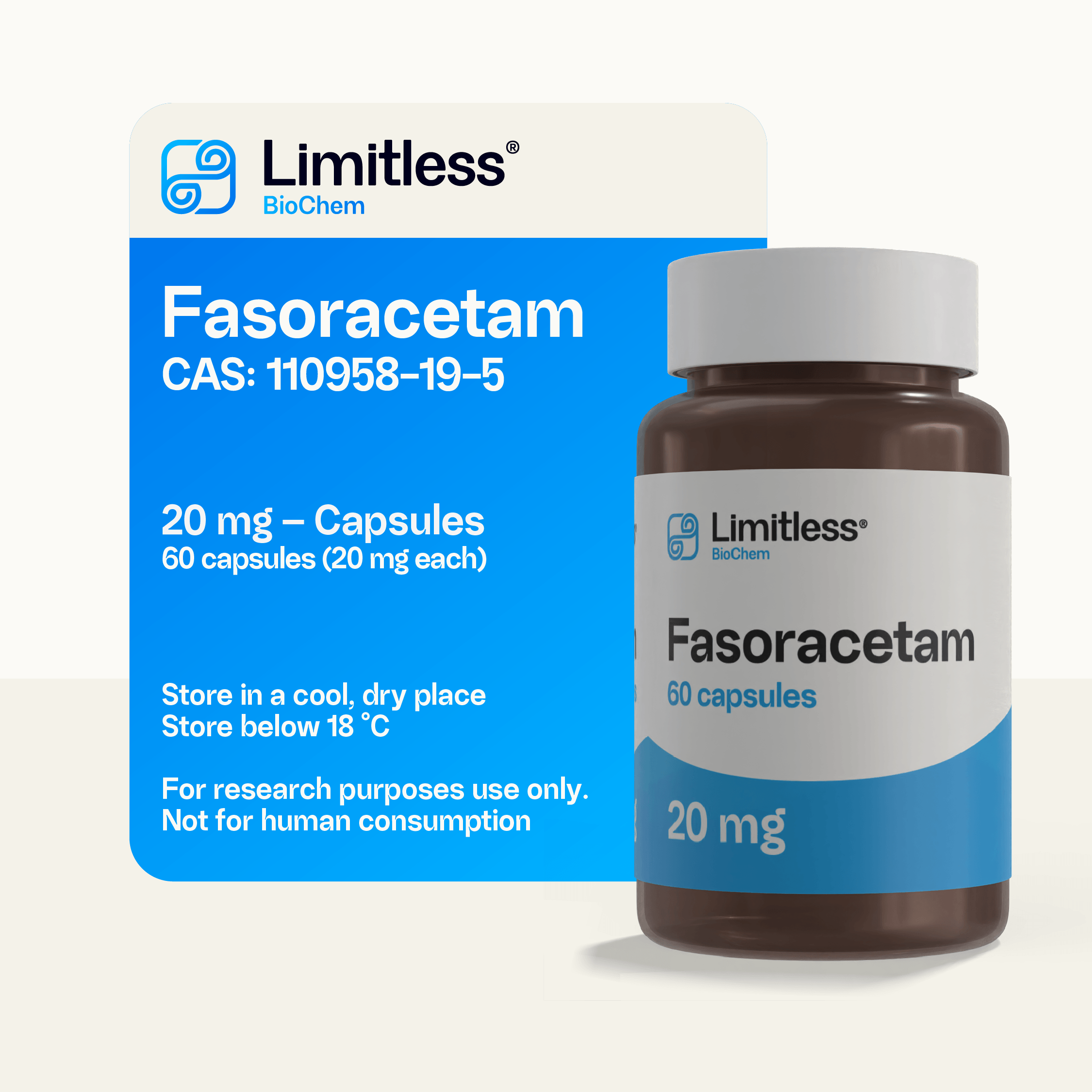
- Fasoracetam began as Nippon Shinyaku's NS-105, a 1990s Japanese candidate for vascular dementia, and was later revived decades later as NFC-1 for ADHD research.
- In its ADHD trial the largest improvements appeared in children carrying specific metabotropic glutamate receptor gene variants, making it a frequently cited example of precision-medicine nootropics.
Mechanism
Fasoracetam's appeal lies in delivering focus and mental drive without the edge of a stimulant, a profile that tends to suit anxious and overactive minds particularly well. Users and researchers describe cleaner concentration, steadier motivation, and a calming quality, effects that trace back to how the molecule engages several neurotransmitter systems at once.
Its central action is agonism across all three groups of metabotropic receptors (mGluR Groups I, II, and III), which lets it fine-tune glutamate release from both presynaptic and postsynaptic sides and set overall excitatory tone rather than simply push it upward. With repeated dosing the compound also up-regulates the density and sensitivity of -B receptors; this adaptive change is the pharmacological rationale behind its popular use for rebuilding GABA-B tone after phenibut or baclofen, agents that lean heavily on that same receptor. Fasoracetam additionally enhances high-affinity uptake in the , supporting synthesis and hippocampal memory.
The clearest human signal comes from the ADHD study, in which fasoracetam moved mean Clinical Global Impressions-Improvement scores from 3.79 at baseline to 2.33 by week 5 and Severity scores from 4.83 to 3.86 (both P < 0.001), with the largest parental Vanderbilt gains in children carrying Tier 1 mGluR variants [1]. Because its benefit appeared concentrated in a genetically defined subgroup, fasoracetam is frequently cited as an example of a precision-medicine approach to cognition [4]. Its documented tolerability and fully defined solid-state pharmacology further set it apart from the many racetams that have never been formally characterized [2][3].
receptor fingerprint
-B receptorsupregulates
mGluR (Groups I, II, III)agonist
uptakeenhances
Dosingtypical ranges, not medical advice
interested in protocols and clinical dosages? make an account to see them! ^_^
Safetyrisks and cautions, not medical advice
Fasoracetam is unscheduled and legal to buy as a research chemical in most countries (US, UK, EU), though no agency has approved it for human use. Because it works on GABA-B, it can in theory interact with GABAergic stuff, so be careful pairing it with phenibut, baclofen, benzodiazepines, or alcohol. Human trials haven't turned up liver toxicity or serious adverse events, but there's no long-term data. Skip it if you react badly to racetams, and avoid it in pregnancy or breastfeeding. Since it modulates mGluRs, go careful if you have a seizure history or take anticonvulsants. It's not a controlled substance.
History
Fasoracetam was originally synthesized in Japan by Nippon Shinyaku, where it was studied under the code NS-105 during the 1990s as a candidate for vascular dementia and related cognitive impairment. Development was discontinued after the compound failed to show sufficient benefit in that program, and it lay largely dormant for years. It was subsequently revived under the designations NFC-1 and AEVI-001, when researchers pursued it as a modulator of metabotropic glutamate receptor signaling for adolescents with attention-deficit hyperactivity disorder who carry variants in mGluR-network genes. This second life makes fasoracetam one of relatively few racetam-class compounds to have been carried into controlled human trials, and a frequently cited example of a genetics-guided, precision-medicine approach to cognition.
Reputation
Fasoracetam has a strong reputation among nootropic users as a calmer, less stimulant-like racetam, often described as delivering focus and motivation with an anxiolytic quality that suits overactive minds. It is especially popular for the theory-driven practice of rebuilding GABA-B tone after phenibut or baclofen, reflecting its documented up-regulation of GABA-B receptors with repeated dosing. Researchers value it as one of the few racetams with both a controlled clinical trial and fully characterized solid-state pharmacology, unlike many analogues that were never formally studied. The honest caveat is that its clearest human evidence comes from a small ADHD study concentrated in a genetically defined subgroup, so broad cognitive claims remain investigational. It stands out as an unusually well-characterized member of an otherwise loosely documented compound class.
Subjective profileweighing the evidence above
One of the better racetams to actually try, both for clean focus without stimulant edge and for rebuilding GABA-B tone after phenibut or baclofen, which is where it earns its reputation. Side effects rarely pass a headache. Human data is short-term, so size expectations to that.
Where to buy

1 other outlet
Suppliers
Vendors carrying Fasoracetam, with live product details and codes. Links are affiliate links that support the wiki at no cost to you.
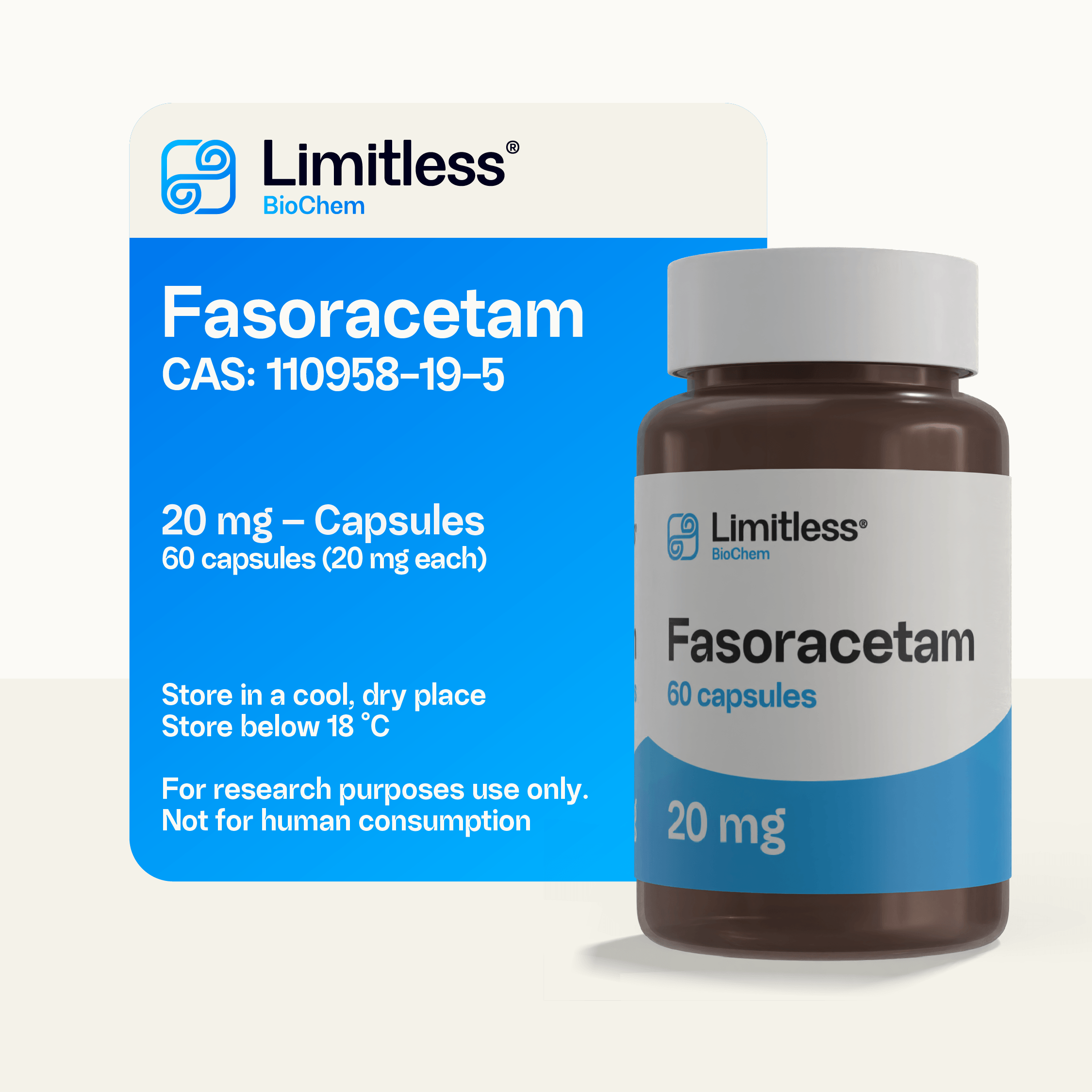
Limitless Biochem🌐
Fasoracetam
Kimera Chems
Fasoracetam
Research
- 1997first citedEffect of a novel cognition enhancer NS-105 on learned helplessness in rats: possible involveme…
- 1999most active year4 papers
- 2018controlled trialFasoracetam in adolescents with ADHD and glutamatergic gene network variants disrupting mGluR n…
- 2019most recentBeyond stimulants: a systematic review of randomised controlled trials assessing novel compound…
- 1.Fasoracetam in adolescents with ADHD and glutamatergic gene network variants disrupting mGluR neurotransmitter signaling
- 2.Fasoracetam. LAM 105, NS 105
- 3.A Study of Fasoracetam's Solid State Forms: A Potential Anti-Alzheimer Pharmaceutical
- 4.Beyond stimulants: a systematic review of randomised controlled trials assessing novel compounds for ADHD
- 5.Pharmacokinetics of NS-105, a novel cognition enhancer. 1st communication: absorption, metabolism and excretion in rats, dogs and monkeys after single administration of 14C-NS-105.
- 6.Pharmacokinetics of NS-105, a novel cognition enhancer. 2nd communication: distribution and transfer into fetus and milk after single administration, and effects of repeated administration on pharmacokinetics and hepatic drug-metabolizing enzyme activities in rats.
- 7.Involvement of cholinergic and GABAergic systems in the reversal of memory disruption by NS-105, a cognition enhancer.
- 8.Effect of a novel cognition enhancer NS-105 on learned helplessness in rats: possible involvement of GABA(B) receptor up-regulation after repeated treatment.
- 9.Role of metabotropic glutamate receptor subclasses in modulation of adenylyl cyclase activity by a nootropic NS-105.
- 10.A novel cognition enhancer NS-105 modulates adenylate cyclase activity through metabotropic glutamate receptors in primary neuronal culture.
- 11.Involvement of metabotropic glutamate receptors in Gi- and Gs-dependent modulation of adenylate cyclase activity induced by a novel cognition enhancer NS-105 in rat brain.
- 12.Comparison of pharmacokinetics of NS-105, a novel agent for cerebrovascular disease, in elderly and young subjects.
12 listed here; entry last updated August 2026
Reviews
My notesprivate to this device
FAQ
What is fasoracetam?
It is a racetam-class nootropic that acts on the glutamate and GABA-B systems.
Is it being studied clinically?
Yes; it has been investigated in trials for ADHD, particularly in certain genetic subgroups.
How is it usually taken?
It is commonly taken in divided servings through the day as a nootropic.
Is it an approved medication?
It is not an approved drug for general use and remains investigational.
Limitations of the evidence
- Human safety data still limited to short studies
Adverse effects
- Occasional headache
- Mild fatigue
- Some GI upset
- Brain fog if overused