
spec sheet6 rows
This is potassium chloride concentrate for intravenous infusion, used in hospital to correct low blood potassium after dilution into a much larger volume of fluid.
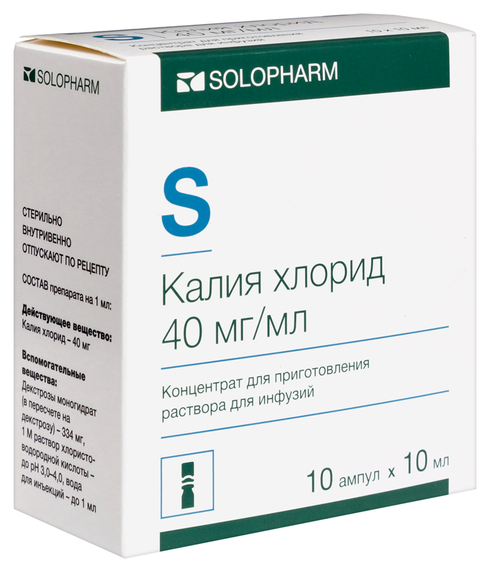
- Potassium chloride is on the WHO Essential Medicines List and is the standard agent for treating and preventing hypokalaemia, available as oral solid and liquid forms and as a concentrated intravenous solution that must always be diluted.
- SSaSS, a cluster-randomized trial in 20,995 people across 600 Chinese villages, showed that replacing regular salt with 75% NaCl / 25% KCl cut stroke (rate ratio 0.86, 95% CI 0.77 to 0.96), major cardiovascular events (0.87, 0.80 to 0.94) and all-cause death (0.88, 0.82 to 0.95) over a mean 4.74 years [1].
- Crucially, SSaSS found no significant excess of serious hyperkalaemia-attributed adverse events with potassium-enriched salt (rate ratio 1.04, 95% CI 0.80 to 1.37), which is the safety objection most often raised [1].
- Potassium supplementation lowers blood pressure in hypertensive subjects across pooled randomized trials [4], with a smaller effect in normotensive populations [5].
- The SSaSS result has been replicated in meta-analysis of salt-substitute trials generally [3], making this one of the best-evidenced population-level cardiovascular interventions available.
Mechanism
Potassium is the main intracellular cation and sets the resting membrane potential of every excitable cell. Restoring a low serum level normalises cardiac and neuromuscular excitability; overshooting produces the peaked T waves, widening QRS and eventual asystole of hyperkalaemia, which is why the rate of administration matters more than the total dose.
receptor fingerprint
Resting membrane potential of excitable cells (set by the transmembrane K+ gradient via the Nernst relation)Restores or raises extracellular and total-body K+, normalising the K+ equilibrium potential that sets resting membrane voltage in cardiac, skeletal muscle and nerve
Na+/K+-ATPase (ATP1A1)Supplies the extracellular K+ substrate the pump requires; the pump is the main determinant of intracellular K+ loading
Renal outer medullary potassium channel (ROMK / KCNJ1) and BK channels in the distal nephronIncreased distal K+ delivery and load drives kaliuresis; also promotes natriuresis, an accepted mechanism for the blood-pressure effect of dietary potassium
Vascular smooth muscle inward-rectifier K+ channels and endothelial Na+/K+-ATPaseModest hyperpolarisation and vasodilation with increased potassium intake
Safetyrisks and cautions, not medical advice
concentrated intravenous potassium is one of the most lethal medication errors in hospital practice; given undiluted or too quickly it stops the heart, and it must be diluted into a large volume, rate limited and given with cardiac monitoring
Subjective profileweighing the evidence above
This entry is the concentrated intravenous ampoule, and it belongs to the very small group of substances that reliably kill when handled outside a hospital. Given undiluted or pushed quickly it stops the heart, which is why wards store it apart from everything else and why it appears on every high alert medication list; its entire safety lies in dilution, rate control and cardiac monitoring. Nobody should be obtaining it, and this page names nowhere that would sell it. Dietary potassium and ordinary oral supplements are a completely different subject and carry none of this.
Resources
No suppliers are provided for compounds like this. This entry is here for reference.
Research
- 2016first citedThe effect of potassium supplementation on blood pressure in hypertensive subjects: A systemati…
- 2022meta-analysisEffects of salt substitutes on clinical outcomes: a systematic review and meta-analysis
- 2024most recentMagnesium and Potassium Supplementation for Systolic Blood Pressure Reduction in the General No…
- 1.Effect of Salt Substitution on Cardiovascular Events and Death
- 2.Secondary Analysis of the Salt Substitute and Stroke Study (SSaSS): Effects of Potassium-Enriched Salt on Cardiac Outcomes
- 3.Effects of salt substitutes on clinical outcomes: a systematic review and meta-analysis
- 4.The effect of potassium supplementation on blood pressure in hypertensive subjects: A systematic review and meta-analysis
- 5.Magnesium and Potassium Supplementation for Systolic Blood Pressure Reduction in the General Normotensive Population: A Systematic Review and Subgroup Meta-Analysis for Optimal Dosage and Treatment Length
5 listed here; entry last updated August 2026
Reviews
My notesprivate to this device
Notes and cautions
- Concentrated potassium chloride for injection is fatal if given undiluted or by rapid intravenous push and is a designated high-alert medication; it must be diluted and infused, conventionally at no more than 10 mEq per hour peripherally without cardiac monitoring.
- Oral solid-dose potassium chloride causes gastrointestinal ulceration, bleeding and stricture, which is why wax-matrix and microencapsulated formulations exist and why the tablets should be taken with food and a full glass of water.
- The risk of hyperkalaemia rises sharply in chronic kidney disease and with ACE inhibitors, ARBs, aldosterone antagonists, NSAIDs and trimethoprim, and potassium-enriched salt substitutes should not be recommended to those patients despite the favourable population data.
- Hypokalaemia refractory to potassium repletion usually indicates untreated hypomagnesaemia, which must be corrected first.