
spec sheet12 rows
Boron is a metalloid (atomic number 5) that occurs naturally as borate minerals and boric acid and is regarded in humans as a beneficial trace element rather than a formally essential nutrient. Controlled depletion and supplementation studies indicate that modest intakes, on the order of 3 mg per day, influence mineral and steroid metabolism; boron supplementation has been shown to reduce urinary calcium and magnesium loss and to raise serum concentrations of 17-beta-estradiol and testosterone, effects that are more pronounced under low-magnesium conditions. A notable short-term human study reported that boron lowered sex hormone-binding globulin and inflammatory markers while increasing free testosterone within a week, and it is obtained from fruits, vegetables, nuts, and pulses or taken as supplements such as sodium borate and calcium fructoborate. Borate compounds have relatively low mammalian toxicity, though intake is bounded by recommended upper limits.
- raised free testosterone in as little as a week
- drops SHBG so more of your testosterone runs free
- cheap, safe and effective at only 3 mg a day
- lowered inflammatory markers in human work
- spares calcium and magnesium from urinary loss
- supports bone as well as hormones
- Food-safety authorities set an upper intake level, and very high exposure can cause nausea, vomiting, and irritation [2].
Overview
Boron is the fifth element of the periodic table, a metalloid that sits on the border between metals and nonmetals. It is never found free in nature but occurs in borate minerals, the best known being borax (sodium borate), and in boric acid [1]. In pure form it exists as a hard, dark crystalline solid or a brown powder, but in biology and nutrition it is encountered as water-soluble borates and boric acid, which is the form boron generally takes in body fluids [1]. It is an established essential nutrient for plants, and this is one reason boron is present throughout the plant-based portion of the human diet [1].
In human nutrition, boron is classified as a bioactive trace element. It has not been formally proven to be essential in the way that vitamins or minerals such as calcium are, but a substantial body of research indicates that it beneficially affects several systems when consumed in the small amounts found in food [1]. Reviews describe roles in bone growth and maintenance, central nervous system function, the easing of arthritic symptoms, and the action of steroid hormones, and they note associations with a reduced risk of some cancers [1][3]. Studies suggest that when boron intake falls very low, these benefits are diminished, and dietary surveys indicate that low intakes are not uncommon [1].
Boron enters the diet chiefly through plant foods; fruits, vegetables, nuts, legumes, and pulses are the richest sources, while meat and fish contribute little [1]. It is marketed as a dietary supplement, often aimed at bone health, joint comfort, or hormonal support, and is sold in several chemical forms, including sodium borate, boric acid, and the organic complex calcium fructoborate [3]. Much of the human research has focused on bone: a narrative review of supplementation trials concluded that boron, alone or with other nutrients, can support bone by favorably influencing the metabolism of calcium, vitamin D, and sex steroid hormones [2]. Boron has long appeared in discussions of nutrients relevant to osteoporosis alongside calcium, magnesium, and vitamin D [4].
The breadth of boron's reported effects has led researchers to propose that it acts at a fundamental biochemical level rather than on a single target [1]. A leading idea is that boron forms ester bonds with biological molecules that carry cis-hydroxyl groups, including sugars and important cofactors such as S-adenosylmethionine and nicotinamide adenine dinucleotide, and that it can complex with components of cell membranes; through these interactions it may influence many enzymatic and signaling processes [1]. Its apparent ability to raise circulating levels of steroid hormones such as testosterone and estrogen, observed in some studies, is one of the more discussed effects, although the underlying mechanism is not fully defined [1][3].
Borate compounds have low acute toxicity in mammals, broadly comparable to common table salt, but boron is not harmless in large amounts, and food-safety authorities have set a tolerable upper intake level for adults [2]. Very high exposure, generally far above dietary or supplemental levels, can cause nausea, vomiting, and other effects, and boric acid and borax are also used industrially, for example as insecticides and preservatives [1]. As a supplement, boron is regulated as a nutrient rather than a drug, and it is sold as tablets and capsules in its various borate and fructoborate forms [3].

Mechanism
Boron is thought to work not by binding a specific receptor but by chemically interacting with a wide range of biological molecules [1]. In body fluids it exists mainly as boric acid, which readily forms reversible ester bonds (boroesters) with compounds that bear cis-hydroxyl groups, such as the ribose sugars in key cofactors including S-adenosylmethionine and nicotinamide adenine dinucleotide, as well as with glycoproteins, glycolipids, and membrane phosphoinositides [1].
By modifying these molecules, boron is proposed to influence numerous enzymatic and cell-signaling processes at once, which would help explain its diverse effects on bone, hormones, and the nervous system [1][3]. With respect to bone specifically, its benefit is attributed to improved handling of calcium and vitamin D and to its influence on the activity of sex steroid hormones [2]. Because so many pathways may be affected, the precise mechanisms in humans remain an active area of study [3].
receptor fingerprint
Sex hormone binding globulinlowers
Free testosteroneincreases
Inflammatory markers (hs-CRP)reduces
Vitamin D metabolismmodulates
Estradiolmodulates
Dosingtypical ranges, not medical advice
interested in protocols and clinical dosages? make an account to see them! ^_^
Safetyrisks and cautions, not medical advice
Safe at typical supplemental doses; the tolerable upper intake is around 20 mg per day for adults. Excess intake can cause nausea, GI upset, and in very high amounts, toxicity signs like skin flushing and tremor. It's not something to megadose. Food sources like fruits, nuts, and legumes provide meaningful amounts already.
Subjective profileweighing the evidence above
Cheap, safe, and has real (if modest) effects on free testosterone and SHBG; worth a low-dose trial for hormonal support.
Where to buy
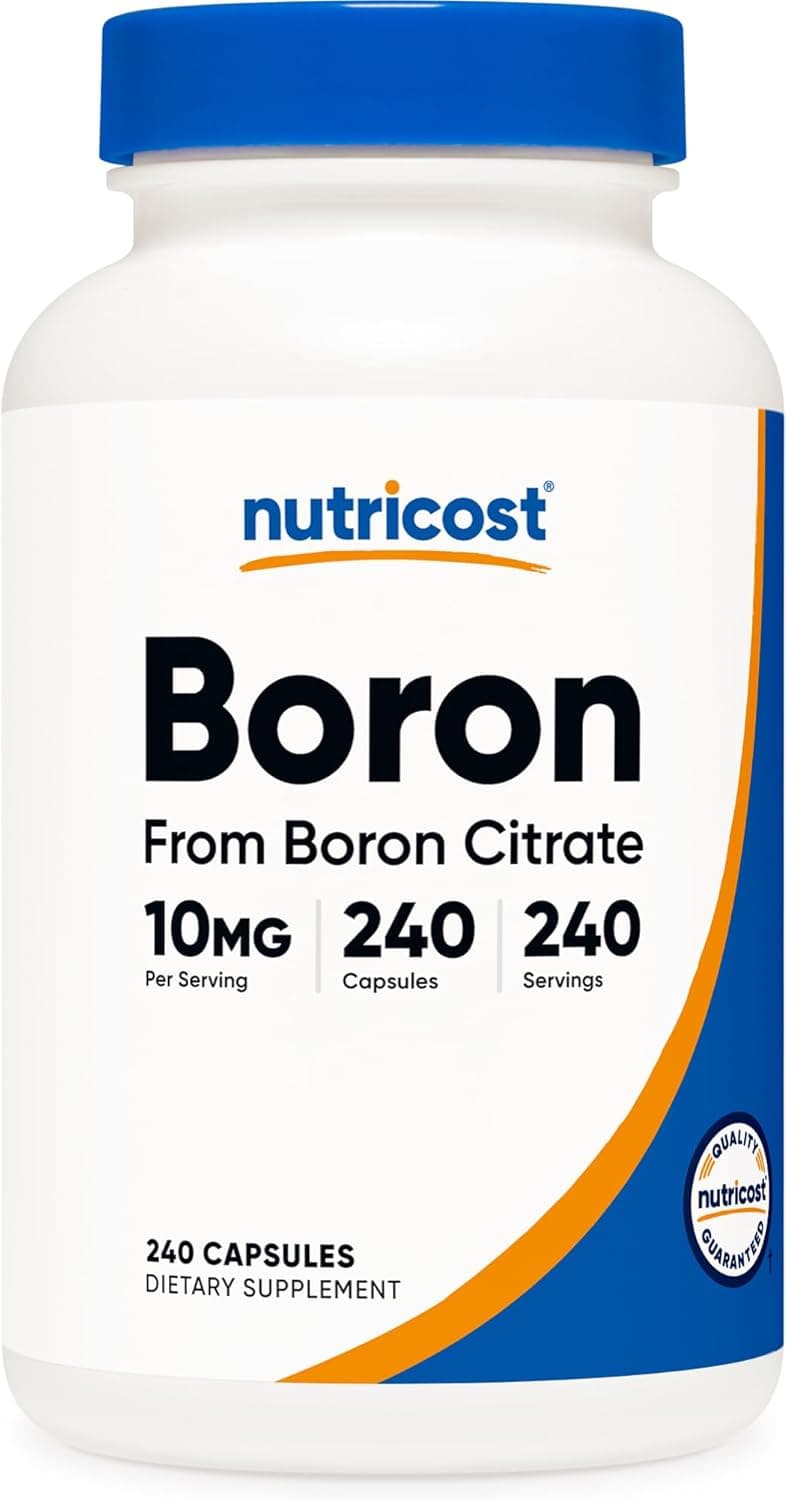
Suppliers
Vendors carrying Boron, with live product details and codes. Links are affiliate links that support the wiki at no cost to you.
Amazon
Boron
Research
- 1987first citedEffect of dietary boron on mineral, estrogen, and testosterone metabolism in postmenopausal wom…
- 2020most recentPivotal role of boron supplementation on bone health: A narrative review.
- 1.Update on human health effects of boron.
- 2.Pivotal role of boron supplementation on bone health: A narrative review.
- 3.Nothing Boring About Boron.
- 4.The role of nutrition in osteoporosis.
- 5.Comparative effects of daily and weekly boron supplementation on plasma steroid hormones and proinflammatory cytokines.
- 6.The significance of dietary boron, with particular reference to athletes.
- 7.The effect of boron supplementation on its urinary excretion and selected cardiovascular risk factors in healthy male subjects.
- 8.Biochemical and physiologic consequences of boron deprivation in humans.
- 9.The influence of a low-boron diet and boron supplementation on bone, major mineral and sex steroid metabolism in postmenopausal women.
- 10.Effect of dietary boron on mineral, estrogen, and testosterone metabolism in postmenopausal women.
- 11.The Impact of Trace Minerals on Bone Metabolism.
- 12.Trace elements and bone health.
14 listed here; entry last updated August 2026
Reviews
My notesprivate to this device
FAQ
Does boron actually raise testosterone?
It raises free testosterone mainly by lowering SHBG. The effect is real but modest, and total testosterone may not change much.
How much boron is safe?
Up to about 20 mg per day is considered the upper limit; most people use 3 to 10 mg.
Can I get boron from food?
Yes, fruits, nuts, leafy greens, and legumes are good sources.
How long until it works?
Hormonal changes have shown up in as little as one week in studies.
Adverse effects
- Food-safety authorities set an upper intake level, and very high exposure can cause nausea, vomiting, and irritation [2].
Notes and cautions
- At the amounts found in food and typical supplements, boron is generally well tolerated [2].
- Boric acid and borax, which share the same chemistry, are used as pesticides, so concentrated industrial forms should not be confused with dietary boron [1].
- Because boron can affect hormone levels, people with hormone-sensitive conditions may prefer caution with high-dose supplements [1].