
spec sheet12 rows
Pimecrolimus is a topical calcineurin inhibitor, a non-steroidal anti-inflammatory cream used to treat eczema (atopic dermatitis). Sold under the brand name Elidel, it calms the overactive immune response in the skin by blocking a signaling enzyme inside immune cells, and unlike corticosteroids it does not cause skin thinning, which makes it useful on delicate areas such as the face. It is generally reserved for when standard treatments are unsuitable or ineffective, and it carries a boxed warning about a theoretical cancer risk that later research has not supported.
- Used to treat eczema, also called atopic dermatitis
- Calms the overactive immune response in the skin
- No skin thinning, unlike corticosteroids
- Safe on the face, eyelids and skin folds
- Cuts itch and redness on delicate areas
- Large long term studies found no increased cancer risk
- A burning, stinging, or warm sensation at the application site is common, especially in the first days of use, and usually eases with time
- Itching, redness, or skin infections at the treated area can occur
- Sun protection is advised, as the label cautions against excessive ultraviolet exposure during treatment
Overview
Pimecrolimus is a topical calcineurin inhibitor, a class of immunomodulating drugs that also includes tacrolimus; chemically it is a derivative of ascomycin, a macrolactam produced by a soil bacterium [4]. It was developed by Novartis, is sold as a skin cream under the brand name Elidel, and was approved by the United States Food and Drug Administration in 2001 [4].
Its established use is the treatment of atopic dermatitis, the common itchy inflammatory skin condition also called eczema [3]. It is applied as a cream and is valued as a non-steroidal option, generally for mild-to-moderate disease and particularly on sensitive sites or when topical corticosteroids are unsuitable; treatment guidelines list topical calcineurin inhibitors alongside corticosteroids among first-line therapies [3]. A large network meta-analysis of topical eczema treatments found pimecrolimus to be among the most effective options for improving disease severity, itch, and other patient-important outcomes [1]. Beyond eczema, it has been used off-label for conditions such as seborrheic dermatitis, vitiligo, oral lichen planus, and cutaneous lupus [4].
A key practical advantage of pimecrolimus over topical steroids is that it does not cause the skin thinning, or atrophy, that can result from prolonged corticosteroid use, so it can be applied to the face and skin folds and used over longer periods [3].
The drug is nevertheless surrounded by a long-running safety debate. In 2006 the FDA added a boxed warning citing a theoretical risk of lymphoma and skin cancer, extrapolated largely from studies of systemic immunosuppression and high-dose animal data [4]. Subsequent large analyses have not borne out this concern; a 2022 systematic review and meta-analysis covering millions of patients concluded that topical calcineurin inhibitors do not increase the risk of cancer, and many dermatologists and professional societies now question the necessity of the warning [2][4]. Only a very small amount of the drug is absorbed through the skin into the bloodstream. It is a prescription cream [4].

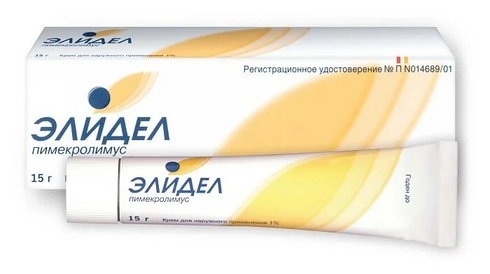
- Unlike corticosteroid creams, it does not cause skin thinning, which is why it is favored for the face, eyelids, and skin folds.
- It is derived from ascomycin, a natural compound made by a soil bacterium, and works by blocking the enzyme calcineurin inside immune cells.
- A five-year randomized trial in more than 2,000 infants found it as safe as topical steroids with no detectable effect on the immune system.
Mechanism
Pimecrolimus enters immune cells and binds an intracellular protein called macrophilin-12, also known as FKBP12, and the resulting complex inhibits calcineurin, an enzyme that removes phosphate groups from other proteins [4]. By blocking calcineurin, the drug prevents activation of the transcription factor NFAT and thereby stops T cells from producing and releasing inflammatory signaling molecules such as interleukin-2; it also reduces the release of inflammatory mediators from mast cells [4].
The overall effect is to quiet the immune activity that drives the inflammation of atopic dermatitis. Pimecrolimus is closely related to tacrolimus but is more and more selective for the skin, and because very little of it is absorbed into the bloodstream its systemic effects are limited [4]. Unlike topical corticosteroids, it does not suppress collagen production, which is why it does not cause the skin thinning associated with long-term steroid use [3].
receptor fingerprint
Calcineurin phosphataseinhibits
FKBP-12 (macrophilin-12)modulates
NFAT and IL-2 transcriptionblocks
T-lymphocyte activationinhibits
Mast cell mediator releaseinhibits
Dosingtypical ranges, not medical advice
interested in protocols and clinical dosages? make an account to see them! ^_^
Safetyrisks and cautions, not medical advice
Pimecrolimus cream is a prescription non-steroidal option for eczema, most often used second-line on the face and skin folds where steroids are risky. The usual side effect is a warm burning or stinging feeling at the site for the first few days, which tends to settle, along with occasional itching or inflamed follicles. It carries a boxed warning about a theoretical risk of skin cancer and lymphoma, though large long-term studies have not confirmed a real increase. It is not for children under two, and it is best to limit sun exposure and avoid using it on skin that looks infected.
Interactionsdocumented pairs only, not exhaustive
Pimecrolimus is applied topically and is not appreciably absorbed, so it has almost no systemic interaction profile. Formal interaction studies were never required for the same reason, and what exists is precautionary.
The exception is anything that raises blood concentrations above the usual trace amounts: widespread or erythrodermic disease, application under occlusion, use in infants, where the surface area to mass ratio is large, and skin barrier defects such as Netherton syndrome. When measurable concentrations do appear, absorbed pimecrolimus is demethylated by CYP3A enzymes, so strong CYP3A inhibitors including ketoconazole, itraconazole, erythromycin, clarithromycin, diltiazem and cimetidine could plausibly raise exposure further. That remains theoretical; no clinical case series has demonstrated it.
Because pimecrolimus belongs to the calcineurin inhibitor class, live vaccines during extensive use are treated with caution, and combination with other systemic immunosuppressants or with phototherapy has not been studied. Flushing and intolerance after alcohol have been reported in users of topical calcineurin inhibitors, an odd but consistent observation.
Checking a whole stack? Run it through interactions + stacks.
History
Pimecrolimus is a semisynthetic derivative of ascomycin, a natural product of the bacterium Streptomyces hygroscopicus, and it was developed by the pharmaceutical company Novartis, which assigned it the research code SDZ ASM 981. It was engineered specifically for skin disease: compared with its relative tacrolimus it is more lipophilic and more selective for the skin, and very little of it is absorbed into the bloodstream, properties intended to concentrate its anti-inflammatory action where it is applied.
The United States Food and Drug Administration approved the 1 percent cream, marketed as Elidel, in December 2001 for the treatment of atopic dermatitis, offering a non-steroidal option that, unlike corticosteroids, does not thin the skin. In 2006 the agency added a boxed warning citing a theoretical concern about cancer risk based on the drug's class and on high-dose animal data, a precaution that shaped its positioning as a second-line therapy. In the years since, large and long observational studies and controlled trials, including a five-year pediatric study, have not borne out that theoretical risk, and the drug has retained an important role in dermatology.
Reputation
Pimecrolimus is well regarded as a gentle yet effective steroid-sparing treatment for eczema, especially valuable on the delicate skin of the face and eyelids and in young children, where the thinning caused by long-term corticosteroids is a genuine concern. A landmark five-year randomized study in infants found it as safe as topical corticosteroids, with no evidence of immune impairment, while sharply reducing the number of steroid days required, a reassuring result for parents and physicians alike.
Patients appreciate that it calms inflammation without the cosmetic drawbacks of steroids, making it well suited to sensitive areas and to maintenance use. In fairness, it carries a boxed warning about a theoretical cancer risk, and it can cause a transient burning or stinging sensation when first applied; it is also generally reserved for when standard treatments are unsuitable. The weight of subsequent evidence, however, has been reassuring, and it remains a trusted tool for long-term eczema care.
Subjective profileweighing the evidence above
Genuinely useful where steroids are a problem, which mostly means the face, eyelids and skin folds, since it calms eczema without thinning skin. The early burning settles within days. The boxed cancer warning sounds alarming, but large long-term studies have not found an actual increase in risk.
Where to buy
1 other outlet

Suppliers
Vendors carrying Pimecrolimus, with live product details and codes. Links are affiliate links that support the wiki at no cost to you.
PCT.Zone
Pimecrolimus
RUPharma🌐
Pimecrolimus
Research
- 2007first citedThe topical calcineurin inhibitor pimecrolimus in atopic dermatitis: a safety update.
- 2023most recentTopical treatments for atopic dermatitis (eczema): Systematic review and network meta-analysis…
- 1.Topical treatments for atopic dermatitis (eczema): Systematic review and network meta-analysis of randomized trials.
- 2.Cancer risk with topical calcineurin inhibitors, pimecrolimus and tacrolimus, for atopic dermatitis: a systematic review and meta-analysis.
- 3.Atopic Dermatitis: Diagnosis and Treatment.
- 4.The topical calcineurin inhibitor pimecrolimus in atopic dermatitis: a safety update.
- 5.Safety and efficacy of pimecrolimus in atopic dermatitis: a 5-year randomized trial
5 listed here; entry last updated August 2026
Reviews
My notesprivate to this device
FAQ
Is pimecrolimus a steroid?
No; it is a non-steroidal calcineurin inhibitor, so it does not thin the skin the way long-term steroid creams can.
Why does it sting when I first apply it?
A warm burning or stinging feeling in the first few days is common as the skin adjusts, and it usually settles.
Is the cancer warning something to worry about?
It carries a precautionary boxed warning, but large long-term studies have not shown a real increase in skin cancer or lymphoma.
Where is it most useful?
It is especially handy on the face, eyelids, and skin folds where steroids are riskier.
Can children use it?
It is approved for ages two and older; it is not recommended for children under two.
Limitations of the evidence
- The product carries a boxed warning about a theoretical risk of lymphoma or skin cancer, although large subsequent studies have not found an increased cancer risk
Adverse effects
- A burning, stinging, or warm sensation at the application site is common, especially in the first days of use, and usually eases with time
- Itching, redness, or skin infections at the treated area can occur
- Sun protection is advised, as the label cautions against excessive ultraviolet exposure during treatment
Notes and cautions
- Because very little is absorbed into the body, systemic side effects are uncommon