
spec sheet6 rows
Azoximer bromide, sold across Russia as Polyoxidonium, is a synthetic water-soluble polymer of ethylene piperazine used as an immunomodulator and as a vaccine adjuvant.
- Sold across Russia as Polyoxidonium, a household name
- Synthetic water soluble polymer with fully defined chemistry
- The adjuvant inside the Russian Grippol influenza vaccines
- Described action on phagocytes and natural killer cells
- Taken by enormous numbers of people every season
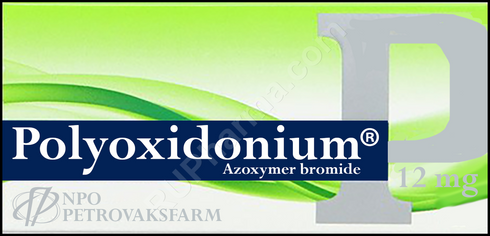
- Azoximer bromide is a Russian synthetic polymer immunomodulator (Polyoxidonium), licensed in Russia and a few neighbouring states and used as the adjuvant in the Grippol influenza vaccines; it is not approved by the FDA or EMA.
- Unlike Allohol and Biotredin, azoximer bromide does have some indexed Western-journal literature, but almost all of it is review, adjuvant-immunology or open-label work; there is no placebo-controlled randomised trial of azoximer bromide as a therapeutic in an indexed journal.
- The most-cited clinical paper, an open-label multicentre COVID-19 study in Drugs in Context, was uncontrolled and subsequently required a published corrigendum (PMID 33828607, corrigendum PMID 34234832); it is not evidence of efficacy.
- A Slovak post-authorisation safety study is the main real-world safety dataset and reported no unexpected signal, but post-authorisation safety studies cannot establish efficacy [4].
- The adjuvant application is the better-supported one: the polymer permits antigen dose-sparing in subunit influenza vaccine with a Th2-skewed humoral response and increased NK activity (PMID 32873403, PMID 36176546).
- No receptor, enzyme or transporter target has ever been identified for azoximer bromide; the 'immunomodulator' label describes an observed effect, not a mechanism.
Mechanism
It is a cationic ternary copolymer of roughly 60 to 100 kDa built from 1,4-ethylene piperazine, its N-oxide and a carboxymethylated piperazinium bromide. The described action is direct adsorption to phagocytes and natural killer cells with increased antibody production and interferon synthesis, plus antioxidant and detoxifying effects attributed to the N-oxide groups. Most real-world human exposure to this molecule is not as a drug at all but as the adjuvant in the Russian Grippol influenza vaccines.
receptor fingerprint
No defined molecular target; azoximer bromide is a synthetic high-molecular-weight N-oxidised polyethylenepiperazine copolymer rather than a small moleculeDescribed by the manufacturer as an immunomodulator acting on monocytes, macrophages and NK cells; no receptor has been identified in peer-reviewed literature
NK cell cytotoxic activityIncreased when used as a vaccine adjuvant in the Grippol formulation
Vaccine antigen dose-sparing (adjuvant function)Permits a reduced haemagglutinin dose in subunit influenza vaccine while maintaining immunogenicity
Polymer detoxification / carrier chemistryThe N-oxide groups are proposed to bind and clear soluble toxins and to act as an antigen carrier
Safetyrisks and cautions, not medical advice
prescription in Russia in the injectable form; a synthetic polymer immunomodulator with no Western approval, whose only study published in a Western journal was an open-label COVID-19 trial with no control group
Subjective profileweighing the evidence above
Few molecules are taken by so many people on so little independent evidence. The described mechanism reads as a list of desirable immune effects rather than a specific target, and the single study to reach a Western journal was open label with no control group, which cannot separate a drug effect from the natural course of a self limiting infection. It is more interesting as a vaccine adjuvant, where most genuine human exposure to the molecule actually occurs, than as a treatment for anything. Anyone with autoimmune disease should note that deliberately raising immune activity is not a neutral act.
Where to buy

Suppliers
Vendors carrying Azoximer Bromide, with live product details and codes. Links are affiliate links that support the wiki at no cost to you.
RUPharma🌐
Azoximer Bromide
Research
- 2018first citedThe safety profile of Polyoxidonium in daily practice: results from postauthorization safety st…
- 2024most recentAzoximer bromide and hydroxyapatite: promising immune adjuvants in cancer.
- 1.Azoximer Bromide: Mystery, Serendipity, and Promise.
- 2.Analysis of the safety and immunogenicity profile of an azoximer bromide polymer-adjuvanted subunit influenza vaccine.
- 3.Low-dose influenza vaccine Grippol Quadrivalent with adjuvant Polyoxidonium induces a T helper-2 mediated humoral immune response and increases NK cell activity.
- 4.The safety profile of Polyoxidonium in daily practice: results from postauthorization safety study in Slovakia.
- 5.The effect of azoximer bromide (Polyoxidonium) in patients hospitalized with coronavirus disease (COVID-19): an open-label, multicentre, interventional clinical study.
- 6.Azoximer bromide and hydroxyapatite: promising immune adjuvants in cancer.
6 listed here; entry last updated August 2026
Reviews
My notesprivate to this device
Notes and cautions
- Azoximer bromide has no regulatory approval in the United States, the European Union or the United Kingdom, and no placebo-controlled randomised efficacy trial in the indexed literature; treating it as a proven immune therapy is not supportable.
- Reported adverse effects are mostly local injection-site pain with the parenteral form and are described as mild in post-authorisation surveillance [4], but that surveillance was manufacturer-associated and cannot exclude uncommon harms.
- Any immunostimulant carries a theoretical risk in autoimmune disease and in transplant recipients on immunosuppression, and there are no interaction data.
- The main practical risk is opportunity cost: using it in place of a therapy with established evidence, which is exactly what the uncontrolled COVID-19 study invited.