
data + articles · 7 listed
newest 2004spec sheet8 rows
Cortagen is a synthetic brain-directed tetrapeptide (Ala-Glu-Asp-Pro) from the Khavinson family of peptide bioregulators, designed to support the structure and repair of nervous tissue [1]. In animal studies it accelerated the regeneration of injured peripheral nerve, raising nerve fiber growth rate and conduction velocity, and it selectively switched on gene expression in target tissues [1][2]. For anyone building a peptide-based longevity or neuro-recovery routine, Cortagen offers a focused, well-defined tool aimed squarely at the nervous system.
- a four amino acid peptide aimed squarely at nervous tissue
- animal studies showed faster peripheral nerve regeneration
- raised nerve fibre growth rate and conduction velocity
- switched on gene expression selectively in target tissue
- from the Khavinson bioregulator family, focused and defined
- the animal data is striking; human trials are still to come
- Injection-site reactions are possible with reconstituted peptide
Overview
Cortagen is a short synthetic peptide belonging to the family of peptide bioregulators, or cytogens, developed at the St. Petersburg Institute of Bioregulation and Gerontology under the direction of Vladimir Khavinson. Its sequence is the tetrapeptide Ala-Glu-Asp-Pro, and it was obtained by directed synthesis based on the amino acid analysis of Cortexin, a natural peptide preparation extracted from the cerebral cortex [1][2]. Like other members of this family, such as Epithalon, Vilon, and Livagen, Cortagen was conceived as a tissue-specific regulator: a very small molecule intended to normalize the function of the organ from whose extract its parent peptide complex was derived.
The research literature on Cortagen centers on the nervous system. In humans it has been reported to aid the structural and functional recovery of peripheral nerve tissue after injury, and animal work has examined its effects on nerve regeneration, gene expression, and tissue culture growth [1][2]. In organotypic culture, Cortagen stimulated the growth of explants from the brain cortex while showing the tissue selectivity characteristic of the cytogen class [3][6]. Screening studies of short peptides have also probed effects on immune cells and chromatin, where Cortagen behaves distinctly from immune-directed peptides, underscoring its comparative specificity for neural tissue [4][5].
Cortagen is not an approved pharmaceutical in Western markets and is not a dietary supplement; it originates in Russian gerontological research and circulates internationally as a research peptide, typically supplied as a lyophilized powder for reconstitution. It is most often discussed alongside the other Khavinson bioregulators within longevity and tissue-recovery protocols, where it is positioned as a targeted, low-burden addition rather than a standalone therapy.


- A microarray study reported that this four-amino-acid peptide altered the expression of 110 known genes in mouse heart tissue, supporting the idea that it acts as a gene regulator rather than a simple growth stimulant.
- In rats whose sciatic nerve had been cut and rejoined, a ten-day course of Cortagen increased regenerating nerve fiber growth rate by 27 percent and conduction velocity by 40 percent.
Mechanism
Cortagen belongs to a class of ultra-short peptides thought to act as gene regulators. The prevailing model, developed across the Khavinson bioregulator program, is that these peptides are small enough to enter cells and even the nucleus, where they bind specific sequences of DNA and modulate the transcription of particular genes, thereby nudging a tissue back toward its youthful pattern of protein synthesis [2]. Consistent with this, a microarray analysis of mouse heart after Cortagen treatment found altered expression of 110 known genes, with changes ranging from roughly a fivefold increase to a nearly threefold decrease, showing that a four-amino-acid can produce broad yet specific shifts in gene activity [2].
The most concrete functional benefit reported for Cortagen is in nerve repair. In rats whose sciatic nerve had been cut and surgically rejoined, a ten-day course of Cortagen increased the growth rate of the regenerating nerve fibers by 27 percent and their conduction velocity by 40 percent compared with untreated animals, indicating faster and more functional reinnervation [1]. This fits its origin as a -derived and its reported use in supporting recovery of damaged peripheral nerves in people [1].
A defining feature of Cortagen is tissue specificity. In organotypic cultures the cytogen peptides stimulate the growth of explants from the tissue matching their source complex, and Cortagen preferentially supports neural tissue rather than acting as a general growth promoter [3][6]. In comparative screens of short peptides on immune cells, Cortagen did not reproduce the proliferative or comitogenic effects of immune-oriented peptides, reinforcing that its activity is directed rather than indiscriminate [4]. For the user, these mechanisms translate into a positioned for neural support and recovery, with a proposed epigenetic style of action that aims to restore, rather than override, normal cellular function [2][5].
receptor fingerprint
Gene expression ( bioregulator)modulates
Neuronal / retinal regenerationsupports
Safetyrisks and cautions, not medical advice
Cortagen is a short peptide bioregulator marketed for nerve and tissue recovery; human safety data are very limited, drawn mainly from small Russian studies, and it is sold as a research chemical. Its risks, long-term effects and drug interactions are not characterized, and considerations are inferred from its peptide class rather than robust clinical evidence.
Reconstitutionarithmetic only, not dosing advice
arithmetic only; not medical or dosing advice.
History
Cortagen is a synthetic tetrapeptide (Ala-Glu-Asp-Pro) developed within the Russian peptide bioregulator program led by Vladimir Khavinson at the St. Petersburg Institute of Bioregulation and Gerontology. It belongs to the family of short synthetic cytogens designed to reproduce the tissue-directed activity of natural peptide complexes, in this case peptides associated with the brain cortex. Research on Cortagen dates chiefly to the late 1990s and early 2000s, including controlled animal experiments on peripheral nerve regeneration published in the Russian physiological literature. Much of its development and clinical use has taken place within Russia, and the compound is representative of the broader Khavinson bioregulator approach rather than a widely registered international medicine.
Reputation
Within the peptide and longevity community Cortagen is well regarded as a focused, clearly defined neuro-directed bioregulator, appreciated for the specificity of its proposed action rather than broad, indiscriminate stimulation. It draws particular interest for its reported ability to accelerate peripheral nerve repair and for the intriguing idea, developed across the Khavinson program, that ultra-short peptides can act as gene regulators that nudge tissue back toward a youthful pattern of protein synthesis.
Its tissue selectivity, preferentially supporting neural explants over unrelated cell types, is frequently cited as a point in its favor. Candor is warranted: the supporting evidence comes largely from animal studies and Russian-language sources, with limited independent international replication, so its human benefits remain modestly documented. It is a well-characterized research peptide with a specific neural focus.
Subjective profileweighing the evidence above
The peripheral-nerve regeneration work in animals is interesting, but the human evidence is small, regional and largely unreplicated, and it is sold as a research chemical. Not something to build a recovery protocol around; treat any benefit as unproven.
Where to buy
1 other outlet
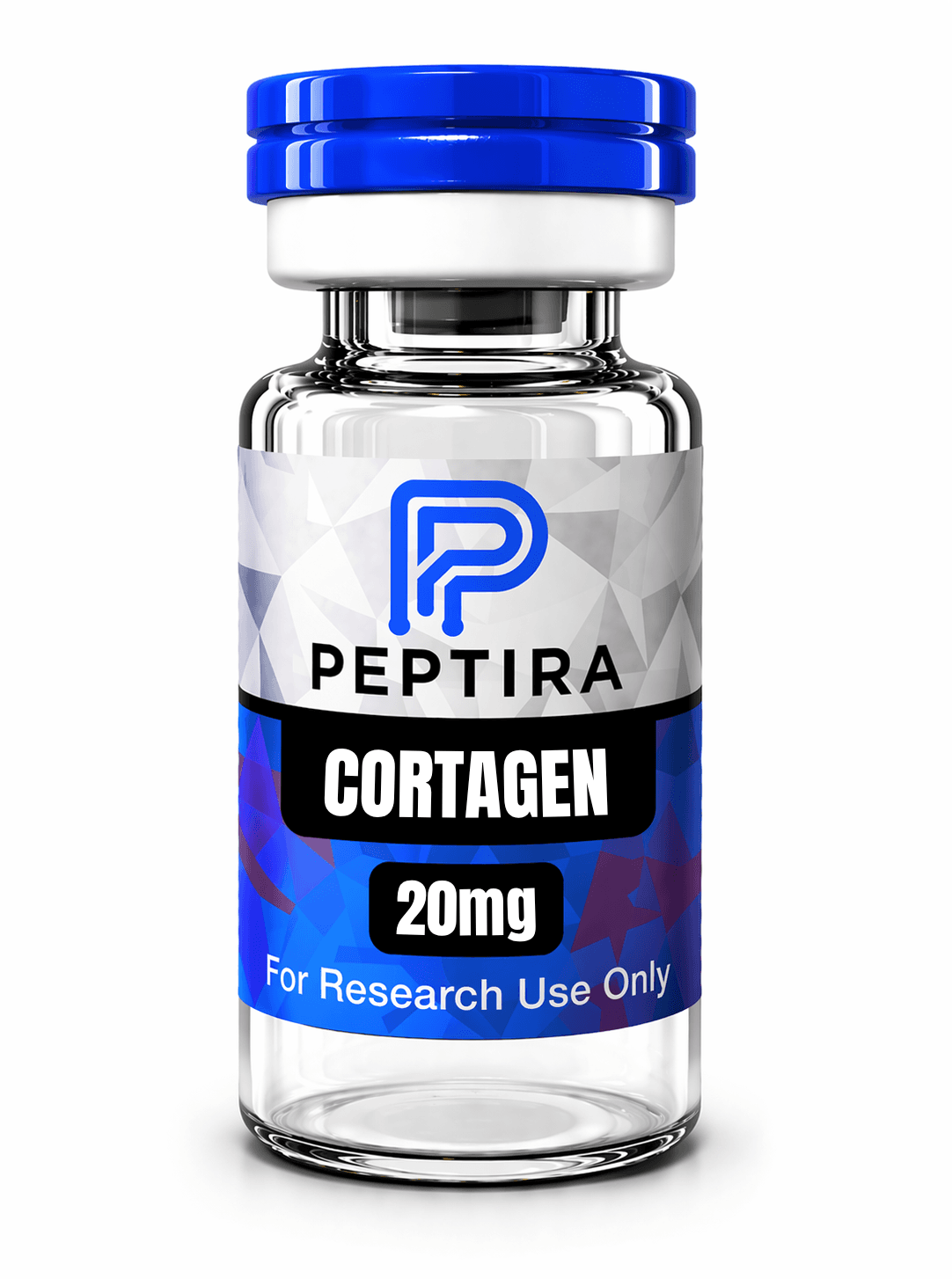
Suppliers
Vendors carrying Cortagen, with live product details and codes. Links are affiliate links that support the wiki at no cost to you.
Peptira
Cortagen
RUO
Cortagen
Research
- 2000first citedEffect of tetrapeptide cortagen on regeneration of sciatic nerve
- 2002most active year3 papers
- 2004most recentElucidation of the effect of brain cortex tetrapeptide Cortagen on gene expression in mouse hea…
- 1.Effect of tetrapeptide cortagen on regeneration of sciatic nerve
- 2.Elucidation of the effect of brain cortex tetrapeptide Cortagen on gene expression in mouse heart by microarray
- 3.Tissue-specific effects of peptides
- 4.Effects of short peptides on thymocyte blast transformation and signal transduction along the sphingomyelin pathway
- 5.Effects of short peptides on lymphocyte chromatin in senile subjects
- 6.[Tissue-specific action of peptides in tissue culture of rats of various ages]
- 7.The delayed effect of cortagen on the restoration of injured nerve function.
7 listed here; entry last updated August 2026
Reviews
My notesprivate to this device
FAQ
What is Cortagen?
It is a short peptide bioregulator that has been studied mainly in Russian research for tissue and nerve repair.
What is it used for?
It has been explored for supporting recovery of nerves and connective tissue.
Is it widely approved?
It is not broadly approved as a mainstream medication and most data comes from limited regional studies.
How is it typically administered?
As a peptide, it is usually given by injection after reconstitution rather than taken orally.
Limitations of the evidence
- Long-term and large-scale human safety data are lacking
Adverse effects
- Injection-site reactions are possible with reconstituted peptide
Notes and cautions
- Reported to be well tolerated in the available Russian studies, though data are limited
- Not evaluated or approved by Western drug regulators