
spec sheet13 rows
Buspirone is an anxiolytic medication of the azapirone class, used mainly to treat generalized anxiety disorder. It acts chiefly as a partial agonist at the serotonin 5-HT1A receptor and, unlike benzodiazepines, does not cause significant sedation, dependence, or withdrawal. It was approved for medical use in the United States in 1986 and is sold as a generic, formerly under the brand name Buspar.
- Built for the everyday, chronic anxiety load
- No dependence and no withdrawal
- Calm arrives without fog or sedation
- Coordination and sharpness stay intact
- A known augmentation partner in clinical use
- Not a controlled substance
- Dizziness or lightheadedness
- Headache
- Nausea
Overview
Buspirone is an anti-anxiety drug belonging to the azapirone chemical class, a group defined by a distinctive azaspirodecanedione structure joined to a pyrimidinylpiperazine group [4][5]. It was synthesized by researchers at Mead Johnson in the late 1960s and received United States Food and Drug Administration approval for generalized anxiety disorder in 1986, marketed as Buspar; it has since become available as an inexpensive generic [1].
Its main approved use is the treatment of generalized anxiety disorder, and controlled trials found its anxiety-relieving effect comparable to that of benzodiazepines while offering a very different tolerability profile [1]. Unlike benzodiazepines, buspirone does not produce meaningful sedation, muscle relaxation, or anticonvulsant effects, and it carries little risk of dependence or withdrawal, which makes it attractive for longer-term use and for patients with a history of substance misuse [1]. A practical drawback is that its benefit builds gradually over weeks rather than working immediately, so it is poorly suited to acute, on-demand relief. It is also used off-label to augment antidepressants and for other indications [3].
Buspirone's characteristic action is partial agonism at serotonin 5-HT1A receptors, and it also shows weak antagonism at certain dopamine receptors [3][4]. Pooled analyses have described it as generally well tolerated, with the most common complaints being dizziness, headache, and nausea; movement-related side effects have only rarely been reported [2][5]. The medicine is a prescription-only, non-controlled drug and is widely available in generic tablet form [1].
Buspirone is taken by mouth and is supplied as oral tablets in several strengths. It is broken down in the liver, and it is usually taken on a regular daily schedule rather than as needed, since its calming effect develops gradually [1].

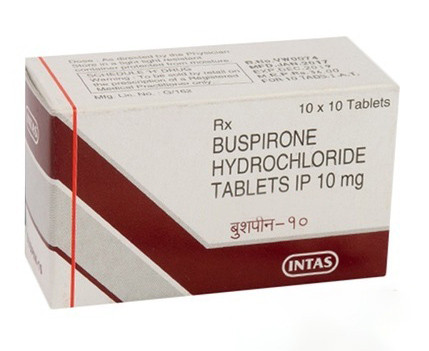
- Buspirone was first studied as an antipsychotic; its calming, anti-anxiety effect was essentially discovered by accident during that research.
- Unlike benzodiazepines, buspirone produces no meaningful sedation or dependence, so it carries no controlled-substance restrictions despite treating anxiety.
Mechanism
Buspirone works mainly through the system, acting as a partial at receptors [3][4]. At presynaptic autoreceptors it behaves as a fuller , which initially lowers the firing of neurons; with continued use these autoreceptors are thought to desensitize, so that serotonin transmission to key brain regions increases over time, a delay that fits the drug's gradual onset of anxiety relief [3]. It has only weak activity at -type receptors and essentially no action at the -benzodiazepine complex, which is why it lacks the sedation, muscle relaxation, and dependence associated with benzodiazepines [4][5]. Studies of azapirones have also documented downstream neuroendocrine effects consistent with stimulation [4].
receptor fingerprint
receptoragonist
Presynaptic autoreceptormodulates
Alpha-2 receptorantagonist
receptorantagonist
5-HT2 receptormodulates
Dosingtypical ranges, not medical advice
interested in protocols and clinical dosages? make an account to see them! ^_^
Safetyrisks and cautions, not medical advice
Buspirone is prescription only but has a favorable safety profile. The most common effects are dizziness, lightheadedness, headache, nausea, and nervousness, usually mild. It does not cause the sedation, dependence, or withdrawal seen with benzodiazepines, and it is not a controlled drug. It should not be combined with MAO inhibitors because blood pressure can spike, and it can add to serotonin load with SSRIs, so watch for serotonin syndrome signs. Strong CYP3A4 inhibitors like ketoconazole or grapefruit juice raise its levels, while inducers like rifampin lower them. It is not useful for acute panic or as-needed relief because of its slow onset.
Interactionsdocumented pairs only, not exhaustive
Buspirone is metabolized exclusively by cytochrome P450 3A4, and inhibitors of this enzyme produce marked increases in buspirone plasma concentration. Ketoconazole and other potent CYP3A4 inhibitors (including clarithromycin, erythromycin, itraconazole, ritonavir, and diltiazem) substantially elevate buspirone levels through pharmacokinetic inhibition, increasing the risk of excessive sedation and dizziness [25]. Grapefruit juice similarly inhibits CYP3A4 and raises buspirone concentrations [25].
A general framework for CYP3A4 substrate interactions identified buspirone as a reliable marker drug for predicting the magnitude of inhibitory interactions [26], with buspirone's AUC increasing by 5-fold or more in some inhibitor combinations. Conversely, CYP3A4 inducers like rifampin, carbamazepine, and St. John's wort reduce buspirone levels and efficacy. Combinations with most other anxiolytics, antidepressants, and antihistamines have not been formally characterized.
Checking a whole stack? Run it through interactions + stacks.
History
Buspirone was synthesized in 1968 by researchers at Mead Johnson and was initially investigated as a potential antipsychotic before its anxiety-relieving properties became apparent. It was approved for medical use in the United States in 1986 under the brand name BuSpar, offering the first widely used anxiolytic of the azapirone class that did not act through the GABA-benzodiazepine system. Because it worked instead as a partial agonist at serotonin 5-HT1A receptors, it introduced a non-sedating, non-dependence-forming alternative for generalized anxiety disorder. It is now available as an inexpensive generic and remains a standard option in anxiety management.
Reputation
Buspirone is well regarded as a gentle, non-habit-forming anxiolytic that occupies a valuable middle ground between antidepressants and benzodiazepines. Its great appeal is safety; it does not cause the sedation, cognitive dulling, dependence, or withdrawal associated with benzodiazepines, making it attractive for long-term use and for patients with substance-use concerns. Systematic reviews find azapirones, including buspirone, superior to placebo for generalized anxiety disorder, particularly in people who have not previously taken a benzodiazepine. It is honest to note that relief builds gradually over weeks rather than instantly, and it may be less potent than benzodiazepines for acute anxiety, but its favorable tolerability keeps it a durable and trusted choice.
Subjective profileweighing the evidence above
One of the better options for chronic, grinding anxiety precisely because it is not a benzodiazepine; no dependence, no withdrawal, and no dulling of memory or coordination. Give it two to four weeks before judging it, and expect nothing from it during an acute panic attack.
Where to buy

1 other outlet

Suppliers
Vendors carrying Buspirone, with live product details and codes. Links are affiliate links that support the wiki at no cost to you.
PCT.Zone
Buspirone
RUPharma🌐
Buspirone
Research
- 1984first citedPreclinical pharmacology of buspirone hydrochloride.
- 1987most active year3 papers
- 1999meta-analysisMeta-analysis of the safety and tolerability of two dose regimens of buspirone in patients with…
- 2026most recentAdverse events related to buspirone: a real-world pharmacovigilance study using the FAERS datab…
- 1.Buspirone in clinical practice
- 2.Meta-analysis of the safety and tolerability of two dose regimens of buspirone in patients with persistent anxiety
- 3.The serotonergic anxiolytic buspirone attenuates circadian responses to light
- 4.Neuroendocrine effects of azapirones
- 5.Buspirone-associated Movement Disorder: A Literature Review
- 6.Molecular basis of buspirone's anxiolytic action.
- 7.Buspirone: review of its pharmacology and current perspectives on its mechanism of action.
- 8.Pharmacological and clinical effects of buspirone.
- 9.Buspirone and related compounds as alternative anxiolytics.
- 10.Preclinical pharmacology of buspirone hydrochloride.
- 11.Buspirone in the long-term treatment of generalized anxiety disorder.
- 12.Azaspirodecanediones in generalized anxiety disorder: buspirone.
26 listed here; entry last updated August 2026
Reviews
My notesprivate to this device
FAQ
How long until buspirone works?
Give it two to four weeks. It builds its anti-anxiety effect gradually and is not meant for immediate, on-the-spot relief.
Is buspirone addictive?
No. It does not act on the GABA system, so there is no high, no dependence, and no withdrawal; it is not a controlled substance.
Can I use it for panic attacks?
Not really. Its slow, steady action makes it poor for acute panic; it is better suited to ongoing generalized anxiety.
Why avoid grapefruit juice?
Grapefruit blocks the CYP3A4 enzyme that clears buspirone, raising its levels and side effects; keep your grapefruit habits consistent.
Does it make you drowsy like other anxiety meds?
Usually not. A key advantage is that it calms anxiety with little sedation, so most people can function normally on it.
Adverse effects
- Dizziness or lightheadedness
- Headache
- Nausea
- Drowsiness in some people
Notes and cautions
- Nervousness or restlessness