
spec sheet12 rows
Tofisopam is an anxiolytic drug of the 2,3-benzodiazepine class, marketed in parts of Europe and Asia under brand names such as Grandaxin [1]. Unlike the familiar 1,4-benzodiazepines such as diazepam, it relieves anxiety without producing sedation, muscle relaxation, memory impairment, or anticonvulsant effects [2]. It is used mainly for anxiety and autonomic symptoms, and it is not approved in the United States or Canada.
- Calm without the drowsiness
- Settles palpitations, sweating and tension
- Built for the middle of a workday
- Leaves memory and coordination alone
- Low risk of dependence or withdrawal
- No hangover feeling afterward
- Reported effects can include headache, nausea, agitation, or disturbed sleep
- It does not produce the muscle relaxation or memory impairment associated with classic benzodiazepines
- Because it inhibits the liver enzyme CYP3A4, it can interact with other medications
Overview
Tofisopam is a psychoactive drug classified as a 2,3-benzodiazepine, a structural variant of the benzodiazepine family in which the ring nitrogen atoms sit in different positions than in the common 1,4- and 1,5-benzodiazepines [1]. Because of this altered structure, sometimes described chemically as a homophthalazine, its pharmacology diverges sharply from that of typical benzodiazepines; it lacks the sedative, hypnotic, anticonvulsant, muscle-relaxant, amnestic, and motor-impairing actions that characterize drugs like diazepam [2]. For this reason it is often called an atypical or daytime anxiolytic.
The compound was developed by the Hungarian pharmaceutical company Egis and has been used clinically for decades [1]. It is prescribed chiefly for anxiety and for the physical symptoms of an overactive autonomic nervous system, and it has also been applied in the management of alcohol withdrawal. Tofisopam is approved and marketed in a number of European and Asian countries under names including Grandaxin, Emandaxin, and Sériel, but it has not been approved in the United States or Canada [1]. A single enantiomer, dextofisopam, was separately investigated as a treatment for irritable bowel syndrome. It is taken by mouth, typically in divided daily doses, and reaches peak blood levels within about two hours.
Research has sought to explain how tofisopam produces anxiolytic effects without engaging the classical benzodiazepine mechanism. Laboratory studies indicate that it does not bind the benzodiazepine site on the GABA-A receptor and instead acts as a selective inhibitor of certain phosphodiesterase enzymes, an activity that has drawn interest for possible antipsychotic and cognitive applications [1][3]. Toxicology testing found no mutagenic or genotoxic activity in standard assays, consistent with the favorable safety record noted during its long clinical use [1][4]. The drug is also recognized as an inhibitor of the liver enzyme CYP3A4, which can affect how other medications are cleared.
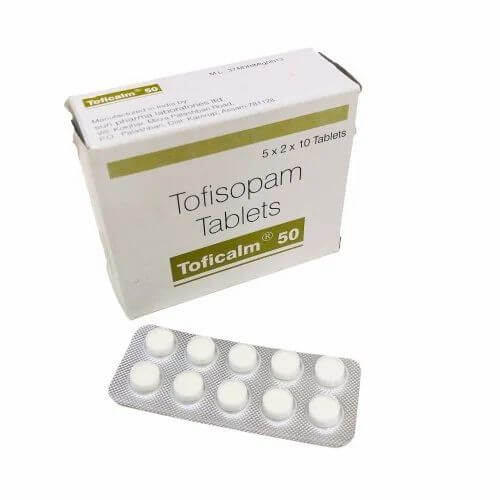
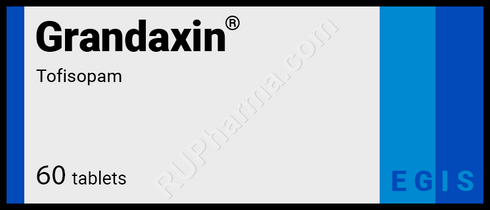
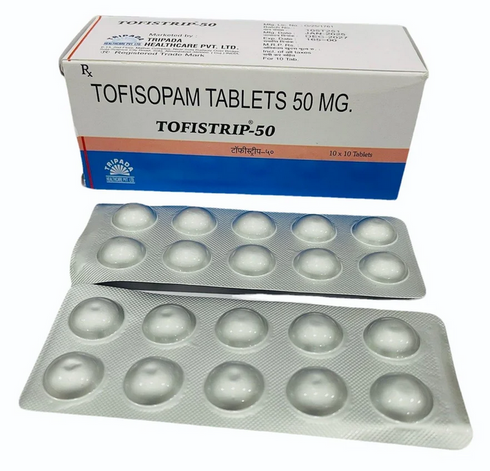
- Tofisopam is a 2,3-benzodiazepine, a structural cousin of diazepam that does not bind the classic benzodiazepine site and therefore causes no sedation, muscle relaxation, or anticonvulsant effect.
- Its anxiolytic action was traced not to GABA but to selective inhibition of phosphodiesterase enzymes, with the strongest effect on PDE-4A.
- Although long marketed in Europe and Asia as Grandaxin, tofisopam has never been approved for use in the United States or Canada.
Mechanism
Tofisopam departs from the mechanism of classical benzodiazepines: it does not bind the benzodiazepine recognition site on the -A receptor and does not the inhibitory neurotransmitter GABA, which is why it lacks the sedation, muscle relaxation, and anticonvulsant activity of drugs such as diazepam [1][2]. Its anxiolytic action is therefore attributed to other targets.
Detailed enzyme studies show that tofisopam is an isoenzyme-selective inhibitor of phosphodiesterases, the enzymes that break down the intracellular second messengers cyclic AMP and cyclic GMP; it inhibits PDE-4A most strongly, followed by PDE-10A, PDE-3, and PDE-2, so that partial, combined blockade of several PDE isoforms raises second-messenger signaling in relevant brain circuits [1].
This phosphodiesterase activity has been proposed to underlie not only its calming effect but also antipsychotic-like actions seen in animal models of the negative symptoms of psychosis [1][3]. Early pharmacology also described mixed effects on systems, and reviewers characterized the drug as improving a person's ability to cope with everyday demands rather than acting through tranquilization [2]. Separately, tofisopam inhibits the hepatic enzyme CYP3A4, a property relevant to its potential for drug interactions.
receptor fingerprint
Phosphodiesterase isoenzymes (PDE2, PDE4, PDE10A)inhibits
Dopaminergic signalingmodulates
Sympathetic autonomic tonemodulates
Cyclic nucleotide (cyclic AMP and cyclic GMP) signalingactivates
-A benzodiazepine binding sitemodulates
Safetyrisks and cautions, not medical advice
Tofisopam is a prescription medicine in the countries that sell it, including much of Europe, Russia, Japan, and Hungary, and it is not approved by the FDA in the United States. Most people tolerate it well; the effects that do show up are usually mild, such as headache, nausea, a bit of agitation, trouble sleeping, or a dry mouth. Take care with it if the liver or kidneys are struggling, during pregnancy or breastfeeding, in advanced respiratory failure, or with closed-angle glaucoma. Strong CYP3A4 blockers can push its blood levels up, so that combination is worth watching. Compared with ordinary benzodiazepines its potential for abuse and withdrawal is low.
History
Tofisopam is an anxiolytic of the unusual 2,3-benzodiazepine class, developed in Hungary by the pharmaceutical company Egis and first introduced in the 1970s under the brand name Grandaxin. It arose from research into benzodiazepine chemistry that produced a compound structurally distinct from the familiar 1,4-benzodiazepines such as diazepam, and pharmacologists soon recognized that it relieved anxiety without the sedation, muscle relaxation, memory impairment, or anticonvulsant activity typical of that class.
This distinctive daytime, non-sedating profile made it attractive for anxiety accompanied by autonomic symptoms, and it was marketed across parts of Europe and Asia. Because tofisopam does not bind the classical benzodiazepine site on the GABA-A receptor, its mechanism remained a puzzle for years; later enzyme studies identified it as an isoenzyme-selective inhibitor of phosphodiesterases, offering a plausible molecular explanation. Tofisopam has never been approved in the United States or Canada, though it has been examined in Western research settings for conditions such as irritable bowel syndrome.
Reputation
Tofisopam has earned a distinctive and favorable reputation as an atypical anxiolytic that calms without clouding, prized precisely because it lacks the sedation, motor impairment, and dependence potential associated with conventional benzodiazepines. Reviewers have described it as helping a person cope with everyday demands rather than tranquilizing them, a quality that makes it appealing for daytime use when clear-headedness matters.
Its unusual pharmacology has kept it scientifically interesting: the finding that it selectively inhibits several phosphodiesterase isoenzymes has linked it to a broader family of cyclic-nucleotide-based drug research and even prompted study of antipsychotic-like actions in animal models. Fairness requires noting its limits: much of the clinical evidence comes from Europe and Asia, it is not approved in North America, and it can inhibit the liver enzyme CYP3A4, giving it potential for drug interactions. As a non-sedating, mechanistically novel anxiolytic with decades of real-world use, it remains a compound of genuine interest.
Subjective profileweighing the evidence above
The most appealing case among anxiolytics: real relief for anxiety and the palpitations and sweating that ride along, without sedation, memory fog or the dependence of ordinary benzodiazepines. Prescription where it is sold and unavailable in the US, and it inhibits CYP3A4, so check what else you take.
Where to buy
Suppliers
Vendors carrying Tofisopam, with live product details and codes. Links are affiliate links that support the wiki at no cost to you.
PCT.Zone
Tofisopam

RUPharma🌐
Tofisopam
RUPharma🌐
Tofisopam
RUPharma🌐
Tofisopam
Research
- 1986first citedIs tofisopam an atypical anxiolytic?
- 2015most recentPsychiatric aspects of phosphodiesterases: An overview.
- 1.The atypical anxiolytic drug, tofisopam, selectively blocks phosphodiesterase isoenzymes and is active in the mouse model of negative symptoms of psychosis.
- 2.Is tofisopam an atypical anxiolytic?
- 3.Psychiatric aspects of phosphodiesterases: An overview.
- 4.Tofisopam--evaluation of mutagenic and genotoxic properties.
4 listed here; entry last updated August 2026
Reviews
My notesprivate to this device
FAQ
Will it make me drowsy?
No, that is its whole point; because it skips the usual benzodiazepine site it calms anxiety without the sedation or fog, so it suits daytime use.
Is it addictive like Xanax or Valium?
Its dependence and withdrawal risk is low compared with classic benzodiazepines, though it is still a prescription drug meant for sensible use.
How is it different from a normal benzodiazepine?
It has a different chemical shape, a 2,3-benzodiazepine, so it does not sedate, relax muscles, or stop seizures; it mainly works through phosphodiesterase enzymes instead.
Can it help the physical side of anxiety?
Yes, it is often chosen for the bodily symptoms of stress such as a racing heart, sweating, and tension rather than just the worried thoughts.
Can I drink alcohol with it?
It adds far less to alcohol than ordinary benzodiazepines, but mixing sedatives and alcohol is never a great idea, so keep it modest.
Limitations of the evidence
- Not approved in the United States or Canada, so availability is limited to certain countries
Adverse effects
- Reported effects can include headache, nausea, agitation, or disturbed sleep
- It does not produce the muscle relaxation or memory impairment associated with classic benzodiazepines
- Because it inhibits the liver enzyme CYP3A4, it can interact with other medications
Notes and cautions
- Generally well tolerated, and unlike typical benzodiazepines it does not usually cause drowsiness or sedation