
spec sheet13 rows
Picamilon (N-nicotinoyl-GABA, pikamilon) is a Soviet-developed nootropic that fuses niacin with the calming neurotransmitter GABA into a single molecule, engineered to carry GABA across the blood-brain barrier that GABA alone cannot cross [4]. Introduced in Russia as a cerebrovascular agent, it is prized for combining gentle, non-sedating relaxation with improved blood flow to the brain [2][3]. Once inside the brain it is thought to split back into niacin, a vasodilator, and GABA, which quiets neural overactivity, an elegant two-in-one design that made it a mainstay of Russian neurology [2][4].
- Calm, relaxed focus without sedation
- Opens up blood flow to the brain
- Real anxiety relief
- Smart two-in-one niacin and GABA design
- Mood support alongside the calm
- Because picamilon releases niacin, it can cause a warm flushing sensation, tingling, or skin redness
- Mild effects such as headache, lightheadedness, or nausea have been reported
- As a GABAergic agent it may add to the effect of other sedating substances
Overview
Picamilon, also spelled pikamilon, is the sodium salt of N-nicotinoyl-gamma-aminobutyric acid, a synthetic molecule that chemically links niacin (nicotinic acid, vitamin B3) to the inhibitory neurotransmitter GABA through an amide bond [2][4]. This conjugate design is the compound's defining feature: plain GABA does not efficiently cross the blood-brain barrier, but attaching the lipophilic nicotinoyl group creates a prodrug that can enter the brain and then be hydrolyzed to release both GABA and niacin at its target [4]. It belongs to the broader family of GABA analogues that also includes phenibut and the drug baclofen [1].
Picamilon was developed in the Soviet Union and introduced into Russian clinical practice as a cerebrovascular and nootropic medicine, and it is documented in the pharmacology literature as a cerebrovascular preparation [2]. In the former Soviet states it has been prescribed for cerebrovascular disorders, for conditions involving reduced cerebral blood flow, and as a mild anxiolytic and asthenia treatment, and its cerebral-circulation effects have been documented in animal studies showing increased cortical blood supply and dilation of pial arterioles [2][3]. Human research from Russian centers has examined picamilon in applied settings, such as aiding cerebral hemodynamic recovery in swimmers with a dysadaptation syndrome [7].
Outside Russia picamilon is not an approved medicine. In the United States the Food and Drug Administration has determined that it does not qualify as a dietary ingredient, yet it has been sold directly to consumers as a nootropic supplement, and analytical surveys have found it in commercial products at widely varying amounts, from a few milligrams to several hundred milligrams per serving [1][6]. A modern regulatory-toxicology screen of picamilon against 50 safety-related receptors, ion channels, enzymes, and transporters found essentially no binding, underscoring that its activity depends on being metabolized to GABA and niacin rather than on the intact molecule itself [1]. It is most often encountered as a crystalline powder or in capsules under the names picamilon or pikamilon [1][6].
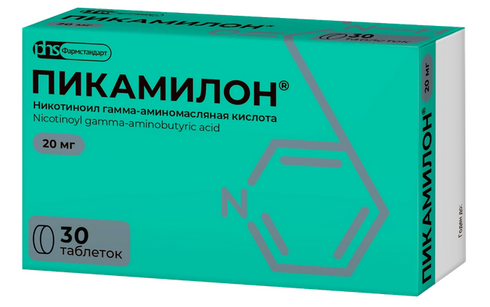
- It is a single molecule made by chemically bonding niacin (vitamin B3) to the calming neurotransmitter GABA.
- The design solves a real problem: free GABA cannot cross the blood-brain barrier, but the lipophilic picamilon conjugate can carry it inside before splitting apart.
- Developed in the Soviet Union around 1969, it was approved as a medicine in Russia but is sold only as a supplement in the United States.
Mechanism
Picamilon works as a , a design in which an inactive parent molecule is converted in the body into active components. It is a covalent conjugate of niacin and , and because the intact molecule is enough to cross the , it can deliver GABA into the central nervous system where free GABA cannot readily go [4]. Once in the brain, picamilon is hydrolyzed to liberate , which activates inhibitory GABA receptors, and niacin, which acts as a vasodilator; the pairing produces picamilon's two signature effects, a mild calming or anxiolytic action and an increase in cerebral blood flow [2][4]. Supporting the model, a modern screen of picamilon against 50 safety-related biological targets found weak or no binding at 10 micromolar, indicating that the parent compound is largely inert until it is metabolized [1].
The cerebrovascular action is the most thoroughly documented benefit. In conscious animals, picamilon produced a significant increase in cerebral blood flow, inhibited neurogenic spasm of cerebral vessels, and restored normal cerebral hemodynamics after -induced disturbance [2]. Direct observation of the microcirculation showed that picamilon dilates pial arterioles, with the most pronounced dilation in the smallest vessels, those with an initial diameter of roughly 10 to 20 microns [3]. Studies of the underlying mechanism indicate a contribution: blocking the chloride channels of receptors with picrotoxin significantly reduced picamilon's effect on cerebral blood flow, linking its vascular action to GABA receptor signaling [5].
The combination of a vasodilatory niacin component and an inhibitory component gives picamilon a gentle, non-sedating profile that distinguishes it from stronger agents such as phenibut, and comparative animal work has directly contrasted the two, finding picamilon to have a steadier vasodilatory effect [4][6]. In applied human research, a four-week course of picamilon helped optimize cerebral circulation and biochemical status in swimmers recovering from a dysadaptation syndrome [7]. Because picamilon must be cleaved to act, its onset and effect depend on this metabolic conversion, and the released niacin can contribute a characteristic flushing sensation at higher exposures [1][4].
receptor fingerprint
-A / GABA-Bagonist (releases GABA)
Niacin ()releases
Dosingtypical ranges, not medical advice
interested in protocols and clinical dosages? make an account to see them! ^_^
Safetyrisks and cautions, not medical advice
Avoid picamilon if you're hypersensitive to niacin or GABA, or if you have severe liver or kidney trouble. It can add to CNS depressants like alcohol and benzodiazepines. Worth knowing: in 2015 the FDA sent a warning letter saying picamilon doesn't count as a dietary ingredient, which pulled it from a lot of supplement shelves in the US. It rarely causes dependence, but stopping abruptly after long high-dose use can bring a bout of rebound anxiety.
Interactionsdocumented pairs only, not exhaustive
Picamilon is a niacin-GABA conjugate that hydrolyzes to nicotinic acid and GABA, and it has no formal drug-interaction studies. Any concern derives from the niacin moiety: nicotinic acid is a vasodilator, so an additive hypotensive or flushing effect with antihypertensives or other vasodilators is theoretical rather than documented for picamilon specifically. There is no established CYP-mediated or clinically characterized interaction data for the intact compound. This is research information, not medical advice.
Checking a whole stack? Run it through interactions + stacks.
History
Picamilon, chemically N-nicotinoyl-GABA, was created in the Soviet Union at the All-Union Vitamin Research Institute, where researchers set out to solve a specific pharmacological problem: the neurotransmitter GABA cannot readily cross the blood-brain barrier, limiting its usefulness as a calming agent. Their solution, developed around 1969, was to bond a molecule of GABA to niacin, producing a lipophilic conjugate that could carry GABA into the central nervous system and then be cleaved to release both components.
The compound was subsequently developed as a cerebrovascular and anxiolytic medicine and was approved for clinical use in Russia in the mid-1980s, where it became a mainstay of neurology for conditions involving impaired cerebral circulation, anxiety, and asthenia. Much of the foundational research was conducted and published within the Russian scientific literature, and picamilon has never been approved as a drug in the United States, where it is instead sold as a dietary-style supplement and nootropic. Its unusual two-in-one prodrug design remains its defining scientific feature.
Reputation
Picamilon enjoys a favorable reputation as a gentle, non-sedating way to combine mild relaxation with improved blood flow to the brain, a pairing that distinguishes it from heavier GABAergic agents. Russian clinical experience accumulated over several decades supports its use as a cerebrovascular agent, and animal studies document genuine dilation of the small pial vessels and increases in cerebral blood flow that appear to depend on GABA receptor signaling.
Enthusiasts in the nootropic community appreciate that it tends to calm without the grogginess or dependence associated with stronger anxiolytics, and modern safety screening found the intact molecule to be largely inert until metabolized, consistent with its prodrug design. The honest caveats are that most of the rigorous evidence comes from older Russian-language research rather than large Western trials, that it is not an approved medicine in many countries, and that the niacin it releases can cause a flushing sensation at higher doses. For those seeking a mild, well-characterized calming and circulatory aid, it remains an intriguing and well-documented compound.
Subjective profileweighing the evidence above
One of the better-value calm-focus compounds, giving real anxiety relief and a lift in cerebral blood flow without much sedation. The niacin half can bring a warm flush, it adds to other sedatives, and the FDA's 2015 ruling means it is no longer sold as a supplement in the US.
Where to buy
1 other outlet
Suppliers
Vendors carrying Picamilon, with live product details and codes. Links are affiliate links that support the wiki at no cost to you.
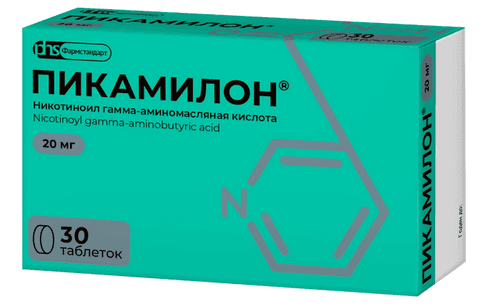
RUPharma🌐
Picamilon
RUO
Picamilon
Research
- 1972first cited[Effect of gamma-aminobutyric acid, nicotinoyl-gamma-aminobutyric acid and its ethyl ester on c…
- 1989most active year3 papers
- 1994controlled trial[Results of pikamilon use in the treatment of patients with open-angle glaucoma].
- 2025most recentNicotinamide and Nicotinoyl-Gamma-Aminobutyric Acid as Neuroprotective Agents Against Type 1 Di…
- 1.Picamilon, a γ-aminobutyric acid (GABA) analogue and marketed nootropic, is inactive against 50 biological targets.
- 2.[The new cerebrovascular preparation pikamilon].
- 3.[Effect of pikamilon on the cortical blood supply and microcirculation in the pial arteriole system].
- 4.Evaluation of isonicotinoyl-gamma-aminobutyric acid (GABA) and nicotinoyl-GABA as pro-drugs of GABA.
- 5.[Gabaergic mechanism of cerebrovascular and neuroprotective effects of afobazole and picamilon].
- 6.Identification and quantification of vinpocetine and picamilon in dietary supplements sold in the United States.
- 7.[Effects of aminalon, fenibut, and picamilon on the typological parameters of cerebral hemodynamics in swimmers with dysadaptation syndrome].
- 8.[Pikamilon pharmacokinetics in animals].
- 9.Determination of picamilon concentration in human plasma by liquid chromatography-tandem mass spectrometry.
- 10.[Metabolism and catabolism to CO2 of [14C] gamma-aminobutyric acid conjugates with pyridoxal phosphate, nicotinate and biotin].
- 11.[Effect of gamma-aminobutyric acid, nicotinoyl-gamma-aminobutyric acid and its ethyl ester on central processes of formation of vasomotor reflexes].
- 12.[Antihypoxic properties of GABA-containing vitamin derivatives].
25 listed here; entry last updated August 2026
Reviews
My notesprivate to this device
FAQ
What is picamilon?
It is a molecule that links niacin to GABA and is used for calm focus and blood-flow support.
How is it thought to work?
It is believed to cross into the brain and release niacin and GABA, supporting both calm and cerebral circulation.
Why the flushing?
The niacin portion can cause the same flushing sensation associated with niacin itself.
Is it a regulated substance?
Its regulatory status varies by country, and it is not an approved medication in many places.
Limitations of the evidence
- It is not approved as a medicine or dietary supplement in the United States
Adverse effects
- Because picamilon releases niacin, it can cause a warm flushing sensation, tingling, or skin redness
- Mild effects such as headache, lightheadedness, or nausea have been reported
- As a GABAergic agent it may add to the effect of other sedating substances
Notes and cautions
- The amount of picamilon in commercial supplements varies widely and may not match the label