
spec sheet12 rows
Bicalutamide is a nonsteroidal antiandrogen, a drug that blocks the action of male sex hormones by competitively antagonizing the androgen receptor. It is used mainly in the treatment of prostate cancer, either combined with medical or surgical castration in advanced disease or, at a higher dose, as a single agent in earlier disease [1]. First approved in the mid-1990s under the brand name Casodex, it is taken as a once-daily oral tablet and is now available as a generic on the World Health Organization's List of Essential Medicines. Unlike some related drugs, it reduces androgen signaling without lowering the body's production of testosterone [1].
- a well established prostate cancer drug on the WHO essential list
- blocks androgen signalling without lowering testosterone production
- one tablet a day, with nothing to time
- as a single agent it is kinder to sexual function and bone
- a cornerstone of combined androgen blockade
- widely available now as a low cost generic
- In men, the most common effects are breast enlargement (gynecomastia) and breast tenderness, which affect a large share of those on single-agent therapy [2].
- Hot flashes, reduced libido, and sexual dysfunction can occur, reflecting reduced androgen activity.
- Uncommonly it can affect the liver, so liver function is usually monitored early in treatment [1].
Overview
Bicalutamide is a member of the nonsteroidal antiandrogen (NSAA) class, a group of drugs that oppose androgen action without themselves being steroids [1]. It is a competitive, so-called silent antagonist of the androgen receptor, meaning it occupies the receptor and stops the natural androgens testosterone and dihydrotestosterone from binding, while producing essentially no activating effect of its own [4]. The medicine is a racemic mixture of two mirror-image forms, but almost all of its antiandrogen activity comes from the (R)-enantiomer, which is cleared slowly and builds up in the blood during daily use [1]. It does not block the enzyme 5-alpha-reductase and does not interfere with androgen production [1].
The principal use of bicalutamide is in prostate cancer, a hormone-driven disease whose growth depends on androgens. In advanced or metastatic disease it is combined with a gonadotropin-releasing hormone analogue or with surgical castration, a strategy known as combined androgen blockade, where it counters the temporary surge in testosterone that these treatments can provoke [1]. In several countries a higher dose is licensed as monotherapy for localized or locally advanced nonmetastatic cancer, either alone or as an addition to surgery or radiotherapy [2]. Beyond cancer, bicalutamide has been used off-label in situations that call for androgen blockade, such as feminizing hormone therapy and certain skin and hair conditions, though these uses are not among its approved indications.
Bicalutamide has been studied extensively, most notably in the large Early Prostate Cancer (EPC) programme, which examined its use as monotherapy and as an addition to standard treatment [2]. This research helped define both its benefits and its limits; in men with lower-risk early disease, adding the drug did not clearly improve survival and could even be counterproductive, whereas patients with more advanced disease tended to benefit more [2]. It has also served as a reference compound in the development of newer, more potent antiandrogens such as enzalutamide, which were designed to remain effective once prostate cancer becomes resistant to castration and to bicalutamide itself [3]. That resistance is thought to involve changes in the androgen receptor, and unlike some older antiandrogens, bicalutamide generally does not switch to stimulating mutated receptors [4].
Pharmacologically, bicalutamide is well absorbed by mouth, is not affected by food, and has a notably long duration of action, so it is taken only once a day [1]. It is broken down mainly in the liver and is eliminated roughly equally in the urine and the feces [1]. Because blocking the androgen receptor removes feedback signals in men, monotherapy tends to raise circulating testosterone and estrogen, which explains why breast-related effects are common with the single-agent regimen [1][2].
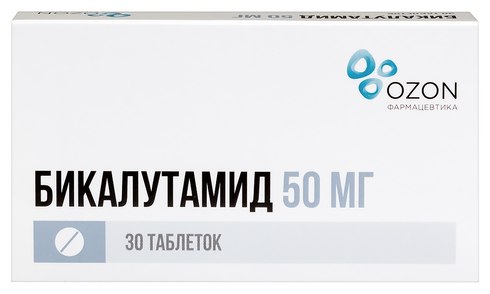
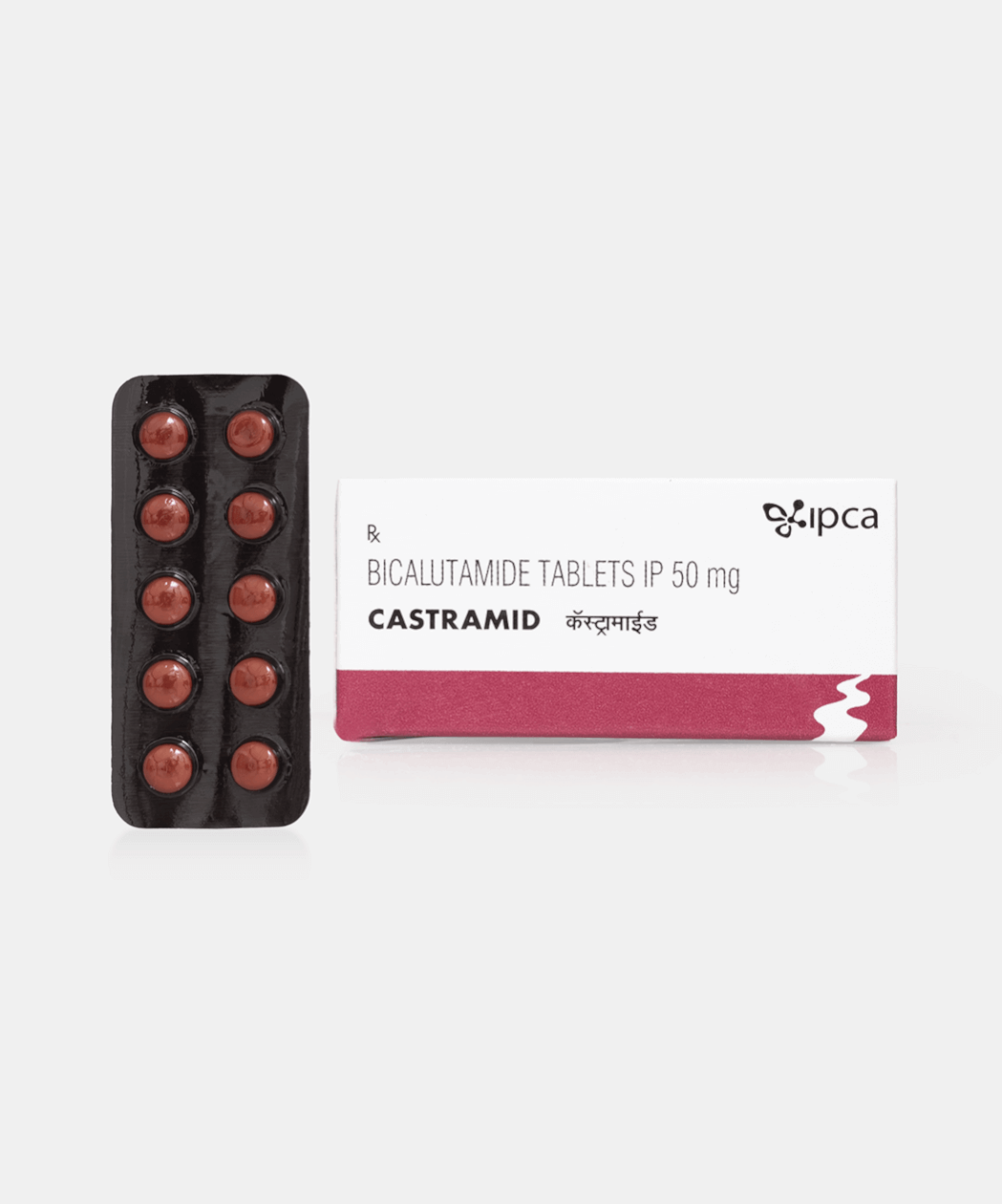
Bicalutamide was developed by the pharmaceutical company ICI, later AstraZeneca, and reached the market in the mid-1990s under the brand name Casodex [1]. It is approved in many countries, is included on the World Health Organization's Model List of Essential Medicines, and is now widely sold as an inexpensive generic. It is supplied as oral tablets and is a prescription-only medicine. Because it can harm a developing fetus, it is not used in pregnancy.
- Only the R-enantiomer of bicalutamide is pharmacologically active; the marketed drug relies on this single mirror-image form to block the androgen receptor.
- Bicalutamide has an unusually long elimination half-life of roughly a week, which is what allows a simple once-daily tablet to maintain steady receptor blockade.
Mechanism
Bicalutamide acts inside target cells by binding competitively to the , the protein through which testosterone and the more potent dihydrotestosterone normally exert their effects [1][4]. By occupying this receptor it blocks androgens from activating it and prevents the receptor from switching on the genes that drive the growth of prostate tissue, including prostate cancer cells [4].
It is described as a silent or pure because, at normal receptors, it produces no androgen-like stimulation of its own, and it does this without lowering the body's synthesis of androgens or inhibiting 5-alpha-reductase [1]. When given alone to men, this receptor blockade interrupts the hormonal feedback loop, so the brain signals the testes to make more testosterone, part of which is converted to ; the resulting shift in hormone balance underlies both its effectiveness and its characteristic breast side effects [1][2].
receptor fingerprint
blocks
Prostate tumor cell proliferationinhibits
nuclear translocationblocks
Hair follicle blocks
Dosingtypical ranges, not medical advice
interested in protocols and clinical dosages? make an account to see them! ^_^
Safetyrisks and cautions, not medical advice
Bicalutamide is prescription only. The most common effects are breast tenderness and breast growth (gynecomastia), hot flashes, and fatigue, all reflecting reduced androgen signaling. It can cause liver injury, so liver function is checked before and during treatment, and it is stopped if serious liver problems appear. Other effects include reduced libido, and when used as monotherapy it tends to preserve erectile function and bone density better than full testosterone suppression. It carries a small risk of lung inflammation (interstitial lung disease). It can increase the effect of blood thinners like warfarin. It is not intended for use in women who are or may become pregnant.
Interactionsdocumented pairs only, not exhaustive
Bicalutamide is metabolized by CYP3A4 and has been shown to inhibit this enzyme in vitro; however, clinical studies using midazolam as a CYP3A4 probe found no clinically relevant inhibition at the standard 150 mg dose (pharmacokinetic interaction absent in vivo despite in vitro evidence) [1]. The drug does not induce hepatic enzyme systems at doses of 150 mg or less in humans. Interactions with other medications remain largely unexplored; most concurrent drugs have not been formally studied with bicalutamide.
Checking a whole stack? Run it through interactions + stacks.
History
Bicalutamide was developed by the pharmaceutical company ICI, later Zeneca and then AstraZeneca, as part of the nonsteroidal antiandrogen class that began with flutamide and nilutamide. It was designed for improved tolerability and convenient once-daily dosing, and its activity resides in the R-enantiomer of the molecule. The drug received United States approval in 1995 under the brand name Casodex for use in advanced prostate cancer combined with medical or surgical castration. It has since become a widely used generic and is included on the World Health Organization's List of Essential Medicines.
Reputation
Bicalutamide is often described as the workhorse of the nonsteroidal antiandrogens, favored for a generally more tolerable profile and simpler dosing than its predecessors. It earned a solid reputation by blocking androgen signaling without lowering the body's testosterone production, which for some patients preserves aspects of quality of life. Oncologists value it both as part of combined androgen blockade and, at higher doses, as a single agent option in appropriately selected earlier disease. Its inclusion among essential medicines reflects broad, durable clinical acceptance, tempered by awareness of side effects such as breast tenderness and enlargement.
Subjective profileweighing the evidence above
A well-established prostate cancer drug, and used as a single agent it is kinder to sexual function and bone than full testosterone suppression. That is an oncology decision made with a specialist, not a hormone to experiment with; breast growth is common and liver function is checked early.
Where to buy

1 other outlet

Suppliers
Vendors carrying Bicalutamide, with live product details and codes. Links are affiliate links that support the wiki at no cost to you.
RUPharma🌐
Bicalutamide
PCT.Zone
Bicalutamide
Research
- 1997first citedAndrogen receptor gene mutations in prostate cancer. Implications for disease progression and t…
- 2009most recentDevelopment of a second-generation antiandrogen for treatment of advanced prostate cancer.
- 1.Bicalutamide: clinical pharmacokinetics and metabolism.
- 2.Treatment of bicalutamide-induced breast events.
- 3.Development of a second-generation antiandrogen for treatment of advanced prostate cancer.
- 4.Androgen receptor gene mutations in prostate cancer. Implications for disease progression and therapy.
4 listed here; entry last updated August 2026
Reviews
My notesprivate to this device
FAQ
How does bicalutamide fight prostate cancer?
It blocks the androgen receptor so testosterone and DHT can no longer signal prostate cancer cells to grow.
Why does it cause breast growth?
By blocking androgens it tips the hormone balance toward estrogen, which can make breast tissue enlarge and feel tender.
Why check my liver?
Rarely it can injure the liver, so doctors check liver enzymes before and during treatment and stop the drug if problems appear.
Is it used with other prostate drugs?
Yes, it is often combined with a GnRH agonist or surgery to fully block androgens; higher-dose monotherapy is an alternative for some men.
Can it interact with blood thinners?
Yes, it can strengthen warfarin's effect and raise bleeding risk, so INR is monitored more closely when they are combined.
Adverse effects
- In men, the most common effects are breast enlargement (gynecomastia) and breast tenderness, which affect a large share of those on single-agent therapy [2].
- Hot flashes, reduced libido, and sexual dysfunction can occur, reflecting reduced androgen activity.
- Uncommonly it can affect the liver, so liver function is usually monitored early in treatment [1].
- It can harm a developing fetus and is therefore not used in pregnancy.