
spec sheet10 rows
Pyrilutamide (KX-826) is a next-generation topical androgen receptor antagonist developed for androgenetic alopecia, designed to block the hair-loss hormone DHT directly at the scalp while avoiding the systemic hormonal side effects of pills like finasteride [1][2]. Applied locally, it aims to shield hair follicles from androgen-driven miniaturization at the root cause of pattern hair loss [2][4]. One of the most closely watched investigational hair-loss drugs, it targets androgen signaling in the skin without lowering hormones throughout the body [1][2].
- Blocks DHT right at the scalp
- Aimed straight at pattern hair loss
- Minimal impact on body wide hormones
- Next-generation answer to finasteride pills
- Simple topical application
- Currently in clinical trials
- As a topical scalp treatment, local application-site reactions such as irritation, redness, or itching are the most likely side effects
Overview
Pyrilutamide, also known by its development code KX-826, is a nonsteroidal androgen receptor (AR) antagonist developed as a topical treatment for androgenetic alopecia (male and female pattern hair loss) and studied for acne [1][2]. It was created by the biopharmaceutical company Kintor Pharmaceutical and belongs to the same broad class of AR-blocking drugs as the antiandrogens used in prostate cancer, but it is formulated for application to the skin so that it acts locally rather than systemically [2][3]. In medicinal-chemistry terms it is built on a thiohydantoin scaffold, the chemical framework shared by modern AR antagonists, and it has become a benchmark compound against which newer topical AR antagonists are compared [3].
The rationale for pyrilutamide rests on the biology of pattern hair loss. In androgenetic alopecia, the androgen dihydrotestosterone (DHT) binds the androgen receptor in genetically susceptible scalp hair follicles, driving progressive follicular miniaturization, a shortened growth (anagen) phase, and thinning hair; blocking the receptor interrupts this cascade [4]. Existing systemic therapies that lower or block androgens, such as the 5-alpha-reductase inhibitor finasteride, are effective but carry a well-publicized risk of sexual and other systemic side effects, which has driven demand for treatments that act only where they are applied [5][6]. Pyrilutamide is designed to occupy the androgen receptor in the skin of the scalp, reducing DHT signaling in the follicle without meaningfully suppressing hormones in the rest of the body [1][2].
Pyrilutamide is an investigational drug and has not been approved by the United States Food and Drug Administration or, as of this writing, brought to market as a finished medicine in Western countries; it has been evaluated in clinical trials, and reviews describe it as a promising but still-unproven pipeline agent whose results have been mixed and require larger, standardized studies to confirm [1][2]. It is nonetheless widely sold through the research-chemical and cosmetic-supply market as a topical solution, where product quality and concentration are not guaranteed [2][3]. It is typically encountered as a dissolved topical solution applied to the scalp [3].
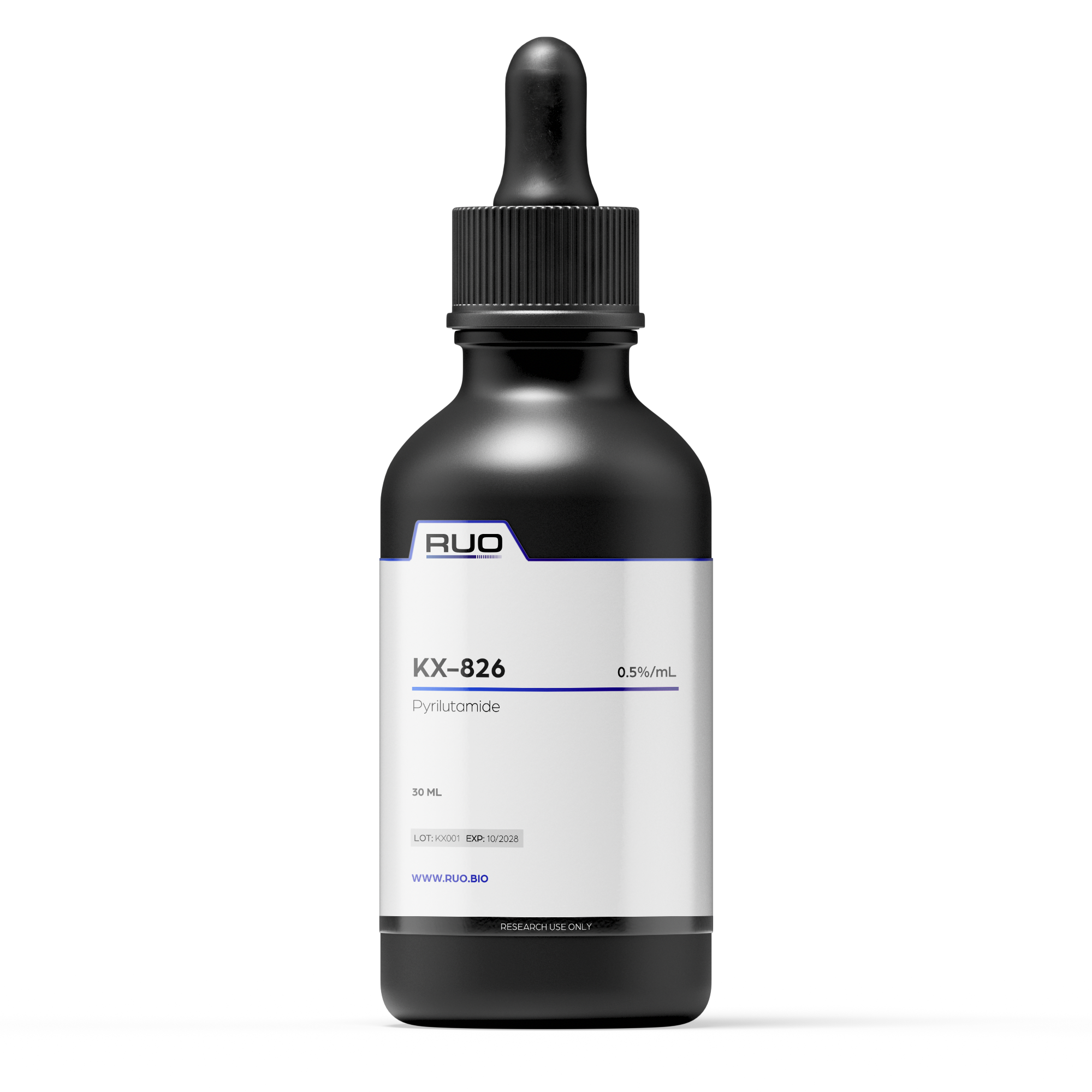
- Pyrilutamide is applied topically to the scalp, aiming to block the hair-loss hormone DHT right at the follicle instead of lowering it throughout the body the way oral finasteride does.
- In a mouse hair-growth model, a 0.5 percent formulation produced visible regrowth with an onset of effect around 21 days, and it is now used as an efficacy standard for newer topical antiandrogens.
- A 2026 review of emerging hair-loss therapies singled out KX-826 as providing targeted androgen receptor modulation without systemic hormonal suppression.
Mechanism
Pyrilutamide (KX-826) works as an , a molecule that binds the androgen receptor and prevents androgens from activating it. The androgen receptor is the master switch through which testosterone and its more potent derivative dihydrotestosterone (DHT) exert their effects, and in the scalp this pathway is central to pattern hair loss [4]. Experimental models make the target concrete: in mice, DHT activates the in hair follicles and causes it to move into the cell nucleus, producing early hair regression, follicular miniaturization, and loss of hair density, and these DHT-driven changes can be reversed by an androgen receptor [4]. Pyrilutamide is designed to do exactly this in human scalp follicles, competitively blocking DHT at the receptor so that the miniaturizing signal is interrupted and follicles can maintain normal growth [2][4].
The distinctive feature of pyrilutamide is that it is delivered topically to act locally. Whereas oral finasteride works by inhibiting 5-alpha-reductase and lowering DHT throughout the body, an approach that is effective but associated in some users with persistent sexual dysfunction, mood changes, and, in women, hormonal disruption, a topical AR is intended to concentrate its effect in the skin of the scalp and minimize systemic exposure [5][6]. This is the core selling point of the compound and of its drug class: androgen blockade at the follicle without body-wide anti-androgen effects [1][2].
Evidence for the approach comes from both mechanism and preclinical efficacy work. In a hair-growth mouse model, 0.5 percent pyrilutamide produced measurable hair regrowth with an onset of effect around 21 days, and it is used in the medicinal-chemistry literature as the efficacy standard that next-generation topical AR antagonists aim to match or exceed [3]. Human clinical trial results have been more mixed, and independent reviews caution that, despite encouraging early data, heterogeneity in study design and endpoints means the true efficacy of pyrilutamide in people remains to be firmly established through larger, rigorous, long-term trials [1][2]. Its ultimate effect size and safety in humans are therefore still being defined [1][2].
receptor fingerprint
(scalp, topical)antagonist
Systemic androgensspares
Dosingtypical ranges, not medical advice
interested in protocols and clinical dosages? make an account to see them! ^_^
Safetyrisks and cautions, not medical advice
Pyrilutamide (KX-826) is an investigational topical androgen receptor antagonist for hair loss that has not received regulatory approval, so its long-term safety is not established. Adverse effects reported in trials have been mainly local, such as scalp irritation, itching, and contact dermatitis. Because it blocks androgen receptors, systemic antiandrogenic effects cannot be entirely excluded, although measured systemic absorption appears low.
History
Pyrilutamide, known by its development code KX-826, is an investigational topical androgen receptor antagonist developed by the Chinese biopharmaceutical company Kintor Pharmaceutical for androgenetic alopecia and acne. It emerged from the broader effort to design nonsteroidal antiandrogens that could be applied directly to the skin, blocking dihydrotestosterone at the hair follicle while minimizing the systemic hormonal exposure associated with oral agents such as finasteride. In preclinical hair-growth models the compound demonstrated measurable regrowth and became a reference standard against which newer topical androgen receptor antagonists are compared in the medicinal chemistry literature.
It subsequently advanced into human clinical trials for pattern hair loss, positioning it as one of the most closely watched investigational treatments in the field. Independent reviews of emerging hair-loss therapies published as recently as 2026 continue to describe KX-826 as offering targeted androgen receptor modulation without systemic hormonal suppression, while cautioning that heterogeneity in trial design and endpoints means its true efficacy in people remains to be firmly established. As an experimental agent, it has not received general regulatory approval.
Reputation
Pyrilutamide has generated considerable excitement as a next-generation approach to pattern hair loss, precisely because it aims to solve the problem that deters many people from oral treatments: unwanted systemic hormonal effects. By blocking the androgen receptor locally in the scalp rather than lowering DHT throughout the body, it holds out the appealing prospect of protecting follicles without the sexual or mood side effects sometimes reported with finasteride.
Its strong performance in preclinical models has made it a benchmark that other topical antiandrogens are measured against, and recent expert reviews highlight it as a leading investigational option. Candor is essential here: it remains experimental, human trial results have been mixed, and reviewers stress that larger, rigorous, long-term studies are still needed before its real-world efficacy and safety can be considered established. For now it is best understood as a genuinely promising but still-unproven frontier therapy.
Subjective profileweighing the evidence above
The most interesting thing in the hair-loss pipeline for anyone who wants DHT blocked at the scalp without finasteride's body-wide effects, and trial side effects have been local irritation. It is not approved anywhere, though, so long-term safety is unestablished and buying it means buying an unapproved drug.
Where to buy

Suppliers
Vendors carrying Pyrilutamide, with live product details and codes. Links are affiliate links that support the wiki at no cost to you.
RUO
Pyrilutamide
Research
- 2016first citedCharacteristics of Men Who Report Persistent Sexual Symptoms After Finasteride Use for Hair Los…
- 2026most recentEmerging pharmacotherapies and regenerative solutions for promoting hair growth for androgeneti…
- 1.What's New in Therapy for Male Androgenetic Alopecia?
- 2.Emerging pharmacotherapies and regenerative solutions for promoting hair growth for androgenetic alopecia.
- 3.Novel Dual Soft Drug Strategy Enables Development of Topical Androgen Receptor Antagonists with Enhanced Efficacy and Optimized Safety for Androgenetic Alopecia.
- 4.Dihydrotestosterone-induced hair regrowth inhibition by activating androgen receptor in C57BL6 mice simulates androgenetic alopecia.
- 5.Characteristics of Men Who Report Persistent Sexual Symptoms After Finasteride Use for Hair Loss.
- 6.Prolonged use of finasteride-induced gonadal sex steroids alterations, DNA damage and menstrual bleeding in women.
6 listed here; entry last updated August 2026
Reviews
My notesprivate to this device
FAQ
What is pyrilutamide?
It is a topical androgen receptor blocker, also called KX-826, being studied for pattern hair loss. It aims to act at the scalp rather than throughout the body.
Is it approved?
It remains investigational and has been evaluated in clinical trials. It is not an established approved treatment in most regions.
How does it differ from finasteride?
Finasteride reduces DHT production systemically, while pyrilutamide is designed to block the androgen receptor locally at the scalp. The topical approach is meant to reduce body-wide hormonal effects.
What is the most common complaint?
Local skin reactions such as irritation, itching or dryness at the application site are most often reported. These are typical of topical scalp products.
Limitations of the evidence
- It is not approved by the US Food and Drug Administration or most other regulators
Adverse effects
- As a topical scalp treatment, local application-site reactions such as irritation, redness, or itching are the most likely side effects
Notes and cautions
- Pyrilutamide is investigational, and its long-term safety in humans has not been fully established
- It is intended to limit systemic hormonal effects, but the degree of systemic exposure is still being confirmed in trials
- Products sold through the research-chemical market vary in quality and concentration