
spec sheet13 rows
Vortioxetine is an antidepressant used to treat major depressive disorder in adults, often described as a serotonin modulator because it combines several actions on the serotonin system. It both blocks the serotonin transporter, like conventional serotonin reuptake inhibitors, and acts directly on a range of serotonin receptors as an agonist, partial agonist, or antagonist. Approved in the United States and Europe in 2013, it is taken once daily by mouth and has drawn particular interest for possible effects on the cognitive symptoms of depression.
- Multimodal; not just another SSRI
- Blocks serotonin reuptake and tunes receptors
- Carries a real pro-cognitive edge
- Built for brighter mood and clearer thinking
- Approved in the United States and Europe
- Nausea is the most common side effect
- Relatively low rates of sexual dysfunction compared with some antidepressants
- Should not be combined with monoamine oxidase inhibitors
Overview
Vortioxetine is an orally administered antidepressant for major depressive disorder, classified as a multimodal or serotonin-modulating agent because it engages the serotonin system in more than one way [1]. It inhibits the serotonin transporter, the same target as selective serotonin reuptake inhibitors, but in addition binds directly to several serotonin receptor subtypes with differing effects [1]. This combination distinguishes it from older classes of antidepressant [1].
Pharmacologically, vortioxetine acts as an agonist at the 5-HT1A receptor, a partial agonist at 5-HT1B, and an antagonist at the 5-HT3, 5-HT1D, and 5-HT7 receptors, while also blocking serotonin reuptake [1]. Through these combined actions it raises levels of serotonin and, indirectly, of several other neurotransmitters in brain regions involved in mood and cognition, and preclinical work has linked it to effects on synaptic plasticity [1][2]. The clinical dose range spans a wide band of serotonin transporter occupancy, and its receptor actions are thought to contribute to both its efficacy and its tolerability [1].
In clinical trials vortioxetine has shown efficacy for major depression broadly comparable to that of other antidepressants, with modest effect sizes, and it is sometimes chosen when other treatments have not succeeded [1][2]. A distinctive feature emphasized in its development is evidence of benefit for certain measures of cognitive function in depression, such as processing speed, that appears at least partly independent of the improvement in mood [1][2]. It has also been examined in specific groups, including older adults [2].
The side-effect profile broadly resembles that of serotonin reuptake inhibitors, with nausea being the most common complaint and other gastrointestinal symptoms also reported [3]. Compared with some antidepressants, vortioxetine is associated with relatively low rates of sexual dysfunction and sleep disturbance, effects attributed to its receptor modulation, though nausea leads some patients to stop treatment [1][3]. As with all antidepressants, warnings apply regarding a risk of increased suicidal thinking in younger patients and the potential for serotonin syndrome, particularly in combination with other serotonergic drugs [1].
Vortioxetine was approved for major depressive disorder in the United States and the European Union in 2013 and is a prescription-only medicine [1]. It is largely cleared by liver enzymes, chiefly CYP2D6, so its dosing may need adjustment when it is combined with drugs that strongly inhibit or induce that enzyme, and it should not be used together with monoamine oxidase inhibitors [1]. It is taken as a once-daily tablet [1].
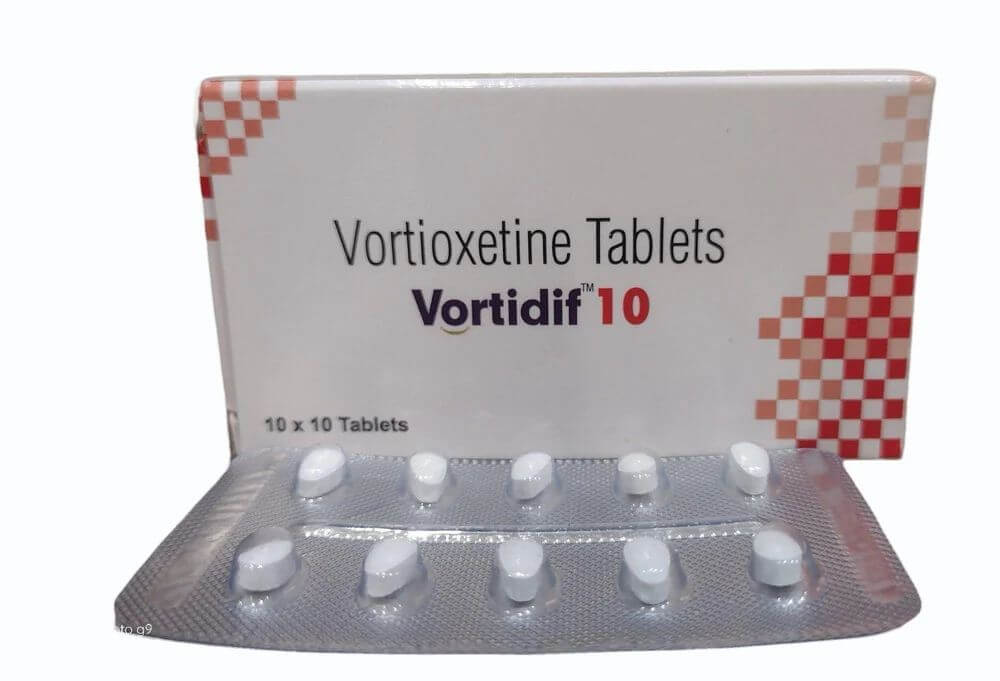

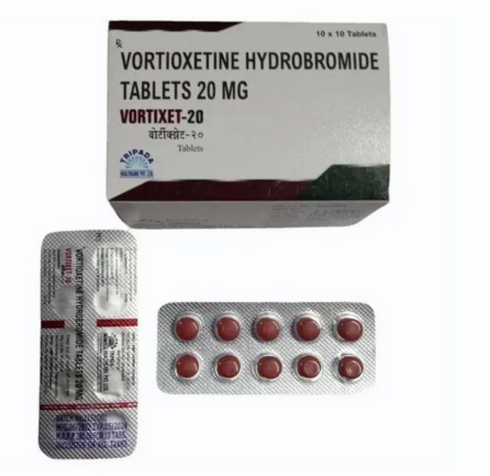
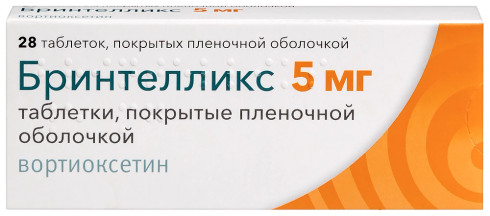
- Vortioxetine is often called multimodal because it acts on the serotonin system in several ways at once, inhibiting the serotonin transporter while also targeting a set of serotonin receptors as agonist, partial agonist, or antagonist.
- It is one of the few antidepressants specifically studied for improving the cognitive symptoms of depression, such as concentration and processing speed.
- It was renamed from Brintellix to Trintellix in the United States because the original name was being confused with the blood thinner Brilinta.
Mechanism
Vortioxetine is described as having a multimodal mechanism because it acts on the system at several points at once [1]. Its most direct action is inhibition of the transporter, which raises the concentration of serotonin in the cleft in the same way as a conventional [1]. In addition it binds a set of receptors, behaving as an at , a partial agonist at 5-HT1B, and an at 5-HT3, 5-HT1D, and 5-HT7 [1]. Antagonism of the 5-HT3 receptor is thought to be especially important, because blocking these receptors on inhibitory interneurons can enhance the activity of pyramidal neurons and further increase extracellular [1].
The net effect of these combined actions is to modulate not only serotonergic transmission but also, indirectly, the release of other neurotransmitters including noradrenaline, , , , and in brain regions relevant to depression [1]. This broad neurochemical influence, together with observed effects on plasticity, is proposed to underlie both the antidepressant action and the effects on cognition that have been reported with the drug [1][2].
receptor fingerprint
transporter (SERT)inhibits
5-HT3 / 5-HT7 / 5-HT1Dantagonist
agonist
5-HT1Bpartial agonist
Dosingtypical ranges, not medical advice
interested in protocols and clinical dosages? make an account to see them! ^_^
Safetyrisks and cautions, not medical advice
Vortioxetine is a multimodal antidepressant whose most common effect is nausea, along with possible sexual dysfunction, constipation, and vomiting. It carries the antidepressant boxed warning for increased suicidal thoughts in children, adolescents, and young adults, and can cause serotonin syndrome, low sodium (hyponatremia), and increased bleeding risk, especially with NSAIDs or anticoagulants. It should not be combined with MAO inhibitors and is generally tapered rather than stopped abruptly.
Interactionsdocumented pairs only, not exhaustive
Vortioxetine has barely been studied for drug interactions, which is worth saying plainly before anything else. The one piece of direct evidence is a laboratory experiment: in human and rat liver microsomes, vortioxetine inhibited several cytochrome P450 enzymes, competitively at CYP2D6 and CYP2C19 and by other patterns at CYP3A4, CYP2C8, CYP2B6 and CYP2C9 [23].
That is a test tube result, not a finding in people. Microsome inhibition is a screening step; it says an interaction is worth looking for, and the concentrations that produce it in glass are often never reached in a person taking an ordinary dose. No clinical study has shown vortioxetine meaningfully raising the levels of a CYP2D6 or CYP2C19 drug, and vortioxetine is better known as a substrate of CYP2D6 than as an inhibitor of it, meaning the more likely direction is other drugs changing vortioxetine rather than the reverse.
So the practical position is an open one. There is no documented clinical interaction to avoid, and no clearance either; the studies that would settle it, formal pairings with narrow-margin CYP2D6 and CYP2C19 drugs, have not been published.
Checking a whole stack? Run it through interactions + stacks.
History
Vortioxetine was discovered by the Danish pharmaceutical company Lundbeck and developed jointly with the Japanese company Takeda, emerging from a medicinal-chemistry program aimed at combining serotonin transporter inhibition with direct actions at several serotonin receptor subtypes. This design gave rise to its description as a multimodal serotonergic agent, distinguishing it from conventional reuptake inhibitors.
It received approval from the U.S. Food and Drug Administration and European regulators in 2013 for the treatment of major depressive disorder in adults, initially marketed as Brintellix and later renamed Trintellix in the United States to avoid confusion with another medication. From early in its development it attracted particular interest for reported effects on the cognitive symptoms of depression, such as difficulties with attention and processing speed, and dedicated trials were designed to examine this domain. It is taken once daily by mouth and has since been studied across a range of ages and comparator drugs.
Reputation
Vortioxetine has earned a favorable reputation as a modern antidepressant that offers something beyond mood improvement alone, most notably its studied effects on the cognitive dysfunction that so often accompanies depression, including attention, processing speed, and executive function. Clinicians and patients also appreciate its comparatively gentle side-effect profile within the class, with a relatively low incidence of the sexual dysfunction and sleep disruption that limit some other serotonergic drugs.
Its multimodal action, blocking the serotonin transporter while simultaneously tuning several serotonin receptors, is a genuinely distinctive pharmacological approach that has intrigued researchers studying synaptic plasticity. Nausea is its most common drawback, usually appearing early and often easing with time. While not every claim about cognition is settled and it is a relatively young medicine, vortioxetine is widely regarded as a well-tolerated and thoughtfully designed option for major depression.
Subjective profileweighing the evidence above
A good modern first choice, especially if mental fog or sexual side effects sank a previous SSRI, since those are its two real selling points rather than marketing. Nausea is the usual cost and often settles. Prescription, never combined with an MAOI, and tapered rather than stopped abruptly.
Where to buy


Suppliers
Vendors carrying Vortioxetine, with live product details and codes. Links are affiliate links that support the wiki at no cost to you.
| supplier | size | price | $/mg |
|---|---|---|---|
| PCT.Zonelowest | 20MG | $5.57 | $0.279/mg |
| PCT.Zone | 10MG | $4.90 | $0.490/mg |

PCT.Zone
Vortioxetine
PCT.Zone
Vortioxetine
RUPharma🌐
Vortioxetine
RUPharma🌐
Vortioxetine
Research
- 2012first citedVortioxetine (Lu AA21004) in generalized anxiety disorder: results of an 8-week, multinational,…
- 2013most active year6 papers
- 2021meta-analysisGastrointestinal side effects associated with antidepressant treatments in patients with major…
- 2025most recentVortioxetine Improves Brain Glymphatic System Function, Functional Connectivity, and Cognitive…
- 1.Vortioxetine, a novel antidepressant with multimodal activity: review of preclinical and clinical data
- 2.Vortioxetine in major depressive disorder: from mechanisms of action to clinical studies. An updated review
- 3.Gastrointestinal side effects associated with antidepressant treatments in patients with major depressive disorder: A systematic review and meta-analysis
- 4.Vortioxetine: Clinical Pharmacokinetics and Drug Interactions.
- 5.The clinical pharmacokinetics of Lu AA21004 and its major metabolite in healthy young volunteers.
- 6.Pharmacokinetic drug interactions involving vortioxetine (Lu AA21004), a multimodal antidepressant.
- 7.5-HTT and 5-HT(1A) receptor occupancy of the novel substance vortioxetine (Lu AA21004). A PET study in control subjects.
- 8.Vortioxetine (Lu AA21004), a novel multimodal antidepressant, enhances memory in rats.
- 9.Antidepressant and anxiolytic potential of the multimodal antidepressant vortioxetine (Lu AA21004) assessed by behavioural and neurogenesis outcomes in mice.
- 10.Efficacy and safety of vortioxetine (Lu AA21004), 15 and 20 mg/day: a randomized, double-blind, placebo-controlled, duloxetine-referenced study in the acute treatment of adult patients with major depressive disorder.
- 11.A randomized, double-blind trial of 2.5 mg and 5 mg vortioxetine (Lu AA21004) versus placebo for 8 weeks in adults with major depressive disorder.
- 12.Vortioxetine (Lu AA21004) in generalized anxiety disorder: results of an 8-week, multinational, randomized, double-blind, placebo-controlled clinical trial.
23 listed here; entry last updated August 2026
Reviews
My notesprivate to this device
FAQ
What is vortioxetine?
It is a modern multimodal antidepressant that blocks serotonin reuptake and modulates several serotonin receptors.
What is its pro-cognitive reputation?
It is noted in some studies for benefits on aspects of cognition alongside its mood effects.
How long does it stay in the body?
It has a long half-life of around 66 hours, supporting once-daily use.
Is nausea common early on?
Nausea is one of the more common early side effects and often eases with time.
Adverse effects
- Nausea is the most common side effect
- Relatively low rates of sexual dysfunction compared with some antidepressants
- Should not be combined with monoamine oxidase inhibitors