
data + articles · 5 listed
newest 2023spec sheet10 rows
TB-500 Fragment 17-23 is a short peptide corresponding to the central actin-binding region of thymosin beta-4, a small protein found in nearly all cells that is involved in cell movement and tissue repair. Made up of the seven-amino-acid sequence LKKTETQ, this motif carries much of the parent protein's ability to encourage blood-vessel growth, wound healing, and cell migration in laboratory studies. It is sold in the peptide research-chemical market, has no approved medical use, and rests on evidence drawn almost entirely from cell and animal work.
- Isolates the seven amino acid core of thymosin beta-4
- Encourages cell migration and repair in laboratory models
- Supports new blood vessel growth in animal and cell work
- Studied for wound healing in those same lab models
- Anti-inflammatory signals reported in tissue repair research
- A far shorter, cheaper peptide than the full protein
Overview
TB-500 Fragment 17-23 refers to a seven-residue peptide taken from thymosin beta-4, a 43-amino-acid protein present in essentially all cells and body fluids [1][2]. Thymosin beta-4 is the principal actin-sequestering molecule in mammalian cells, meaning it binds single actin subunits and thereby helps regulate assembly of the cytoskeleton, the internal scaffolding that gives cells their shape and allows them to move [1][3]. The fragment named here spans residues 17 to 23, the sequence LKKTETQ, which lies at the heart of that actin-binding function [1].
Research on thymosin beta-4 has shown that several of its biological activities are localized to distinct short stretches of the molecule; the central LKKTETQ segment, in particular, has been reported to promote the formation of new blood vessels, accelerate wound healing, and drive cell migration [1]. On the strength of these findings, the full protein has been advanced into clinical trials for dermal, corneal, and cardiac repair, and reviews describe a broad range of tissue-protective and regenerative properties [2]. Much of what is claimed for the isolated 17-23 fragment is inferred from this larger body of work on thymosin beta-4 and its active sites [1][2].
The name TB-500 is used loosely in the peptide marketplace, where it may refer either to the full thymosin beta-4 sequence or to short fragments such as this one; the labeling is not standardized [2]. TB-500 Fragment 17-23 is sold as a research chemical rather than an approved drug, and it has no recognized medical indication in humans [1]. The scientific evidence behind it comes overwhelmingly from cell cultures and animal models, and rigorous human data are lacking, so the fragment is best regarded as an experimental substance intended for laboratory study rather than personal use [1][2][3].
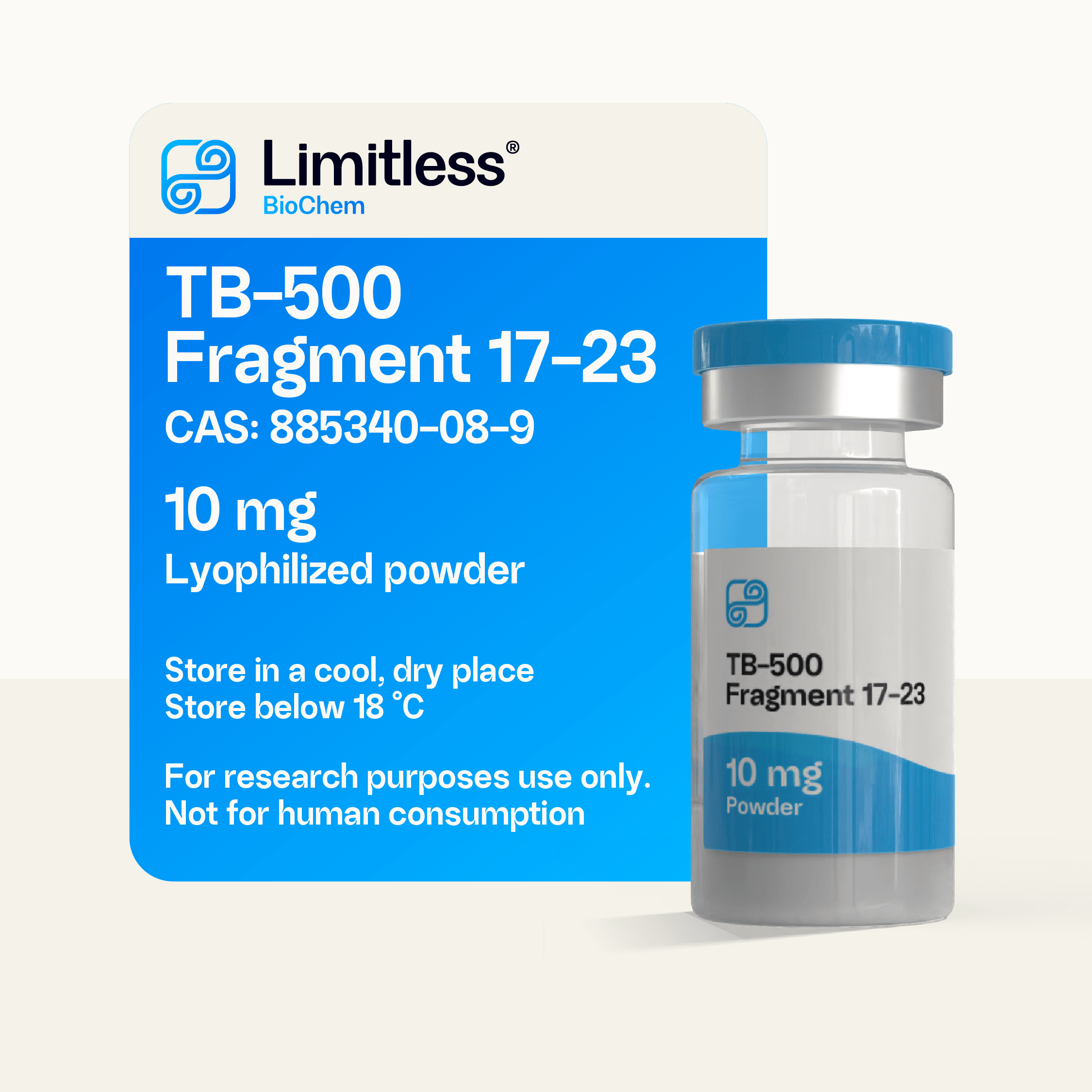
- The whole peptide is just seven amino acids, LKKTETQ, corresponding to the central actin-binding region of a much larger protein found in almost every cell of the body.
- Thymosin beta-4 is the most abundant member of the beta-thymosin family in human cells, making up roughly 70 to 80 percent of the beta-thymosins present.
- Its parent protein acts as the body's main actin-sequestering factor, holding a reserve of actin building blocks that cells draw on for movement and repair.
Mechanism
Thymosin beta-4 works largely by binding and sequestering monomeric actin, maintaining a reserve of actin subunits that cells can draw on to build and remodel the filaments needed for movement, division, and repair [1][3]. The short 17-23 sequence, LKKTETQ, is the central actin-binding domain responsible for much of this interaction, and studies of this and closely related fragments report that they can promote the growth of new blood vessels, encourage the migration of cells into a wound, and speed the closure of tissue defects [1].
Beyond its direct handling of actin, thymosin beta-4 has been shown to influence a variety of downstream events, including the activation of survival-related signaling molecules and changes in the expression of genes tied to matrix remodeling and angiogenesis [1][2]. Reviews of the protein attribute its regenerative effects to this combination of cytoskeletal regulation and signaling activity, though the precise molecular targets of the extracellular are not fully defined [2][3]. The isolated fragment is presumed to reproduce a portion of these actin-related actions, but its behavior in the human body has not been well characterized [1].
receptor fingerprint
G-actin cytoskeletonBinds and helps regulate actin polymerization
Endothelial cells / angiogenesisPromotes new blood-vessel sprouting
Keratinocytes and fibroblastsDrives migration for re-epithelialization
Safetyrisks and cautions, not medical advice
TB-500 Fragment 17-23 is a short peptide corresponding to the actin-binding region of thymosin beta-4; it is a research material with no approved use and no meaningful human safety data. Its risk profile is essentially unknown, and reported use is anecdotal. As with the parent peptide, theoretical concerns about promoting cell proliferation cannot be excluded.
History
This peptide is a laboratory fragment rather than a drug with a discovery story of its own; its history is that of its parent molecule, thymosin beta-4. Thymosin beta-4 was first isolated from calf thymus in the 1980s as part of thymosin fraction 5, work associated with Allan Goldstein and colleagues, and was initially thought to be a thymic hormone before being recognized as the principal actin-sequestering peptide present in nearly all cells.
Researchers subsequently mapped its central actin-binding domain to the short sequence spanning residues 17 to 23, LKKTETQ, and studies in the 1990s and 2000s showed that this motif carries much of the parent protein's activity in cell and animal models of wound healing and blood-vessel growth. The synthetic 17-23 heptapeptide is a research chemical derived from that mapping work; it has never been developed as an approved medicine, and its behavior in the human body remains poorly characterized. The related full-length agent TB-500 circulates in the peptide and sports-supplement markets, but neither it nor this fragment holds regulatory approval.
Reputation
TB-500 Fragment 17-23 draws its interest from the genuinely intriguing biology of thymosin beta-4, a molecule that has been shown in laboratory and animal studies to encourage new blood-vessel formation, cell migration, and tissue repair across the heart, skin, cornea, and nervous system. The 17-23 motif is scientifically meaningful because it represents the compact core responsible for much of the parent protein's actin-binding activity, making it an elegant tool for probing how a tiny sequence can reproduce a larger protein's effects.
Within the peptide research community it is discussed with enthusiasm for its potential regenerative properties. In fairness, that enthusiasm rests almost entirely on preclinical evidence; there are no controlled human trials establishing that the isolated fragment is safe or effective, it has no approved medical use, and its pharmacology in people is essentially unstudied. It is best understood as a research peptide with a promising biological pedigree rather than a proven therapy.
Subjective profileweighing the evidence above
Reducing thymosin beta-4 to its seven-residue core is elegant, but the evidence is cell and animal work and there is no human safety data at all. The parent peptide's theoretical proliferation concern applies here too, which matters for something people run for months.
Where to buy
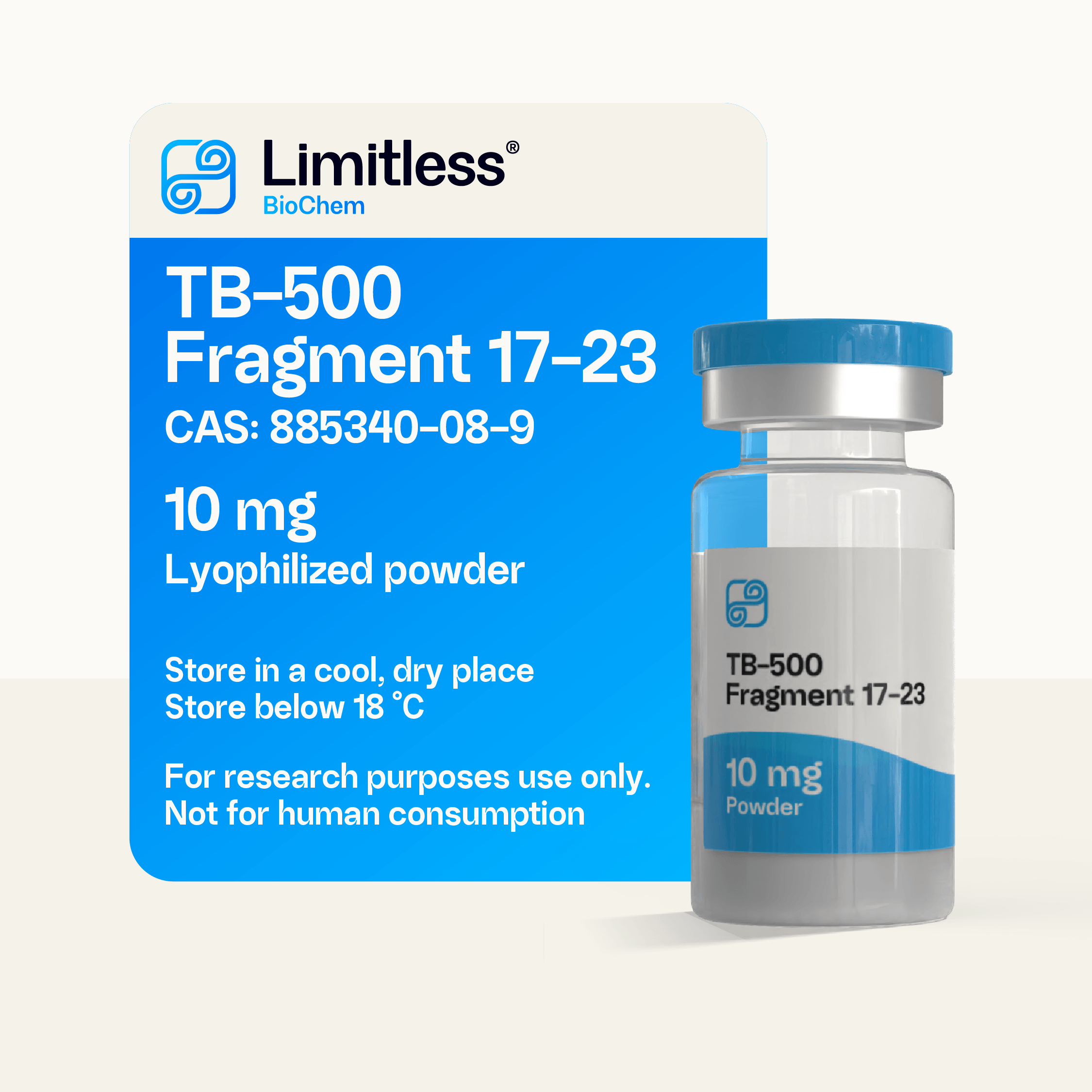
Suppliers
Vendors carrying TB-500 Fragment 17-23, with live product details and codes. Links are affiliate links that support the wiki at no cost to you.
Limitless Biochem🌐
TB-500 Fragment 17-23
Research
- 2001first citedbeta-Thymosins, small acidic peptides with multiple functions.
- 2023most recentThymosin β4 and Actin: Binding Modes, Biological Functions and Clinical Applications.
- 1.Biological activities of thymosin beta4 defined by active sites in short peptide sequences.
- 2.Thymosin beta4: structure, function, and biological properties supporting current and future clinical applications.
- 3.beta-Thymosins, small acidic peptides with multiple functions.
- 4.Thymosin β4 and Actin: Binding Modes, Biological Functions and Clinical Applications.
- 5.The beta-thymosins: intracellular and extracellular activities of a versatile actin binding protein family
5 listed here; entry last updated August 2026
Reviews
My notesprivate to this device
FAQ
How is this different from full TB-500?
It is just the seven-residue actin-binding core rather than the whole thymosin beta-4 peptide, yet in studies this small motif carries much of the migration and angiogenesis activity.
What is it studied for?
Mainly cell migration, wound and dermal repair, new blood-vessel growth and hair-follicle activity in lab and animal models.
Is there human evidence?
Very little; most data is preclinical, so any claims should be treated as early research.
Notes and cautions
- Not approved for medical use in humans
- Human safety data are lacking
- Sold as an unregulated research chemical
- Purity and contents of products can vary
- Effects are known mainly from lab and animal studies