
spec sheet12 rows
Tazarotene is a topical retinoid, a vitamin-A-derived compound of the third generation, used on the skin to treat acne, plaque psoriasis, and signs of sun-related aging. It is applied as a gel, cream, lotion, or foam and works as a prodrug that the skin converts into its active form, tazarotenic acid. Like other retinoids, it is avoided during pregnancy.
- Third generation vitamin A retinoid for skin
- Clears blackheads and stubborn breakouts
- Aimed at thick, scaly psoriasis plaques
- Softens fine lines from sun damage
- Fades blotchy, uneven pigmentation
- Resets skin cell turnover so pores stay clear
Overview
Tazarotene is a member of the acetylenic class of retinoids and is regarded as a third-generation topical retinoid, meaning a synthetic relative of vitamin A designed for application to the skin [3]. It is a prodrug: after entering the skin it is rapidly converted by esterase enzymes into its active metabolite, tazarotenic acid [1]. It reached the market in the late 1990s and is sold under brand names such as Tazorac and Avage, with generic versions now available [3].
The drug is approved for plaque psoriasis, in which it helps normalize the overgrowth and faulty maturation of skin cells, and for acne, where it promotes the shedding of cells that would otherwise plug the pores [2][3]. It is also used cosmetically to improve photoaged skin, reducing fine wrinkles and the mottled pigmentation caused by sun exposure [3]. In treating psoriasis it is often paired with a topical corticosteroid, a combination that improves results and reduces irritation [3].
Tazarotenic acid works by binding retinoic acid receptors in skin cells, chiefly the RAR-beta and RAR-gamma subtypes, and thereby altering the activity of genes that control how keratinocytes grow and differentiate [2]. Because it is applied topically and only a small fraction is absorbed into the bloodstream, systemic exposure is low [1]. Tazarotene is a prescription medicine and comes in several formulations, including gels, creams, a lotion, and a foam; like other retinoids it is contraindicated in pregnancy because of the risk of harm to a developing fetus [3]. The most common drawback is local skin irritation, which is usually mild to moderate [3].
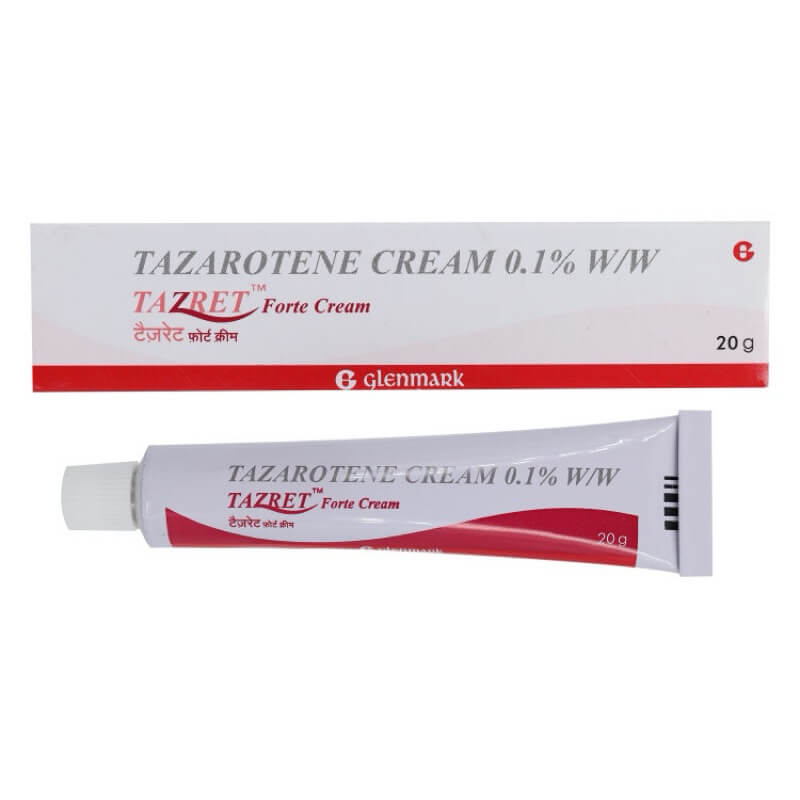
- Tazarotene is one of the rare topical retinoids approved for both acne and psoriasis, two very different skin conditions.
- It is inactive as applied; the skin itself converts it into tazarotenic acid, the form that actually engages the retinoic acid receptors.
- Unusually for a psoriasis treatment, its improvements often persist after the drug is stopped, which is why it is studied as a maintenance therapy.
Mechanism
Tazarotene is inactive as applied and must be transformed within the skin into tazarotenic acid, the compound responsible for its effects [1]. Tazarotenic acid belongs to the retinoid family and works by binding to retinoic acid receptors, acting selectively on the RAR-beta and RAR-gamma subtypes present in skin cells [2]. These receptors regulate gene transcription, and by engaging them the drug changes the expression of genes that govern how keratinocytes, the main cells of the epidermis, proliferate and mature [2].
In psoriasis this normalizes the excessive growth and abnormal differentiation of these cells and calms inflammation, while in acne it encourages the turnover of cells lining the follicle so that pores are less likely to become blocked [2][3]. Tazarotene also switches on a set of genes originally identified in connection with the drug, the tazarotene-induced genes, which are thought to contribute to its ability to restrain cell proliferation [2]. Only a small amount reaches the bloodstream, and the absorbed drug is cleared relatively quickly, which limits its effects on the rest of the body [1].
receptor fingerprint
Retinoic acid receptor gamma (RAR-gamma)agonist
Retinoic acid receptor beta (RAR-beta)agonist
Keratinocyte proliferation and differentiationmodulates
Follicular keratinizationmodulates
Inflammatory mediators in skininhibits
Dosingtypical ranges, not medical advice
interested in protocols and clinical dosages? make an account to see them! ^_^
Safetyrisks and cautions, not medical advice
Tazarotene is prescription only. Most effects are local: burning, stinging, redness, dryness, peeling, and itching, especially in the first few weeks, and it raises sun sensitivity. It is teratogenic and carries a pregnancy category X rating, so it is contraindicated in pregnancy, and women who can become pregnant need effective contraception while using it. Do not apply it to sunburned or eczema-prone skin, and pair it with daytime sunscreen and a moisturizer; starting every other day helps when irritation runs high.
Interactionsdocumented pairs only, not exhaustive
Tazarotene is contraindicated in pregnancy; like other retinoids, it is a documented teratogen with significant risk of congenital abnormalities including cleft palate, heart defects, central nervous system malformations, and thymic aplasia. Women of childbearing potential using tazarotene must use effective contraception and understand that the drug can cause severe fetal harm even at topical doses.
Tazarotene exhibits photosensitizing properties when exposed to UVA and UVB light; the compound forms long-lived triplet excited states under UVA exposure that generate reactive singlet oxygen and may form photoproducts with skin proteins like tryptophan, leading to phototoxic reactions in sun-exposed skin [19]. Users should expect enhanced photosensitivity and avoid or minimize sun exposure during treatment, or use rigorous photoprotection including broad-spectrum sunscreen and protective clothing. While tazarotene is sometimes used alongside narrow-band UVB phototherapy for psoriasis, this combination requires close clinical monitoring due to increased photosensitivity risk.
Checking a whole stack? Run it through interactions + stacks.
History
Tazarotene was developed by Allergan and introduced in the late 1990s, receiving US FDA approval in 1997 for plaque psoriasis and acne vulgaris under the brand name Tazorac (marketed as Zorac in some regions). It was one of the first of the so-called third-generation topical retinoids, a class of acetylenic compounds engineered for greater receptor selectivity than earlier vitamin-A derivatives.
Chemically it was designed as a prodrug that the skin rapidly converts to its active form, tazarotenic acid, which binds selectively to the RAR-beta and RAR-gamma retinoic acid receptors. Over the following two decades its indications broadened to include photodamage and fine facial wrinkling, and newer vehicles were developed, including foam (Fabior), a lower-strength lotion (Arazlo), and a fixed combination with the corticosteroid halobetasol to improve tolerability in psoriasis. It remains a prescription retinoid and, like others in its class, is contraindicated in pregnancy.
Reputation
Tazarotene has a solid reputation among dermatologists as a potent and versatile topical retinoid, notable for being one of the few approved for both acne and psoriasis. In psoriasis it produces meaningful reductions in plaque elevation and scaling and, distinctively, tends to sustain its benefit after treatment stops, a property that has made it attractive for maintenance regimens and for pairing with topical corticosteroids to offset steroid-induced skin thinning.
In acne it promotes healthy turnover of the cells lining the pores, helping to keep them clear. Its relatively high potency is a double-edged quality: it is effective, but it is also among the more irritating retinoids, and the dryness, redness, and peeling of the early retinization period lead some users to combine it with moisturizers or a corticosteroid. Only a small fraction is absorbed into the bloodstream, which limits systemic effects.
Subjective profileweighing the evidence above
A strong prescription retinoid that delivers on acne, psoriasis plaques and sun damage, often faster than the gentler options. The irritation is real, so starting every other night helps, along with sunscreen and moisturizer. It is contraindicated in pregnancy, which is not a soft caution.
Where to buy

Suppliers
Vendors carrying Tazarotene, with live product details and codes. Links are affiliate links that support the wiki at no cost to you.
PCT.Zone
Tazarotene
Research
- 1997first citedMolecular mechanisms of tazarotene action in psoriasis.
- 2006controlled trialTazarotene versus tazarotene plus clindamycin/benzoyl peroxide in the treatment of acne vulgari…
- 2026most recentMechanistic Insights Into the Photosensitizing Properties of the Topical Retinoid Tazarotene.
- 1.Clinical pharmacokinetics and drug metabolism of tazarotene: a novel topical treatment for acne and psoriasis.
- 2.Molecular mechanisms of tazarotene action in psoriasis.
- 3.Tazarotene (Foster et al., Drugs, 1998)
- 4.Tazarotene versus tretinoin or adapalene in the treatment of acne vulgaris.
- 5.Tazarotene versus tazarotene plus clindamycin/benzoyl peroxide in the treatment of acne vulgaris: a multicenter, double-blind, randomized parallel-group trial.
- 6.Successful treatment of acne vulgaris using a new method: results of a randomized vehicle-controlled trial of short-contact therapy with 0.1% tazarotene gel.
- 7.Optimizing treatment with topical tazarotene.
- 8.Once-daily tazarotene 0.1 % gel versus once-daily tretinoin 0.1 % microsponge gel for the treatment of facial acne vulgaris: a double-blind randomized trial.
- 9.Tazarotene gel: efficacy and safety in plaque psoriasis.
- 10.Strategies to optimize efficacy, duration of remission, and safety in the treatment of plaque psoriasis by using tazarotene in combination with a corticosteroid.
- 11.Tazarotene 0.1% gel plus corticosteroid cream in the treatment of plaque psoriasis.
- 12.Tazarotene cream in the treatment of psoriasis: Two multicenter, double-blind, randomized, vehicle-controlled studies of the safety and efficacy of tazarotene creams 0.05% and 0.1% applied once daily for 12 weeks.
19 listed here; entry last updated August 2026
Reviews
My notesprivate to this device
FAQ
Is tazarotene safe during pregnancy?
No; it is pregnancy category X and contraindicated, and anyone who can become pregnant needs reliable contraception while using it.
How is it different from adapalene or tretinoin?
Tazarotene is a potent prodrug that selectively hits the beta and gamma retinoid receptors; it tends to be stronger and can be more irritating than adapalene.
How long until I see results?
Give it several weeks of nightly use; retinoids work slowly by resetting skin cell behavior rather than clearing things overnight.
Why is my skin red and peeling early on?
That is the retinization phase as skin adjusts; buffering with moisturizer and starting every other night usually settles it.
Do I need sunscreen with it?
Yes; tazarotene makes skin more sun-sensitive, so daytime sunscreen protects both your skin and your progress.
Notes and cautions
- Redness, peeling, or dryness at the site
- Burning or stinging on application
- Increased sensitivity to sunlight
- Itching or irritation, usually mild
- Not for use during pregnancy