
spec sheet7 rows
Proroxan is a non-selective alpha adrenoceptor blocker developed at the Soviet Institute of Toxicology in the 1970s; in Russia today it is used less for blood pressure than for autonomic crises, anxiety and withdrawal states in psychiatry and addiction medicine.
- Turns down the noradrenergic storm of withdrawal
- Earns its place in Russian addiction medicine
- Blocks both alpha-1 and alpha-2 receptors
- Used for autonomic crises, anxiety and withdrawal states
- Soviet era pharmacology still in Russian clinical use
- Lowers blood pressure through one clear action

- Proroxan (pyrroxan) is a benzodioxane-derived alpha-adrenoceptor antagonist developed and registered only in the USSR/Russian Federation; it has never been approved by FDA or EMA.
- PubMed returns 52 records, almost all Russian-language pharmacology from the 1970s-1990s; there is no English-language randomised efficacy trial for any of its registered indications.
- The only recent, peer-reviewed, English-language work using proroxan is a 2026 J Med Chem drug-repurposing screen in which it was tested as a human GPCR antagonist against filarial nematodes, producing a modest 25-36% reduction in worm burden and a significant fall in worm fecundity [1].
- Two small Russian placebo-controlled studies in healthy volunteers report that proroxan modifies psychophysiological performance and reduces situational anxiety under psycho-emotional stress, with effect size dependent on individual sensitivity (PMID 27416676, PMID 26087584).
- Treat any dosing or indication claim for proroxan as coming from the Russian State Register of Medicines, not from indexed clinical evidence.
Mechanism
It blocks alpha-1 and alpha-2 adrenoceptors both centrally and peripherally, damping sympathetic tone. That single action accounts for the fall in blood pressure, the settling of autonomic crises and its use in opioid and alcohol withdrawal, where the withdrawal syndrome is largely a noradrenergic storm.
receptor fingerprint
Nematode GPCRs (gar-3, ser-7 orthologues); repurposing targetAntagonist
Alpha-1 adrenoceptor (ADRA1)Antagonist
Alpha-2 adrenoceptor (ADRA2)Antagonist
Safetyrisks and cautions, not medical advice
a non-selective alpha adrenoceptor blocker, so first dose orthostatic hypotension and syncope are the expected hazard, and it is contraindicated in severe atherosclerosis and heart failure
Subjective profileweighing the evidence above
Proroxan earns its place in Russian addiction medicine for one honest reason: withdrawal is largely a noradrenergic storm, and a non-selective alpha blocker turns that storm down. Used for anxiety on its own it is a blunt instrument, and the trade is a real cardiovascular side effect profile in exchange for something better tolerated drugs deliver without it. First dose orthostatic hypotension and syncope are the expected hazard rather than a rare one, and severe atherosclerosis or heart failure rule it out entirely.
Where to buy
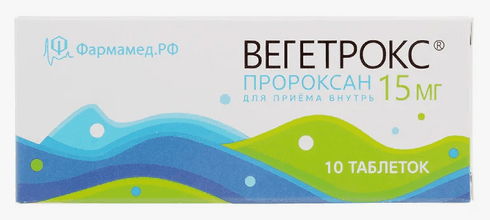
Suppliers
Vendors carrying Proroxan, with live product details and codes. Links are affiliate links that support the wiki at no cost to you.
RUPharma🌐
Proroxan
Research
- 2015first cited[Individual approach to the use of medications to normalize situational anxiety under the psych…
- 2016controlled trial[Effect of mediator-type drugs on human psychophysiological status during model operator activi…
- 2026most recentDiscovery of GPCR Antagonists with Potent In Vitro and In Vivo Macrofilaricidal Activity.
- 1.Discovery of GPCR Antagonists with Potent In Vitro and In Vivo Macrofilaricidal Activity.
- 2.[Effect of mediator-type drugs on human psychophysiological status during model operator activity]
- 3.[Individual approach to the use of medications to normalize situational anxiety under the psycho-emotional stress]
3 listed here; entry last updated August 2026
Reviews
My notesprivate to this device
Notes and cautions
- There is essentially no modern indexed safety data.
- As a non-selective alpha-blocker the predictable risks are orthostatic hypotension, syncope, reflex tachycardia and nasal congestion, and first-dose hypotension is the expected acute hazard; none of this is quantified in any indexed trial.
- One controlled volunteer study found proroxan measurably altered components of sustained operator performance, so impairment of driving or safety-critical work should be assumed [2].
- No boxed warning exists because no Western regulator has ever reviewed it.