
spec sheet10 rows
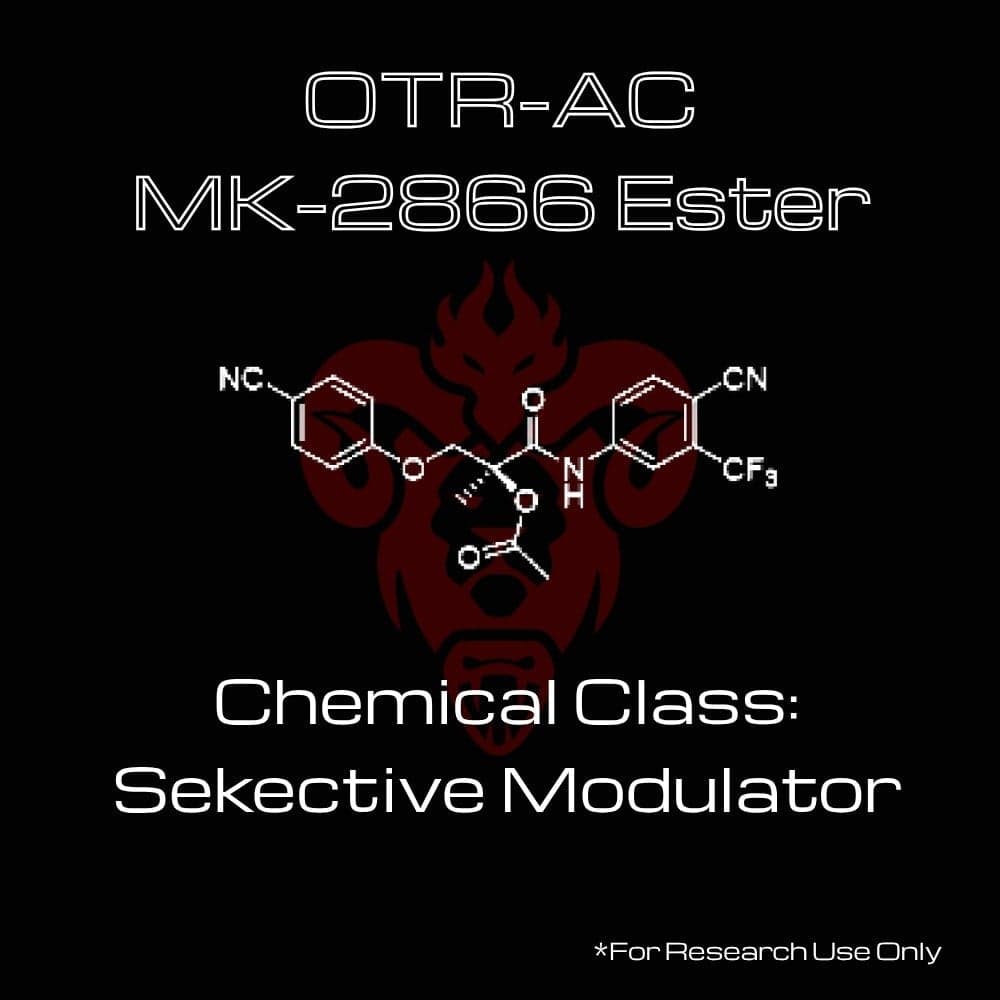
OTR-AC is an acetate ester of ostarine (enobosarm), the most clinically characterized selective androgen receptor modulator (SARM) in development. It is designed to deliver enobosarm's muscle-selective, orally active anabolic signal, building lean mass and physical function while sparing the prostate and other tissues that traditional androgens affect [3][4]. In controlled trials, enobosarm consistently increased lean body mass in older adults and cancer patients [1][2], and the acetate ester form is marketed as more potent per milligram.
- Built on ostarine, the most studied SARM
- Real lean mass gains in enobosarm trials
- Physical function improved, not just scale weight
- Muscle-selective androgen signaling, active orally
- Acetate ester marketed as the more potent form
- Preclinical bone healing signals as a bonus
- Can nudge HDL cholesterol down
- Some natural testosterone suppression likely
- Liver enzymes worth monitoring
Overview
OTR-AC is the acetate ester of ostarine, also known as enobosarm, GTx-024, or S-22, a nonsteroidal selective androgen receptor modulator (SARM). The ester is designed to release enobosarm in the body, and it is promoted as offering greater potency per milligram than the base compound. Enobosarm itself is widely regarded as the most clinically characterized SARM, having progressed through Phase I, II, and III clinical testing [2][4].
SARMs are a class of anabolic agents that bind the androgen receptor and exhibit tissue selectivity; they modulate the same anabolic pathways as classical androgens but, within their effective dose range, increase muscle mass and physical function while largely sparing androgenic effects on tissues such as the prostate, skin, and hair. Unlike testosterone, enobosarm is orally active, nonaromatizable, nonvirilizing, and tissue-selective, which is the central rationale for its development [3][4].
The clinical evidence for enobosarm is substantial. A double-blind, placebo-controlled Phase 2 trial in patients with cancer found that enobosarm significantly increased total lean body mass compared with baseline, with a median gain of about 1.5 kg at the 1 mg dose, without the toxic effects associated with androgens [1]. The Phase 3 POWER program evaluated enobosarm at 3 mg once daily for the prevention and treatment of muscle wasting in non-small-cell lung cancer, using lean body mass and stair climb power as co-primary endpoints [2]. Earlier work established its activity in cancer cachexia [3], and it received FDA fast track designation for muscle wasting [4]; SARMs including enobosarm have also increased pelvic floor muscle mass in preclinical models [5].
OTR-AC itself is sold as a research chemical and is not an approved medication; enobosarm remains investigational. As an androgen receptor modulator, the ester carries the class considerations of possible reductions in HDL cholesterol and suppression of natural testosterone, so routine monitoring is prudent for anyone studying it.
- OTR-AC is an acetate ester designed to deliver ostarine (enobosarm), the most clinically studied selective androgen receptor modulator.
- The clinical evidence cited for it comes from trials of enobosarm itself, since the ester form has not had its own formal trial program.
- Enobosarm is nonaromatizing, so it does not convert to estrogen the way traditional anabolic androgens can.
Mechanism
OTR-AC is built around one of the strongest evidence bases in the SARM field, because it is engineered to deliver enobosarm, whose anabolic action on muscle is well documented. As a selective modulator, enobosarm binds the androgen receptor and activates the same anabolic transcriptional program as testosterone in muscle and bone, but its tissue-selective character means it drives muscle and physical function gains while producing little of the androgenic activity classical steroids exert on prostate, skin, and hair [3][4]. The acetate ester is a delivery modification intended to increase potency per milligram, releasing ostarine after administration.
The practical benefit is muscle-directed anabolism without the full burden of running steroids. Because enobosarm is orally active, nonaromatizable, and nonvirilizing, it avoids conversion and the virilizing effects that limit traditional androgens, which is the core of its appeal for lean mass and function [3][4].
Clinical results give this profile concrete numbers. In a randomized, double-blind, placebo-controlled Phase 2 trial in cancer patients, enobosarm significantly increased total lean body mass by day 113, with a median gain of about 1.5 kg at 1 mg (p = 0.0012) and 1.0 kg at 3 mg, while the placebo group showed no significant change [1]. The Phase 3 POWER trials then tested 3 mg once daily against co-primary endpoints of lean body mass and stair climb power, a functional measure, in non-small-cell lung cancer [2]. Across programs, enobosarm consistently increased lean body mass and improved measures of physical function and power, with a favorable safety profile relative to androgens [3][4], and preclinical work confirmed anabolic effects on specific muscle groups such as the pelvic floor [5].
Because the mechanism is androgen-receptor modulation, the same biology that builds muscle can nudge HDL cholesterol downward and suppress endogenous testosterone to some degree, which is why liver enzymes, lipids, and natural testosterone are worth monitoring. Reported strength gains in trials were more variable than lean-mass gains, a nuance consistent with the endpoints used [1][2].
receptor fingerprint
Selective tissue agonist (via released ostarine)
Skeletal muscle / lean massAnabolic stimulation
BoneAnabolic support
Safetyrisks and cautions, not medical advice
OTR-AC is an ester form of the SARM enobosarm (ostarine) with essentially no dedicated human safety data; like other SARMs it is expected to suppress endogenous testosterone, lower HDL cholesterol, and potentially strain the liver. It is not an approved medicine and is prohibited in sport, and the pharmacology and purity of research-grade material are not validated. Its long-term risks in humans are unknown.
History
OTR-AC is an acetate ester of ostarine (enobosarm), and its history is largely the history of that parent molecule; enobosarm itself was developed by the Memphis biotechnology firm GTx out of selective androgen receptor modulator chemistry pioneered by James Dalton and Duane Miller, and it became the most clinically characterized SARM through randomized trials and the Phase 3 POWER program in cancer-related muscle wasting. The acetate ester is a delivery modification rather than a separately developed drug; adding the ester is intended to alter absorption and increase potency per milligram, releasing ostarine after administration.
Unlike enobosarm, OTR-AC has not been the subject of its own formal clinical development program, and documentation specific to the ester form is limited, drawn mainly from the research-chemical and performance market rather than peer-reviewed pharmacology. Its evidentiary foundation therefore rests on the well-studied clinical record of enobosarm, described in the Phase 2 trial published in 2013 and the Phase 3 design papers that followed.
Reputation
OTR-AC is positioned as a more potent, milligram-for-milligram delivery form of the best-documented SARM, which gives it borrowed credibility from enobosarm's strong clinical track record of building lean body mass and physical function while sparing the prostate and other tissues that classical steroids affect. For users drawn to muscle-directed anabolism without aromatization or virilization, that underlying profile is genuinely attractive, and the reported goal of the ester, greater potency at a smaller dose, is a coherent pharmaceutical idea.
The candid limitation is that the ester itself has not been independently trialed, so claims about its added potency rest on formulation logic rather than published head-to-head data. As with all SARMs, the same androgen-receptor biology that builds muscle can nudge HDL cholesterol down and suppress endogenous testosterone, making lipids, liver enzymes, and natural testosterone worth monitoring, and it remains an unapproved research compound rather than a licensed medicine.
Subjective profileweighing the evidence above
It trades on enobosarm's evidence without having any of its own. The ester has no dedicated human data, and SARMs still suppress your own testosterone, push HDL down and can strain the liver. Unapproved, banned in sport, and research-grade purity is a coin flip. Not recommended.
Where to buy
Suppliers
Vendors carrying OTR-AC, with live product details and codes. Links are affiliate links that support the wiki at no cost to you.
Kimera Chems
OTR-AC
Research
- 2009first citedNonsteroidal selective androgen receptor modulator Ostarine in cancer cachexia
- 2017most recentTissue Selective Androgen Receptor Modulators (SARMs) Increase Pelvic Floor Muscle Mass in Ovar…
- 1.Effects of enobosarm on muscle wasting and physical function in patients with cancer: a double-blind, randomised controlled phase 2 trial
- 2.Study Design and Rationale for the Phase 3 Clinical Development Program of Enobosarm, a Selective Androgen Receptor Modulator, for the Prevention and Treatment of Muscle Wasting in Cancer Patients (POWER Trials)
- 3.Nonsteroidal selective androgen receptor modulator Ostarine in cancer cachexia
- 4.Selective androgen receptor modulators for the prevention and treatment of muscle wasting associated with cancer
- 5.Tissue Selective Androgen Receptor Modulators (SARMs) Increase Pelvic Floor Muscle Mass in Ovariectomized Mice
- 6.Enobosarm (GTx-024, S-22): a potential treatment for cachexia
6 listed here; entry last updated August 2026
Reviews
My notesprivate to this device
FAQ
Is OTR-AC different from ostarine?
It is an acetate ester of ostarine; the idea is that it releases ostarine after dosing. The ester itself has not been studied in humans.
Why does the underlying data matter?
Enobosarm is the most trialed SARM, so its results are the closest evidence we have; but those trials still did not lead to approval.
Is it safe?
Its safety is not established, and the ester form specifically has no human data. It is investigational only.
Adverse effects
- Can nudge HDL cholesterol down
- Some natural testosterone suppression likely
- Liver enzymes worth monitoring
Notes and cautions
- Ester form is research only in humans