
spec sheet11 rows
ACP-105 is a potent nonsteroidal selective androgen receptor modulator (SARM) engineered to deliver the muscle- and bone-building benefits of androgens with greater tissue selectivity than testosterone. As a partial agonist at the androgen receptor, it was designed to drive anabolism in muscle and bone while limiting the unwanted effects tied to classic steroids. Its combination of anabolic potency and an intriguing signal for cognitive and neuroprotective effects has made it a standout among research-grade SARMs.
- Muscle and bone gains, minus the steroid baggage
- Binds the androgen receptor hard
- Engineered for tissue selectivity beyond testosterone
- Sharpened cognition alongside an ER-beta agonist
- Calmer, less anxious mice in testing
- Low prostate stimulation in preclinical work
- Androgenic effects can suppress natural testosterone production
- Possible strain on cholesterol and lipid profile like other SARMs
- Human safety and toxicity are not clinically established
Overview
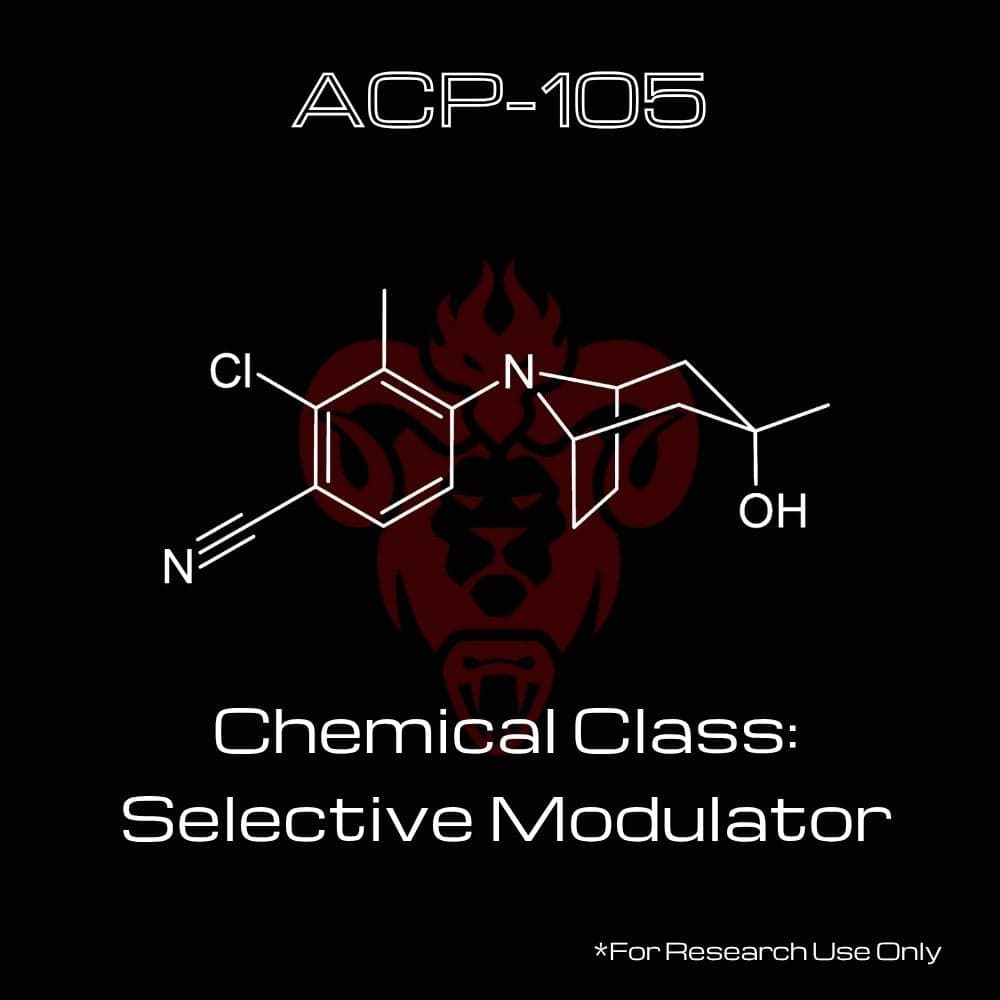
ACP-105 is a synthetic, nonsteroidal selective androgen receptor modulator (SARM). Chemically it is 2-chloro-4-[(3-endo)-3-hydroxy-3-methyl-8-azabicyclo[3.2.1]oct-8-yl]-3-methylbenzonitrile, built around an azabicyclic tropanol core rather than the four-ring steroid skeleton of testosterone [1][3]. It was discovered and developed by ACADIA Pharmaceuticals using a receptor screening technology, and reported in 2009 as a novel, potent SARM that behaves as a partial agonist at the androgen receptor relative to the natural hormone testosterone [1].
Like other SARMs, ACP-105 was pursued because it aims to separate the desirable anabolic actions of androgens on muscle and bone from their less desirable effects on other tissues, a property described as tissue selectivity [4]. In its original preclinical characterization, oral ACP-105 improved anabolic parameters in castrated male rats over a two-week course, supporting its potential in areas such as muscle wasting, osteoporosis, and androgen-replacement therapy [1]. Beyond muscle and bone, it has been studied for effects on the brain; in female mice, ACP-105 enhanced learning in a fear-conditioning task and protected sensorimotor function against radiation-induced impairment, pointing to possible neuroprotective and cognitive applications [2].
Despite this promise, ACP-105 has never received clinical approval, and much of the published literature comes from anti-doping science rather than therapeutic trials. SARMs as a class have been prohibited in sport by the World Anti-Doping Agency since 2008, and researchers have characterized ACP-105 and its many hydroxylated metabolites specifically to enable its detection in human and equine doping control samples [3][4][5]. Its human safety profile remains insufficiently explored and has so far been assessed mainly through in silico toxicity prediction rather than clinical study [6]. It circulates as a research chemical, typically as a powder or in capsule or liquid form, and is not an approved drug or dietary supplement.
- Beyond muscle and bone, ACP-105 was tested in a mouse Alzheimer's model, where it reduced anxiety-like behavior and, paired with an estrogen receptor beta agonist, lowered brain amyloid-beta and improved cognition.
- ACP-105 is so extensively metabolized that anti-doping laboratories track its hydroxylated metabolites in urine, some of which stay detectable for several days after a single dose.
Mechanism
ACP-105 works by binding the (AR), the same intracellular receptor that testosterone and other androgens use to switch on genes that build muscle and bone. What makes it a selective androgen receptor modulator rather than a simple steroid is how it engages that receptor. ACP-105 is a nonsteroidal molecule and acts as a partial ; when it binds the AR it produces a submaximal androgenic signal compared with testosterone, and, importantly, it does so in a tissue-selective way, favoring anabolic tissues such as muscle and bone while sparing others [1][4]. This selectivity is the central design goal of the SARM class, intended to capture the muscle-building and bone-strengthening benefits of androgens with fewer of the side effects associated with anabolic-androgenic steroids [4].
Once the receptor is activated, ACP-105 promotes the classic androgenic anabolic program; increased protein accretion in muscle and support of bone density. In its original preclinical study, oral administration improved anabolic parameters in castrated male rats over a two-week period, a standard model for demonstrating androgenic activity [1]. Separate work in the brain suggests the pathway it activates is also relevant to neurons, since ACP-105 enhanced a form of learning and protected motor function in mice, effects consistent with the known role of androgens in supporting cognition [2].
Because it is extensively metabolized, ACP-105 is a well-studied analyte in doping control. After oral dosing it undergoes oxidation to a series of mono-, di-, and tri-hydroxylated metabolites, and these products remain detectable in urine for meaningful windows; monohydroxylated and bishydroxylated species have been traced for up to four and six days after administration in one study, and parent drug and metabolites for around 72 hours in another [4][5]. Its human safety and toxicity have not been established in clinical studies and have so far been approached mainly through computational prediction, underscoring that its risk profile in people remains uncertain [6].
receptor fingerprint
High-affinity selective agonist
Central nervous systemNeuroprotective modulation
Skeletal muscle and boneAnabolic stimulation
Dosingtypical ranges, not medical advice
interested in protocols and clinical dosages? make an account to see them! ^_^
Safetyrisks and cautions, not medical advice
Every bit of the human picture here is a blank; ACP-105 never reached human clinical trials, so there is no established safety profile, no characterized half-life, and no dosing anyone can point to with confidence. Judging by the SARM class it belongs to, the expected cautions are suppression of your natural testosterone, unfavorable lipid shifts (HDL tends to drop), and possible liver strain, so bloodwork and a proper recovery protocol are the sensible baseline if someone experiments. Source purity is a real concern too, since research-chemical SARMs are frequently underdosed or contaminated. It is investigational and not approved for human use anywhere, and it is banned in competitive sport. Treat it as research only.
History
ACP-105 is a nonsteroidal selective androgen receptor modulator that originated in pharmaceutical research on tissue-selective androgens, developed as a partial agonist intended to capture the anabolic benefits of androgens with greater selectivity than testosterone. Its early preclinical characterization used the classic castrated-rat model to demonstrate androgenic activity after oral dosing.
Interest widened when it was studied in the brain; in a mouse model of Alzheimer's disease, ACP-105 reduced anxiety-like behavior and, combined with a selective estrogen receptor beta agonist, lowered amyloid-beta levels and improved cognition, hinting at a role for androgen signaling in neuroprotection. Because it is extensively metabolized and detectable in urine for days, it has also become a well-studied analyte in sports doping control. Its safety and toxicity in humans have not been established in clinical studies.
Reputation
ACP-105 has a standout reputation among research-grade SARMs, prized both for its anabolic potency and for an unusually intriguing secondary story in the brain. Physique-focused users are drawn to the promise of muscle- and bone-building action with the tissue selectivity that defines the SARM class, while the neuroprotective and cognitive signals seen in animal work give it an extra layer of scientific interest that few of its peers share. The responsible framing, which serious discussions include, is that all of this rests on preclinical and doping-control research; there are no human clinical safety data, and its risk profile has so far been approached mainly through computational prediction. It is best treated as a genuinely interesting but still experimental compound.
Subjective profileweighing the evidence above
Strictly experimental. The tissue-selectivity theory is interesting and the cognitive signal is unusual for a SARM, but it never reached human trials: no safety record, no half-life, no dose. Testosterone suppression and lipid damage are the class expectation, and nobody is checking what you would be buying.
Where to buy
Suppliers
Vendors carrying ACP-105, with live product details and codes. Links are affiliate links that support the wiki at no cost to you.
Kimera Chems
ACP-105
Research
- 2009first citedSynthesis, structure-activity relationships, and characterization of novel nonsteroidal and sel…
- 2025most recentToxicity of ACP-105: a substance used as doping in sports: application of in silico methods for…
- 1.Synthesis, structure-activity relationships, and characterization of novel nonsteroidal and selective androgen receptor modulators
- 2.Effects of the SARM ACP-105 on rotorod performance and cued fear conditioning in sham-irradiated and irradiated female mice
- 3.Expanding sports drug testing assays: mass spectrometric characterization of the selective androgen receptor modulator drug candidates RAD140 and ACP-105
- 4.Detection and identification of ACP-105 and its metabolites in equine urine using LC/MS/MS after oral administration
- 5.Liquid chromatography-high resolution/high accuracy (tandem) mass spectrometry-based identification of in vivo generated metabolites of the selective androgen receptor modulator ACP-105 for doping control purposes
- 6.Toxicity of ACP-105: a substance used as doping in sports: application of in silico methods for prediction of selected toxicological endpoints
- 7.Nonsteroidal selective androgen receptor modulators and selective estrogen receptor β agonists moderate cognitive deficits and amyloid-β levels in a mouse model of Alzheimer's disease.
7 listed here; entry last updated August 2026
Reviews
My notesprivate to this device
FAQ
Why is ACP-105 linked to the brain?
Preclinical mouse studies found it reduced anxiety-like behavior and protected cognition, sometimes alongside an estrogen receptor beta agonist. This is all animal work.
Has it been in humans?
No; it never advanced to human clinical trials, so its human effects are unknown.
Is it approved or safe?
No; it is investigational and its safety is not established. It is sold only as a research chemical.
Adverse effects
- Androgenic effects can suppress natural testosterone production
- Possible strain on cholesterol and lipid profile like other SARMs
- Human safety and toxicity are not clinically established
Notes and cautions
- Banned in sport; use will trigger anti-doping tests
- Purity and dose of research-grade material vary by source