
data + articles · 8 listed
newest 2025spec sheet10 rows
YK-11 is a synthetic steroidal SARM (selective androgen receptor modulator) famous in bodybuilding circles as a myostatin inhibitor, prized for its potential to push muscle growth past the body's natural limits. Uniquely among SARMs, it drives muscle cells to produce follistatin, a protein that blocks myostatin, the built-in brake on muscle size. This dual action as both an androgen receptor activator and a follistatin booster has made YK-11 one of the most talked-about compounds for lean mass, though it remains an experimental, unapproved research chemical.
- Attacks the myostatin brake on muscle
- Pushes growth past the body's natural ceiling
- Raises follistatin, the myostatin blocker
- Doubles as an androgen receptor activator
- Legendary status in bodybuilding circles
- As a steroidal androgen-active compound, suppression of natural testosterone is a recognized risk
- Rodent studies have raised concerns about memory impairment and increased brain inflammation
- Steroidal SARMs of this type carry potential concern for liver strain
Overview
YK-11 is a synthetic steroidal selective androgen receptor modulator (SARM). Unlike the more common nonsteroidal SARMs such as ostarine and RAD-140, YK-11 is built on a steroidal backbone; its full chemical name is (17-alpha,20E)-17,20-[(1-methoxyethylidene)bis(oxy)]-3-oxo-19-norpregna-4,20-diene-21-carboxylic acid methyl ester, a 19-norprogesterone-derived molecule [1][3]. It was first described in 2011 by Kanno and colleagues at Toho University, who identified it as a partial agonist of the androgen receptor [1].
What sets YK-11 apart from other SARMs is its reputation as a myostatin inhibitor. In muscle cell studies it not only activates the androgen receptor but also induces the expression of follistatin, a protein that antagonizes myostatin, the body's principal negative regulator of muscle growth [2]. Because raising follistatin can release this brake on muscle, YK-11 is marketed as a potent muscle-building agent, and it is described in the scientific literature as having both SARM-like and myostatin inhibitor-like properties [5].
YK-11 has never completed clinical development and is not approved for human use. It surfaced as an ingredient in seized black-market products and is sold on the supplement and research-chemical markets as a powder or oral capsule [5]. Like all SARMs, it is prohibited in sport; the World Anti-Doping Agency added SARMs to its Prohibited List in 2008, and doping-control laboratories have developed dedicated methods to detect YK-11 and its urinary metabolites [3][4][5]. Human safety and efficacy data are essentially absent, and its evidence base rests on cell and animal studies.
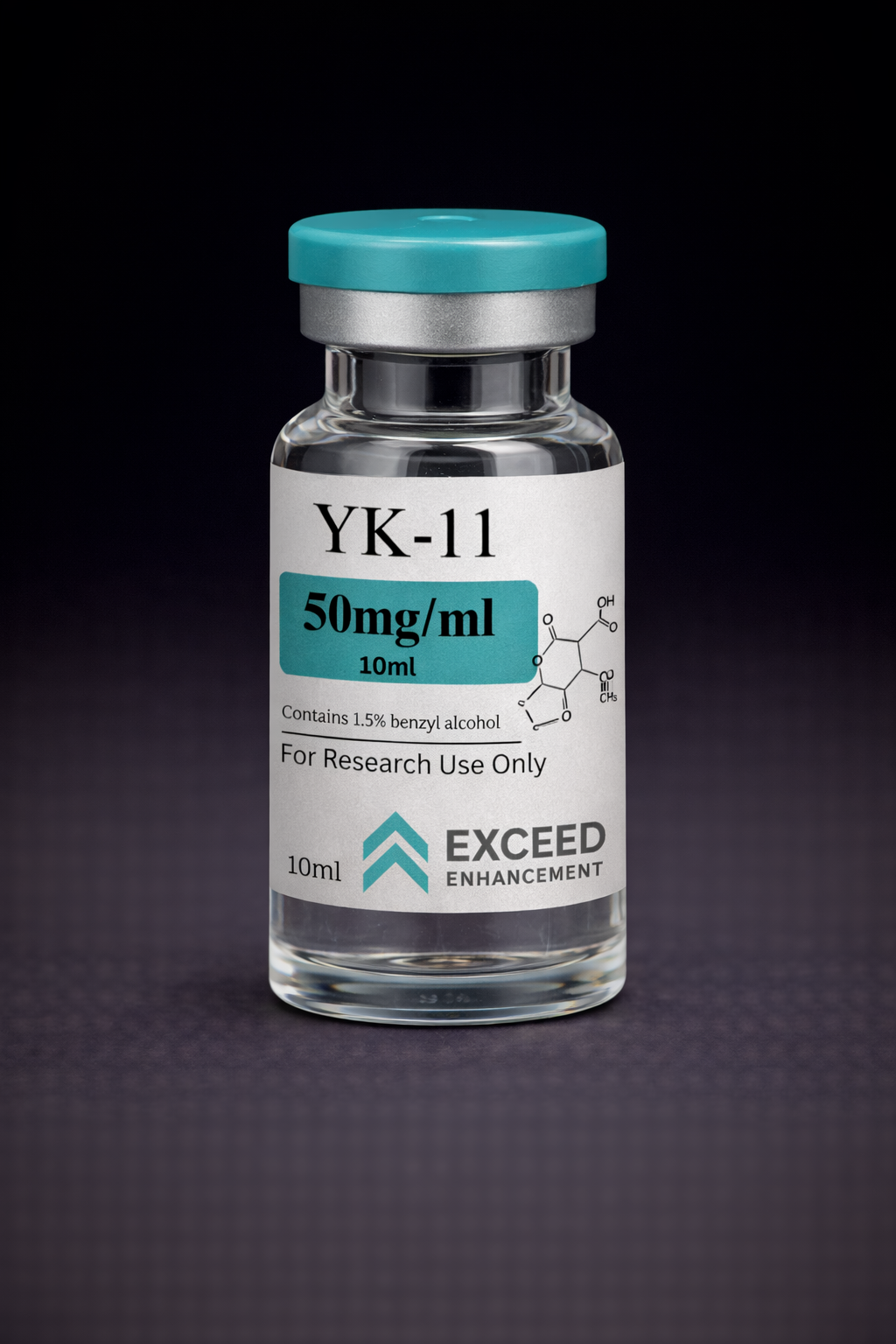
- YK-11 is a steroidal SARM, setting it apart from most popular SARMs, which are non-steroidal, and in cell studies it induced the myogenic factors MyoD, Myf5, and myogenin more strongly than dihydrotestosterone.
- Its muscle-building effect depends on follistatin: when researchers blocked follistatin with an antibody, YK-11's anabolic action on muscle cells disappeared.
Mechanism
YK-11 works through two linked mechanisms that together account for its muscle-building reputation. First, it is a partial of the . In reporter assays it activates the androgen receptor and accelerates its translocation into the nucleus, but, unlike full androgens such as dihydrotestosterone, it does not induce the amino-terminal and carboxyl-terminal (N/C) interaction of the receptor; this altered activation is thought to explain its gene-selective, partial-agonist behavior, so that it switches on some androgen-responsive genes more than others [1]. This gene-selective profile is the defining feature of a SARM and underlies the hope that such compounds can build muscle with fewer of the effects of conventional anabolic steroids [3].
Second, and more distinctively, YK-11 drives myogenic differentiation by increasing follistatin. In cultured muscle cells it induced the key myogenic regulatory factors MyoD, Myf5, and myogenin more strongly than dihydrotestosterone, and it uniquely stimulated the expression of follistatin; blocking follistatin with an antibody reversed the muscle-building effect, showing that follistatin induction is central to its anabolic action [2]. Because follistatin antagonizes myostatin, the principal negative regulator of muscle mass, this positions YK-11 as an indirect myostatin inhibitor, the property most responsible for its popularity [2][5]. Additional work indicates that YK-11 can inhibit 5-alpha-reductase and crosses into the brain [7].
The reported benefits therefore center on increased muscle growth, elevated follistatin, and suppression of myostatin-driven muscle breakdown. In a mouse model of sepsis, myostatin inhibition by YK-11 reduced pro-inflammatory cytokines and organ-damage markers and lowered mortality, suggesting it can counter muscle wasting [6]. The safety picture, however, is a serious caveat: in rats, anabolic exposure to YK-11 impaired memory consolidation, raised hippocampal interleukin-1 beta and interleukin-6, lowered anti-inflammatory interleukin-10, and activated apoptotic signaling through p38 MAPK and the Bax, Bcl-2, and caspase-3 cascade [7]. Being an unapproved experimental agent prohibited in sport since the addition of SARMs to the World Anti-Doping Agency list in 2008, YK-11 has no established human safety profile [3][7].
receptor fingerprint
partial agonist
Myostatininhibits (via follistatin)
Follistatinraises
Safetyrisks and cautions, not medical advice
YK-11 is an unapproved research compound, a steroidal SARM that also acts as a myostatin/follistatin modulator, with no human safety studies and no status as a medicine. Based on its androgenic activity and steroidal structure, it is expected to suppress natural testosterone, adversely affect cholesterol, and potentially stress the liver. Its long-term and cardiovascular risks in humans are unknown.
History
YK-11 is a synthetic, steroidal selective androgen receptor modulator first described by Yuichiro Kanno and colleagues in Japan, whose research around 2011 to 2013 characterized both its partial-agonist behavior at the androgen receptor and, distinctively, its ability to induce follistatin in cultured muscle cells. The follistatin finding, that blocking follistatin reversed its muscle-building effect, established the follistatin-driven, indirect myostatin-inhibiting mechanism that gave YK-11 its reputation. It has never been developed as an approved drug and exists only as an experimental research chemical with no established human safety profile. Because SARMs were added to the World Anti-Doping Agency's Prohibited List in 2008, YK-11 has been prohibited in sport, and analytical laboratories have since developed methods to detect it in doping control.
Reputation
YK-11 is one of the most talked-about compounds in bodybuilding circles because of its unusual dual action: it activates the androgen receptor and, uniquely among SARMs, drives muscle cells to produce follistatin, which opposes myostatin, the body's built-in brake on muscle size. That myostatin-inhibiting angle is genuinely distinctive and is the source of much of the excitement around it. Honesty requires flagging the serious caveats: it is an unapproved research chemical with no human safety data, it is banned in sport, and rodent work has reported adverse effects including impaired memory consolidation and pro-inflammatory and apoptotic signaling in the brain at anabolic exposures. It is best understood as a mechanistically fascinating but experimental agent.
Subjective profileweighing the evidence above
Hard pass. Rodent work flags memory impairment and brain inflammation, it is expected to suppress natural testosterone, and its steroidal structure raises real liver and cholesterol concerns, none of which has been studied in humans. The myostatin story is marketing running well ahead of the data.
Where to buy

1 other outlet

Suppliers
Vendors carrying YK-11, with live product details and codes. Links are affiliate links that support the wiki at no cost to you.
Kimera Chems
YK-11
Exceed Enhancement
YK-11
Research
- 2011first cited(17α,20E)-17,20-[(1-methoxyethylidene)bis(oxy)]-3-oxo-19-norpregna-4,20-diene-21-carboxylic aci…
- 2025most recentDetection of nonsteroidal and steroidal selective androgen receptor modulators in equine hair a…
- 1.(17α,20E)-17,20-[(1-methoxyethylidene)bis(oxy)]-3-oxo-19-norpregna-4,20-diene-21-carboxylic acid methyl ester (YK11) is a partial agonist of the androgen receptor
- 2.Selective androgen receptor modulator, YK11, regulates myogenic differentiation of C2C12 myoblasts by follistatin expression
- 3.Detection of SARMs in doping control analysis
- 4.Mass spectrometric characterization of the selective androgen receptor modulator (SARM) YK-11 for doping control purposes
- 5.Studies on the in vivo metabolism of the SARM YK11: Identification and characterization of metabolites potentially useful for doping controls
- 6.Myostatin inhibitor YK11 as a preventative health supplement for bacterial sepsis
- 7.From gains to gaps? How Selective Androgen Receptor Modulator (SARM) YK11 impact hippocampal function: In silico, in vivo, and ex vivo perspectives
- 8.Detection of nonsteroidal and steroidal selective androgen receptor modulators in equine hair after oral administrations
8 listed here; entry last updated August 2026
Reviews
My notesprivate to this device
FAQ
What is YK-11?
It is a SARM-like research compound thought to affect myostatin, a protein that limits muscle growth.
How is it different from typical SARMs?
Its structure is steroidal and its main proposed angle is raising follistatin to counter myostatin.
Is it well studied in humans?
No, it is a research compound with very limited human safety data.
Does it suppress natural hormones?
It is reported to be suppressive, so it behaves more like a steroid than a mild SARM in that regard.
Adverse effects
- As a steroidal androgen-active compound, suppression of natural testosterone is a recognized risk
- Rodent studies have raised concerns about memory impairment and increased brain inflammation
- Steroidal SARMs of this type carry potential concern for liver strain
Notes and cautions
- Not approved for human use, and human safety data are essentially absent
- Prohibited in competitive sport and sold only as an unregulated research chemical