
spec sheet11 rows
LGD-2226 is a first-generation selective androgen receptor modulator (SARM) developed to build muscle and bone with far less impact on the prostate than traditional androgens. In animal studies it increased muscle and bone mass and enhanced bone strength while sparing the prostate and preserving male sexual behavior, showcasing the tissue selectivity that defines the SARM class. Orally active and non-steroidal, LGD-2226 is a notable early example of the effort to capture the benefits of androgens while minimizing their drawbacks.
- rodent muscle and bone gains are genuine and striking
- tissue selective, with far less prostate stimulation than testosterone
- bone strength and density both improved in preclinical work
- orally active in animals, with no injection involved
- gentler on luteinizing hormone than testosterone in rodents
- a landmark first generation SARM; human trials still to come
- Some suppression of natural testosterone is expected, as with androgens
- Lipid and cholesterol shifts are common across SARMs
- No long-term human toxicology data exist
Overview
LGD-2226 is a non-steroidal, non-aromatizable selective androgen receptor modulator (SARM), a class of compounds designed to activate the androgen receptor in a tissue-selective manner so as to deliver the anabolic benefits of androgens in muscle and bone while minimizing unwanted activity in tissues such as the prostate [1][2][3]. It was developed by Ligand Pharmaceuticals and reported in the mid-2000s as one of the early orally active SARMs [1].
In the foundational study, LGD-2226 bound the androgen receptor with high selectivity and showed full anabolic activity in cell-based models of bone and muscle; in rodents it produced anabolic effects on muscle and bone, enhanced bone strength above control levels, and remained efficacious in a model of male sexual behavior, all with markedly reduced impact on prostate growth compared with conventional androgens [1]. This separation of muscle-and-bone benefits from prostate stimulation is the hallmark property that motivates SARM development for indications such as osteoporosis, frailty, muscle wasting, and hypogonadism [2][3].
LGD-2226 itself did not advance to become an approved medicine and is best understood as a research compound and a proof of concept for the class; the broader SARM field has since produced later molecules that reached human testing, and a human trial of a related oral SARM confirmed increases in lean body mass with tissue-selective effects [4]. SARMs are not approved by regulators for these uses, are prohibited in sport by anti-doping authorities, and on the consumer market are frequently sold as grey-market research chemicals whose purity is not guaranteed [2][3].
- In laboratory tests LGD-2226 bound the androgen receptor with a distinctive pattern of protein interactions unlike that of testosterone, a molecular fingerprint thought to underlie its tissue selectivity.
- Treated animals showed bone strength enhanced above the levels of untreated controls, not merely preserved.
- It was one of the first non-steroidal, non-aromatizable androgens shown to benefit bone, muscle, and sexual function all at once.
Mechanism
Like all SARMs, LGD-2226 works by binding the , the same receptor activated by testosterone and dihydrotestosterone, but it does so with a chemistry that produces tissue-selective gene activation [1]. When a SARM settles into the receptor's -binding pocket, it induces a receptor conformation and a pattern of coregulator protein interactions that differ from those induced by classical steroids; because the availability of these coregulators varies from tissue to tissue, the same molecule can act as a strong anabolic signal in muscle and bone yet exert much weaker activity in the prostate [1][2][3].
For LGD-2226 specifically, this translated into full activation of muscle and bone pathways with enhanced bone mechanical strength, while prostate growth stayed well below what conventional androgens produce [1]. Being non-aromatizable, it is not converted to , and the study demonstrated beneficial effects on bone, muscle, and sexual function that were independent of estrogenic conversion [1]. Oral activity is a further practical advantage over injectable steroidal androgens [1].
Because the ultimate signal still runs through the , SARMs retain androgenic feedback on the hypothalamic-pituitary axis and can suppress the body's own testosterone production, and class data indicate effects on lipids such as reductions in HDL cholesterol [2][3][4]. In a placebo-controlled human study of the related oral SARM LGD-4033, lean body mass rose in a dose-dependent manner over a short treatment period, accompanied by dose-dependent suppression of total testosterone and HDL cholesterol, illustrating the class mechanism that LGD-2226 helped establish [4].
receptor fingerprint
Selective tissue agonist
Skeletal muscle (levator ani)Anabolic stimulation
Bone tissueAnabolic stimulation
Safetyrisks and cautions, not medical advice
LGD-2226 is an investigational selective androgen receptor modulator with essentially no human clinical data; like other SARMs it is expected to suppress the body's own testosterone production, worsen cholesterol by lowering HDL, and place strain on the liver. It is not an approved drug and is prohibited in sport, and the long-term consequences of use in humans are unknown.
History
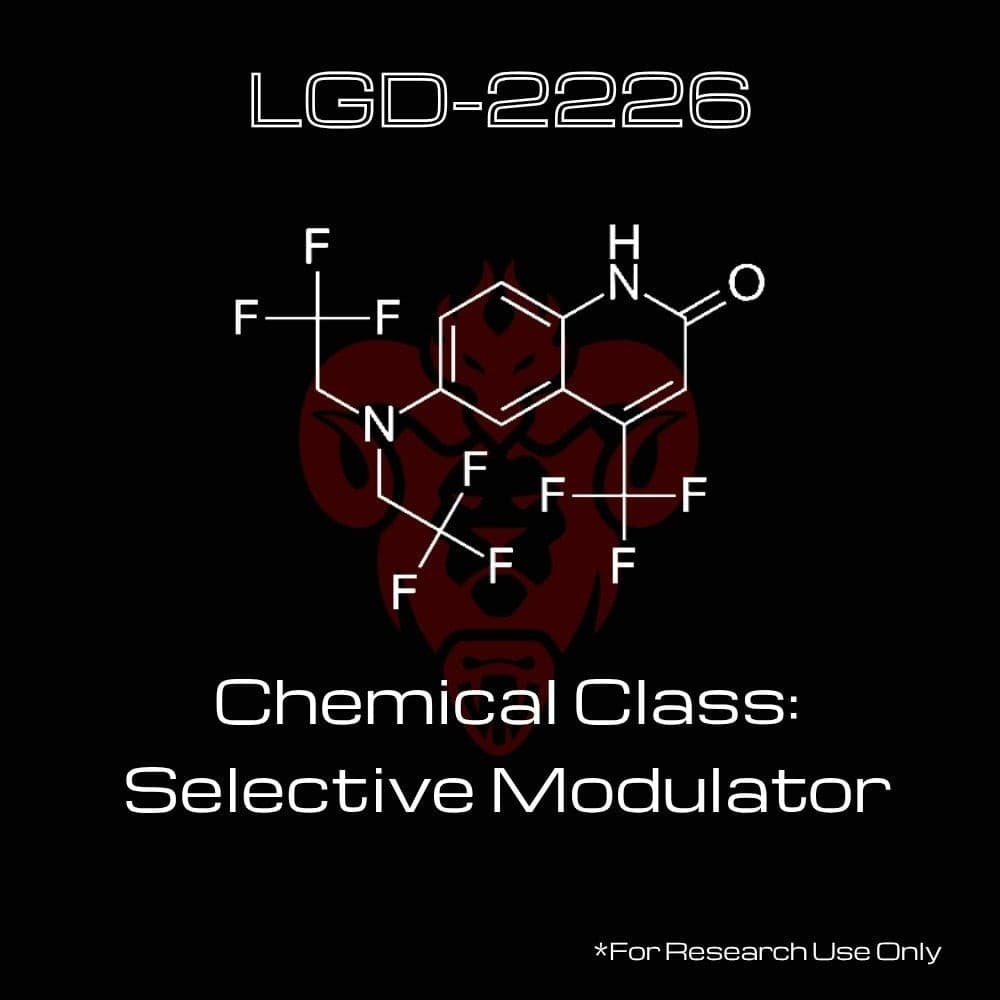
LGD-2226 was discovered by the research group at Ligand Pharmaceuticals in San Diego and formally described in 2006 across two companion papers, a chemistry report in the Journal of Medicinal Chemistry by van Oeveren and colleagues and a pharmacology report in Endocrinology by Miner and colleagues. The molecule belongs to a series of 6-dialkylamino-4-trifluoromethylquinolin-2(1H)-ones identified during an effort to create orally available, non-steroidal androgens.
Its stated purpose was to capture the bone- and muscle-building benefits of testosterone while sharply reducing the prostate-stimulating and other side effects that limit conventional androgen therapy. In rodent studies it proved fully active on muscle and bone, enhanced bone mechanical strength above baseline, and preserved male sexual behavior, all while producing much less prostate growth than classical androgens. As one of the earliest well-documented selective androgen receptor modulators, LGD-2226 helped establish the proof of concept that tissue selectivity through the androgen receptor was achievable, laying groundwork for the broader SARM field.
Reputation
LGD-2226 holds an honored place in pharmacology as a foundational example of the SARM idea made real, cited repeatedly in reviews as evidence that a single molecule can act as a strong anabolic signal in muscle and bone yet remain relatively quiet in the prostate. Researchers were struck that it improved not only muscle and bone mass but also bone strength and sexual function in animals, and that these benefits arose without conversion to estrogen.
Because it is orally active, it pointed toward the convenience that later SARMs would pursue in place of injectable steroids. It is important to be candid that LGD-2226 remained an investigational compound and was never advanced into the large human trials needed to confirm efficacy or long-term safety, so its human profile is undocumented. Its lasting value is scientific and historical, as a clean early demonstration of androgen-receptor tissue selectivity that shaped an entire class.
Subjective profileweighing the evidence above
Not recommended. The rodent muscle and bone data are genuine and the prostate sparing is real, but no human has taken it in a published trial, and SARMs as a class suppress testosterone and worsen cholesterol. Better-characterised options exist even inside that compromised category.
Where to buy
Suppliers
Vendors carrying LGD-2226, with live product details and codes. Links are affiliate links that support the wiki at no cost to you.
Kimera Chems
LGD-2226
Research
- 2006first citedDiscovery of 6-N,N-bis(2,2,2-trifluoroethyl)amino-4-trifluoromethylquinolin-2(1H)-one as a nove…
- 2013controlled trialThe safety, pharmacokinetics, and effects of LGD-4033, a novel nonsteroidal oral, selective and…
- 2020most recentSelective androgen receptor modulators: the future of androgen therapy?
- 1.An orally active selective androgen receptor modulator is efficacious on bone, muscle, and sex function with reduced impact on prostate
- 2.Selective Androgen Receptor Modulators: Current Knowledge and Clinical Applications
- 3.Selective androgen receptor modulators: the future of androgen therapy?
- 4.The safety, pharmacokinetics, and effects of LGD-4033, a novel nonsteroidal oral, selective androgen receptor modulator, in healthy young men
- 5.Discovery of 6-N,N-bis(2,2,2-trifluoroethyl)amino-4-trifluoromethylquinolin-2(1H)-one as a novel selective androgen receptor modulator
5 listed here; entry last updated August 2026
Reviews
My notesprivate to this device
FAQ
Has LGD-2226 been tested in people?
No; the published evidence is all preclinical rodent work. There are no human trials, so its human effects and safety are unknown.
Is it legal or approved?
It is an investigational compound not approved for human use anywhere. It is sold only as a research chemical.
How is it different from testosterone?
In animals it aimed for muscle and bone benefits with less prostate stimulation; that tissue selectivity is the whole point of a SARM.
Limitations of the evidence
- Human safety data are not established
Adverse effects
- Some suppression of natural testosterone is expected, as with androgens
- Lipid and cholesterol shifts are common across SARMs
- No long-term human toxicology data exist
Notes and cautions
- Grey-market purity is worth verifying