
spec sheet10 rows
Levodopa + carbidopa is a fixed-dose combination medication used chiefly to treat Parkinson's disease. Levodopa is a precursor that the brain converts into dopamine, the neurotransmitter that is depleted in the disease, while carbidopa prevents levodopa from being broken down before it reaches the brain. Sold under brand names such as Sinemet, the pairing remains the most effective symptomatic treatment for Parkinson's disease.
- still the most effective symptom control in Parkinson's
- decades on, nothing has displaced it
- carbidopa protects the dose so more reaches the brain
- eases the stiffness and slowness directly
- gives back everyday movement and ease
- several dosing forms allow fine titration
- Nausea
- Dizziness and drowsiness
- Low blood pressure on standing
Overview
Levodopa combined with carbidopa is a fixed-dose medication that has been a cornerstone of Parkinson's disease treatment for decades. Parkinson's disease is marked by the loss of dopamine-producing neurons, and because dopamine itself cannot cross the blood-brain barrier, therapy instead supplies levodopa, an amino acid precursor that the brain converts into dopamine [1]. Carbidopa is added because, on its own, much of an oral levodopa dose is converted to dopamine in the bloodstream before reaching the brain, which both wastes the drug and causes nausea; carbidopa blocks that peripheral conversion without entering the brain, so more levodopa gets through and side effects are reduced [1].
Levodopa's value in Parkinson's disease was established in the 1960s through the work of George Cotzias and others, and combining it with a decarboxylase inhibitor such as carbidopa followed soon after. The combination is marketed under names including Sinemet, with extended-release and other formulations such as Rytary and an intestinal gel sold as Duopa. It is available as a generic medicine and is listed on the World Health Organization's Model List of Essential Medicines.
The medication relieves the core motor symptoms of Parkinson's disease, including slowness, stiffness, and tremor, though it treats symptoms rather than halting the underlying disease. In the ELLDOPA dose-ranging trial, levodopa improved symptoms in a dose-dependent way and did not appear to hasten clinical decline, although higher amounts were more likely to trigger motor complications [2]. Beyond Parkinson's disease, the combination is used for dopa-responsive dystonia and sometimes for restless legs syndrome.
With long-term use, many patients develop motor fluctuations, in which the benefit of each dose wears off before the next, and levodopa-induced dyskinesia, which are involuntary writhing movements. These complications are thought to stem partly from the pulsatile, on-and-off way that standard oral dosing stimulates dopamine receptors. To smooth out delivery, a levodopa-carbidopa intestinal gel can be infused continuously through a tube into the small intestine; in controlled trials this reduced off-time and increased useful on-time in advanced disease [3]. Deep brain stimulation is another option at that stage.
Levodopa + carbidopa is a prescription medicine supplied as immediate-release and extended-release tablets, an orally disintegrating tablet, and the enteral gel. Common side effects include nausea, dizziness, drowsiness, and low blood pressure on standing, while longer-term or higher-dose use is associated with dyskinesia, hallucinations, and, in some people, impulse-control problems such as compulsive gambling or hypersexuality driven by dopaminergic stimulation.
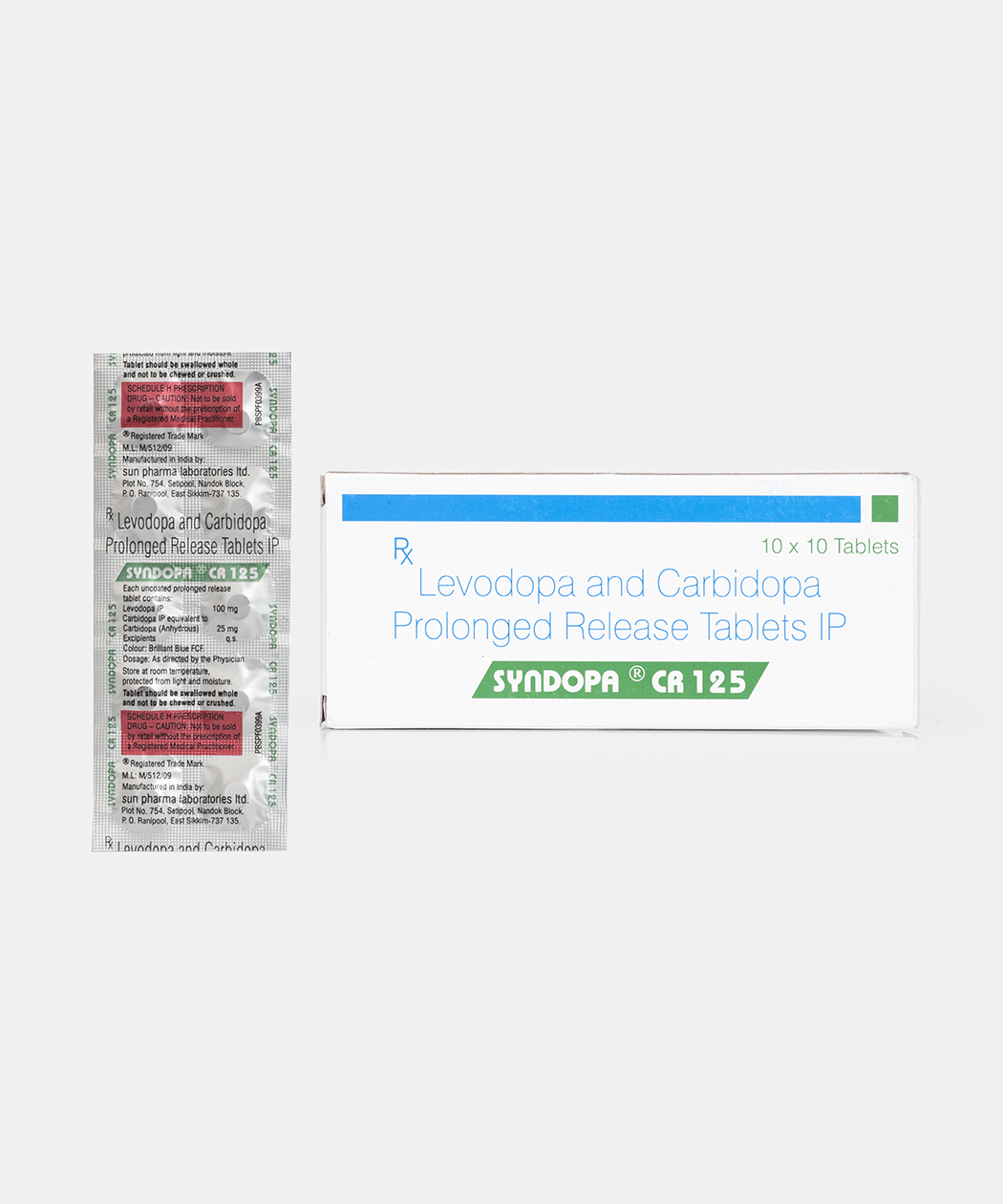
- The brand name Sinemet comes from Latin roughly meaning without vomiting, reflecting carbidopa's role in curbing the nausea levodopa alone can cause.
- Dopamine itself cannot be given as a drug for Parkinson's because it cannot cross the blood-brain barrier; levodopa, its precursor, can.
- Carbidopa never enters the brain; it works entirely in the body to protect levodopa so more of it reaches its target.
Mechanism
Parkinson's disease results from the progressive loss of -producing neurons in a brain region called the substantia nigra, leaving the movement circuits short of dopamine. Dopamine given directly cannot cross the , so levodopa, its immediate metabolic precursor, is used instead because it can enter the brain, where the enzyme aromatic L-amino acid decarboxylase converts it into dopamine [1].
Carbidopa is a decarboxylase inhibitor that cannot cross into the brain itself; by blocking the same enzyme in the rest of the body, it stops levodopa from being turned into in the bloodstream, which increases the fraction reaching the brain and reduces peripheral effects such as nausea [1]. The restored stimulates striatal dopamine receptors and improves movement. Over time, the intermittent nature of oral dosing produces swings in brain dopamine levels that are linked to wearing-off and to levodopa-induced dyskinesia, which is part of the rationale for continuous delivery methods [3].
receptor fingerprint
Aromatic L-amino acid decarboxylase (brain)activates
DOPA decarboxylase (body)inhibits
Striatal receptorsagonist
Nigrostriatal pathwayactivates
Large neutral amino acid transporter (LAT1)modulates
Dosingtypical ranges, not medical advice
interested in protocols and clinical dosages? make an account to see them! ^_^
Safetyrisks and cautions, not medical advice
This combination is prescription only. Early on it can cause nausea and dizziness on standing, and with long term use many people develop involuntary movements and wearing off between doses. Hallucinations, confusion, sudden sleepiness and impulse control problems such as gambling can occur. It should not be stopped suddenly, as that can trigger a dangerous reaction, and it must not be combined with nonselective MAOI antidepressants because of the risk of a blood pressure crisis. Dopamine blocking drugs like metoclopramide and typical antipsychotics work against it and are best avoided.
History
The therapeutic story of levodopa began in the 1960s, when the pioneering work of George Cotzias demonstrated that high oral doses could dramatically relieve the symptoms of Parkinson's disease, building on the discovery that the disorder involves a loss of brain dopamine. Early levodopa therapy was limited by severe nausea and cardiovascular effects caused by its conversion to dopamine outside the brain.
The solution came with carbidopa, a peripheral decarboxylase inhibitor that cannot cross into the brain; combining the two allowed more levodopa to reach its target while sharply reducing peripheral side effects. The fixed-dose combination was approved in the United States in 1975 under the brand name Sinemet, a name meaning without vomiting. Decades of use revealed that intermittent oral dosing contributes to motor fluctuations and dyskinesia, spurring the development of controlled-release and continuous-delivery formulations. The pairing remains on the World Health Organization's List of Essential Medicines.
Reputation
Levodopa combined with carbidopa is universally regarded as the single most effective symptomatic treatment for Parkinson's disease, a status it has held for roughly half a century. For most patients it produces a striking improvement in slowness, stiffness, and tremor, often restoring function in a way no other therapy matches. The addition of carbidopa is a large part of its favorable reputation, greatly reducing the nausea that once made levodopa difficult to tolerate.
Its principal long-term limitation is well recognized; after years of use, the intermittent nature of oral dosing tends to produce wearing-off and involuntary movements called dyskinesia. This challenge has driven genuine innovation, including intestinal gel and subcutaneous infusion systems shown in controlled trials to smooth out motor fluctuations. As an essential, life-changing medicine, the combination remains the foundation of Parkinson's care.
Subjective profileweighing the evidence above
Still the most effective symptom control in Parkinson's, and nothing has displaced it. The trade-offs arrive over years as dyskinesia, wearing off between doses and occasional impulse-control problems, and it must never be stopped abruptly. A neurologist's drug, titrated dose by dose.
Where to buy

Suppliers
Vendors carrying Levodopa + Carbidopa, with live product details and codes. Links are affiliate links that support the wiki at no cost to you.
PCT.Zone
Levodopa + Carbidopa
Research
- 2005first citedDoes levodopa slow or hasten the rate of progression of Parkinson's disease?
- 2014controlled trialContinuous intrajejunal infusion of levodopa-carbidopa intestinal gel for patients with advance…
- 2022most recentSafety and efficacy of continuous subcutaneous foslevodopa-foscarbidopa in patients with advanc…
- 1.Diagnosis and Treatment of Parkinson Disease: A Review.
- 2.Does levodopa slow or hasten the rate of progression of Parkinson's disease?
- 3.Continuous intrajejunal infusion of levodopa-carbidopa intestinal gel for patients with advanced Parkinson's disease: a randomised, controlled, double-blind, double-dummy study.
- 4.Safety and efficacy of continuous subcutaneous foslevodopa-foscarbidopa in patients with advanced Parkinson's disease: a randomised, double-blind, active-controlled, phase 3 trial
4 listed here; entry last updated August 2026
Reviews
My notesprivate to this device
FAQ
Why is carbidopa added to levodopa?
Carbidopa stops levodopa turning into dopamine before it reaches the brain, which boosts its effect and cuts nausea.
Should I take it with food?
Protein rich meals can block absorption, so take it about 30 to 60 minutes before eating when you can.
What is the wearing off effect?
Over time each dose may last less long, so symptoms return before the next dose; your doctor can adjust timing or add drugs.
What are dyskinesias?
These are extra involuntary movements that can appear with long term use or higher doses.
Can I stop it suddenly?
No. Stopping abruptly can cause a serious reaction, so any changes should be gradual and supervised.
Adverse effects
- Nausea
- Dizziness and drowsiness
- Low blood pressure on standing
- Involuntary movements (dyskinesia) with long-term use
- Impulse-control problems in some people
Notes and cautions
- Wearing-off of benefit between doses