
spec sheet12 rows
Sipagladenant (development code KW-6356; CAS 858979-50-7) is an investigational, orally active, highly selective antagonist and inverse agonist of the adenosine A2A receptor developed by Kyowa Kirin for Parkinson's disease. It belongs to the non-dopaminergic class of antiparkinsonian agents typified by istradefylline, but in vitro studies distinguish it by insurmountable antagonism, very slow receptor dissociation, and inverse-agonist activity that suppresses the constitutive signaling of the A2A receptor. Because A2A receptors are densely co-expressed with dopamine D2 receptors as A2A-D2 heteromers on striatopallidal neurons of the indirect motor pathway, blockade of A2A relieves the adenosine-mediated brake on D2 signaling and improves motor output without directly stimulating dopamine receptors. In 1-methyl-4-phenyl-1,2,3,6-tetrahydropyridine (MPTP) treated marmosets it reversed motor disability as monotherapy, produced greater anti-parkinsonian activity than istradefylline, and potentiated levodopa with a low propensity to induce dyskinesia; a placebo-controlled trial in early, untreated Parkinson's disease reported improvement in MDS-UPDRS Part III scores. Sipagladenant remains a clinical-stage compound; it is not approved for any indication, and much of its long-term efficacy and safety profile is still being characterized.
- Blocks adenosine A2A to lift dopamine tone
- Studied for Parkinson's motor symptoms
- Worked alone in early, untreated disease studies
- Amplifies levodopa with low dyskinesia in primates
- Long half life supports once daily dosing
- Explored for cognitive benefit too
- Constipation
- Nasopharyngitis (cold-like symptoms)
- Class-level risk of dyskinesia when combined with levodopa
Overview
KW-6356, assigned the international nonproprietary name sipagladenant, is an investigational small-molecule drug that acts on the adenosine A2A receptor [1]. It was developed by the Japanese pharmaceutical company Kyowa Kirin as a candidate treatment for Parkinson's disease, following the company's earlier adenosine A2A antagonist istradefylline [1][2]. The compound is taken by mouth and has been evaluated both as a stand-alone therapy and as an addition to levodopa [2][3].
What distinguishes KW-6356 from first-generation antagonists is its mode of action at the receptor. In laboratory studies it functioned as both an antagonist and an inverse agonist, and it bound in an insurmountable manner with a slow off-rate; by contrast, istradefylline acts as a surmountable antagonist [1]. Researchers determined the crystal structures of the receptor in complex with each drug and linked KW-6356's inverse agonism and insurmountable binding to particular molecular interactions in the binding site, differences expected to influence how the two compounds behave in the body [1].
In preclinical experiments using marmosets treated with the neurotoxin MPTP, a standard primate model of Parkinson's disease, oral KW-6356 reduced motor disability on its own, producing a larger anti-parkinsonian effect than istradefylline, and repeated dosing caused little dyskinesia [3]. When combined with levodopa, it enhanced the drug's benefit across a range of levodopa doses while keeping the risk of dyskinesia low [4].
In clinical development, phase 1 studies in healthy volunteers found the compound to be well tolerated across the doses tested and characterized its pharmacokinetics, including a long elimination half-life and an active metabolite [5]. A randomized, double-blind, placebo-controlled trial then evaluated once-daily KW-6356 as monotherapy in people with early, untreated Parkinson's disease and reported greater improvement in motor scores than placebo over twelve weeks; the most common side effects were constipation and nasopharyngitis [2].
Despite these encouraging findings, KW-6356 remains an experimental agent that has not received marketing approval, and its longer-term efficacy and safety are still being established through ongoing research [2].
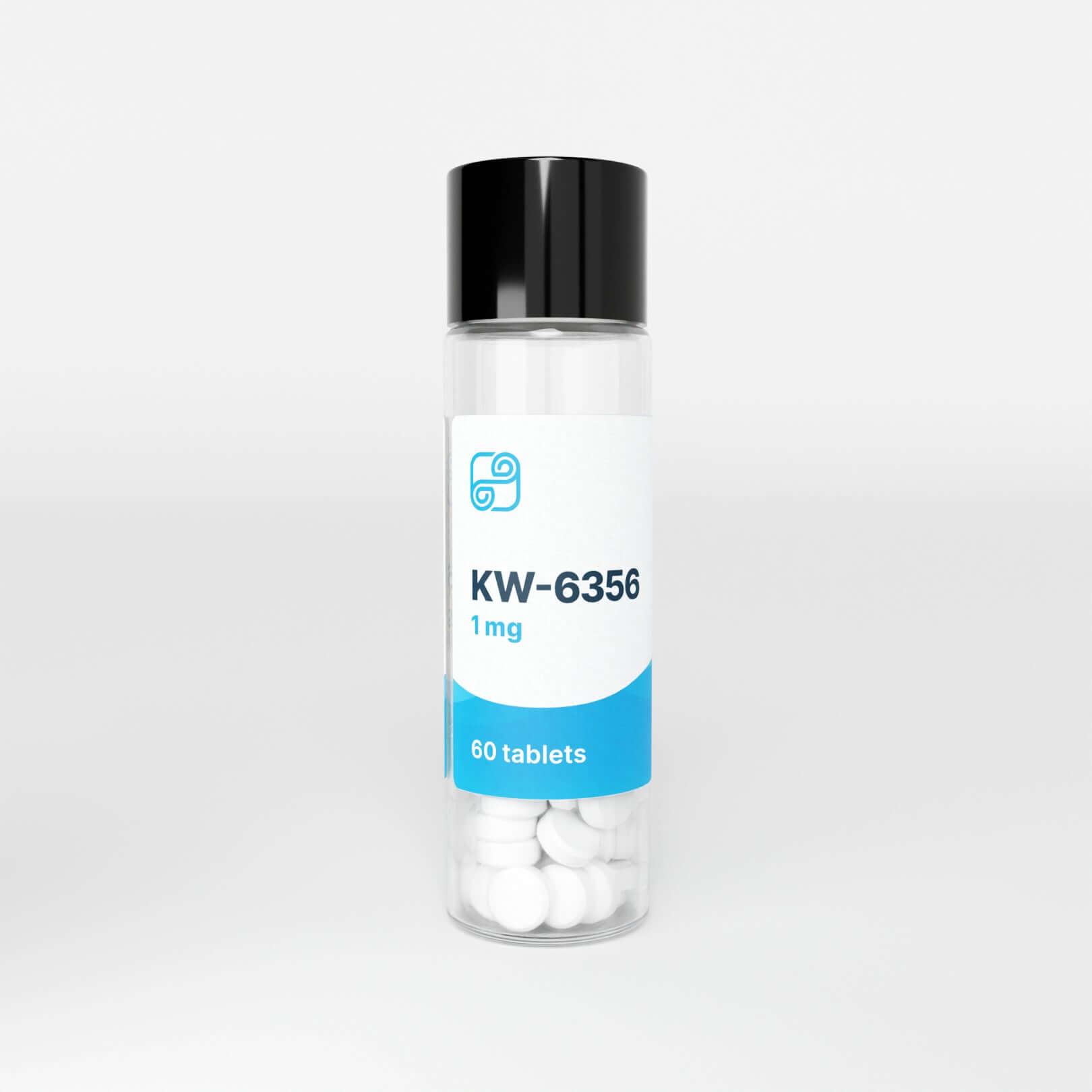
- Unlike the approved drug istradefylline, KW-6356 is an inverse agonist, meaning it shuts down the A2A receptor's baseline activity rather than merely blocking adenosine.
- It binds the receptor so tightly and lets go so slowly that rising adenosine cannot simply compete it off, a property called insurmountable antagonism.
- In marmoset models of Parkinson's disease, KW-6356 relieved motor disability even on its own, a feat the first-generation A2A drug did not manage as monotherapy.
Mechanism
The A2A receptor is a Gs-coupled G-protein-coupled receptor concentrated in the striatum, where it is co-localized and forms A2A- heteromers with the D2 receptor on medium spiny neurons of the indirect (striatopallidal) pathway. Endogenous adenosine acting at A2A raises cyclic AMP and, through an interaction within the heteromer, lowers the affinity and signaling of the co-expressed D2 receptor; this opposes dopaminergic motor facilitation and contributes to the hypokinetic state of Parkinson's disease. By occupying the orthosteric pocket of the A2A receptor, sipagladenant blocks adenosine binding and, as an inverse , additionally suppresses the receptor's constitutive (-independent) activity, thereby releasing the D2 receptor from adenosine-mediated inhibition and restoring indirect-pathway balance without acting as a dopamine agonist.
Structural and functional studies indicate that sipagladenant differs pharmacologically from the first-generation A2A istradefylline. It binds with high affinity and dissociates very slowly from the human A2A receptor and behaves as an insurmountable antagonist, whereas istradefylline is surmountable; co-crystal structures implicate interactions with residues His250 and Trp246 in its inverse- behavior and contacts deep within the orthosteric pocket and the pocket lid in its insurmountable kinetics. These properties are hypothesized to underlie its efficacy as monotherapy in preclinical and early clinical Parkinson's disease, a setting in which istradefylline has not shown consistent monotherapy benefit; the clinical significance of the distinction remains under investigation.
receptor fingerprint
A2A receptorantagonist / inverse agonist
A1 receptorlow affinity (selectivity margin)
receptor (via A2A-D2 heteromer)indirect potentiation
Dosingtypical ranges, not medical advice
interested in protocols and clinical dosages? make an account to see them! ^_^
Safetyrisks and cautions, not medical advice
Sipagladenant is an investigational agent that has been evaluated only in phase 1 pharmacology studies and early-phase Parkinson's disease trials, so its safety profile is not fully established. In reported studies it was generally well tolerated; the most common treatment-emergent adverse events in a monotherapy trial were constipation and nasopharyngitis, and single oral doses up to 60 mg and multiple daily doses up to 24 mg were tolerated in healthy volunteers. As a drug class, adenosine A2A antagonists such as istradefylline can be associated with dyskinesia, nausea, dizziness, insomnia, and hallucinations, particularly when combined with levodopa, and these class-level risks may be relevant. No long-term or large-scale safety data are publicly available, and the compound is not approved for medical use in any jurisdiction. Not medical advice.
History
KW-6356, also known as sipagladenant, was developed by the Japanese pharmaceutical company Kyowa Kirin as a second-generation adenosine A2A receptor ligand for Parkinson's disease. It was designed to improve upon the company's own first-generation A2A antagonist, istradefylline, which is approved as an adjunct to levodopa for patients experiencing OFF episodes. Detailed in vitro pharmacology, reported in 2023, showed that KW-6356 differs from istradefylline in two important ways: it is not merely an antagonist but an inverse agonist that suppresses the receptor's baseline constitutive activity, and it binds in an insurmountable manner with a very slow dissociation rate, so rising adenosine levels cannot simply outcompete it.
Co-crystal structures of the receptor bound to each drug traced these distinct behaviors to specific contacts within and around the binding pocket. In MPTP-treated common marmoset models, KW-6356 produced anti-parkinsonian activity exceeding that of istradefylline, worked even as monotherapy, and enhanced the levodopa response with a low risk of dyskinesia. It has been studied in Parkinson's patients both alone and as an add-on to levodopa, and remains an investigational compound.
Reputation
KW-6356 has generated genuine interest among Parkinson's researchers as a potentially more capable successor to the first approved A2A receptor drug. Its distinguishing features are pharmacologically elegant: as an inverse agonist it switches off the receptor's resting activity rather than merely blocking adenosine, and its insurmountable, slowly reversing binding means it is not easily overwhelmed by the brain's own adenosine. These properties translated into meaningful advantages in animal models, where it outperformed istradefylline and, notably, showed activity even when given alone, something the older drug did not achieve as monotherapy.
Because it enhances movement circuitry indirectly, without supplying or directly stimulating dopamine, it carries a low risk of dyskinesia in preclinical testing, an attractive profile for long-term Parkinson's care. The candid qualifier is that it remains investigational, and its clinical performance in humans has yet to be fully established. As a mechanistically refined non-dopaminergic candidate, however, it is a promising molecule to watch.
Subjective profileweighing the evidence above
Worth watching, not worth buying. Monotherapy benefit in early Parkinson's is rare for an A2A antagonist and the low dyskinesia signal in primates is encouraging, but the human evidence is early-phase and thin, and it has no established use as a nootropic at all.
Where to buy
Suppliers
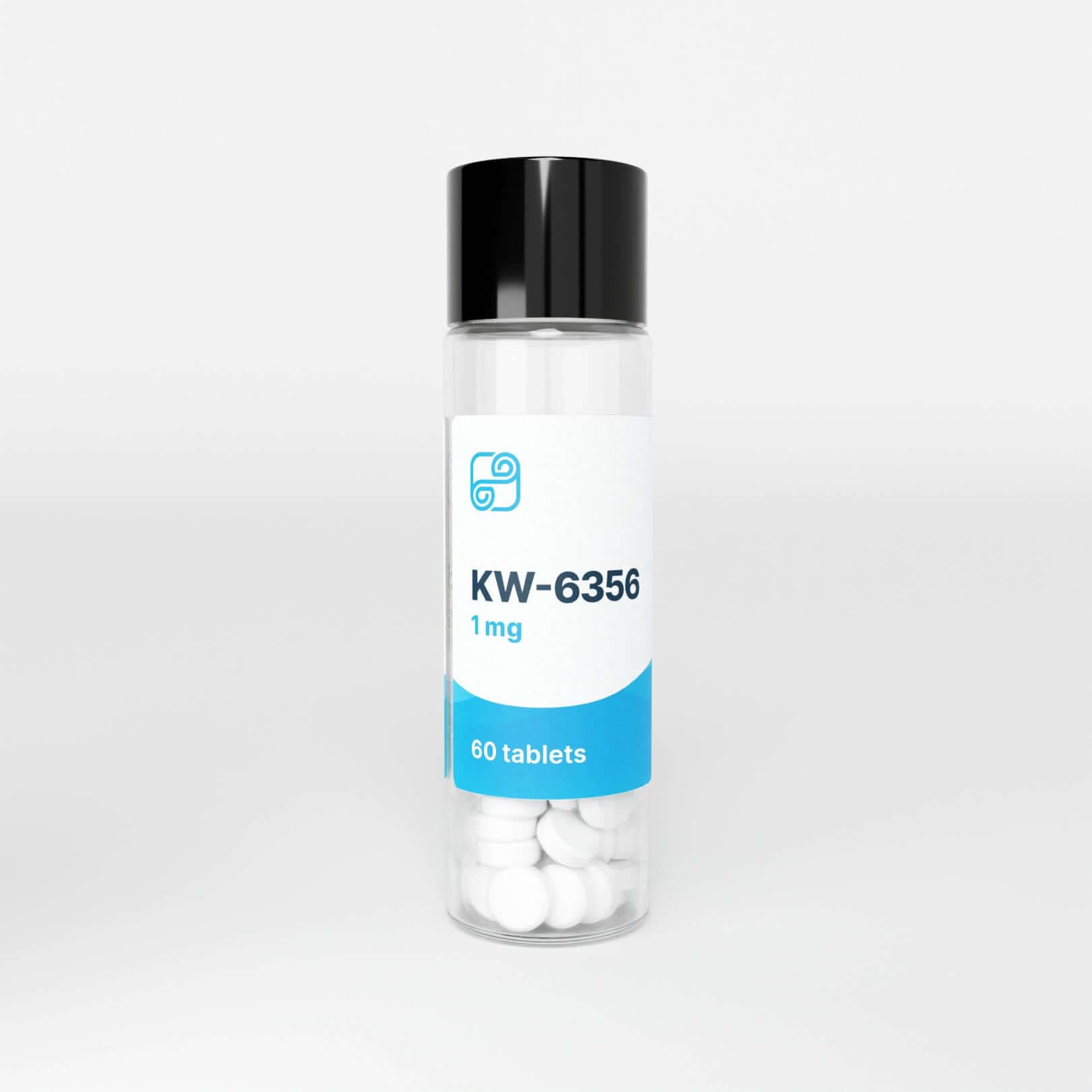
Vendors carrying Sipagladenant, with live product details and codes. Links are affiliate links that support the wiki at no cost to you.
Limitless Biochem🌐
KW-6356
Research
- 2010first citedPathophysiological roles for purines: adenosine, caffeine and urate.
- 2023most active year6 papers
- 2026most recentSafety Profile of Istradefylline in Parkinson's Disease: A Meta-Analysis of Randomized Controll…
- 1.In Vitro Pharmacological Profile of KW-6356, a Novel Adenosine A2A Receptor Antagonist/Inverse Agonist.
- 2.Anti-parkinsonian activity of the adenosine A2A receptor antagonist/inverse agonist KW-6356 as monotherapy in MPTP-treated common marmosets.
- 3.The adenosine A2A receptor antagonist/inverse agonist, KW-6356 enhances the anti-parkinsonian activity of L-DOPA with a low risk of dyskinesia in MPTP-treated common marmosets.
- 4.Randomized controlled trial of KW-6356 monotherapy in patients with early untreated Parkinson's disease.
- 5.Safety, Tolerability, and Pharmacokinetics of the Novel Adenosine A2A Antagonist/Inverse Agonist KW-6356 Following Single and Multiple Oral Administration in Healthy Volunteers.
- 6.Population Pharmacokinetics of the Novel Adenosine A2A Antagonist/Inverse Agonist KW-6356 and Its Active Metabolite Following Single and Multiple Oral Administration in Healthy Individuals and Patients with Parkinson's Disease.
- 7.Boolean analysis shows a high proportion of dopamine D2 receptors interacting with adenosine A2A receptors in striatal medium spiny neurons of mouse and non-human primate models of Parkinson's disease.
- 8.Allosteric Interactions between Adenosine A2A and Dopamine D2 Receptors in Heteromeric Complexes: Biochemical and Pharmacological Characteristics, and Opportunities for PET Imaging.
- 9.Essential Control of the Function of the Striatopallidal Neuron by Pre-coupled Complexes of Adenosine A2A-Dopamine D2 Receptor Heterotetramers and Adenylyl Cyclase.
- 10.L-DOPA-treatment in primates disrupts the expression of A2A adenosine-CB1 cannabinoid-D2 dopamine receptor heteromers in the caudate nucleus.
- 11.A2A Adenosine Receptor Antagonists and Their Efficacy in Rat Models of Parkinson's Disease.
- 12.Impact of Istradefylline on Levodopa Dose Escalation in Parkinson's Disease: ISTRA ADJUST PD Study, a Multicenter, Open-Label, Randomized, Parallel-Group Controlled Study.
17 listed here; entry last updated August 2026
Reviews
My notesprivate to this device
FAQ
How is sipagladenant different from istradefylline?
Both block the adenosine A2A receptor, but sipagladenant is an inverse agonist that also switches off the receptor's constitutive activity and binds in an insurmountable, slowly reversing way, whereas istradefylline is a surmountable antagonist. In animal models sipagladenant produced greater anti-parkinsonian activity and, unlike istradefylline, showed benefit as monotherapy; whether this becomes a clinical advantage is still being studied.
Is sipagladenant approved or available to buy?
No. It is an experimental, clinical-stage compound studied by Kyowa Kirin. It has completed phase 1 studies and early Parkinson's disease trials but is not approved by any regulator and is not sold as a medicine or supplement.
What is the A2A-D2 heteromer and why does it matter here?
In the striatum, adenosine A2A and dopamine D2 receptors physically pair up as a heteromer on neurons of the indirect movement pathway. Adenosine acting on A2A weakens D2 dopamine signaling; by blocking A2A, sipagladenant lifts that suppression and helps restore motor balance, which is how an adenosine-targeting drug can help a dopamine-deficiency disease.
How does blocking A2A help dopamine?
Adenosine A2A receptors oppose dopamine signaling, so blocking them can indirectly support dopamine activity. This is the rationale in Parkinson's.
Why is it studied for cognition?
A2A antagonism is being explored for effects on learning and neuroprotection. Research is ongoing.
Is it an approved drug?
It's a newer investigational compound rather than an established medication in most regions. Human data are still developing.
What is dyskinesia?
It refers to involuntary movements sometimes seen with dopaminergic therapies in Parkinson's. It's a monitored side effect.
Limitations of the evidence
- Longer-term efficacy and safety are still being studied
- Every human trial to date was run in Japan and, in phase 1, in a mixed Japanese and White healthy population; no other population has been studied.
- The phase 2 result is a twelve-week change on a rating scale in early untreated Parkinson's disease, not a demonstration of disease modification.
- Nothing in the published record measures cognition in healthy people, which is the use the research-chemical market sells it for.
- The active metabolite M6 has its own pharmacokinetics, so exposure is not described by the parent compound alone.
Adverse effects
- Constipation
- Nasopharyngitis (cold-like symptoms)
- Class-level risk of dyskinesia when combined with levodopa
- Possible nausea, dizziness, insomnia, or hallucinations (A2A-antagonist class effects)
- In an early Parkinson's trial the most common effects were constipation and nasopharyngitis
Notes and cautions
- It is an experimental drug that has not been approved for use
- It acts through the adenosine system rather than by supplying dopamine
- Sold under the vendor name Metabolite 6, whose listing carries identifiers for two different molecules: the CAS number, molecular formula and mass are the parent drug, while the IUPAC name printed alongside them describes a hydroxymethyl compound, which is what an oxidative metabolite of the parent looks like. Anyone buying it cannot tell from the listing which one it is.
- There is no such compound as SNW-6356; that name appears to be a misreading of KW-6356 and returns nothing in either the vendor catalogue or PubMed.
- It is a genuinely different pharmacology from the first-generation adenosine A2A antagonist istradefylline, not a dose variation: it is an inverse agonist with insurmountable antagonism and a very slow off-rate, where istradefylline is a surmountable antagonist [1].