
spec sheet15 rows
Selegiline, also known as L-deprenyl, is a selective and irreversible inhibitor of monoamine oxidase B (MAO-B), used in the treatment of Parkinson's disease and, in a transdermal patch form, of major depressive disorder. At low doses it selectively spares MAO-A, which avoids the dietary tyramine restrictions required by older monoamine oxidase inhibitors, though this selectivity is lost at higher doses. It is marketed under names including Eldepryl, Zelapar, and, as a skin patch, Emsam.
- Preserves dopamine by shutting down MAO-B
- Mood support with a long clinical pedigree
- Neuroprotective angle in the aging brain
- Long studied in longevity research
- Selective for MAO-B, unlike older MAOIs
- Insomnia
- Dizziness
- Nausea or dry mouth
Overview
Selegiline is a small-molecule monoamine oxidase inhibitor that, at usual therapeutic doses, selectively and irreversibly blocks the B form of the enzyme monoamine oxidase while sparing the A form [1]. Chemically it is the levorotatory enantiomer of deprenyl, and it is partly metabolized in the body to levomethamphetamine and levoamphetamine [1]. At higher doses this MAO-B selectivity breaks down and the drug also inhibits MAO-A [1].
Its first major use was in Parkinson's disease. By inhibiting MAO-B, which breaks down dopamine in the brain, selegiline raises dopamine levels and can be used alone in early disease or as an adjunct to levodopa in more advanced disease [1]. In the large DATATOP trial in early, untreated Parkinson's disease, selegiline significantly delayed the point at which patients needed to start levodopa, although whether this reflected a genuine slowing of the disease or simply a symptomatic effect remained unresolved [2].
Selegiline is also used for depression. Because taking a monoamine oxidase inhibitor by mouth exposes the gut to the enzyme and creates the risk of a tyramine-induced rise in blood pressure, known as the cheese effect, a transdermal patch was developed that delivers the drug through the skin and largely bypasses this exposure [1][3]. Marketed as Emsam, the selegiline transdermal system is approved for major depressive disorder, and at its lowest dose it can be used without the dietary restrictions otherwise required of MAO inhibitors [3][4]. It is notable among antidepressants for not causing weight gain or sexual dysfunction [4].
Selegiline is available as oral tablets and orally disintegrating tablets for Parkinson's disease and as a transdermal patch for depression [1][4]. It is a prescription medication and, unlike stimulant relatives, is generally considered to lack meaningful abuse potential [4]. It has also attracted informal interest as a possible cognitive or anti-aging agent, though such uses are not established [1].
The principal safety concerns of selegiline stem from its monoamine oxidase inhibition. Combining it with serotonergic drugs such as SSRIs, SNRIs, certain opioids, or dextromethorphan can precipitate serotonin syndrome, and high oral doses taken with tyramine-rich foods or sympathomimetic drugs can cause dangerous rises in blood pressure [1][3]. Common milder effects include insomnia, dizziness, nausea, dry mouth, and, with the patch, application-site reactions [3][4].
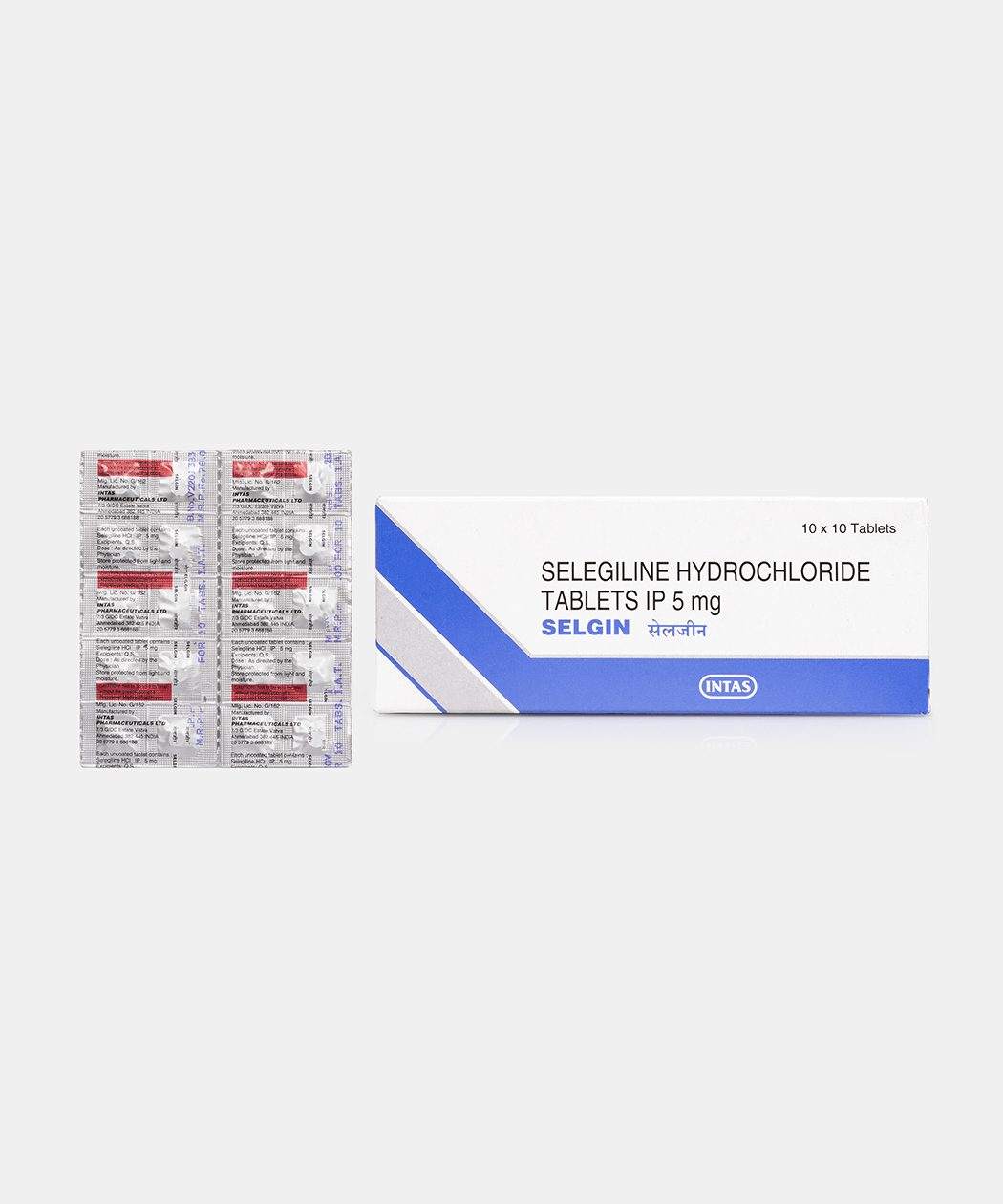
- It was developed by the Hungarian pharmacologist Jozsef Knoll, who first described its selective, irreversible blockade of MAO-B.
- The body partly converts it into l-methamphetamine and l-amphetamine, which may contribute modestly to its effects.
- Its Emsam patch, approved in 2006, was the first transdermal treatment for depression, and at its lowest dose it lifts the usual dietary tyramine restrictions.
Mechanism
Selegiline works primarily by irreversibly inhibiting monoamine oxidase B, one of the two enzymes that break down monoamine neurotransmitters [1]. MAO-B is especially important for the metabolism of in the brain, so inhibiting it increases dopamine availability, which underlies the benefit in Parkinson's disease [1][2]. At low doses the drug leaves MAO-A largely untouched, which is why it avoids the tyramine interaction seen with nonselective inhibitors, but at higher doses it inhibits MAO-A as well and behaves like a classic monoamine oxidase inhibitor, raising and and restoring the risk of the cheese effect [1].
The antidepressant action of the transdermal system is thought to depend on this broader MAO inhibition in the brain, achieved while minimizing enzyme exposure in the gut and liver [3][4]. Selegiline is also metabolized to amphetamine derivatives that can modestly promote catecholamine release, and it has been proposed to have neuroprotective properties, though these have not been confirmed in humans [1].
receptor fingerprint
MAO-Birreversible inhibitor
reuptakeinhibits
Neuroprotection (propargylamine)protects neurons
Dosingtypical ranges, not medical advice
interested in protocols and clinical dosages? make an account to see them! ^_^
Safetyrisks and cautions, not medical advice
Kept in the low 1 to 5 mg range, selegiline stays selective for MAO-B and is generally well tolerated, with insomnia, dizziness, or nausea the usual mild effects; morning dosing helps sleep. The big caution is the 'cheese effect': as the dose climbs and MAO-A gets inhibited, aged and fermented tyramine-rich foods can trigger a hypertensive reaction, so dose discipline matters. Do not combine it with SSRIs, SNRIs, other MAOIs, tramadol, or dextromethorphan given serotonin syndrome risk; that is the interaction to respect most. It converts to trace amphetamines, so it can feel stimulating. It is a prescription drug for Parkinson's and, as the EMSAM patch, for depression. Not medical advice.
Interactionsdocumented pairs only, not exhaustive
Selegiline is a selective MAO-B inhibitor at low doses, but selectivity is lost at higher oral or transdermal doses, which drives its well-documented interaction warnings. Co-administration with serotonergic agents; SSRIs, SNRIs, tricyclics, meperidine, tramadol, methadone, dextromethorphan, St John's wort, and other MAO inhibitors; is contraindicated because of the risk of serotonin syndrome, and label washout periods apply (for example, five weeks after fluoxetine). Combination with sympathomimetics, pseudoephedrine, or tyramine-rich foods can precipitate hypertensive crisis, so dietary tyramine restriction is advised at higher transdermal doses. It is also contraindicated with other MAOIs and with carbamazepine/oxcarbazepine per the transdermal (Emsam) label. This is research information, not medical advice.
Checking a whole stack? Run it through interactions + stacks.
History
Selegiline, originally designated E-250 and later known as l-deprenyl, was developed in Hungary in the 1960s by the pharmacologist Jozsef Knoll and colleagues at the Chinoin company, with the molecule synthesized by Zoltan Ecseri. Knoll characterized its defining feature, a selective and irreversible inhibition of monoamine oxidase B, distinguishing it from the nonselective monoamine oxidase inhibitors then in use.
This selectivity meant that at low doses it largely spared monoamine oxidase A, avoiding the dangerous interaction with dietary tyramine known as the cheese effect. Selegiline was introduced for the treatment of Parkinson's disease, where inhibiting the breakdown of dopamine offered clinical benefit, and it is marketed under names such as Eldepryl and Zelapar. In 2006 a transdermal patch formulation, Emsam, was approved by the United States Food and Drug Administration for major depressive disorder.
Reputation
Selegiline enjoys a durable reputation as a well-understood MAO-B inhibitor with a distinctive place in both neurology and psychiatry. In Parkinson's disease it has long been used to extend dopaminergic tone, and its transdermal patch offered a clever solution to an old problem, delivering enough drug to treat depression through the brain while minimizing exposure in the gut and liver so that, at the lowest patch strength, the traditional tyramine dietary restrictions can be relaxed. Its selectivity at low doses is a genuine advantage over older, nonselective inhibitors. Candor is warranted on two points; that selectivity is lost at higher doses, restoring the need for dietary caution, and its frequently cited neuroprotective properties, while biologically intriguing, have not been confirmed in humans. It remains a respected and still-relevant option.
Subjective profileweighing the evidence above
Genuinely useful at low doses, where MAO-B selectivity holds and the dopaminergic and neuroprotective case is real. Dose discipline is the whole game, because climbing higher brings back MAO-A inhibition and the tyramine problem. It is a prescription drug, and the serotonergic interaction list deserves real respect.
Where to buy
1 other outlet

Suppliers
Vendors carrying Selegiline, with live product details and codes. Links are affiliate links that support the wiki at no cost to you.
PCT.Zone
Selegiline
RUPharma🌐
Selegiline
Research
- 1984first citedl-Deprenyl in atypical depressives.
- 1994most active year9 papers
- 2025most recentL-deprenyl extends lifespan across mammalian species: A meta-analysis of 22 longevity experimen…
- 1.Inhibitors of MAO-A and MAO-B in Psychiatry and Neurology
- 2.An interim report of the effect of selegiline (L-deprenyl) on the progression of disability in early Parkinson's disease. The Parkinson Study Group.
- 3.Seligiline transdermal system in depression.
- 4.Critical appraisal of selegiline transdermal system for major depressive disorder
- 5.How Selegiline ((-)-Deprenyl) Slows Brain Aging (Joseph Knoll, Bentham Science, 2012)
- 6.Are metabolites of l-deprenyl (selegiline) useful or harmful? Indications from preclinical research.
- 7.Biochemical actions of l-deprenyl (selegiline).
- 8.Pharmacokinetic aspects of l-deprenyl (selegiline) and its metabolites.
- 9.Pharmacology of selegiline.
- 10.Therapy with l-deprenyl (selegiline) and relation to abuse liability.
- 11.Selegiline (L-Deprenyl) Mitigated Oxidative Stress, Cognitive Abnormalities, and Histopathological Change in Rats: Alternative Therapy in Transient Global Ischemia.
- 12.Metabolism of selegiline [(-)-deprenyl)].
25 listed here; entry last updated August 2026
Reviews
My notesprivate to this device
FAQ
How does selegiline work?
It inhibits monoamine oxidase B, which slows the breakdown of dopamine. This keeps more dopamine available in the brain.
Why take it in the morning?
It can be stimulating and may disturb sleep if taken late. Morning use is common to reduce this.
Is the tyramine 'cheese effect' a concern?
At lower exposures its MAO-B selectivity limits this, but selectivity can fade at higher amounts. Food and drug interactions matter and warrant medical guidance.
What conditions is it associated with?
It is used in Parkinson's disease and, in a patch form, for depression. It is also discussed for aging and neuroprotection.
Can selegiline actually slow brain aging?
That's the case Joseph Knoll (who discovered it) spent decades building. His argument is that low, MAO-B-selective doses support the catecholaminergic neurons that fade with age, and in animal studies deprenyl extended lifespan. It's a genuinely interesting thesis, but the firmest human evidence is still for Parkinson's and depression, so treat the anti-aging angle as promising rather than settled.
Adverse effects
- Insomnia
- Dizziness
- Nausea or dry mouth
Notes and cautions
- Application-site reactions with the patch
- Risk of serotonin syndrome with serotonergic drugs
- Tyramine interactions at higher doses