
spec sheet10 rows
BPAP is an experimental laboratory compound created in the late 1990s by the Hungarian and Japanese team behind selegiline; it has never been approved as a medicine in any country. It is described as a "monoaminergic activity enhancer", meaning that in animal tissue it makes dopamine, noradrenaline and serotonin neurons release more transmitter when they fire, rather than forcing transmitter out the way amphetamine does; at higher concentrations it also blocks dopamine and noradrenaline reuptake. Essentially all the evidence comes from rats, mice and cell cultures, and almost all of it was produced by the two groups with a stake in the compound, namely Knoll's Semmelweis University laboratory and Fujimoto Pharmaceutical Corporation. No clinical trial in humans has ever been run or even registered, so claims about memory, mood, longevity or anti-aging benefit in people rest on no human evidence at all.
- Potently enhances dopamine signaling
- Boosts drive and motivation
- Lifts serotonin activity for mood
- A low-dose enhancer, not a blunt stimulant
- Makes neurons release more when they fire
- Neuroprotective, catecholamine-preserving effects
- Can feel overstimulating
- Some jitteriness
Overview
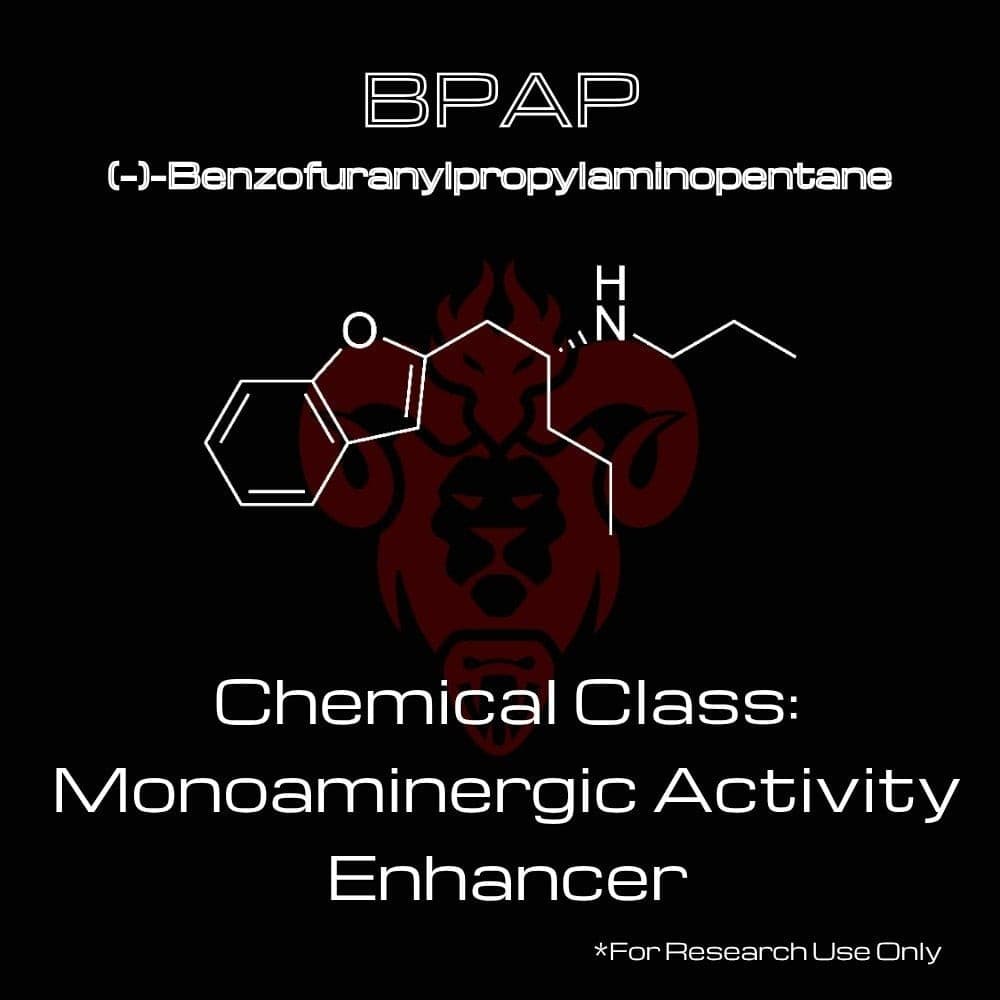
BPAP, chemically R-(-)-1-(benzofuran-2-yl)-2-propylaminopentane, is a synthetic compound belonging to the class of catecholaminergic and serotonergic activity enhancers, sometimes simply called enhancer substances. It was developed in the laboratory of the Hungarian pharmacologist Joseph Knoll, the same researcher behind selegiline (deprenyl), as part of his theory that the brain contains an endogenous enhancer regulation, a mechanism by which certain neurons can be tuned to release more transmitter when they fire [4]. BPAP was derived from the tryptamine side of this chemistry, which tilts it toward serotonin as well as the catecholamines dopamine and norepinephrine [3].
The defining feature of an enhancer is that, unlike a releaser such as amphetamine or methamphetamine that forces non-vesicular transmitter out of the cell, BPAP amplifies the neuron's own impulse-evoked, vesicular release; when a neuron fires, BPAP makes that firing release more transmitter [1]. Research places it among the most potent enhancers known, reported as roughly a hundred times more potent than selegiline at enhancing catecholaminergic neuronal activity [3]. In animal and cell studies, BPAP improved mood in models relevant to depression, strongly upregulated the synthesis and secretion of neurotrophic factors by astrocytes, and displayed the catecholamine-preserving, neuroprotective character shared by the broader enhancer and selegiline family [2][3][5].
BPAP is a research compound and has not been approved as a medicine or evaluated in large human trials. It remains lightly studied compared with mainstream drugs, and its human efficacy and long-term safety are not established. It is encountered as a research chemical, typically as a powder, and is of interest for mood, motivation, cognition, and neuroprotection based on its unusual mechanism and high potency [3].
- In cultured mouse astrocytes, (-)-BPAP raised secretion of nerve growth factor by as much as roughly 120-fold, a striking neurotrophic effect for a small molecule.
- BPAP does not force transmitter out of neurons the way amphetamine does; instead it amplifies the neuron's own impulse-driven release, turning up a natural signal rather than draining the cell's stores.
Mechanism
BPAP is the flagship of the enhancer concept developed in Joseph Knoll's laboratory, and it works in a way that is genuinely different from a stimulant. Instead of forcing transmitter out of the cell the way amphetamine does, BPAP amplifies the neuron's own impulse-driven release; when a , , or neuron fires, BPAP makes that firing release more transmitter, so it turns up the natural signal rather than draining the stores [1]. The current best explanation for how it does this is action at the trace amine-associated receptor 1 (TAAR1), an intracellular G protein-coupled receptor; BPAP is thought to bind an enhancer site on TAAR1 distinct from the releaser site used by amphetamines, activating protein kinase C-mediated phosphorylation that specifically potentiates vesicular release and boosts activity of the vesicular monoamine transporter VMAT2 [1].
Its potency is striking; in enhancer assays BPAP is reported to be roughly a hundred times more potent than selegiline at enhancing catecholaminergic neuronal activity, and unlike selegiline it also strongly enhances serotonergic neurons [3]. Beyond acute transmitter release, BPAP has a pronounced neurotrophic and neuroprotective character; in cultured astrocytes, (-)-BPAP up-regulated neurotrophic factor synthesis, increasing the secretion of nerve growth factor () by up to about 120 times, along with several-fold increases in brain-derived neurotrophic factor () and glial cell line-derived neurotrophic factor (GDNF) [2].
These mechanisms translate into the reported benefits: elevated mood and motivation, sharper drive and orienting behavior tied to raised catecholamine and tone, and neuroprotection consistent with the wider enhancer and selegiline family, which preserve catecholaminergic neurons and delay apoptosis [3][4][5]. The catch is that this rich picture comes almost entirely from animal and cell research, so BPAP's effects and safety in humans remain to be established [3].
receptor fingerprint
Catecholamine / activityenhances (not releases)
TAAR1agonist
(, SLC6A3)Uptake inhibitor
transporter (NET, SLC6A2)Uptake inhibitor
transporter (SERT, SLC6A4)Weak uptake inhibitor
Trace amine-associated receptor 1 (TAAR1)Proposed agonist
Vesicular monoamine transporter 2 (VMAT2)Proposed interaction at a distinct site; enhances vesicular monoamine accumulation and release
Sigma receptor (sigma-1 presumed)Weak ligand; neuroprotection blocked by sigma antagonist BD1063
Monoamine oxidase B (MAO-B)NOT an inhibitor (explicit negative)
Dosingtypical ranges, not medical advice
interested in protocols and clinical dosages? make an account to see them! ^_^
Safetyrisks and cautions, not medical advice
HUMAN SAFETY DATA: none. No trial, no case report, no case series, no post-marketing surveillance, no toxicology in humans. This is not a case of thin evidence; it is a complete absence. No Phase 1 study has ever been run. A human trial was designed and published in 2004, proposing 1 mg per day of BPAP against a selegiline arm and placebo in women aged 75 to 85 [24]; it was never conducted. Every indexed paper on the compound is an animal or a cell study.
The repeated claims of "unusual safeness and tolerability" [3][25] and "low toxicity" [23][26] all come from the laboratory that created the compound. Two of the four are review articles that assert safeness while presenting no toxicology at all [3][25]. The other two are rodent cancer and longevity experiments in which tolerability was a secondary observation rather than the object of the study, one in a mouse lung adenocarcinoma xenograft [23] and one in rats [26]. No dedicated toxicology programme in any species has ever been published, so none of this carries across to people.
Pharmacological features that warrant caution:
1. The concentration-response curve is bell-shaped in essentially every assay, and bimodally so, with activity at femtomolar-to-picomolar concentrations and again in the nanomolar-to-micromolar range [12][7][26][18]. More is not better, and higher exposure loses the effect rather than amplifying it; in live rats, a dose one hundred times above the effective one released no more noradrenaline than saline did [12]. The shape has been reproduced by a team outside the originating laboratory [27]. There is no measurable endpoint a user could titrate against.
2. BPAP inhibits dopamine and noradrenaline reuptake at roughly 40 to 50 nM, and serotonin reuptake weakly at about 640 nM [6]. That is a stimulant-like transporter profile, so cardiovascular and psychiatric stimulant risks should be assumed rather than excluded. The rodent record puts the stimulation in the milligram range rather than the enhancer range: locomotor activity rose dose-dependently from 0.3 mg/kg upward [16][14], while at 0.0001 and 0.05 mg/kg motility and circadian pattern were unchanged [28][9]. Nothing cardiovascular has ever been measured; no blood pressure, heart rate or ECG endpoint for BPAP appears anywhere in the literature, in any species.
3. Serotonergic interaction risk is theoretical but genuine. The compound increases impulse-evoked serotonin release [11][19] and weakly inhibits SERT [6]. No co-administration study with an MAO inhibitor, SSRI, SNRI, triptan, tramadol or any other serotonergic agent exists in any species at any dose. The originators proposed precisely that combination, BPAP together with uptake inhibitors, as a treatment for resistant depression [3], and nobody tested it. One study does place BPAP in the same assay as fluoxetine and as selective MAO-A and MAO-B inhibitors, but as separate comparator arms rather than in combination [19].
AN ERROR WORTH CORRECTING: BPAP does not work by inhibiting monoamine oxidase, and that is what separates it from selegiline. It came out of a structure-activity programme aimed deliberately at a scaffold unrelated to the amphetamines [22], and the enhancer effect it produces is demonstrably not an MAO effect, because selective MAO-A and MAO-B inhibitors do not reproduce it in the same assay [19]. Selegiline's dietary tyramine restrictions and MAOI interaction warnings therefore do not transfer. The transporter study found that BPAP inhibits tyramine-induced noradrenaline release, and its authors suggest it may block rather than cause a tyramine pressor response [6]; that study is also the only piece of BPAP pharmacology on record carrying United States Public Health Service research support. One limit belongs here rather than in silence: no assay of BPAP against MAO-A or MAO-B has ever been published. Freedom from MAO inhibition is a design intent that the literature has never directly measured, and the analogue that was measured and found free of MAO-B inhibition is the sibling compound PPAP, not BPAP [21].
WHO PRODUCED THIS EVIDENCE: almost all of it comes from two interested parties, Joseph Knoll's laboratory at Semmelweis University, which created the compound, and Fujimoto Pharmaceutical Corporation, which makes it. Of the studies cited on this page, one is primary BPAP research by a group with neither affiliation, an independent rat study reporting that BPAP reduced relapse-like methamphetamine seeking while not itself reinstating drug seeking and not altering methamphetamine self-administration [10]. Every claim of safeness or low toxicity comes from the originating side, and none of them has been independently tested.
REGULATORY STATUS: - Not approved as a medicine in any jurisdiction. Never submitted for approval anywhere. - Not listed in the United States DEA controlled substance schedules (21 CFR Part 1308). Sold only as a research chemical. Non-scheduling is not a safety finding. - WADA: not named on the Prohibited List. However, the S6 stimulant category is explicitly non-exhaustive and closes with a catch-all covering substances of similar chemical structure or similar biological effect. Given the documented DAT and NET inhibition [6] and the dose-dependent locomotor stimulation in rats [16], a tested athlete cannot treat absence from the list as clearance. This is an inference from BPAP's pharmacology, not a WADA ruling; no WADA determination on BPAP could be located.
History
BPAP, or R-(-)-1-(benzofuran-2-yl)-2-propylaminopentane, was created in the laboratory of the Hungarian pharmacologist Joseph Knoll at Semmelweis University, in collaboration with Japanese chemists, and reported around the turn of the millennium as the most potent member of his enhancer drug class. Knoll had earlier developed selegiline and the enhancer concept, the idea that certain neurons can be pharmacologically primed to release more transmitter when they fire; BPAP was designed as a tryptamine-derived enhancer far more potent and selective than selegiline. Its distinct mechanism was demonstrated in part through a purpose-built low-activity analog, 3-F-BPAP, which selectively antagonized BPAP's enhancer effect. BPAP has been studied only in animal and cell models, and its effects and safety in humans remain undocumented.
Reputation
Among researchers interested in the enhancer concept, BPAP is regarded as a landmark compound, reported to be on the order of a hundred times more potent than selegiline and, unlike selegiline, a strong enhancer of serotonergic as well as catecholaminergic neurons. It draws particular interest for its pronounced neurotrophic actions in cell culture, where it markedly increased the synthesis of nerve growth factor and related factors, and for its neuroprotective character consistent with the wider selegiline family. It is best understood as a compelling research tool for mood, motivation, and brain-aging questions rather than an established therapy. Enthusiasm for it is appropriately paired with the caveat that the human evidence has yet to be generated.
Subjective profileweighing the evidence above
Interesting, and very easy to get wrong. The enhancer mechanism is real and genuinely unlike a stimulant, but the effective window is tiny and bell-shaped, so more is worse rather than stronger, and human data barely exists. Only for people willing to run a careful experiment on themselves.
Where to buy
Suppliers
Vendors carrying BPAP, with live product details and codes. Links are affiliate links that support the wiki at no cost to you.
Kimera Chems
BPAP
Research
- 1999first cited(-)1-(Benzofuran-2-yl)-2-propylaminopentane, [(-)BPAP], a selective enhancer of the impulse pro…
- 2002most active year5 papers
- 2025most recentRegulation by Trace Amine-Associated Receptor 1 (TAAR1) of Dopaminergic-GABAergic Interaction i…
- 1.Enhancer Regulation of Dopaminergic Neurochemical Transmission in the Striatum.
- 2.The novel catecholaminergic and serotoninergic activity enhancer R-(-)-1-(benzofuran-2-yl)-2-propylaminopentane up-regulates neurotrophic factor synthesis in mouse astrocytes.
- 3.Major depression and the synthetic enhancer substances, (-)-deprenyl and R-(-)-1-(benzofuran-2-yl)-2-propylaminopentane.
- 4.An HPLC tracing of the enhancer regulation in selected discrete brain areas of food-deprived rats.
- 5.Neuroprotective actions of selegiline.
- 6.Transporter-mediated actions of R-(-)-1-(benzofuran-2-yl)-2-propylaminopentane.
- 7.Enhancer substances: selegiline and R-(-)-1-(benzofuran-2-yl)-2-propylaminopentane [(-)-BPAP] enhance the neurotrophic factor synthesis on cultured mouse astrocytes.
- 8.Antiaging compounds: (-)deprenyl (selegeline) and (-)1-(benzofuran-2-yl)-2-propylaminopentane, [(-)BPAP], a selective highly potent enhancer of the impulse propagation mediated release of catecholamine and serotonin in the brain.
- 9.Effects of (R)-(-)-1-(benzofuran-2-yl)-2-propylaminopentane hydrochloride [(-)-BPAP] in animal models of mood disorders.
- 10.A tryptamine-derived catecholaminergic enhancer, (-)-1-(benzofuran-2-yl)-2-propylaminopentane [(-)-BPAP], attenuates reinstatement of methamphetamine-seeking behavior in rats.
- 11.(-)1-(Benzofuran-2-yl)-2-propylaminopentane, [(-)BPAP], a selective enhancer of the impulse propagation mediated release of catecholamines and serotonin in the brain.
- 12.Stimulation of the catecholaminergic and serotoninergic neurons in the rat brain by R-(-)-1-(benzofuran-2-yl)-2-propylaminopentane, (-)-BPAP.
28 listed here; entry last updated August 2026
Reviews
My notesprivate to this device
FAQ
What is an enhancer compound?
Enhancers, a concept from Joseph Knoll's lab, are thought to increase the responsiveness of neurons rather than simply flooding them with neurotransmitter.
Is it well studied?
No, BPAP is lightly researched and most data comes from animal and lab studies.
How does it differ from selegiline?
Both come from enhancer research, but BPAP is described as far more potent and affects both dopamine and serotonin systems.
Is it a stimulant?
It has activating properties on paper, but its real-world profile in humans is not well characterized.
Limitations of the evidence
- Human data are still very sparse
- Long-term safety not established
Adverse effects
- Can feel overstimulating
- Some jitteriness