
data + articles · 5 listed
newest 2026spec sheet11 rows
JXL069 is an experimental mitochondrial pyruvate carrier (MPC) inhibitor developed in the University of California, Los Angeles hair-biology program as a novel metabolic approach to hair loss [1][2]. By blocking pyruvate's entry into mitochondria, it pushes hair follicle stem cells toward glycolysis and lactate production, the metabolic switch that wakes these dormant cells and drives a new hair growth cycle [2]. It is closely related to PP405, a topical clinical candidate from the same line of research now advancing through trials for pattern hair loss, although JXL069 itself is sold as a research chemical [3].
- Wakes dormant hair follicle stem cells
- Flips follicles back into growth mode
- Born from UCLA hair biology research
- Its topical sibling is already in trials
- Stays local; minimal systemic absorption
- A genuinely new metabolic angle on hair
Overview
JXL069 is an experimental small-molecule inhibitor of the mitochondrial pyruvate carrier (MPC), a compound that emerged from research at the University of California, Los Angeles into the metabolism of hair follicle stem cells. It belongs to a chemical series of MPC inhibitors, structurally derived from the classic tool compound UK-5099, that were specifically designed and optimized to treat hair loss; the most active members carry a 3,5-bis(trifluoromethyl)benzyl group and increase cellular lactate production far more effectively than UK-5099 itself [1].
The biological rationale traces to a landmark finding that hair follicle stem cells rely on glycolytic metabolism and generate substantially more lactate than surrounding epidermal cells, and that this lactate is critical for waking the normally dormant stem cells to begin a new hair cycle. Deleting lactate dehydrogenase prevented stem cell activation, whereas genetically forcing more lactate production, including by removing the mitochondrial pyruvate carrier, accelerated activation and the hair cycle; small molecules that raise lactate by inhibiting the carrier could topically induce hair growth [2]. JXL069 is a direct pharmacological embodiment of this strategy.
Within the fast-moving field of androgenetic alopecia therapeutics, this metabolic approach is represented in clinical pipelines by PP405, a follicular activator developed from the same UCLA research and listed among emerging mechanism-targeted therapies for pattern hair loss [3]. JXL069 itself has not been the subject of published human trials and is handled as a research chemical rather than an approved medicine; confidence in its mechanism rests on the underlying stem cell metabolism science and on the related clinical candidate [1][2][3].
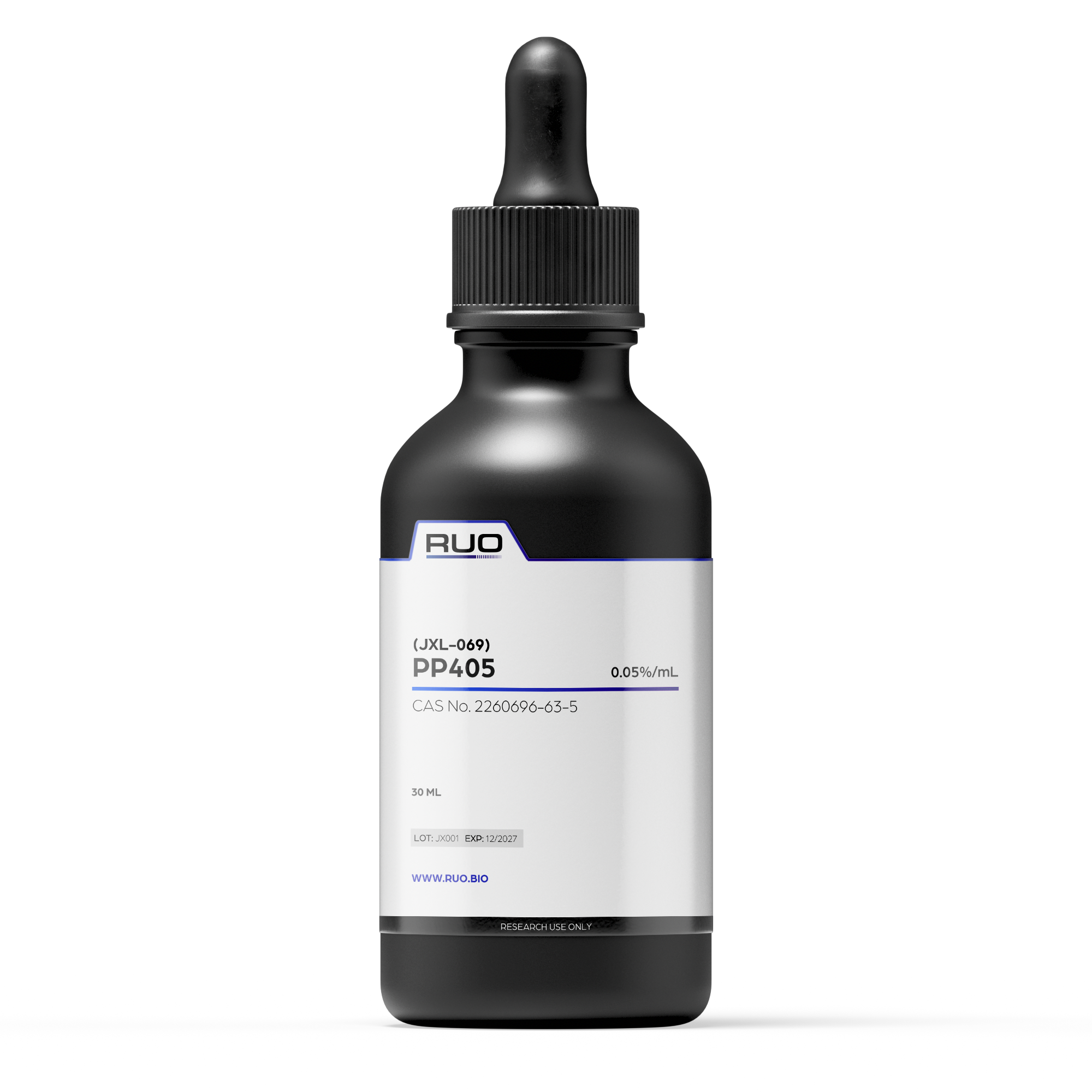
- Hair follicle stem cells are unusually glycolytic and pump out far more lactate than the skin cells around them; that lactate is the signal that wakes them to grow.
- Deleting the mitochondrial pyruvate carrier gene in mice sped up the hair cycle, which is exactly the effect JXL069 aims to reproduce with a topical drug.
- JXL069 comes from the same UCLA research line as PP405, the topical candidate now being tested in humans for pattern hair loss.
Mechanism
JXL069 works by manipulating the metabolism of hair follicle stem cells. Its target is the pyruvate carrier (MPC), the transporter on the inner mitochondrial membrane that shuttles pyruvate, the end product of glycolysis, into mitochondria for oxidation. When JXL069 inhibits the MPC, pyruvate can no longer enter mitochondria efficiently; instead it is diverted by lactate dehydrogenase into lactate. Blocking the carrier therefore raises intracellular lactate, exactly the metabolic signal that the follicle uses to switch its stem cells from dormancy to activity [1][4].
The importance of that switch was established in foundational work: hair follicle stem cells are unusually glycolytic and produce significantly more lactate than neighboring epidermal cells, and lactate generation is required for their activation. Removing lactate dehydrogenase blocked activation, while promoting lactate, including through deletion of the pyruvate carrier gene, accelerated stem cell activation and sped up the hair cycle. Crucially, small molecules that increase lactate by inhibiting the pyruvate carrier were able to topically induce the hair cycle in mice [2]. JXL069 is one such carrier-inhibiting molecule, from a series in which more than ten related analogues promoted visible hair growth when applied topically to shaved mice [1].
The downstream benefit is follicle activation and hair regrowth driven by a mechanism entirely distinct from existing treatments: rather than blocking androgens like finasteride or opening potassium channels like minoxidil, JXL069 reprograms follicle stem cell metabolism toward the lactate-rich state that triggers growth [1][3]. Because it acts locally on this metabolic pathway, the topical version of the strategy is associated with minimal systemic absorption, and the approach has drawn interest for pattern hair loss, with the sibling compound PP405 carrying it into clinical testing [3]. JXL069 remains a research chemical, and its own human efficacy and safety have not been formally established [1][3].
receptor fingerprint
pyruvate carrier (MPC1/MPC2)inhibits
Lactate dehydrogenase (LDH) / lactateraises
Hair follicle stem cellsactivates
Glycolytic metabolismupshifts
Ki67 / hair bulge proliferationincreases
Dosingtypical ranges, not medical advice
interested in protocols and clinical dosages? make an account to see them! ^_^
Safetyrisks and cautions, not medical advice
JXL069 is an experimental research chemical, not an approved drug, so there is no established human safety profile for the raw molecule; it is not sold for human use. Most of what is reassuring comes from its topical sibling PP405, which in early trials hit its safety endpoint with no detectable systemic absorption when applied to the scalp; that matters because a drug that shifts whole-body metabolism could cause trouble if it got into circulation broadly. Systemic MPC inhibition is not something to take lightly, since pyruvate metabolism sits at the center of energy production; that is exactly why the hair programs keep it topical and local. Treat any powder or liquid version as unproven, keep it off broken skin, and do not ingest it. Real long-term human data does not exist yet.
History
JXL069 arose from a distinctive line of hair-biology research at the University of California, Los Angeles, where investigators led by Heather Christofk and William Lowry established that hair follicle stem cells depend on an unusual metabolic state. In foundational work published in 2017, the group showed that these normally dormant cells are strongly glycolytic and generate far more lactate than neighboring epidermal cells, and that lactate production is required for their activation; genetically deleting the mitochondrial pyruvate carrier accelerated stem-cell activation and the hair cycle.
Crucially, they demonstrated that small molecules inhibiting the pyruvate carrier could topically induce the hair cycle in mice, pointing directly toward a druggable pathway. JXL069 is one such carrier-inhibiting molecule from a chemical series in which more than ten related analogues promoted visible hair growth when applied to shaved mice. It is closely related to PP405, a topical clinical candidate from the same research lineage now advancing through human trials for pattern hair loss. JXL069 itself is sold as a research chemical, and its own human efficacy and safety have not been formally established.
Reputation
JXL069 is regarded within the hair-loss research community as an exciting representative of a genuinely novel therapeutic idea: rather than blocking androgens like finasteride or opening potassium channels like minoxidil, it reprograms the metabolism of follicle stem cells toward the lactate-rich state that wakes them from dormancy. This mechanistic originality is its main draw, and it rests on well-regarded foundational biology showing that lactate generation is a real switch for follicle activation.
Because the approach acts locally on a metabolic pathway, the topical strategy is associated with minimal systemic absorption, an attractive feature for a chronic cosmetic condition. Interest is further buoyed by its sibling compound PP405, which has carried the same concept into clinical testing. The candid caveat is significant: JXL069 remains a research chemical whose own efficacy and safety in humans have not been demonstrated. As a window into next-generation metabolic hair therapy, though, it is a compelling molecule.
Subjective profileweighing the evidence above
Not the one to buy. The metabolic approach to hair loss is genuinely novel, but the molecule actually being tested in people is its sibling PP405; this one has no human data, and systemic inhibition of pyruvate entry into mitochondria is not a trivial thing to set off.
Where to buy
Suppliers
Vendors carrying JXL069, with live product details and codes. Links are affiliate links that support the wiki at no cost to you.
RUO
JXL069
Research
- 2017first citedLactate dehydrogenase activity drives hair follicle stem cell activation.
- 2026most recentEmerging pharmacotherapies for androgenetic alopecia.
- 1.Development of Novel Mitochondrial Pyruvate Carrier Inhibitors to Treat Hair Loss.
- 2.Lactate dehydrogenase activity drives hair follicle stem cell activation.
- 3.Emerging pharmacotherapies for androgenetic alopecia.
- 4.Hypoxia induces lactate secretion and glycolytic efflux by downregulating mitochondrial pyruvate carrier levels in human umbilical vein endothelial cells.
- 5.Activation of the integrated stress response in human hair follicles
5 listed here; entry last updated August 2026
Reviews
My notesprivate to this device
FAQ
What is JXL069?
It is a small molecule from UCLA that blocks the mitochondrial pyruvate carrier (MPC). By forcing cells toward glycolysis and lactate, it flips the metabolic switch that activates dormant hair follicle stem cells.
How is it related to PP405?
PP405 is the clinical candidate from the same UCLA research program, formulated as a topical scalp cream and now in mid-stage human trials for pattern hair loss. JXL069 is the research-grade MPC inhibitor from that work.
How does it grow hair?
Hair follicle stem cells run on glycolysis. Blocking the MPC piles up pyruvate, which becomes lactate, and that lactate surge is what wakes the follicle and starts a new growth cycle.
Is it safe?
The raw chemical has no established human safety profile and is research-only. The related topical PP405 showed no detectable systemic absorption in early trials, which is reassuring for scalp use but not a green light for the powder.
How is it used?
As a low-concentration topical applied to the scalp, mirroring how PP405 is dosed. There is no basis for oral or systemic use.
Limitations of the evidence
- A research chemical, not an approved medicine
Notes and cautions
- JXL069 itself has not been tested in published human trials
- Most evidence comes from mouse and cell studies of the drug class
- Applied topically, related compounds show minimal systemic absorption
- Purity and contents of research-chemical products are not guaranteed