
spec sheet12 rows
Insulin Human (Regular) Regular insulin, also called soluble or short-acting insulin, is human insulin with its natural, unmodified amino acid sequence, used to lower blood sugar in diabetes. Given by injection before meals or into a vein in the hospital, it begins working in about half an hour and lasts several hours, and it is a standard treatment for diabetic emergencies such as ketoacidosis and for dangerously high blood potassium. Modern regular insulin is produced by recombinant DNA technology, and it appears on the World Health Organization list of essential medicines.
- Identical to the insulin your body makes
- Short, predictable action on blood sugar
- Hospital grade; can be given intravenously
- Low cost and available almost everywhere
- Listed among the WHO essential medicines
- Made by recombinant DNA technology
- Low blood sugar (hypoglycemia), the main risk of all insulins
- Low blood potassium (hypokalemia)
- Injection-site reactions
Overview
Regular insulin is short-acting human insulin, meaning it has the same amino acid sequence as the insulin produced naturally by the human body, with no engineered modifications [2]. It is also known as soluble or neutral insulin and is supplied as a clear solution [4]. Historically the hormone was extracted and purified from the pancreases of cattle and pigs, but since the 1980s it has been made almost entirely by recombinant DNA technology, in which bacteria or yeast are engineered to produce the human insulin protein [2].
Insulin was first isolated and used to treat a patient in 1922, following the work of Banting, Best, and colleagues in Toronto, a breakthrough that transformed type 1 diabetes from a fatal disease into a manageable one [2]. Regular insulin was the first form available [3]. The introduction of recombinant human insulin in the early 1980s, among the first products of the biotechnology industry, ended reliance on animal pancreases and provided a consistent, less immunogenic supply [2][4].
Regular insulin is used to control blood glucose in type 1 and type 2 diabetes and in gestational diabetes, typically injected under the skin before meals so that its onset coincides with the rise in blood sugar from food [4]. Because it can be given intravenously, it also has essential roles in the hospital treatment of diabetic ketoacidosis and hyperosmolar states and in lowering severe hyperkalemia when combined with glucose [2]. With the arrival of rapid-acting analogs such as lispro and aspart, which act faster and are more convenient because they can be taken right at mealtimes, the use of regular insulin for routine mealtime coverage has declined, though it remains widely used and important [4].
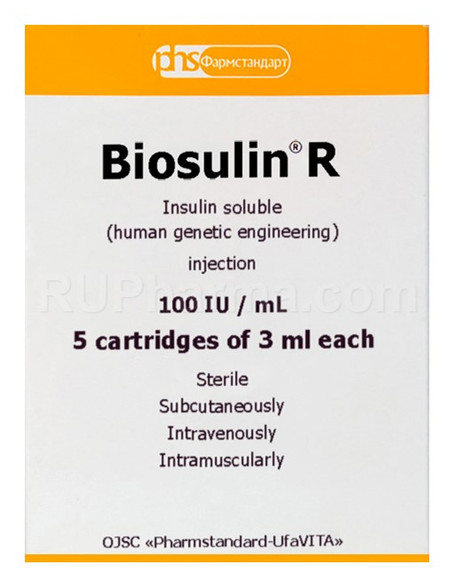
Regular insulin is available in vials and cartridges under brand names such as Humulin R, Novolin R, and Actrapid, and it is one of the few insulins that can be mixed with intermediate-acting insulin in the same syringe [4]. Its most important side effect, common to all insulins, is hypoglycemia, and it can also cause low blood potassium, injection-site reactions, changes in the fat under the skin at overused sites, weight gain, and, rarely, allergic reactions [2]. It is included on the World Health Organization list of essential medicines [2].

- Recombinant human regular insulin (Humulin) was the first genetically engineered medicine ever approved for people, launched in 1982.
- In the vial, regular insulin molecules cluster into six-unit zinc hexamers that must break apart before absorption, which is why it works faster given into a vein than under the skin.
- Hospitals use intravenous regular insulin, paired with glucose, as a fast treatment for dangerously high blood potassium, a use unrelated to diabetes.
Mechanism
Regular is identical in structure to the insulin the human pancreas makes, and it works by binding the insulin receptor on cells throughout the body [2]. Activating this receptor prompts muscle and fat tissue to take glucose out of the blood and store it, stimulates the liver to build up glycogen instead of releasing glucose, and promotes the storage of fat and the building of protein, so blood glucose falls [4]. In solution, regular exists mainly as zinc-containing hexamers, six insulin molecules clustered together, and after subcutaneous injection these must break apart into dimers and single molecules before they can be absorbed into the bloodstream [1].
This disassembly step delays its action compared with the newer rapid-acting analogs, so regular typically starts to lower glucose around thirty minutes after injection, peaks after a few hours, and lasts somewhat longer than those analogs [4]. Because it is also effective when infused directly into a vein, where the absorption delay does not apply, regular acts quickly in that setting and is the form commonly used in hospitals to manage diabetic ketoacidosis and to drive potassium into cells when blood potassium is dangerously high [2]. In the latter use it is given together with glucose so that blood sugar does not fall too far [2].
receptor fingerprint
receptor (INSR)agonist
GLUT4 glucose transporteractivates
Hepatic gluconeogenesis and glycogenolysisblocks
Cellular potassium uptakeactivates
Protein synthesis and lipogenesisactivates
Dosingtypical ranges, not medical advice
interested in protocols and clinical dosages? make an account to see them! ^_^
Safetyrisks and cautions, not medical advice
This is a prescription injectable and low blood sugar is the main danger, with symptoms like sweating, shaking, confusion, and, if severe, seizures or unconsciousness that need urgent sugar or glucagon. It also lowers blood potassium, which is useful when treating high potassium but must be watched otherwise. Injection sites can develop lumps if not rotated, and weight gain is common. Intravenous use requires hospital monitoring. As with other insulins, using it without diabetes to build muscle is very dangerous and has caused fatal low blood sugar, since a non-diabetic body has no need for the extra insulin and can crash without warning. Doses must be matched to food, and it should never be dosed casually.
History
Regular insulin traces its lineage to the original discovery of insulin by Frederick Banting, Charles Best, James Collip, and John Macleod at the University of Toronto in 1921 and 1922, a breakthrough that turned type 1 diabetes from a fatal disease into a manageable one and earned a Nobel Prize. For decades the hormone was purified from the pancreases of cattle and pigs, but a landmark advance came in 1978 when scientists at Genentech, working with the biotechnology of recombinant DNA, produced human insulin in bacteria.
This recombinant human insulin was commercialized by Eli Lilly as Humulin and approved in 1982, becoming the first recombinant protein drug ever marketed. Regular insulin retains the natural, unmodified amino acid sequence of human insulin, distinguishing it from the later engineered analogs. It remains essential in hospital practice for intravenous use in diabetic ketoacidosis and hyperkalemia, and it is listed by the World Health Organization as an essential medicine.
Reputation
Regular insulin holds a place of enduring respect as the workhorse form of a hormone that has saved countless lives since the 1920s. Clinicians particularly value that it can be given intravenously, where its absorption delay disappears and it acts rapidly, making it the standard tool for managing diabetic emergencies such as ketoacidosis and for driving dangerously high blood potassium back into cells.
Its identical match to natural human insulin and its long track record give it a well-understood, predictable profile, and it remains far more affordable than newer analogs in many settings. The manufacture of recombinant human insulin is also celebrated as a founding achievement of the modern biotechnology industry. Honestly, its slower subcutaneous onset means it must be injected well before meals and carries a somewhat higher risk of between-meal lows than rapid-acting analogs, which is why analogs are often preferred for outpatient mealtime dosing.
Subjective profileweighing the evidence above
An essential medicine, cheap and effective, and non-negotiable as a prescription drug used with glucose monitoring. Using insulin without diabetes to push muscle growth has killed people, because a body that does not need it crashes without warning. Hypoglycemia is the standing risk even used correctly.
Where to buy

1 other outlet

Suppliers
Vendors carrying Insulin Human (Regular), with live product details and codes. Links are affiliate links that support the wiki at no cost to you.
PCT.Zone
Insulin Human (Regular)
RUPharma🌐
Insulin Human (Regular)
Research
- 1979first citedExpression in Escherichia coli of chemically synthesized genes for human insulin
- 2021most recentA century of progress in diabetes care with insulin: a history of innovations and foundation fo…
- 1.A century of progress in diabetes care with insulin: a history of innovations and foundation for the future
- 2.Structural principles of insulin formulation and analog design: a century of innovation
- 3.Insulin therapy for type 1 diabetes mellitus: past and present
- 4.Evolution of insulin development: focus on key parameters
- 5.Expression in Escherichia coli of chemically synthesized genes for human insulin
5 listed here; entry last updated August 2026
Reviews
My notesprivate to this device
FAQ
How is regular insulin different from rapid analogs?
It acts slower and lasts longer, starting in about 30 minutes, so it is injected about half an hour before a meal rather than right at it.
Why is it the one given by drip in hospital?
Regular insulin can be safely given intravenously, which lets doctors control blood sugar precisely in emergencies like ketoacidosis.
How does insulin lower high potassium?
It drives potassium into cells along with glucose, so an insulin and glucose drip quickly brings down dangerous potassium levels.
Is insulin safe for bodybuilding?
No, injecting insulin without diabetes to build muscle is very dangerous and has caused fatal low blood sugar; it is not a safe shortcut.
When do I inject it before eating?
About 30 minutes ahead, because it needs time to start working and match the rise in blood sugar from the meal.
Adverse effects
- Low blood sugar (hypoglycemia), the main risk of all insulins
- Low blood potassium (hypokalemia)
- Injection-site reactions
- Lipodystrophy at overused injection sites
- Weight gain and, rarely, allergic reactions