
spec sheet11 rows
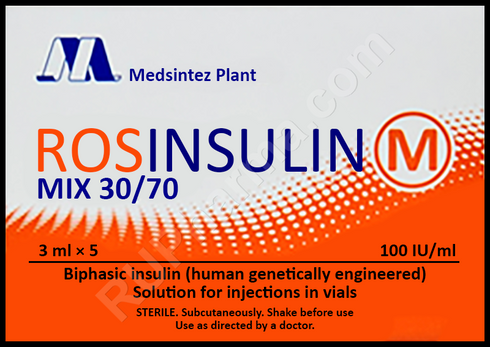
Insulin Human (30/70 Biphasic) Biphasic human insulin 30/70 is a premixed insulin that combines a short-acting and an intermediate-acting insulin in a single fixed formulation, containing 30 percent soluble regular human insulin and 70 percent protamine-bound isophane (NPH) insulin. This blend delivers both a mealtime and a background insulin effect from one injection, which is why it is often used in type 2 diabetes to simplify treatment. It is a cloudy suspension given once or twice daily and is a long-established, widely used insulin preparation.
- Mealtime and background insulin from a single injection
- One simple twice daily routine
- Fewer injections than juggling separate insulins
- A long established workhorse in type 2 diabetes
- Cheap and widely available almost everywhere
- Human insulin, identical to what the body makes
- Low blood sugar (hypoglycemia), especially if meals do not match the fixed dose
- Weight gain
- Low blood potassium (hypokalemia)
Overview
Biphasic human insulin 30/70, often abbreviated BHI 30, is a premixed insulin preparation, meaning it contains a fixed blend of two kinds of insulin in one vial or pen [1]. As named in Europe, the 30/70 ratio refers to 30 percent soluble, short-acting regular human insulin combined with 70 percent intermediate-acting isophane (NPH) insulin; the same product is labeled 70/30 in the United States [1]. Both insulin fractions are ordinary human insulin made by recombinant DNA technology, with the slower fraction rendered longer-acting by complexing it with protamine [1].
Premixed insulins were developed to spare people the inconvenience and error of drawing up and mixing two separate insulins themselves, combining basal and mealtime coverage in a single injection [2]. Roughly two of every five insulin-treated people with diabetes worldwide have been estimated to use premixed formulations, largely for this practicality [3]. Biphasic human insulin was the conventional premix before rapid-acting analog premixes, such as biphasic insulin aspart, were introduced to improve after-meal control [1].
The 30/70 premix is used chiefly in type 2 diabetes, typically injected twice daily before breakfast and the evening meal, to provide both prandial and basal insulin with fewer injections than a full basal-bolus regimen [1]. Clinical reviews find that premixed insulins give better overall control than intermediate or long-acting insulin used alone, though the newer analog premixes achieve somewhat better after-meal glucose levels and allow more flexible dosing relative to meals [1]. Studies comparing biphasic human insulin with analog premixes and with basal insulin report broadly similar rates of serious low blood sugar, with differences mainly in postprandial glucose and injection timing [3][4].
Biphasic human insulin 30/70 is supplied as a cloudy suspension in vials and prefilled pens under brand names such as Humulin 30/70, Novolin 30/70, and Mixtard 30 [2]. Its risks are those of insulin generally, above all hypoglycemia, which can occur when the fixed dose does not match food intake; because the timing of the two components is set, careful coordination with meals is important [1]. Other possible effects include weight gain, low blood potassium, injection-site reactions, and changes in the fat under the skin at overused injection sites [2].

Mechanism
Biphasic human works by supplying two insulin components with different time courses in a fixed ratio, so that a single injection covers both immediate and background needs [1]. The 30 percent that is soluble regular is absorbed relatively quickly and acts as the mealtime, or prandial, portion, blunting the rise in blood glucose after eating [1]. The remaining 70 percent is isophane (NPH) , in which the insulin is complexed with protamine and zinc to form crystals that dissolve slowly, providing a prolonged, intermediate-acting background level between meals and overnight [3].
Both components lower blood glucose by the universal mechanism, binding the insulin receptor to make muscle and fat take up glucose and to signal the liver to stop releasing it [2]. The result is a two-phase, or biphasic, action: an early peak from the soluble fraction followed by a broader, sustained effect from the protaminated fraction [1].
Because the proportions are fixed, this convenience comes at the cost of flexibility, since the prandial and basal amounts cannot be adjusted independently; the soluble regular component also needs to be injected some time before a meal for best effect, unlike the faster premixed analogs [1]. The preparation is a cloudy suspension that must be gently remixed before each dose so the two fractions are evenly distributed [3].
receptor fingerprint
receptor (INSR)agonist
GLUT4 glucose transporteractivates
Hepatic gluconeogenesisblocks
Soluble fraction (30 percent)activates
Isophane (NPH) fraction (70 percent)modulates
Dosingtypical ranges, not medical advice
interested in protocols and clinical dosages? make an account to see them! ^_^
Safetyrisks and cautions, not medical advice
This is a prescription injectable. Low blood sugar is the main risk, and with a premix the timing matters: because the ratio is fixed, meals need to be regular and reasonably consistent or lows and highs can follow. Human premix insulin should be given about 30 minutes before eating, unlike faster analog premixes. It can cause weight gain, and it lowers blood potassium. Injection sites should be rotated to avoid lumps and fat changes. The vial or pen must be gently rolled to resuspend the cloudy insulin before each dose, since an uneven mix changes the delivered ratio. It is not suitable for intravenous use or for rapid correction of very high sugars.
Subjective profileweighing the evidence above
A workhorse: cheap, widely available, and effective when a simple twice-daily routine suits someone better than juggling separate insulins. The fixed ratio is the trade, so meals have to stay regular or hypoglycemia follows. Prescribed, monitored, and given about thirty minutes before eating.
Where to buy
1 other outlet

Suppliers
Vendors carrying Insulin Human (30/70 Biphasic), with live product details and codes. Links are affiliate links that support the wiki at no cost to you.
PCT.Zone
Insulin Human (30/70 Biphasic)
RUPharma🌐
Insulin Human (30/70 Biphasic)
Research
- 2005first citedEfficacy of biphasic insulin aspart in patients with type 2 diabetes
- 2012most recentEvolution of insulin development: focus on key parameters
- 1.Premixed insulin treatment for type 2 diabetes: analogue or human?
- 2.Evolution of insulin development: focus on key parameters
- 3.Efficacy of biphasic insulin aspart in patients with type 2 diabetes
- 4.Mid- and high-ratio premix insulin analogues: potential treatment options for patients with type 2 diabetes in need of greater postprandial blood glucose control
4 listed here; entry last updated August 2026
Reviews
My notesprivate to this device
FAQ
What does 30/70 mean?
It is the blend: 30 percent fast-acting soluble insulin for meals and 70 percent slower isophane insulin for background needs.
Why roll the pen before injecting?
The cloudy insulin settles, and gently mixing it evenly keeps the 30/70 ratio correct so your dose behaves as expected.
How long before a meal do I inject?
About 30 minutes ahead, because the soluble human insulin in it takes a little time to start working.
Can I skip meals on this insulin?
Not safely; the fixed ratio expects regular meals, and skipping one raises the risk of low blood sugar.
Is a premix as flexible as separate insulins?
No, it trades some flexibility for convenience; people needing fine adjustments may do better with separate basal and mealtime insulins.
Adverse effects
- Low blood sugar (hypoglycemia), especially if meals do not match the fixed dose
- Weight gain
- Low blood potassium (hypokalemia)
- Injection-site reactions
- Lipodystrophy at overused injection sites