
spec sheet9 rows
Fursultiamine, also called TTFD, is a man-made form of vitamin B1 in which the vitamin is joined to a fatty side group, so it crosses membranes without needing the saturable transporter that caps how much ordinary thiamine the gut can absorb; once inside a cell the bond is cut and plain thiamine is released. It is an approved medicine in Japan, where it has been used since 1961 for beriberi, vitamin B1 deficiency and Wernicke encephalopathy, and for those jobs it works. The popular claims that it lifts energy, focus or mood in people who are not deficient rest on very thin evidence; there is one small crossover trial in athletes, one uncontrolled 12 week study in Alzheimer's patients and an open pilot in ten autistic children, with no modern randomised trial for any cognitive endpoint. It does have one genuinely non-vitamin action, blocking the hormone hepcidin at a cysteine on the iron exporter ferroportin, but that effect vanished in live mice because the compound breaks down to ordinary thiamine within about an hour.
- the B1 form that skips the gut's absorption bottleneck
- crosses membranes freely and reaches the brain
- an approved Japanese medicine since 1961
- clears the fatigue that comes with real thiamine deficiency
- cheap, low risk, and the right pick for repletion
- nerve support where B1 is running short
- Possible mild stomach upset or nausea
- Uncommon skin rash or itching from hypersensitivity
- Rarely, allergic-type reactions reported with injectable thiamine derivatives
Overview
Fursultiamine belongs to the allithiamine family of thiamine derivatives, a group of compounds in which the thiazole ring of vitamin B1 has been opened to expose a reactive thiol that is then joined to another group through a disulfide bond [1]. In fursultiamine that partner group is a tetrahydrofurfuryl moiety, which gives the molecule its alternative name, thiamine tetrahydrofurfuryl disulfide, or TTFD [1]. The design goal was to keep the vitamin activity of thiamine while making the molecule far more lipid-soluble, so that it can pass through cell membranes more easily than the charged, water-soluble vitamin [2].
The story begins with allithiamine, a naturally occurring disulfide form of thiamine that Japanese researchers isolated from garlic and other Allium plants in 1951 [1]. Investigators working with the Vitamin B Research Committee of Japan found that this garlic-derived form carried thiamine into tissues more effectively than the ordinary vitamin, and they went on to synthesize a series of related disulfide derivatives [1]. Fursultiamine, developed in the 1960s, is one of the best known of these synthetic analogues and was later marketed in Japan, parts of Europe, and elsewhere [1].
Its main established use is the treatment and prevention of thiamine deficiency, including the classic deficiency disease beriberi [1]. Because the brain is highly sensitive to a shortage of thiamine, lipid-soluble derivatives such as fursultiamine and the closely related sulbutiamine have attracted interest for raising thiamine levels in nervous tissue, in contrast to benfotiamine, an S-acyl derivative that boosts thiamine in blood and liver but not in the brain [2]. Laboratory work also indicates that these disulfide derivatives interact with the cell's thiol redox systems and can switch on antioxidant defenses, which may contribute to effects beyond simple vitamin replacement [3].
Fursultiamine is regulated as a vitamin medicine rather than a controlled substance and is generally available without prescription; it has been sold under brand names such as Alinamin-F and Lipothiamine, among others [1]. It is supplied mainly as oral tablets and capsules, sometimes combined with other B vitamins [1].

Mechanism
Once absorbed, fursultiamine is reduced back to free thiamine by the body's thiol-based redox systems, including the glutathione and thioredoxin pathways, releasing the active vitamin inside cells [3]. Thiamine is then converted to thiamine diphosphate, the cofactor required by key metabolic enzymes such as transketolase, pyruvate dehydrogenase, and alpha-ketoglutarate dehydrogenase, which are central to carbohydrate metabolism and energy production [1].
Its fat-soluble, open-ring structure lets fursultiamine cross membranes without depending on the saturable transporters that limit uptake of ordinary thiamine, which is why disulfide derivatives of this type raise tissue and, for the brain-penetrant members of the family, central thiamine levels more effectively than the standard vitamin [2]. Experimental studies also show that these thiamine disulfides can activate the Nrf2 transcription factor and increase antioxidant enzyme activity, pointing to an additional role in the cellular response to [3].
receptor fingerprint
Cell membrane thiamine deliveryElevation
Pyruvate dehydrogenase / transketolaseCofactor support
Thiamine pyrophosphate (TPP)-dependent enzymes: pyruvate dehydrogenase, alpha-ketoglutarate dehydrogenase, transketolaseIndirect cofactor supply, not receptor binding. Fursultiamine is a prodrug; its disulfide is reduced intracellularly to an open-ring thiol that recyclizes to thiamine, which is then phosphorylated to TPP, the obligate cofactor for these enzymes.
Thiamine transporters ThTr1 / ThTr2 (SLC19A2 / SLC19A3)BYPASSED, not engaged. The lipophilic open-ring disulfide crosses membranes without the saturable carrier that rate-limits ordinary thiamine absorption; this transporter independence, not any novel pharmacology, is the compound's actual selling point.
Ferroportin (SLC40A1), cysteine 326 thiolThiol-blocking hepcidin antagonist. Occupies the C326 residue hepcidin requires, preventing hepcidin-induced ferroportin ubiquitination, endocytosis and degradation, so cellular iron export continues.
Thioredoxin reductase (TrxR) and the glutathione systemSubstrate. Both systems reduce the fursultiamine disulfide, directly or via thioredoxin, generating the active thiol species; TrxR inhibition depletes total cellular thiols in its presence.
Nrf2 / NQO1 / TrxR (antioxidant response element pathway)Indirect induction. Raises nuclear Nrf2 levels and increases both expression and activity of NQO1 and TrxR; other glutathione and thioredoxin system enzymes were scarcely affected.
receptor (downstream, rodent only)Indirect and non-binding. Systemic TTFD increased dopamine release in rat medial prefrontal cortex and the resulting locomotor increase was fully suppressed by D1 antagonism but not D2; no evidence exists that fursultiamine binds any dopamine receptor.
Dosingtypical ranges, not medical advice
interested in protocols and clinical dosages? make an account to see them! ^_^
Safetyrisks and cautions, not medical advice
TOLERABILITY: Generally well tolerated at vitamin-replacement doses. The 12-week Alzheimer's trial at 100 mg/day reported no adverse reactions and full tolerance (PMID 8815393). A 6-week mouse study up to 500 mg/kg/day found no adverse signal on body composition, blood biochemistry or histopathology (PMID 29966293), though that study was co-authored by a pharmaceutical manufacturer.
DOCUMENTED ADVERSE EFFECTS: - Gastrointestinal irritation. Explicitly flagged by investigators as a risk requiring management in paediatric TTFD therapy (PMID 21816221). - Refeeding syndrome from the infusion vehicle. High-dose parenteral fursultiamine carries glucose; its caloric contribution was overlooked and precipitated refeeding syndrome during Wernicke encephalopathy treatment (PMID 42476772). Count the vehicle calories. - Secondary pulmonary oedema after rapid thiamine repletion in a severely deficient patient (PMID 31534090). This is a haemodynamic consequence of correcting deficiency rather than direct drug toxicity, but it is a real risk of treating advanced beriberi. - Behavioural effects in juvenile mice at 100 and 340 mg/kg/day: reduced activity, altered social interaction, decreased acoustic startle and lower percentage weight gain (PMID 21816221). Relevant because these are the doses used in the paediatric supplementation literature by allometry. - Sulfurous garlic-like breath and body odour is widely reported by users and is chemically plausible from the disulfide, but no controlled incidence figure was found in the peer-reviewed literature.
INTERACTIONS: No published human drug-interaction study was found. Two theoretical concerns follow from the chemistry rather than from data: the thiol-reactive behaviour at ferroportin C326 (PMID 23292796) means iron handling is a plausible interaction surface, and the compound is a substrate for thioredoxin reductase and glutathione (PMID 39302148), so it consumes reducing equivalents. Neither has been tested in people. Fursultiamine had no effect on plasma CGRP, VIP, motilin or substance P in healthy volunteers, unlike pantethine (PMID 21963510).
REGULATORY STATUS: - JAPAN: approved prescription and OTC medicine since 1 May 1961 (Takeda, Alinamin-F). Also widely marketed in South Korea and parts of Asia. - UNITED STATES: NOT FDA approved. The single DailyMed listing containing fursultiamine (ARONAMIN GOLD, 50 mg, human OTC) carries marketing category "unapproved drug other" and the statutory disclaimer that the drug has not been found by FDA to be safe and effective; its NDC was inactivated by FDA-initiated compliance action. It is not a scheduled substance. It is sold in the US as a supplement ingredient. - WADA: not on the 2026 Prohibited List. No vitamin B1 derivative appears in any prohibited class, and the 2026 modifications do not mention thiamine. This is a reasoned negative from the list text rather than a direct GlobalDRO query, which could not be executed; athletes should verify on GlobalDRO because the list is revised annually. - PREGNANCY AND LACTATION: no adequate published human safety data specific to fursultiamine.
Subjective profileweighing the evidence above
The form to reach for when thiamine is actually the problem, since it absorbs far better than plain B1 and reaches the brain. Cheap, low risk, and worth it for repletion or the fatigue that comes with a real deficiency. If thiamine status is already fine, expect nothing.
Where to buy
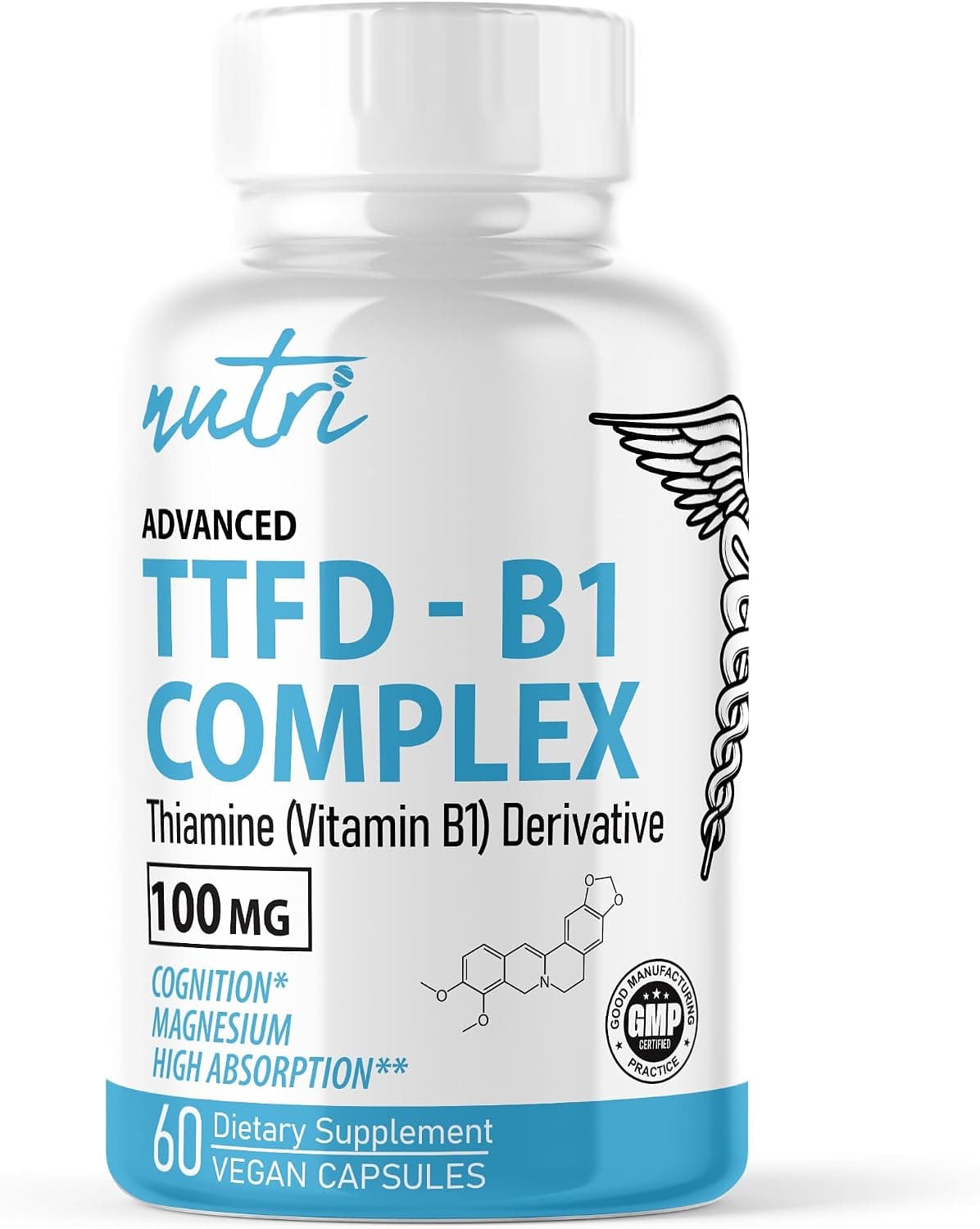
Suppliers
Vendors carrying Fursultiamine, with live product details and codes. Links are affiliate links that support the wiki at no cost to you.
Amazon
TTFD
Research
- 1996first citedEffects of thiamine supplementation on exercise-induced fatigue.
- 2016controlled trialComparative Pharmacokinetic Analysis of Thiamine and Its Phosphorylated Metabolites Administere…
- 2026most recentRefeeding Syndrome Induced by Fursultiamine Infusion in Wernicke Encephalopathy: A Case Report.
- 1.Thiamine tetrahydrofurfuryl disulfide: a little known therapeutic agent
- 2.Benfotiamine, a synthetic S-acyl thiamine derivative, has different mechanisms of action and a different pharmacological profile than lipid-soluble thiamine disulfide derivatives
- 3.Thiamine disulfide derivatives in thiol redox regulation: Role of thioredoxin and glutathione systems
- 4.Comparative Pharmacokinetic Analysis of Thiamine and Its Phosphorylated Metabolites Administered as Multivitamin Preparations.
- 5.Comparative bioavailability of various thiamine derivatives after oral administration.
- 6.PET imaging of 11C-labeled thiamine tetrahydrofurfuryl disulfide, vitamin B1 derivative: First-in-human study.
- 7.High-throughput screening of small molecules identifies hepcidin antagonists.
- 8.Effects of thiamine supplementation on exercise-induced fatigue.
- 9.Thiamine therapy in Alzheimer's disease.
- 10.Treatment of autism spectrum children with thiamine tetrahydrofurfuryl disulfide: a pilot study.
- 11.Thiamine tetrahydrofurfuryl disulfide promotes voluntary activity through dopaminergic activation in the medial prefrontal cortex.
- 12.Refeeding Syndrome Induced by Fursultiamine Infusion in Wernicke Encephalopathy: A Case Report.
12 listed here; entry last updated August 2026
Reviews
My notesprivate to this device
FAQ
What is Fursultiamine used for?
Thiamine deficiency, fatigue, and nerve issues; it absorbs and penetrates far better than plain B1.
How does it work?
Its disulfide structure slips across cell membranes without the usual transporters, then converts back to active thiamine inside the cell to fuel energy enzymes.
Is it well-researched?
Yes for thiamine repletion; it is used as a medication and supplement, especially in Japan.
What are the main side effects?
A garlic-like smell or taste, and occasional mild GI upset or headache.
Limitations of the evidence
- Not one placebo-controlled trial of TTFD exists for any cognitive or neurological outcome
- The Alzheimer's result is a 12-week open trial with no placebo arm
- The autism result is an unblinded pilot in ten children with parent-rated outcomes
- A registered phase 2 in esophageal cancer completed in 2017 and has posted no results and produced no publication
- The pilot documented rising urinary cadmium, lead and nickel during dosing; mobilising heavy metals is as plausibly a harm as a benefit and has never been studied properly
Adverse effects
- Possible mild stomach upset or nausea
- Uncommon skin rash or itching from hypersensitivity
- Rarely, allergic-type reactions reported with injectable thiamine derivatives
Notes and cautions
- Generally well tolerated when used as a vitamin supplement
- A garlic-like taste or faint body odor in some users