
spec sheet13 rows
Fosfomycin is a broad-spectrum antibiotic belonging to a distinctive chemical class, the phosphonic acid derivatives, and it kills bacteria by blocking an early step in the building of their cell walls. Discovered in the 1960s in cultures of soil bacteria, it is most familiar as a single oral dose used to treat uncomplicated bladder infections, sold under the brand name Monurol. An intravenous form is also used in hospitals against more serious and drug-resistant infections. It is on the World Health Organization's List of Essential Medicines.
- One sachet handles an uncomplicated bladder infection
- Still effective against many resistant urinary bugs
- Concentrates exactly where it is needed, in the urine
- Phosphonic acid chemistry, a class all its own
- On the World Health Organization list of essential medicines
- Convenient single dose, nothing to remember for days
- Diarrhea, nausea, and headache, usually mild and short-lived
- Vaginal yeast infections
- Rarely severe allergic reactions or C. difficile-associated diarrhea
Overview
Fosfomycin is an antibiotic that stands somewhat apart from other antibacterial drugs, both in its chemistry and in the way it works [1][2]. Despite the "mycin" ending in its name, it is not a macrolide but a phosphonic acid derivative, a small, simple molecule with the formula C3H7O4P whose most important feature is a strained, chemically reactive three-membered epoxide ring [1]. This distinctive structure means there is little cross-resistance between fosfomycin and other antibiotic families, so bacteria resistant to other drugs often remain sensitive to it [2]. It is water-soluble, is not bound to blood proteins or broken down by the body, and is excreted largely unchanged through the kidneys into the urine, where it reaches high concentrations [2].
The drug was discovered in 1969, originally under the name phosphonomycin, through a collaboration between the American company Merck and the Spanish firm CEPA [1]. It was isolated from cultures of Streptomyces soil bacteria by screening for the ability to make bacterial cells swell into fragile spheres, a sign of damage to the cell wall [1]. Although it was first obtained from microbes, it is now produced by chemical synthesis [1]. It reached the United States market in 1996 and is included on the World Health Organization's List of Essential Medicines [1].
Fosfomycin's best-established use is in the treatment of uncomplicated lower urinary tract infections, or cystitis, where its concentration in the urine and its single-dose oral regimen make it a convenient option; taken as the tromethamine salt sold as Monurol, one dose can clear many bladder infections [2]. It is active against the common urinary pathogen Escherichia coli, including strains that produce extended-spectrum beta-lactamases and resist many other antibiotics, as well as a range of other gram-negative and gram-positive bacteria [1][2]. As resistance to other drugs has spread, interest in fosfomycin has revived, and an intravenous form is used off its original label for more serious problems such as complicated urinary infections, kidney infection, and infections caused by multidrug-resistant organisms, often in combination with other antibiotics [3]. A clinical trial found intravenous fosfomycin to be an effective option for complicated upper urinary infections and pyelonephritis [3].
Bacteria can become resistant to fosfomycin, either by changing the transporters that carry the drug into the cell or by making enzymes, known as FosA, FosB, and FosX, that break open its reactive ring and inactivate it; the spread of these resistance enzymes among gram-negative bacteria is being watched with concern [4]. The drug is generally well tolerated, and its side effects are mostly mild and short-lived, chiefly diarrhoea, nausea, headache, and vaginal yeast infections [1][2]. As with many antibiotics, more serious problems such as severe allergic reactions or Clostridioides difficile-associated diarrhoea can occur rarely [1]. Its single-dose oral form and favourable safety record have made it a useful choice for treating bladder infection, including during pregnancy [2].
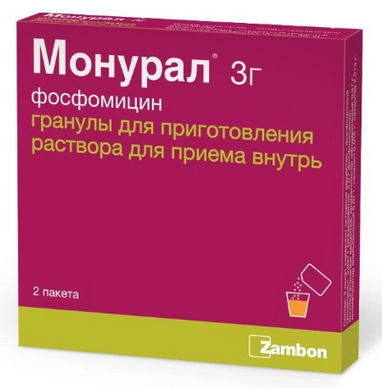

- Fosfomycin is one of the only clinically used antibiotics built on a phosphonic acid backbone, and it inactivates its target enzyme by permanently bonding to it.
- A common course for uncomplicated cystitis is a single 3-gram sachet dissolved in water.
- Because its target and mechanism are unique, organisms resistant to many other antibiotics frequently stay susceptible to it, fuelling renewed interest against drug-resistant urinary infections.
Mechanism
Fosfomycin kills bacteria by cutting off the very first committed step in the construction of peptidoglycan, the mesh-like polymer that forms the bacterial cell wall [1]. It does this by inactivating an enzyme called MurA, formally UDP-N-acetylglucosamine enolpyruvyl transferase, which catalyses that step [1]. Fosfomycin resembles the enzyme's natural partner phosphoenolpyruvate closely enough to slip into its active site, where its reactive epoxide ring then permanently bonds to a key cysteine amino acid, shutting the enzyme down [1]. Deprived of the ability to make new cell wall, growing bacteria weaken and burst, so the drug is bactericidal [1].
To reach its target, fosfomycin is carried into the bacterial cell by transporter proteins that normally import glycerophosphate and other sugar phosphates, and loss of these transporters is one way bacteria can resist it [1][4]. Because building peptidoglycan is vital to bacteria but has no counterpart in human cells, the step fosfomycin blocks is specific to the microbe, which underlies its selective toxicity; the unusual target also means organisms resistant to other antibiotic families often stay susceptible to it, since the mechanisms that defeat those drugs do not apply here [1][2].
receptor fingerprint
MurA (enolpyruvyl transferase)inhibits
Bacterial cell wall (peptidoglycan)blocks
Uropathogens including E. coliblocks
GlpT / hexose-phosphate transportersmodulates
Dosingtypical ranges, not medical advice
interested in protocols and clinical dosages? make an account to see them! ^_^
Safetyrisks and cautions, not medical advice
Fosfomycin is a prescription antibiotic, usually given as a single sachet for a simple bladder infection. It is generally well tolerated; the usual complaints are diarrhea, nausea, headache, and sometimes vaginitis or dizziness. It is meant for uncomplicated lower urinary tract infections, not for kidney infections or systemic infections where it does not reach high enough levels. Taking it with metoclopramide can lower its absorption, so those are separated. Overall it is considered a reasonable option in pregnancy for cystitis, but as with any antibiotic it should only be used when truly needed.
Interactionsdocumented pairs only, not exhaustive
Fosfomycin has an unusually short interaction list. It is not metabolised by cytochrome P450 enzymes, it is barely protein bound, and it is excreted unchanged in the urine, so the usual metabolic and protein-displacement mechanisms have nothing to act on.
The one documented and clinically real interaction involves gastrointestinal transit. Metoclopramide given with the oral tromethamine sachet lowers both the serum concentration and the urinary excretion of fosfomycin by accelerating passage through the absorptive window, and other drugs that increase gut motility are expected to behave the same way. Because urinary tract infection is treated with a single dose, the consequence is a treatment that quietly fails rather than one that causes harm. Cimetidine was tested for comparison and did not alter fosfomycin pharmacokinetics.
No meaningful interactions have been reported with co-administered antibiotics; fosfomycin's activity in combination is generally additive or synergistic rather than antagonistic.
Checking a whole stack? Run it through interactions + stacks.
History
Fosfomycin was discovered in 1969 through a collaboration between scientists at Merck Sharp and Dohme and the Spanish company CEPA, who isolated it from cultures of soil-dwelling Streptomyces species; it was originally named phosphonomycin. Chemically it was a striking find, being one of the very few naturally occurring antibiotics built around a phosphonic acid group and bearing a reactive epoxide ring, a structure unlike that of any other antibiotic class.
Its mechanism, blocking the very first committed step in bacterial cell-wall synthesis by inactivating the enzyme MurA, was equally distinctive. For many years it was used chiefly in parts of Europe and Japan, but its most familiar modern form is the single oral dose of fosfomycin tromethamine, sold as Monurol, for uncomplicated bladder infections. An intravenous formulation is used in hospitals against serious and drug-resistant infections, and the drug appears on the World Health Organization's List of Essential Medicines.
Reputation
Fosfomycin has enjoyed a genuine renaissance in the era of antibiotic resistance, prized because its unusual mechanism and target mean that bacteria resistant to other drug families, including many extended-spectrum beta-lactamase-producing strains of E. coli, often remain susceptible to it. The convenience of a single oral sachet for uncomplicated cystitis is a considerable practical advantage, encouraging adherence and simplifying treatment.
Its long clinical history and its place on the essential-medicines list reinforce confidence in its safety. Honest discussion notes that resistance can develop, that the single-dose oral regimen is best reserved for lower urinary tract infection rather than more serious disease, and that the intravenous form, valuable against multidrug-resistant organisms, has historically been less available in some countries including the United States. As a well tolerated agent that sidesteps common resistance mechanisms, it is increasingly valued.
Subjective profileweighing the evidence above
Hard to beat for an uncomplicated bladder infection; one sachet, still effective against many resistant urinary bugs, and usually nothing worse than brief stomach upset. It only reaches useful levels in the lower urinary tract, so anything involving the kidneys needs a different antibiotic.
Where to buy

1 other outlet

Suppliers
Vendors carrying Fosfomycin, with live product details and codes. Links are affiliate links that support the wiki at no cost to you.
RUPharma🌐
Fosfomycin
PCT.Zone
Fosfomycin
Research
- 1997first citedFosfomycin tromethamine. A review of its antibacterial activity, pharmacokinetic properties and…
- 2024most recentParenteral Fosfomycin in Gastrointestinal Surgery: A Systematic Review.
- 1.Parenteral Fosfomycin in Gastrointestinal Surgery: A Systematic Review.
- 2.Fosfomycin tromethamine. A review of its antibacterial activity, pharmacokinetic properties and therapeutic efficacy as a single-dose oral treatment for acute uncomplicated lower urinary tract infections
- 3.Oral and Intravenous Fosfomycin for the Treatment of Complicated Urinary Tract Infections
- 4.Fosfomycin resistance mechanisms in Enterobacterales: an increasing threat
4 listed here; entry last updated August 2026
Reviews
My notesprivate to this device
FAQ
Is one dose really enough?
For an uncomplicated bladder infection in women, a single 3 g sachet is usually enough because the drug concentrates in urine for up to two days.
How should I take the sachet?
Dissolve the granules in a glass of cool water, stir, and drink it right away, ideally at bedtime after emptying your bladder.
Can I take it for a kidney infection?
No; fosfomycin is meant for lower urinary tract infections and does not reach high enough levels for kidney or bloodstream infections.
Is it safe in pregnancy?
It is generally considered a reasonable option for cystitis in pregnancy, but you should only take it if your doctor prescribes it.
When will I feel better?
Symptoms usually start improving within a day or two; contact your doctor if they persist beyond that.
Adverse effects
- Diarrhea, nausea, and headache, usually mild and short-lived
- Vaginal yeast infections
- Rarely severe allergic reactions or C. difficile-associated diarrhea
Notes and cautions
- Resistance can develop, especially in gram-negative bacteria