
spec sheet10 rows
Unifiram (DM232) is an exceptionally potent synthetic nootropic developed by Italian medicinal chemists as a next-generation cognition enhancer. Structurally related to the ampakines and to piracetam, it was reported in preclinical studies to be roughly four orders of magnitude more potent than piracetam at reversing memory impairment. This remarkable potency, paired with an ampakine-like boost to learning circuitry, has made unifiram a headline compound in the research-chemical nootropic scene.
- Reported four orders of magnitude past piracetam
- Powerful anti-amnesic effect in animal models
- Active at astonishingly small amounts
- Sharpens learning in preclinical work
- An ampakine-style angle on AMPA signaling
- A headline name in research nootropics
- Long-term toxicity has not been characterized
- As a glutamatergic and ampakine-like agent, overstimulation or headache is plausible
Overview
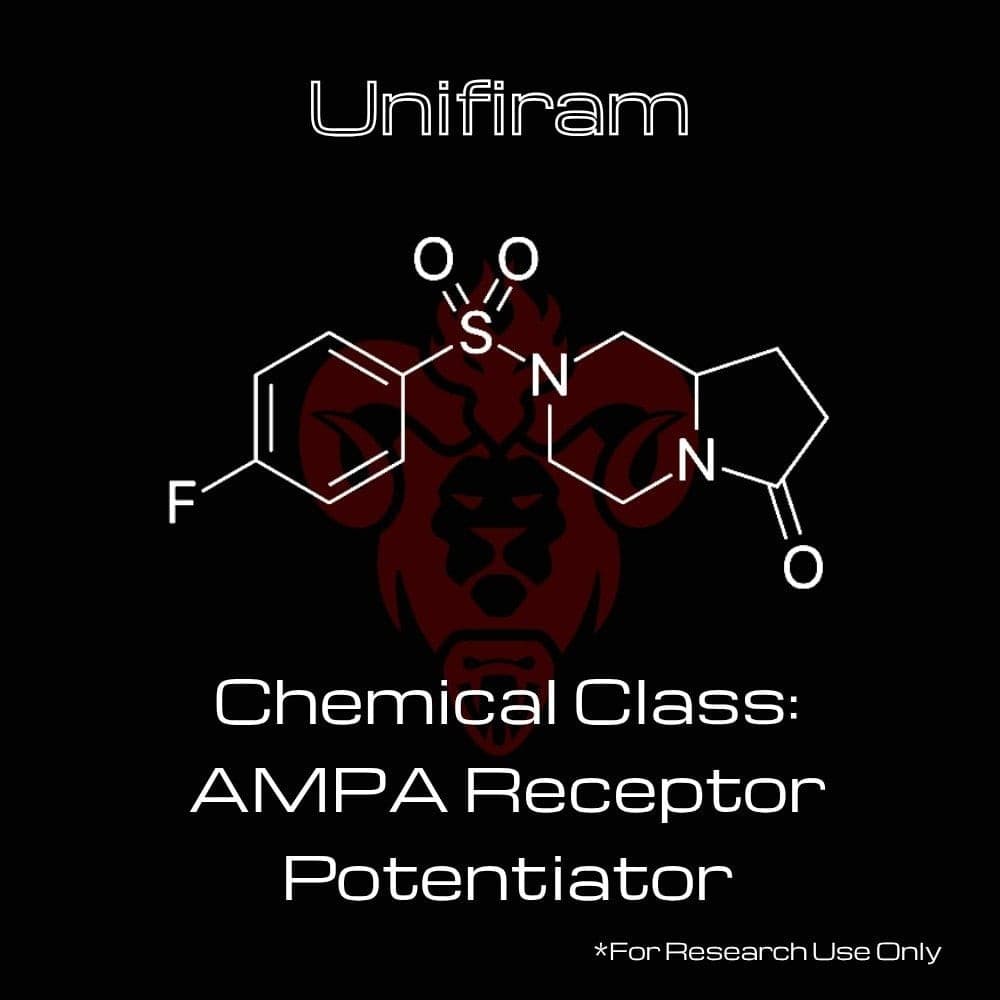
Unifiram, known by its laboratory code DM232, is a synthetic cognition-enhancing compound (a nootropic) first developed around the year 2000 by the medicinal chemistry group of Fulvio Gualtieri at the University of Florence in Italy [1][3]. It emerged from a research program aimed at designing more potent successors to the classic nootropic piracetam. Chemically, unifiram is a small piperazine and pyrrolidinone-derived molecule, and although it is often described as piracetam-like, it is structurally related to the ampakines, a class of compounds that modulate glutamate signaling [2].
In preclinical testing, unifiram proved strikingly potent. In standard rodent memory models such as the mouse passive-avoidance test, it reversed amnesia induced by a variety of chemical challenges and did so at far lower amounts than piracetam; the developers characterized unifiram and its sister compound sunifiram as roughly four orders of magnitude more potent than piracetam [1]. Its two mirror-image forms differ in activity, with the (R)-(+) enantiomer being the more potent [5].
Despite this promise, unifiram was never advanced as a medicine. For a variety of reasons the compounds were not protected by a patent, and only a handful of preclinical studies were ever conducted; there are no clinical trials in humans and the long-term toxicity is unknown [3]. Some years after their scientific disclosure, the developers were surprised to discover unifiram and sunifiram being sold online as cognitive enhancers for healthy people [3]. Today unifiram exists purely as a research chemical, sold as a powder, with no regulatory approval as a drug or dietary supplement and no established human safety data [3].
- In animal studies, unifiram was reported to be roughly four orders of magnitude, about ten thousand times, more potent than piracetam at reversing memory impairment.
- Despite this potency, receptor binding studies find that unifiram has no meaningful affinity for the major brain receptors, suggesting it works through a downstream, convergent mechanism.
- Unifiram has never been tested in humans; every reported benefit comes from preclinical rodent experiments.
Mechanism
Unifiram is best understood as an ampakine-like cognition enhancer that amplifies excitatory neurotransmission in the brain. A notable feature is that, in receptor binding studies, unifiram shows no meaningful affinity for the major central receptors or ion channels, yet it robustly prevents amnesia produced by interfering with many different neurotransmitter systems, indicating that it works downstream through a convergent mechanism rather than by occupying a single classical receptor [1]. The evidence points to the subtype of receptor as central to that mechanism [2].
Several lines of experiment support this. Unifiram reverses the amnesia caused by the NBQX, and it increases excitatory transmission in the rat , raising the amplitude of field excitatory postsynaptic potentials in hippocampal slices; both observations are consistent with potentiation of -mediated signaling, the same pathway targeted by the ampakines [1][2]. Unifiram also enhances the release of from the cerebral , linking it to the cholinergic system that is important for learning and memory [1][5]. Through these combined actions on and cholinergic transmission, it strengthens the processes that underlie memory formation.
The headline benefit reported in animals is powerful procognitive and antiamnesic activity. Across passive-avoidance and social learning tests, unifiram restored memory in impaired animals with a potency estimated at about four orders of magnitude greater than piracetam, while at effective amounts it did not impair motor coordination or spontaneous activity [1][2]. Structure-activity work in the same series additionally uncovered analgesic activity against neuropathic pain for some related compounds, hinting at a broader pharmacology [4]. It is important to stress that all of these benefits derive from preclinical rodent studies; unifiram has not been tested in humans, and its efficacy and safety in people remain unestablished [3].
receptor fingerprint
receptorsenhances (ampakine-like)
Hippocampal excitatory transmissionincreases
Cholinergic systemsupports
Dosingtypical ranges, not medical advice
interested in protocols and clinical dosages? make an account to see them! ^_^
Safetyrisks and cautions, not medical advice
Unifiram is a potent research chemical with almost no formal safety data; it has never been through human toxicology or trials, so the long-term picture is simply unknown, and that is the main thing to keep in mind. Because it drives fast excitatory, glutamate-linked signaling, informed users flag a theoretical excitotoxicity risk and are cautious about stacking it with other glutamatergic or stimulant compounds. Tolerance builds quickly, so cycling is wise, and pairing it with a choline source like Alpha-GPC or CDP-Choline is common to head off headaches. Legal status varies by country. Treat it as promising but genuinely experimental, with moderation the smart default. Not medical advice.
History
Unifiram, also known by its laboratory code DM232, was created by Italian medicinal chemists working in the tradition of the racetam and ampakine cognition enhancers, with the research centered at the University of Florence in the early 2000s. It was conceived as a next-generation nootropic, and the design goal was to achieve procognitive and antiamnesic activity at far lower doses than the prototype piracetam.
In preclinical reports the compound proved remarkably potent, reversing memory impairment in rodents at concentrations estimated to be roughly four orders of magnitude below those needed for piracetam, while sparing motor coordination and spontaneous activity at effective doses. The same academic groups explored a family of structurally related molecules, uncovering additional activities such as analgesia against neuropathic pain in some analogues. It is important to state plainly that unifiram has been studied only in animals; it has never undergone formal human trials, and its efficacy and safety in people remain undocumented.
Reputation
Unifiram has acquired an almost legendary status within the research-chemical nootropic community, largely on the strength of its reported potency; the figure of being about ten thousand times stronger than piracetam at reversing amnesia is frequently cited and is genuinely striking. Scientifically, it is intriguing because binding studies find no meaningful affinity for the major central receptors, yet it robustly protects memory across many models, implying a convergent downstream mechanism that appears to involve AMPA-type glutamate signaling and enhanced acetylcholine release.
This unusual pharmacology has kept it a headline compound and a favorite subject of discussion. Prospective users should temper that enthusiasm with an honest caveat; all of the evidence comes from short-term rodent experiments, and there is essentially no human data on its effects, dosing, or long-term safety. Its reputation therefore rests on fascinating preclinical promise rather than clinical confirmation.
Subjective profileweighing the evidence above
Strictly experimental. The extraordinary potency in animal amnesia models is what makes it famous and is also the reason for caution, because there is no human toxicology at all and the amounts people take are guesses. Tolerance builds fast; cycling and a choline source are the minimum.
Where to buy
Suppliers
Vendors carrying Unifiram, with live product details and codes. Links are affiliate links that support the wiki at no cost to you.
Kimera Chems
Unifiram
Research
- 2000first citedMolecular simplification of 1,4-diazabicyclo[4.3.0]nonan-9-ones gives piperazine derivatives th…
- 2022most recentBenefits and Harms of 'Smart Drugs' (Nootropics) in Healthy Individuals.
- 1.Pharmacological characterization of DM232 (unifiram) and DM235 (sunifiram), new potent cognition enhancers
- 2.AMPA-receptor activation is involved in the antiamnesic effect of DM 232 (unifiram) and DM 235 (sunifiram)
- 3.Unifi nootropics from the lab to the web: a story of academic (and industrial) shortcomings
- 4.Structure-activity relationship studies on unifiram (DM232) and sunifiram (DM235), two novel and potent cognition enhancing drugs
- 5.Enantioselective synthesis and preliminary pharmacological evaluation of the enantiomers of unifiram (DM232), a potent cognition-enhancing agent
- 6.Design, synthesis and preliminary pharmacological evaluation of new analogues of DM232 (unifiram) and DM235 (sunifiram) as cognition modulators
- 7.Benefits and Harms of 'Smart Drugs' (Nootropics) in Healthy Individuals.
- 8.Substituted piperazines as nootropic agents: 2- or 3-phenyl derivatives structurally related to the cognition-enhancer DM235.
- 9.Molecular simplification of 1,4-diazabicyclo[4.3.0]nonan-9-ones gives piperazine derivatives that maintain high nootropic activity.
- 10.Design, synthesis, and preliminary pharmacological evaluation of 1, 4-diazabicyclo[4.3.0]nonan-9-ones as a new class of highly potent nootropic agents.
- 11.Design, synthesis and preliminary pharmacological evaluation of new piperidine and piperazine derivatives as cognition-enhancers.
11 listed here; entry last updated August 2026
Reviews
- Unifiram is AWESOME
When i say i have never been more focused in my life i mean that. I mentioned previously in my review on Nooglutyl that i go for runs in the morning after taking 600mg Alpha-GPC and 300mg Citicoline. After my run around 12:30-1 I decided it was time to take the Unifiram i received from kimera. After around 20mins i was LASER focused on my mandarin study. There was no come up that i felt and it seemed everything hit me at once but wasn't overwhelming at all. I had went to take my dog out and was upset because i felt the need to study more. Unifiram is AWESOME!
0
My notesprivate to this device
FAQ
What is unifiram?
It is a potent research nootropic in the sunifiram family with reported anti-amnesic and cognitive effects.
Is it well studied?
No, it has almost no human safety data and remains an experimental research compound.
Why is it active at such small amounts?
It is far more potent than classic racetams, so very small quantities are reported to be active.
Is it related to piracetam?
It is loosely part of the broader racetam-adjacent family but is structurally distinct and much more potent.
Limitations of the evidence
- No human studies exist, so the side-effect profile in people is unknown
Adverse effects
- Long-term toxicity has not been characterized
- As a glutamatergic and ampakine-like agent, overstimulation or headache is plausible
Notes and cautions
- Sold only as an unregulated research chemical, so purity and content can vary
- Not approved as a drug or dietary supplement anywhere