
spec sheet10 rows
Nooglutyl (N-(5-hydroxynicotinoyl)-L-glutamic acid) is a memory-oriented nootropic developed at the Zakusov Institute of Pharmacology, the Russian laboratory also associated with Noopept and Semax. Radioligand studies identify it as a direct positive modulator of AMPA-subtype glutamate receptors, competing with selective AMPA agonists at low micromolar concentrations, which links it mechanistically to the fast excitatory signaling that underlies learning and synaptic plasticity. Across diverse rodent models of amnesia, including those induced by hypoxia, electroconvulsive shock, and cerebral trauma, it produced consistent anti-amnesic effects, and it additionally displayed neuroprotective, antihypoxic, and antioxidant activity in models of ischemic and hemorrhagic stroke. Notably, it improved behavior and memory retrieval in senescence-accelerated (SAMP10) mice, extending interest toward age-related cognitive decline. It remains an investigational compound characterized largely in preclinical research.
- Direct positive modulator of AMPA glutamate receptors
- Built squarely around memory
- Strengthens the synaptic plasticity behind learning
- Studied across hypoxia and injury memory models
- Neuroprotective angle alongside the memory work
- From the Russian lab behind Semax
- Occasional headache
Overview
Nooglutyl, also spelled nooglutil and known by the code ONK-10, is a nootropic developed at the Zakusov Institute of Pharmacology (formerly the Institute of Pharmacology of the Russian Academy of Medical Sciences) in Moscow, the research center associated with Noopept and Semax. Chemically it is a nicotinoyl-glutamic acid derivative, described as N-(5-hydroxynicotinoyl)-L-glutamic acid, which places it structurally alongside other nicotinoyl-amino acid conjugates [2][3].
Its principal pharmacological identity is that of a positive modulator of AMPA-subtype glutamate receptors, the receptors that mediate fast excitatory neurotransmission and are central to memory encoding and synaptic plasticity [2]. Comparative animal studies of nootropic agents attributed nooglutyl's anti-amnesic action largely to activation of non-NMDA (chiefly AMPA) receptors for excitatory amino acids, distinguishing its mechanism from agents that work through GABA-A or other systems [1].
The preclinical literature emphasizes both memory enhancement and neuroprotection. Nooglutyl produced marked anti-amnesic effects across several distinct models of amnesia, including deficits induced by microwave irradiation, acute hypoxia, and motion sickness [1], and it corrected cognitive disturbances in rats subjected to intrauterine hypoxia [4]. It also showed pronounced neuroprotective activity in a model of hemorrhagic stroke, reducing neurological deficit and preventing loss of animals when given after injury [5]. Additional work characterized its anti-motion-sickness effect and its neuronal basis [6], and its favorable oral pharmacokinetics; a tableted formulation achieved essentially complete bioavailability relative to the pure substance in rabbits [7].
Nooglutyl is a research compound rather than an approved medication and is not widely available commercially. Its body of evidence is largely preclinical and originates from a single Russian research network, which places it among the more exploratory, frontier nootropics aimed specifically at memory and neuroprotection.
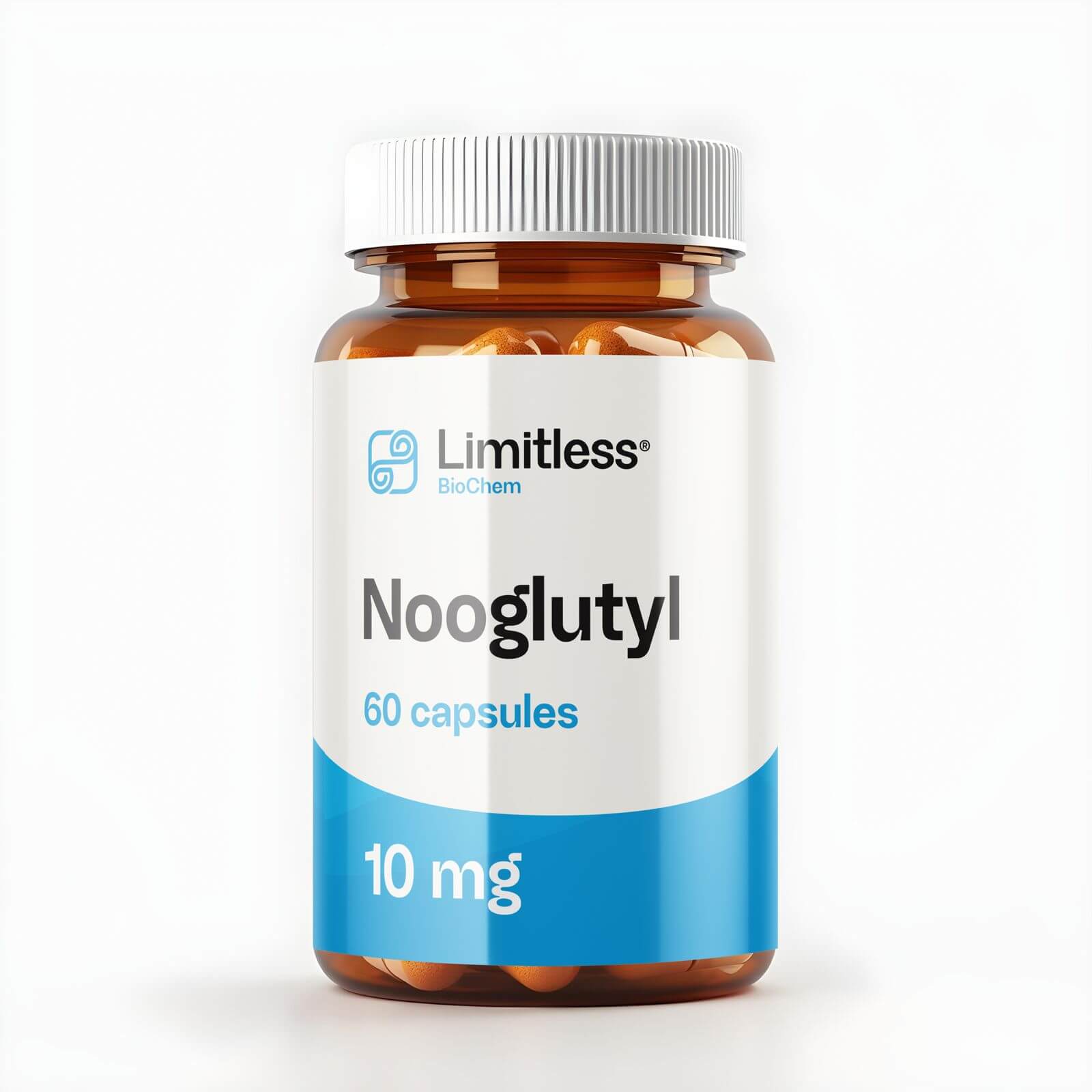
- Nooglutyl comes from the same Russian institute, the Zakusov Institute of Pharmacology, that developed the better-known nootropics Noopept and Semax.
- In head-to-head studies its anti-amnesic action was attributed largely to activation of AMPA-type glutamate receptors, setting it apart from comparators that worked through GABA-A receptors.
Mechanism
Nooglutyl is attractive to memory-minded users because it engages the comparatively directly, turning up the fast excitatory signaling that underpins learning. It acts as a positive modulator of -subtype receptors, enhancing the currents that mediate rapid excitatory neurotransmission and support plasticity and memory encoding [2]. In head-to-head evaluations of substances, the anti-amnesic effect of nooglutyl was attributed to a significant degree to activation of non- receptors of excitatory amino acids, generally the receptors, setting it apart from comparators that acted through -A receptors [1].
This action also touches other systems indirectly. In rats withdrawn from chronic diazepam, nooglutyl reduced anxiety and altered striatal receptor parameters in vivo without binding those receptors directly, suggesting that its influence on the dopaminergic system is mediated through the glutamatergic system rather than by direct receptor interaction [2]. The result is a compound whose effects radiate outward from -receptor modulation.
The functional consequences reported in animals span memory and resilience. Nooglutyl produced strong anti-amnesic effects across amnesia induced by microwave irradiation, acute , and motion sickness [1], normalized behavior and learning in rats exposed to intrauterine [4], and exerted pronounced neuroprotection in a hemorrhagic stroke model, where single injections given a few hours after injury reduced neurological deficit, restored motor coordination, improved memory retrieval, and prevented animal loss [5]. It also blunted experimental motion sickness through an identified neuronal mechanism [6]. Practically, its oral profile is favorable; a tablet formulation reached about 104 percent relative to the substance in rabbits, indicating efficient oral delivery [7].
Users interested in nooglutyl are typically drawn to this combination of memory encoding support and antihypoxic neuroprotection. Reported subjective effects are modest and center on cognitive sharpening; the compound's identity in the literature is that of a focused, -driven memory and neuroprotective agent.
receptor fingerprint
receptorspositive allosteric modulator
plasticity / strengthens
Antiamnesic / antihypoxic pathwayssupports
-type ionotropic receptorPositive modulator; labelled an ampakine / positive allosteric modulator by its developers, and the antiamnesic effect in vivo is attributed to non-NMDA (chiefly AMPA) receptor activation
No direct binding demonstrated; an NMDA-dependent action appears only at supra-therapeutic concentrations
receptorNot a direct target; effects on D2 appear indirect and glutamate-mediated
Metabotropic (mGlu) receptorsNo competition detected
Brain-derived neurotrophic factor ()No increase, unlike several comparator nootropics
Brain oxidative phosphorylationPreserves respiratory function after traumatic brain injury
Dosingtypical ranges, not medical advice
interested in protocols and clinical dosages? make an account to see them! ^_^
Safetyrisks and cautions, not medical advice
MEASURED ADVERSE EFFECTS (calcium salt, intravenous, only). In the 124-patient phase III trial adverse events occurred in 14.52% on drug versus 8.06% on placebo, a non-significant difference (p=0.395), with no dropouts (PMID 34184474). The approved Russian label lists dizziness in 0.8% and mild drowsiness in 0.8%, plus possible allergic reactions to components. Label contraindications: hypersensitivity, pregnancy, breastfeeding, age under 18, and renal or hepatic impairment.
SEIZURE SIGNAL, the one real mechanistic red flag. The calcium salt at 10 mM in rat hippocampal slices provoked epileptiform activity, blocked by the NMDA antagonist MK-801 (PMID 29797131); high-concentration nooglutil separately suppressed CA1 responses through an AP7-sensitive NMDA-dependent mechanism (PMID 11177255). These are in vitro concentrations far above the therapeutic range, and no seizures were reported in any human study, but potentiating AMPA receptors carries a recognised theoretical convulsant risk and this is the only ceiling evidence that exists. It matters most for anyone self-dosing an oral powder for which no human ceiling has ever been established.
REPRODUCTIVE. The calcium salt at 6.7 mg/kg in rats, stated as 10 times the maximum human therapeutic dose, did not affect reproductive function and was not embryotoxic or teratogenic (PMID 22550856). Only a 10-fold margin was tested, and the label still contraindicates pregnancy.
UNKNOWN. No drug interaction studies of any kind exist. No human overdose data. No safety data beyond 15-day courses. No published carcinogenicity or genotoxicity. Total human exposure across the entire published record is roughly 650 patients, all Russian, all intravenous, all short-course, essentially all with developer involvement. Nothing is known about oral free-acid safety in humans.
REGULATORY. Nooglutyl free acid: never approved by any regulator, anywhere, in 36 years. Not scheduled under the US Controlled Substances Act, not FDA-approved, and not a lawful dietary supplement ingredient (no NDI notification, no pre-DSHEA status); it is sold as a research chemical. Nooglutyl calcium is approved in Russia as Ampasse, prescription-only IV solution 5 mg/mL, registration ЛП-006394 (2020), current registration ЛП-№(002862)-(РГ-RU) 2023, marketing authorisation holder OOO TAVITA, manufactured by OOO Ellara, indicated for chronic cerebrovascular insufficiency. It has no FDA, EMA or MHRA approval.
WADA. Not named on the Prohibited List, and there is no ampakine or AMPA-modulator category on it. The live question is the S0 non-approved-substances catch-all, which prohibits at all times any substance "with no current approval by any governmental regulatory health authority for human therapeutic use." Russian approval of the calcium salt arguably lifts that salt out of S0, while the free acid sold as Nooglutyl powder has no approval anywhere and would sit squarely in S0. This is genuinely unsettled; a tested athlete should obtain a ruling rather than assume either reading.
History
Nooglutyl, chemically N-(5-hydroxynicotinoyl)-L-glutamic acid, was developed at the Zakusov Research Institute of Pharmacology in Moscow, the same laboratory associated with Noopept and Semax. It was investigated principally during the 1990s and 2000s as a memory-oriented nootropic and neuroprotective agent, with radioligand studies identifying it as a positive modulator of AMPA-subtype glutamate receptors. Its documented characterization rests almost entirely on Russian preclinical research in rodent models of amnesia and cerebral ischemia. It has not undergone the large controlled human trials required for regulatory approval, and it remains an investigational compound.
Reputation
Nooglutyl is discussed within nootropic circles as an intriguing, mechanistically direct ampakine, valued for engaging the AMPA-receptor signaling that underlies learning and synaptic plasticity comparatively directly. Its appeal rests on a consistent record of anti-amnesic and neuroprotective effects across diverse rodent models, including amnesia induced by hypoxia, electroconvulsive shock, and cerebral trauma, and on reports of benefit in senescence-accelerated mice. Enthusiasts are drawn to this combination of memory-encoding support and antihypoxic protection. Honesty requires noting that essentially all of this evidence is preclinical, and much of it published in Russian, with little independent human data. Reported subjective effects, where described, are modest and centered on cognitive sharpening.
Subjective profileweighing the evidence above
For anyone drawn to the AMPA angle it is one of the more mechanistically direct options, and the rodent anti-amnesic data is consistent across models. But three decades on it has never entered a human trial, so any dose is unvalidated; avoid it with a seizure disorder and keep choline alongside.
Where to buy

1 other outlet

Suppliers
Vendors carrying Nooglutyl, with live product details and codes. Links are affiliate links that support the wiki at no cost to you.
Kimera Chems
Nooglutyl
Limitless Biochem🌐
Nooglutyl
Research
- 1990first cited[A new substance with nootropic activity--N-5(hydroxynicotinoyl)-L-glutamic acid].
- 1998most active year3 papers
- 2021controlled trial[Efficacy and safety of treatment with ampasse: the results of a randomized, double-blind, plac…
- 2026most recent[AMPA receptors: molecular mechanisms of synaptic plasticity and the potential of Ampasse in ad…
- 1.[The antiamnestic effect of nootropic substances in rats]
- 2.Effect of nooglutil on benzodiazepine withdrawal syndrome and binding of 3H-spiperone with D2 receptors in rat striatum
- 3.[Effect of nooglutil on rats with intracerebral posttraumatic hematoma (hemorrhagic stroke)]
- 4.[The correction with nooglutil and L-pyroglutamyl-D-alanine amide of cognitive disorders in rats due to intrauterine hypoxia]
- 5.[The bioavailability of tableted drug forms of the new Russian nootropic preparation nooglutil in rabbits]
- 6.[Antimotion-sickness effect of nooglutil and its neuronal mechanism]
- 7.[A new substance with nootropic activity--N-5(hydroxynicotinoyl)-L-glutamic acid].
- 8.[New trends in the search for nootropic preparations].
- 9.[The effect of nooglutil and piracetam on different forms of operant learning].
- 10.[The sodium oxybutyrate and nooglutil correction of dopamine release in the striatum of prenatally alcoholized rat pups].
- 11.[The effect of substances with nootropic activity on oxidative phosphorylation in brain mitochondria in acute craniocerebral trauma].
- 12.[Effect of phenyl-tert-butylnitrone, mexidol and nooglutil on the ischemic lesion zone and memory in rats following middle cerebral artery occlusion].
30 listed here; entry last updated August 2026
Reviews
- Ordered some nooglutyl from kimera.
Honestly, this isn't the greatest compound in the world but its definitely something. Went for a run this morning around 9:30 after taking 600mg Alpha-GPC and 300mg Citicoline to get my head going and took the 30mg around 11:30 to study some mandarin. After around 15 minutes i could feel it the tunnel vision coming in so i knew something was happening. The day before i took 20mg Unifiram and that study session was absolutely amazing, and maybe that's why i thought this Nooglutyl wasn't anything crazy. I for sure was focused and recall/repetition of mandarin was flowing nicely.
0
My notesprivate to this device
FAQ
Where does nooglutyl come from?
It is a Russian-developed nootropic studied for AMPA-modulating and memory effects.
What is an ampakine?
Ampakines are compounds that modulate AMPA glutamate receptors, which are involved in learning and plasticity.
Is it widely available?
It is mostly an investigational compound with limited availability and human data.
What is it studied for?
Research has focused on memory and neuroprotection in preclinical settings.
Adverse effects
- Occasional headache
Notes and cautions
- A touch of overstimulation
- Mild irritability