
spec sheet11 rows
TAK-653, also called osavampator or NBI-1065845, is an experimental oral drug that makes the brain's main excitatory receptor, the AMPA glutamate receptor, respond more strongly to glutamate the brain is already releasing; crucially it cannot switch the receptor on by itself, a design choice intended to avoid the seizure risk that stopped earlier drugs of this type. It is being developed as a fast-acting antidepressant for people whose depression has not responded to standard antidepressants. A 183-person Phase 2 trial found that 1 mg once daily beat placebo on a standard depression rating scale while 3 mg did not reach statistical significance, and five Phase 3 trials are now enrolling; those Phase 2 results have not yet been published in a peer-reviewed journal. It is approved nowhere in the world, it is not a legal supplement, and the entire published literature amounts to about ten papers, most of them written by employees of the companies that own it.
- Amplifies your own glutamate signaling
- Ketamine-style plasticity without the dissociation
- Sharper cognition measured in healthy humans
- Wide safety margin for its class
- In active Phase 3 development
- Raises BDNF at low doses
- Human safety data are still limited to early-phase trials
- Headache and dizziness are possible with glutamatergic agents
- Potential for overstimulation or difficulty sleeping
Overview
TAK-653, known by the international nonproprietary name osavampator and also designated NBI-1065845, is an investigational small-molecule positive allosteric modulator (PAM) of the AMPA subtype of glutamate receptor [3][4]. It was discovered by Takeda Pharmaceutical Company and later advanced by Neurocrine Biosciences in clinical development for major depressive disorder (MDD) [4][7].
AMPA receptors mediate the majority of fast excitatory synaptic transmission in the brain, and their activation is now understood to be a common downstream trigger for the rapid antidepressant effects of ketamine and related agents [3][8]. Earlier AMPA receptor potentiators, historically called ampakines, tended to carry intrinsic agonist activity, which was associated with a narrow bell-shaped dose-response curve and a heightened seizure risk [3]. TAK-653 was deliberately screened and optimized to have minimal agonistic activity, potentiating the receptor only in the presence of glutamate through a structural interaction at the GluA1 subunit; this design aims to preserve the physiological pattern of synaptic signaling while widening the safety margin [1][3].
The compound has been characterized extensively in preclinical models, where it enhances synaptic responses and cognition and produces antidepressant-like effects, and it has progressed through phase 1 human pharmacokinetic studies and into phase 2 trials for depression [1][4][5]. In early human studies it was generally well tolerated and showed no meaningful cytochrome P450 3A induction, supporting co-administration with other medications [4]. As an experimental agent, osavampator is not approved for medical use and remains confined to clinical research; it is administered orally in trial settings [4].
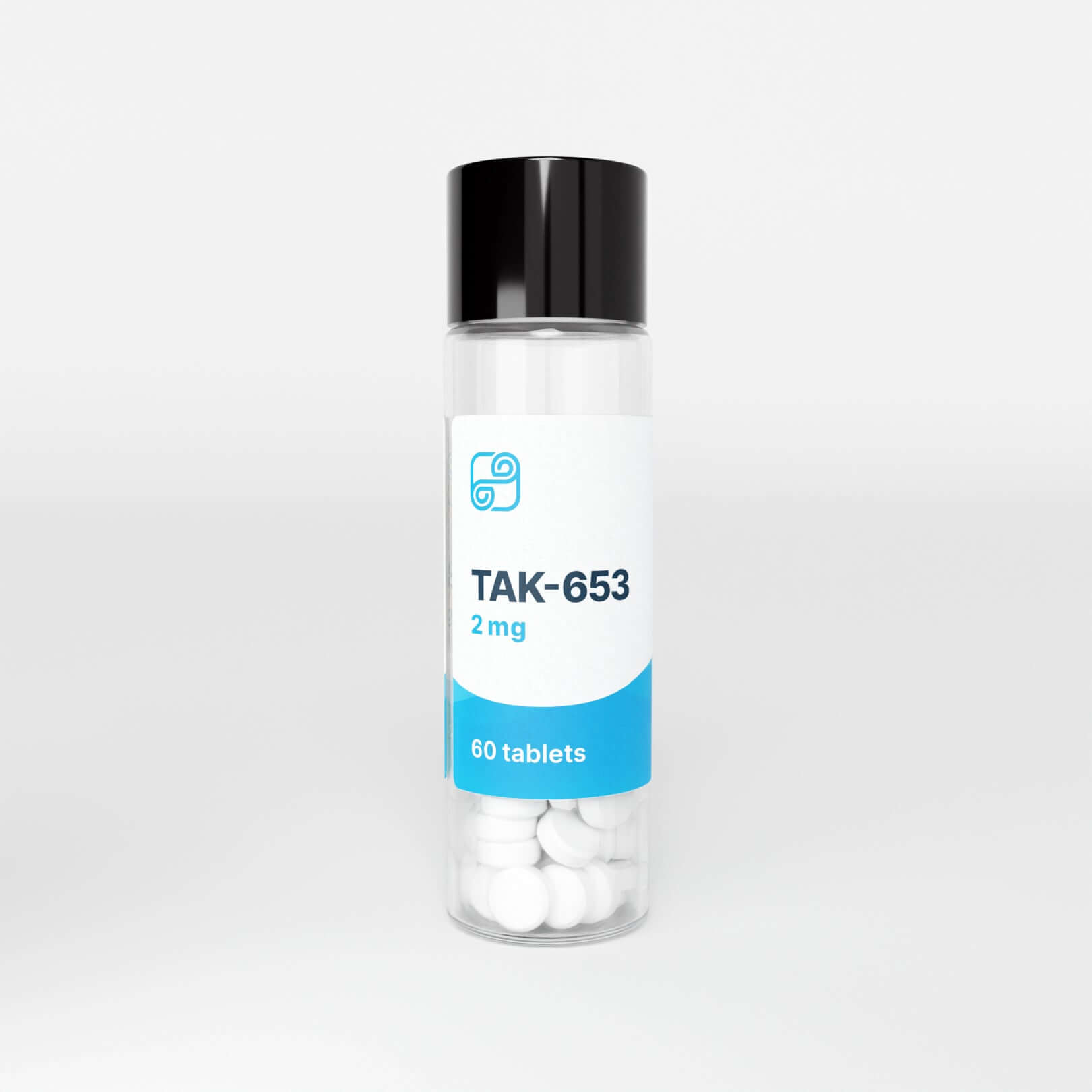
- TAK-653 potentiates the AMPA receptor only when the brain's own glutamate is present, and in rats this glutamate-dependence produced a safety margin of roughly a thousandfold on total exposure between synaptic activity and convulsions.
- Under the name osavampator, the compound advanced into phase II trials for major depressive disorder after being licensed from Takeda to Neurocrine Biosciences.
- its low-agonism trick comes down to one amino acid: how it engages Ser743 on the GluA1 subunit keeps it from over-activating the receptor.
- it now has a real generic name, osavampator, and is run by Neurocrine as NBI-1065845, not Takeda.
- in rats the gap between the helpful dose and the seizure dose is over 1000-fold on exposure; older ampakines had almost no gap.
- in a monkey depression model it lowered the stress hormone cortisol and the inflammatory marker IL-6 while raising BDNF.
Mechanism
TAK-653 (osavampator, NBI-1065845) is a positive modulator of the subtype of ionotropic receptors, and its defining feature is how little it does on its own. according to PubMed, it binds the -binding domain of the receptor in a glutamate-dependent manner and potentiates glutamate-induced calcium influx and currents through physiological AMPA receptors while producing almost no direct activity; structurally, this low-agonism behavior traces to how the molecule interacts around Ser743 on the GluA1 subunit (Suzuki et al., 2021, Sci Rep, https://doi.org/10.1038/s41598-021-93888-0).
that distinction is the whole thesis of the compound. classical potentiators like the older 'ampakines' tend to carry two linked liabilities: a bell-shaped dose-response (too much becomes counterproductive) and a narrow safety margin against seizures, both of which track with intrinsic agonistic activity. by potentiating only when endogenous is already released, TAK-653 amplifies genuine phasic transmission rather than tonically switching on receptors that should be at rest. in brain slices it enhanced evoked AMPA-receptor-mediated EPSPs more potently than AMPA itself or than a strongly agonistic potentiator, and it improved both working and recognition memory where the more agonistic comparators did not (Suzuki et al., 2021).
downstream, activation drives the same intracellular cascade implicated in rapid antidepressant action: TAK-653 increased phosphorylation of , ERK, and p70S6 kinase and raised protein in rat cortical neurons, and produced antidepressant-like effects in the rat reduction-of-submissive-behavior model without the hyperlocomotion that flags psychotomimetic risk (Hara et al., 2021, Pharmacol Biochem Behav, https://doi.org/10.1016/j.pbb.2021.173289). this is essentially an attempt to reach ketamine's AMPA -> mTOR -> BDNF endpoint directly, skipping the blockade and dissociation.
crucially the safety margin is wide for this class: about 419-fold on peak plasma concentration and 1017-fold on AUC between the effective and convulsive doses in rats (Suzuki et al., 2021). in humans, single 0.5 mg and 6 mg doses gave a psychostimulant-like pharmacodynamic profile on the NeuroCart (increased saccadic peak velocity, improved adaptive tracking) consistent with increased cortical excitability seen on transcranial magnetic stimulation (Dijkstra et al., 2022, Transl Psychiatry, https://doi.org/10.1038/s41398-022-02148-w). a nonhuman primate chronic-stress study later showed reversal of depression-like behavior alongside lower and IL-6 and higher (Li et al., 2025, Biomedicines, https://doi.org/10.3390/biomedicines13061389).
the honest status: mechanism and target engagement are unusually well characterized for an investigational -adjacent molecule, but proof that it treats depression in people is still pending the phase 3 readouts.
receptor fingerprint
(GluA1/GluA2, -binding domain)positive allosteric modulator; potentiates glutamate-evoked currents only when glutamate is present, with minimal intrinsic agonism
GluA1 Ser743 (structural interaction site)binds at the dimer interface and stabilizes the active conformation; structural interference at Ser743 is what keeps agonistic activity low
/ p70S6K / / ERK signaling (downstream)increases phosphorylation in cortical neurons secondary to AMPA-R activation
release (downstream)raises BDNF protein in rat primary cortical neurons and in a primate chronic-stress model
(ionotropic receptor, GluA1-GluA4) -binding domainPositive allosteric modulator; binds only in the presence of glutamate, at the intradimer interface in the channel-closed state, sterically gated by Ser750 in GluA2o (Ser743 in GluA1i)
Human GluA1 (flip) , functional potentiationPotentiates glutamate-evoked Ca2+ influx in hGluA1i-expressing CHO cells; no effect without glutamate
Native neuronal , Ca2+ influxPotentiates AMPA-evoked Ca2+ influx in rat primary hippocampal neurons
Native neuronal , whole-cell currentPotentiates AMPA-elicited whole-cell currents in rat primary hippocampal neurons
orthosteric () siteNo binding; TAK-653 does not displace [3H]-AMPA and instead mildly enhances its binding, confirming it is not an agonist
GluA1-GluA4 subunit selectivity (flip and flop, with TARP gamma-2)No prominent subunit selectivity across homomeric AMPA receptor subtypes
5-lipoxygenase (ALOX5)Off-target enzyme inhibition; the only hit in a 97-target screening panel at 10 uM
/ERK to and p70S6 kinase signalling, and proteinDownstream consequence of AMPA receptor potentiation, not a binding target; increased phosphorylated mTOR, p70S6K, Akt and ERK and raised BDNF protein in rat primary cortical neurons
Dosingtypical ranges, not medical advice
interested in protocols and clinical dosages? make an account to see them! ^_^
Safetyrisks and cautions, not medical advice
REGULATORY: investigational only. Not approved by FDA, EMA, PMDA or any other authority. Not a scheduled or controlled substance in the United States. Not named on the WADA Prohibited List, but it is captured by class S0 Non-Approved Substances, which prohibits at all times "any pharmacological substance which is not addressed by any of the subsequent sections of the List and with no current approval by any governmental regulatory health authority for human therapeutic use (e.g. drugs under pre-clinical or clinical development...)"; a tested athlete taking it commits an anti-doping rule violation. Any material sold to consumers is unlicensed research chemical, not a clinical preparation.
HUMAN ADVERSE EFFECTS: in Phase 1 (NCT02561156, posted results) there were zero serious adverse events across all doses up to 18 mg single and 9 mg daily; the commonest events were headache (17 participants) and dizziness (13), both also common on placebo. Single cases of palpitations at 9 mg, sinus tachycardia and anxiety at 5 mg, presyncope at 3 mg, asthenia and lethargy at 9 mg daily. One participant recorded an "electroencephalogram abnormal" adverse event at 5 mg, but zero participants in either part met the criterion for a clinically significant EEG change, and zero had treatment-emergent suicidal ideation on the C-SSRS. One discontinuation for an adverse event, in the 6 mg multiple-dose cohort (16.7% of that cohort of six).
In Phase 2 (n=183) the sponsor reports no serious adverse events and no adverse events of special interest; headache 11.1% at 1 mg and 4.3% at 3 mg, nasopharyngitis 4.4% and 6.4%. CNS profile in healthy volunteers was psychostimulant-like on the NeuroCart battery, with improved adaptive tracking and increased saccadic peak velocity but no subjective drug effect and no body sway.
INTERACTIONS: TAK-653 is not a CYP3A inducer; after 10 days of dosing, midazolam AUC ratio was 0.88, ethinyl estradiol AUC ratio 1.01 and levonorgestrel AUClast ratio 0.87, so no clinically meaningful loss of oral contraceptive exposure (PMID 38700236). No other human interaction data exists.
CLASS RISK: AMPA receptor potentiators as a class have caused seizures and narrow therapeutic windows; TAK-653 caused tonic-clonic convulsions in one rat only at 100 mg/kg orally, giving margins of 419-fold on plasma Cmax and 1017-fold on AUC, versus 42-fold and 122-fold for TAK-137 and 3.4-fold and 4.0-fold for LY451646. Those margins are rat data and have not been reproduced in humans. Long-term human safety is unknown; the open-label Phase 3 safety study (NCT06966401) does not complete until 2029.
Interactionsdocumented pairs only, not exhaustive
The one formal interaction study run on TAK-653 asked whether it induces CYP3A, the enzyme that clears a large share of ordinary medication. It does not. In a phase I trial, healthy adults took TAK-653 for nine days before receiving either midazolam, a sensitive CYP3A substrate used as the standard probe, or a combined oral contraceptive. Exposure barely moved in any arm; the geometric mean ratios sat between 0.87 and 1.01, with confidence intervals spanning 1.0 [4]. Contraceptive levels in particular were unchanged, which is the practical question, since an inducer would quietly reduce their effectiveness.
That is the extent of the documented record. TAK-653 is investigational, so there is no interactions section on any label and no post-marketing reporting; nothing is known about combining it with the compounds people actually pair it with. The absence of findings here reflects an absence of study, not a clean bill.
Checking a whole stack? Run it through interactions + stacks.
History
TAK-653, also known as osavampator and NBI-1065845, was discovered by Takeda Pharmaceutical Company through a screening program aimed at finding an AMPA receptor potentiator with minimal intrinsic agonist activity, a property intended to avoid the narrow dose-response and seizure liability that limited earlier ampakines. Preclinical work published in 2021 and 2022 described its glutamate-dependent mechanism, its engagement of the Akt, ERK, mTOR, and BDNF cascade implicated in rapid antidepressant action, and a wide safety margin against convulsions. The compound was subsequently licensed to Neurocrine Biosciences and advanced into phase II clinical development for major depressive disorder, with phase I studies confirming favorable tolerability and no meaningful cytochrome P450 3A interaction. It remains investigational, with efficacy in patients still being established.
Reputation
TAK-653 is viewed as a genuinely next-generation ampakine, engineered to deliver the synaptic and BDNF-boosting benefits associated with ketamine's mechanism while sidestepping the agonist baggage and seizure risk that troubled its predecessors. Its striking preclinical safety margin against convulsions and its clean phase I tolerability profile have helped it become one of the more credible rapid-acting antidepressant candidates to reach mid-stage trials. The measured view is that its antidepressant and pro-cognitive promise, though well supported in cells and animals, still awaits confirmation of efficacy in patients through ongoing clinical work. As a designed, glutamate-dependent potentiator with a real development pipeline, it stands out from the typical research chemical.
Subjective profileweighing the evidence above
The most interesting glutamatergic compound in the nootropic conversation right now, and restraint is why: it barely activates AMPA on its own, which gives it a much wider gap to convulsant effects than older ampakines. Human data is still early-phase, and anyone with a seizure history should skip it.
Where to buy
1 other outlet
Suppliers
Vendors carrying TAK-653, with live product details and codes. Links are affiliate links that support the wiki at no cost to you.
Limitless Biochem🌐
TAK-653
Kimera Chems
TAK-653
Research
- 2019first citedRapid-acting antidepressants
- 2021most active year3 papers
- 2024controlled trialEffects of the selective AMPA modulator NBI-1065845 on the pharmacokinetics of midazolam or eth…
- 2025most recentAll roads lead to glutamate: NMDA and AMPA receptors as targets for rapid-acting antidepressants
- 1.Strictly regulated agonist-dependent activation of AMPA-R is the key characteristic of TAK-653 for robust synaptic responses and cognitive improvement
- 2.TAK-653, an AMPA receptor potentiator with minimal agonistic activity, produces an antidepressant-like effect with a favorable safety profile in ratsmanufacturer authoredauthored by the Takeda discovery unit that created the compound
- 3.Role of the AMPA receptor in antidepressant effects of ketamine and potential of AMPA receptor potentiators as a novel antidepressantmanufacturer authoredreview written by the Takeda discovery team behind the compound; the authors declare they are Takeda employees
- 4.Effects of the selective AMPA modulator NBI-1065845 on the pharmacokinetics of midazolam or ethinyl estradiol-levonorgestrel in healthy adultsmanufacturer authoredauthored by Neurocrine Biosciences, which develops the compound; the authors declare they are employees and hold stock
- 5.TAK-653 Reverses Core Depressive Symptoms in Chronic Stress-Induced Monkey Model
- 6.All roads lead to glutamate: NMDA and AMPA receptors as targets for rapid-acting antidepressants
- 7.Emerging trends in antipsychotic and antidepressant drug development: Targeting nonmonoamine receptors and innovative mechanisms
- 8.Rapid-acting antidepressants
- 9.Central nervous system effects of TAK-653, an investigational alpha-amino-3-hydroxy-5-methyl-4-isoxazole receptor (AMPAR) positive allosteric modulator in healthy volunteers.
- 10.Transcranial magnetic stimulation as a translational biomarker for AMPA receptor modulation.
- 11.Phase 2 study of NBI-1065845 in adults with major depressive disorder (ClinicalTrials.gov NCT05203341)
- 12.Phase 3 study of NBI-1065845 as adjunctive treatment in MDD (ClinicalTrials.gov NCT06786624)
12 listed here; entry last updated August 2026
Reviews
- amazing, been using daily
been using 2.75mgs daily caps from kimera. pretty solid. i feel like like my verbal flow is slightly impaired, albeit i've only noticed that during the first 1-4 days of usage, afterwards, the opposite. i feel as if my ability to pull words to mind is slightly better, albeit i don't think i'm the BEST at articulating myself just yet. definitely a boost. definitely feel more inclined to work. less anhedonic tone, if that makes sense. feels extremely smooth and i feel more dedicated to my work (especially cuz of video editing god i hate my life man) but saying i feel more grounded when doing said work is also fairly true, IME. I feel very motivated, and always grounded with my work, moreso when I pair it with guanfacine or tropisetron; alone, i feel very driven but slightly scatterbrained. not bad though. slightly anxiogenic at doses 5mg+ for me, seems to cause pretty gnarly anxiety, but for most people? 1-4mgs is all you'd need. probably don't take it daily, too. long half-life. personal favorite of mine; don't pair with any other AMPAkines (excitotoxicity) and DON'T pair with a million stims. stimulation =/= good cognition. god.
0 - goated all around for anhedonia
i run 4mgs of TAK daily. honestly soooo great for processing speed + anhedonia IMO.
0 - awesome glutamatergic, my fave
i love TAK man. best thing ever. been taking 3mgs every morning for the past 2 months, now swapping to 2.75mgs because I got the capsules from kimera. pretty solid. i feel like I have much quicker reaction speed, way more inclinitation/motivation to actually GO and DO STUFF or work, which is great doesn't stack well with a high dose stim, seems to be great when it's mod. dose stimulant, and mod. dose of TAK. i started with 1mg, and moved up to 2mg after a week. felt great, if I take too much I seem to get some anxiety, but other than that it's awesome. mood is pretty solid too, just driven to WORK and do things, awesome. did mess with my sleep for the first few days (Mainly because I take it daily, most people don't) and it went away after like 3 days or just around that. feels veeery similar to Oxiracetam for me, except better for work and processing-speed tasks. TAK653 IS GOATED.
0 Hello. Id like to share my experience with my first noots. So yesterday i started 1mg tak and 5mg acd856. Within 30mins i started getting dizziness and feeling heavyheaded.I took it at 4pm. Dizziness went away after like 3-4h but not the feeling of heavyheadiness.Till 3am i didnt notice anything else so i thought i just didnt respond its just first dose. Little did i know 😭 . I woke up at 6am to my bro's alarm. He always puts the same alarm but i never woke up before to it. But this time my wake up was different. Usually when i wake up(cause of my subh sleep schedule)it takes some time to get off bed and im still like off mood. Bro today i woke up and i was fully wired . I sat there talking with myself on bed and started debating things by myself. The funny part? Im like immo on valorant and high elo faceit on cs which is one of the reasons i started (besides clearing up my brain fog and my cooked attention span). All of the sudden i started remembering things that happened like 5y ago and getting nostalgia. ill give one example. I remembered a day where i went to buy some clothes. The difference is that my brain although it recreated the memmory i started like applying my life skills into that memmory. What i mean? Basically i started jiggle peeking and checking corners into the store(anyone playing cs or val will understand) . I aint gonna lie this shi was funny ash. I managed to fall asleep today like 4h and i kinda feel better. Fogyness and heavyheaded feeling is out .Didnt dose yet. Should i just wake up early in the morning to dose tak? What yall think caused this? Shutout to Pilk for helping me since the beggining🙏
0- TAK experience
TAK was similar to a stimulant in a way, absolutely amazing experience.
0
My notesprivate to this device
FAQ
what is TAK-653 and what does it actually do?
it is an AMPA receptor positive allosteric modulator (an ampakine), now carrying the generic name osavampator. it does not switch AMPA receptors on by itself; it only amplifies the signal when your own glutamate is already firing across a synapse. that glutamate-dependent, 'minimal agonism' design is the whole point; according to PubMed it lets the drug boost real synaptic traffic without the runaway activation that made older ampakines seizure-prone (Suzuki et al., 2021, Sci Rep, https://doi.org/10.1038/s41598-021-93888-0).
is it a nootropic i can buy?
no. it is an investigational prescription-stage drug from Takeda, now licensed to Neurocrine Biosciences as NBI-1065845, and it is in phase 3 trials for depression. it is not sold as a supplement, there is no established consumer dose, and the human safety database is still small. treat any 'research chemical' vendor selling it as unverified and risky.
how is it different from noopept or the racetams?
mechanistically it is much more direct. racetams and noopept nudge glutamate/cholinergic tone in fuzzy, poorly-characterized ways; TAK-653 binds a defined pocket on the AMPA receptor and has real receptor-level and human pharmacodynamic data behind it. on the site we do not recommend noopept at all (it behaves like an AMPA-releasing agent with a murkier profile); TAK-653 is the cleaner, better-studied way to think about AMPA potentiation, though it is still experimental.
does it work like ketamine?
it aims at the same downstream target but from the front door. ketamine's fast antidepressant effect is thought to run through a burst of AMPA activation that turns on mTOR and BDNF; TAK-653 tries to trigger that AMPA -> mTOR -> BDNF cascade directly, without ketamine's NMDA blockade or dissociation. in rats it produced antidepressant-like effects with no hyperlocomotion (a proxy for psychotomimetic effects), unlike ketamine (Hara et al., 2021, Pharmacol Biochem Behav, https://doi.org/10.1016/j.pbb.2021.173289).
is there any human evidence it does anything?
yes, at the pharmacodynamic level. in healthy volunteers a single 0.5 mg or 6 mg dose produced a psychostimulant-like signature on the NeuroCart battery (faster saccadic eye movements, better adaptive tracking) and increased cortical excitability, consistent with real target engagement (Dijkstra et al., 2022, Transl Psychiatry, https://doi.org/10.1038/s41398-022-02148-w). efficacy for depression itself is what the ongoing phase 3 program is designed to prove; that is not settled yet.
what is the seizure risk?
lower than the old ampakines by design, but not zero. the classic problem with AMPA potentiators is a narrow gap between the cognitive dose and the convulsive dose. because TAK-653 barely activates resting receptors, it showed a wide margin in rats; roughly 419-fold on peak plasma level and 1017-fold on exposure between the effective and convulsive doses (Suzuki et al., 2021, Sci Rep, https://doi.org/10.1038/s41598-021-93888-0). that is a big improvement, but seizure liability is still watched closely in the clinic.
who is developing it and what stage is it at?
Takeda discovered it; Neurocrine Biosciences licensed it and is running it as NBI-1065845. a phase 2 study in major depressive disorder (NCT05203341, 183 patients) completed in early 2024, and in 2025 Neurocrine launched a broad phase 3 program testing it as an adjunctive (add-on) treatment for MDD (for example NCT06786624, NCT06963021 and a long-term safety study NCT06966401).
does it interact with the liver enzymes that metabolize other drugs?
it does not appear to induce CYP3A. a dedicated phase 1 study found no meaningful effect of repeated TAK-653/NBI-1065845 dosing on midazolam or on an ethinyl estradiol/levonorgestrel oral contraceptive, so it did not behave as a CYP3A inducer (Lin et al., 2024, Clin Transl Sci, https://doi.org/10.1111/cts.13791). that is reassuring for eventual co-medication, but the full interaction picture is still being built.
is there evidence beyond rodents?
yes. in a nonhuman primate chronic-stress model of depression, two weeks of TAK-653 reversed core depression-like behaviors (motivation, activity, huddling), lowered cortisol and the inflammatory cytokine IL-6, and raised BDNF (Li et al., 2025, Biomedicines, https://doi.org/10.3390/biomedicines13061389). primate data like this is a meaningful step up from the usual rodent-only story, though it is still preclinical.
why does 'glutamate-dependent' matter so much?
because it means the drug follows your brain's own activity instead of overriding it. TAK-653 potentiated electrically-evoked AMPA responses more strongly than an actual AMPA agonist did, yet improved both working memory and recognition memory in animals, whereas a more agonistic potentiator helped only recognition memory and a plain agonist helped neither (Suzuki et al., 2021, Sci Rep, https://doi.org/10.1038/s41598-021-93888-0). the takeaway: amplifying real, phasic signals beats blanket activation of receptors sitting at rest.
Limitations of the evidence
- Not an approved medicine; long-term effects are unknown
Adverse effects
- Human safety data are still limited to early-phase trials
- Headache and dizziness are possible with glutamatergic agents
- Potential for overstimulation or difficulty sleeping
Notes and cautions
- As a glutamatergic potentiator, a theoretical seizure risk exists, though preclinical margins were wide