
spec sheet6 rows
MitoVitan Active is a concentrated SkQ1 solution meant to be blended into an existing cream or serum.
- Concentrated SkQ1, a mitochondria targeted antioxidant
- Quenches lipid peroxidation inside the membrane itself
- Regenerated by the respiratory chain, so it keeps working
- Blends into whatever cream or serum is already used
- One concentrate stretches across a whole shelf of products
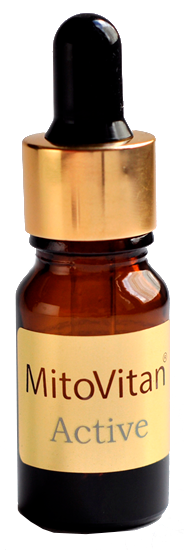
- PubMed indexes NO study naming MitoVitan or MitoVitan Active; every citation and target row here is for its declared active SkQ1 (10-(6'-plastoquinonyl)decyltriphenylphosphonium) from Mitotech and the Skulachev group, and the product-to-active link comes from the manufacturer, not from indexed literature.
- SkQ1 accumulates selectively in mitochondria because the lipophilic decyltriphenylphosphonium cation is drawn across the inner membrane by the membrane potential, delivering a redox-cycling plastoquinone head to the site of ROS production.
- In a randomised, double-masked, placebo-controlled Phase 2 trial in 91 subjects, SkQ1 ophthalmic solution significantly improved corneal fluorescein staining, lissamine green staining, lid margin redness, ocular discomfort, dryness and grittiness versus placebo over 29 days [1].
- Applied topically at 7.5 microM in rabbits, SkQ1 prevented anaesthesia-induced dry eye by inhibiting corneal apoptosis, raising glutathione peroxidase and reductase activity, downregulating TNF-alpha and IL-6 and upregulating IL-10 in tears [2].
- In old mice, SkQ1 accelerated dermal wound healing through faster resolution of inflammation, myofibroblast differentiation, vascularisation and epithelialisation, and prevented TNF-induced breakdown of endothelial VE-cadherin junctions [3].
- SkQ1 extended lifespan in outbred and inbred mice and in dwarf hamsters and mole-voles, with the largest effect where baseline lifespan was shortened by pathogen exposure, and it prevented age-dependent loss of oestrous cycling [4].
Mechanism
SkQ1 pairs a plastoquinone antioxidant with a triphenylphosphonium cation, which drags it across the inner membrane and concentrates it where most reactive oxygen species are generated. It quenches lipid peroxidation in the membrane itself and is regenerated by the respiratory chain, which is what distinguishes a targeted antioxidant from an untargeted one.
receptor fingerprint
inner membrane (electrophoretic accumulation)The decyltriphenylphosphonium cation of SkQ1 is driven across the inner membrane by the mitochondrial membrane potential, concentrating the plastoquinone antioxidant head at the site of ROS generation
reactive oxygen species and cardiolipin peroxidationThe plastoquinonyl moiety is reduced and re-oxidised by the respiratory chain, acting catalytically to intercept lipid peroxidation
Corneal glutathione peroxidase and glutathione reductaseStimulates intrinsic antioxidant enzyme activity and raises antioxidant capacity and stability of the tear film
VE-cadherin endothelial junctionsPrevents TNF-driven decomposition of VE-cadherin contacts and the resulting rise in endothelial monolayer permeability
TGF-beta signalling and fibroblast-to-myofibroblast differentiationDrives fibroblast differentiation to myofibroblasts producing matrix proteins and growth factors, whose TGF-beta then stimulates endothelial cell motility
Safetyrisks and cautions, not medical advice
MitoVitan Active is a single molecule in the topical formula class. A full adverse effect profile has not been compiled for this entry yet, so nothing here should be read as evidence that it is well tolerated; the absence is missing work rather than a finding. What is documented is what the compound is and what it is used for.
Subjective profileweighing the evidence above
A concentrate meant to be stirred into whatever cream is already on the shelf is an odd delivery choice for a molecule whose entire selling point is precision, since the dilution, the base and the final concentration all become the buyer's problem. Anyone set on putting SkQ1 on their face is better served by a finished formulation where at least the concentration is fixed and the vehicle was designed for it. The targeted antioxidant mechanism is identical either way, and so is the absence of evidence about faces.
Where to buy

Suppliers
Vendors carrying MitoVitan Active, with live product details and codes. Links are affiliate links that support the wiki at no cost to you.
RUPharma🌐
MitoVitan Active
Research
- 2011first citedEffects of the mitochondria-targeted antioxidant SkQ1 on lifespan of rodents.
- 2016controlled trialSkQ1 Ophthalmic Solution for Dry Eye Treatment: Results of a Phase 2 Safety and Efficacy Clinic…
- 2017most recentMitochondria-Targeted Antioxidant SkQ1 Prevents Anesthesia-Induced Dry Eye Syndrome.
- 1.SkQ1 Ophthalmic Solution for Dry Eye Treatment: Results of a Phase 2 Safety and Efficacy Clinical Study in the Environment and During Challenge in the Controlled Adverse Environment Model.
- 2.Mitochondria-Targeted Antioxidant SkQ1 Prevents Anesthesia-Induced Dry Eye Syndrome.
- 3.Mitochondria-targeted antioxidant SkQ1 improves impaired dermal wound healing in old mice.
- 4.Effects of the mitochondria-targeted antioxidant SkQ1 on lifespan of rodents.
4 listed here; entry last updated August 2026
Reviews
My notesprivate to this device
Notes and cautions
- No safety data exist for the finished MitoVitan product, because nothing under that name is indexed in PubMed.
- For the active ingredient, SkQ1 ophthalmic solution was reported safe over 29 days in a 91-subject Phase 2 trial [1] and topical SkQ1 showed no corneal toxicity in rabbits at 7.5 microM [2], but no human dermal safety study is published and no SkQ1 product holds FDA or EMA approval.
- Triphenylphosphonium-targeted compounds concentrate in mitochondria in proportion to membrane potential and turn pro-oxidant and uncoupling above a narrow concentration window, so dose matters far more than for a conventional antioxidant.
- Treat the marketed cosmetic as an unregulated preparation of unverified active concentration.