
spec sheet10 rows
Ethanol is the two-carbon alcohol and the oldest cosolvent in pharmacy. It mixes with water in all proportions and with most organic liquids at the same time, dissolves a wide range of poorly water-soluble compounds, evaporates cleanly, and actively enhances permeation through skin rather than sitting on it. It is catalogued here as a solvent, because that is what people buy it for. It is also the alcohol in alcoholic drinks, and the health record for drinking it is one of the largest in epidemiology and not a favourable one. Both facts are true of the same molecule and neither cancels the other.
- Dissolves compounds that water alone will never touch
- Mixes freely with water and PEG; the classic bridge solvent
- Evaporates clean, leaving no residue in a prepared stock
- Actively drives compounds through skin instead of sitting on it
- Better characterized than any alternative cosolvent on the shelf
- Cheap, everywhere, and the default vehicle in published preparations
- Skin drying, defatting and irritation on repeated contact
- Absorption through skin, so a topical preparation delivers ethanol as well as the compound dissolved in it
- Flammability; neat ethanol has a low flash point and is an ignition hazard rather than a chemical one
Mechanism
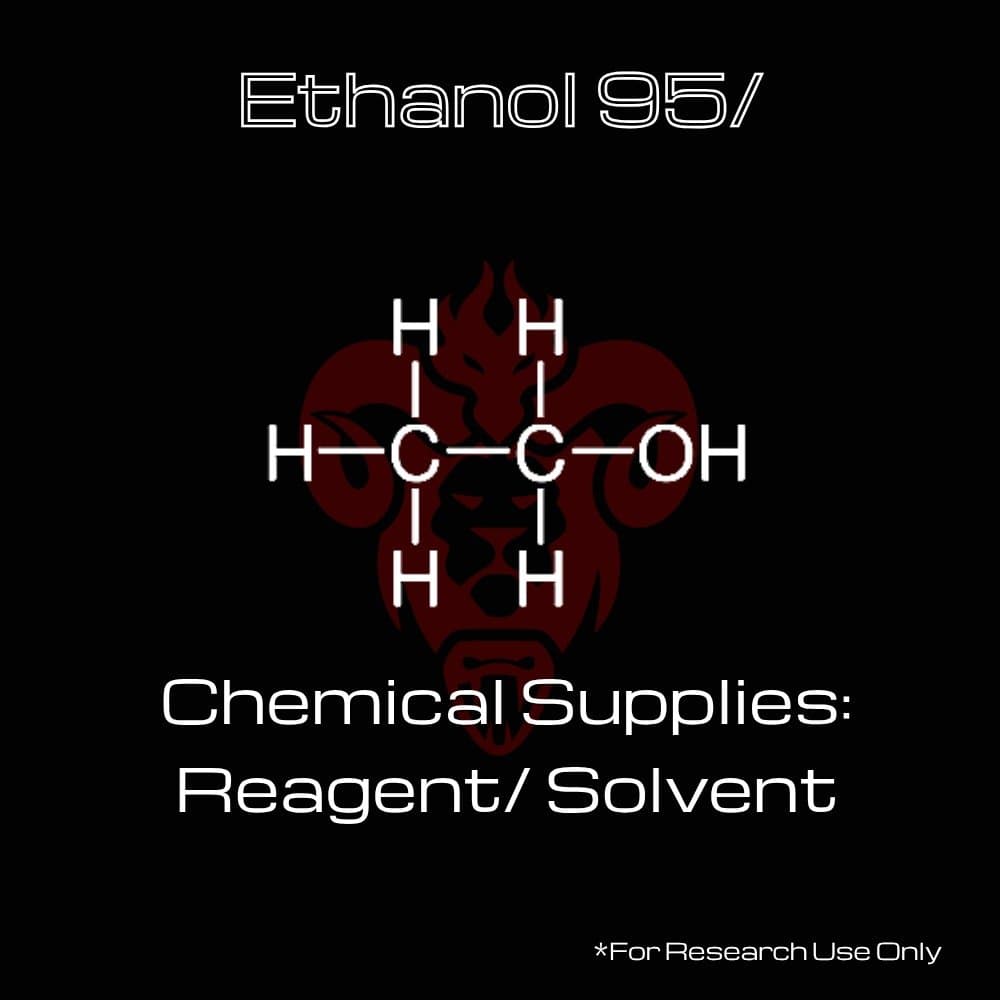
Ethanol is about as small as a useful solvent gets: a two-carbon chain with a hydroxyl group on the end. It donates hydrogen bonds and accepts them, which makes it polar protic, and it carries just enough hydrocarbon to sit comfortably next to a greasy solute. That is why it mixes with water in all proportions and with most organic liquids at the same time, and why it sits at the centre of the cosolvent group in the survey of what marketed oral and injectable solutions actually contain, alongside PEG-300, PEG-400, propylene glycol, glycerin, dimethylacetamide and dimethylsulfoxide, on the other side of the divide from the water-insoluble lipids, which include castor, olive, soybean and medium-chain triglyceride oils [9].
Cosolvency has a simple and measurable shape. Adding ethanol makes the aqueous phase less polar, and the solubility of a poorly soluble compound rises roughly log-linearly with the ethanol fraction; phenytoin followed that model across ethanol, PEG-400 and dimethylacetamide, with glycerol as the exception [3]. How much a cosolvent buys is not uniform between solvents or between compounds. In one head-to-head ranking of solubilization power the order was dioxane, then ethanol, then PEG-400, and the power of a cosolvent for a particular solute tracks that solute's logarithm of partition coefficient linearly [2]. That last relationship is the most useful single fact on this page, because it says the answer for any specific compound is a property of the compound rather than of the bottle.
Combinations are where intuition fails. Adding a cosolvent to a surfactant solution does not simply add the two effects: ethanol raised phenytoin solubility in a Tween 80 solution and lowered it dramatically in a sodium lauryl sulfate solution [3]. Cosolvents can also be used to dissolve a second solubilizing agent rather than the drug; ethanol and propylene glycol dissolving a partially miscible aromatic solute such as benzyl alcohol or benzoate, which then acts as the solubilizer itself, raised rapamycin's aqueous solubility more than a thousandfold [4].
On skin, ethanol is an active participant rather than a vehicle. Molecular dynamics simulations of stratum corneum lipid bilayers built from equimolar ceramide, cholesterol and free fatty acid found ethanol raising permeability by two mechanisms at once, extracting lipids out of the bilayer and increasing the mobility of the chains that remain, with the advantage coming from how well it hydrogen bonds to the lipid headgroups; it enhances permeation of polar and non-polar molecules alike [1]. That is a direct contrast with DMSO, which showed no measurable interaction with the same kind of stratum corneum model at 10% and 30% [10]. Formulation practice is built on the difference: ethosomes are vesicles carrying 20 to 45% ethanol specifically so they deform and penetrate more deeply than conventional liposomes [5], and ethanol is the standard continuous phase in the spray and microemulsion vehicles used for transdermal delivery [7] [8].
Because it evaporates, a topical ethanol formulation is a moving target. As the solvent leaves, the compound left behind concentrates, and whether that helps depends on how long the vehicle stays in the skin; in fentanyl spray formulations, enhancers that persisted benefited from increasing the degree of saturation while faster-depleting ones did not [7].
Once absorbed it stops being a solvent. Ethanol is oxidised by alcohol dehydrogenase to acetaldehyde, and acetaldehyde by aldehyde dehydrogenase to acetate, with cytochrome P450 2E1 contributing as a second oxidative route [14]. Which variants of those enzymes a person carries changes the entire picture: certain ADH1B and ADH1C alleles encode particularly active enzymes that convert ethanol to acetaldehyde faster, and a common ALDH2 variant encodes an essentially inactive enzyme so that acetaldehyde accumulates; both patterns are protective against alcoholism precisely because they make drinking unpleasant [13]. Acetaldehyde, not ethanol, carries much of the toxicity [14]. And ethanol is a central nervous system depressant, which is not a footnote about a solvent; it is what the molecule does once it is in circulation.
receptor fingerprint
Aqueous phase polarity (cosolvent power)Lowers the polarity of the water it is mixed into; the solubility of a poorly soluble solute rises roughly log-linearly with ethanol fraction, and the size of the gain tracks that solute's logarithm of partition coefficient linearly
Stratum corneum lipidsExtracts ceramides and free fatty acids out of the skin barrier and increases the mobility of the lipid chains that remain, driven by strong hydrogen bonding to the lipid headgroups
Alcohol dehydrogenase (ADH)Oxidised by ADH to acetaldehyde as the first step of clearance; certain ADH1B and ADH1C alleles encode faster enzymes and convert ethanol to acetaldehyde more rapidly
Aldehyde dehydrogenase (ALDH2)Acetaldehyde is cleared to acetate by ALDH2; a common variant encodes an essentially inactive enzyme, so acetaldehyde accumulates and produces flushing
Central nervous systemActs as a CNS depressant once absorbed, by any route including through skin; the banked sources do not identify the receptors involved and this entry does not guess at them
Safetyrisks and cautions, not medical advice
Two separate safety questions live on this page, and blending them is how both get answered badly.
The first is ethanol as a laboratory and formulation liquid. It is flammable and has a low flash point, so an open container near an ignition source is the most likely way it hurts someone. It defats and dries skin on repeated contact, and it is absorbed through skin, so a topical preparation is a route of exposure to the ethanol as well as to whatever is dissolved in it. Because it enhances skin permeation by extracting stratum corneum lipids and loosening the ones that remain [1], anything dissolved in it gets further in than it would from water. That is the reason to use it and equally the reason not to be casual about what is in the bottle. Denatured alcohol is not interchangeable with food or pharmaceutical grade; denaturants are added specifically to make it undrinkable and can include methanol, and isopropyl alcohol is a different molecule entirely.
Stability is an under-appreciated hazard with this particular solvent, because ethanol is chemically reactive as well as volatile. In an injectable conivaptan solution built on a 40% alcohol cosolvent system with lactic acid added to improve solubility, the pH rose steadily across storage, driven both by hydrolysis of lactic acid oligomers and by ester formation between the lactic acid and the alcohols in the vehicle; an uncontrolled pH rise threatened to reduce solubility and precipitate the drug [6]. A solution built with ethanol can change its own composition on the shelf rather than simply losing potency.
The second question is ethanol as a substance that goes into people, and here the record is one of the largest in epidemiology. In the Global Burden of Disease analysis for 2016, alcohol was the seventh leading risk factor for both deaths and disability-adjusted life years worldwide, and the leading risk factor of any kind among people aged 15 to 49, accounting for 3.8% of female deaths and 12.2% of male deaths in that age group; the level of consumption that minimised overall health loss across all outcomes was zero [11]. For cancer specifically, an estimated 741,300 new cancer cases in 2020, 4.1% of all new cancers, were attributable to alcohol, led by cancers of the oesophagus, liver and breast, and roughly 14% of that burden came from moderate rather than heavy drinking [12]. The pharmacology side gives a consistent list of chronic effects: liver disorders, carcinogenicity, cardiovascular and neuropsychiatric disorders, addiction and a withdrawal syndrome, haematological effects, reproductive toxicity and osteoporosis, with acetaldehyde doing much of the damage [14].
Those two questions meet in exactly one place. Food and pharmaceutical grade ethanol is the same molecule as the ethanol in a drink; reagent and denatured grades are not the same substance and are more dangerous rather than less. Neither fact makes ethanol a bad solvent. It makes it a solvent that should be bought at the right grade, kept away from flame, and not treated as consumable merely because it happens to be pure.
Dilutionarithmetic only, not dosing advice
dilute a stock solution
C1 x V1 = C2 x V2. Concentrations must share a unit and volumes must share a unit; nothing here converts between them.
Make up to the final volume rather than adding the two numbers together: mixed liquids do not always occupy the sum of their volumes, and ethanol with water measurably contracts.
History
Ethanol is the oldest solvent in pharmacy. Distillation produced a liquid that would extract and hold plant constituents water could not, and the tincture, the elixir and the fluid extract were all built on that single property centuries before anyone could explain it. A large part of the traditional materia medica exists in the form it does because ethanol was the only cosolvent available.
Its modern role is documented rather than assumed. The survey of commercially available oral and injectable solution formulations lists ethanol among the standard water-soluble organic solvents used to get poorly soluble drugs into solution, beside PEG-300, PEG-400, propylene glycol and glycerin [9]. Newer skin delivery systems went further and made the ethanol structural rather than incidental: ethosomes are vesicles built around a high ethanol content, 20 to 45%, specifically so that they deform and penetrate more deeply than conventional liposomes [5]. Microemulsions and volatile spray vehicles followed the same logic from different directions [8] [7].
The scientific account of what happens to alcohol in the body arrived far later than the drinking did. The alcohol dehydrogenase and aldehyde dehydrogenase pathway, and the discovery that common coding variants in both enzymes change how quickly acetaldehyde accumulates and therefore how much people drink and what risk they run, is a comparatively recent chapter [13].
Reputation
Ethanol carries the strangest reputation of the four carriers here, because almost everyone meets it socially before they ever meet it as a solvent. That produces two opposite errors. One is treating a bottle of solvent-grade ethanol as drinkable because it is pure; reagent and denatured grades are neither food nor pharmaceutical grade, and denaturants are chosen precisely to be harmful. The other is treating the health record of drinking as irrelevant to a solvent because the intent is different; the molecule does not know the intent, and skin absorbs it.
Among people who make things themselves, ethanol's reputation as the reliable choice is largely earned. Its solubilization power for a given compound is predictable from that compound's partition coefficient [2], it follows the log-linear cosolvent model [3], it evaporates rather than lingering, and it is the best characterised of the group on skin [1]. Where it disappoints is in mixtures, since combining it with a surfactant can raise or sharply lower solubility depending on which surfactant [3], and on the shelf, where it can esterify with acidic excipients and shift a formulation's pH over time [6].
Set beside the others: PEG-400 is less volatile, less flammable and gentler, but a weaker solubilizer [2]. DMSO takes up more and carries more through skin, and is correspondingly less forgiving. MCT oil is not further along the same scale at all; it is on the other side of the polarity line [9] and is the right answer only for compounds that are fat-soluble to begin with.
Where to buy
Suppliers
Vendors carrying Ethanol, with live product details and codes. Links are affiliate links that support the wiki at no cost to you.
Kimera Chems
Ethanol
Research
- 2001first citedSolubilization of rapamycin.
- 2006most active year3 papers
- 2021most recentGlobal burden of cancer in 2020 attributable to alcohol consumption: a population-based study.
- 1.Molecular mechanism of the skin permeation enhancing effect of ethanol: a molecular dynamics study.
- 2.A new definition of solubilization power of a cosolvent.
- 3.Solubilization behavior of a poorly soluble drug under combined use of surfactants and cosolvents.
- 4.Solubilization of rapamycin.
- 5.Ethosomes as Nanocarriers for the Development of Skin Delivery Formulations.
- 6.Excipient hydrolysis and ester formation increase pH in a parenteral solution over aging.
- 7.Influence of penetration enhancer on drug permeation from volatile formulations.
- 8.Microemulsions as transdermal drug delivery vehicles.
- 9.Solubilizing excipients in oral and injectable formulations.
- 10.The effect of hydrophilic penetration/diffusion enhancer on stratum corneum lipid models: Part II*: DMSO.
- 11.Alcohol use and burden for 195 countries and territories, 1990-2016: a systematic analysis for the Global Burden of Disease Study 2016.
- 12.Global burden of cancer in 2020 attributable to alcohol consumption: a population-based study.
14 listed here; entry last updated August 2026
Reviews
My notesprivate to this device
FAQ
Can I just use vodka?
It works far less well than it looks like it should. A spirit is mostly water, and the ethanol fraction is what does the dissolving; cosolvent solubility rises roughly log-linearly with that fraction [3], so cutting the ethanol content by more than half does not halve the solvent power, it collapses it. A spirit also brings sugars, flavour compounds and its own water into whatever is being made. Food-grade or pharmaceutical-grade ethanol at high strength is the right material; a drinking spirit is a diluted and adulterated version of it.
Is it safe to drink the ethanol I bought as a solvent?
Only food or pharmaceutical grade is the same substance as drinking alcohol. Reagent and denatured grades are not, and denaturants are added specifically to poison it and can include methanol. Grade aside, the honest answer to the question underneath is that drinking ethanol has one of the largest measured health records of any exposure and it is not a good one: in the Global Burden of Disease analysis the consumption level that minimised overall health loss was zero [11], and an estimated 4.1% of all new cancers in 2020 were attributable to alcohol [12]. That is a separate question from whether ethanol is a good solvent, and it is a good solvent.
Will ethanol dissolve my compound?
The determining property is the compound's own partition coefficient rather than anything about the ethanol; solubilization power scales linearly with logP [2]. Lipophilic compounds usually do well in it, salts and strongly polar compounds often do not, and there is no substitute for testing the actual material. If the compound is strongly fat-soluble, an oil such as MCT may be the better vehicle; if it resists both water and ethanol, DMSO covers the widest range [9].
Does the alcohol evaporate off?
Yes, and that changes the formulation while it happens. As ethanol leaves a film on skin, the compound left behind becomes more concentrated and can be pushed into supersaturation. Whether that helps depends on how long the vehicle stays in the skin: in fentanyl spray formulations, enhancers that persisted benefited from a higher degree of saturation while faster-depleting ones did not [7]. A bottle left open is also no longer at the concentration it was made at.
Why does ethanol get a compound further into skin than water does?
Because it takes the barrier apart on the way in. Simulations of stratum corneum lipid bilayers show ethanol acting by two mechanisms at once, extracting ceramides and fatty acids out of the bilayer and increasing the mobility of the chains that stay, both driven by how strongly it hydrogen bonds to the lipid headgroups; the effect applies to polar and non-polar compounds alike [1]. This is worth knowing in both directions: it is why ethanol formulations work, and it is why spilling a loaded solution matters more than spilling a plain one.
Can I add a surfactant to dissolve more?
Sometimes, and sometimes it makes things much worse. Adding ethanol to a Tween 80 solution raised phenytoin solubility, while adding it to a sodium lauryl sulfate solution lowered it dramatically [3]. Cosolvent and surfactant effects do not simply add together and the combination has to be tested. A related approach that does work reliably is using ethanol to dissolve a second solubilizing agent: ethanol and propylene glycol carrying benzyl alcohol or benzoate raised rapamycin's aqueous solubility more than a thousandfold [4].
Why is there no dosing section on this page?
Because ethanol is catalogued here as a solvent, and a solvent has no dose. The amount that matters is the amount of whatever is dissolved in it. The separate question of how much alcohol is safe to drink is not one this entry answers, beyond reporting what the global burden analysis found, which is that the consumption level minimising overall health loss was zero [11].
Limitations of the evidence
- No source establishes whether a given compound dissolves in ethanol; solubilization power is a property of that compound's partition coefficient and has to be measured
- The skin permeation mechanism comes from molecular dynamics simulation rather than from measurement in people
- The stability finding on ester formation and pH drift comes from one parenteral formulation and does not describe every ethanol solution
- Cosolvent and surfactant combinations behaved unpredictably in the one head-to-head study available and have to be tested rather than reasoned about
- The health record cited here is for oral consumption; no comparable record exists for the small amounts absorbed while handling ethanol as a solvent
- The banked sources do not identify the receptor pharmacology behind ethanol's CNS depression, so this entry does not describe it
- This entry deliberately carries no dosing section, because ethanol appears here as a solvent and a solvent has no dose
Adverse effects
- Skin drying, defatting and irritation on repeated contact
- Absorption through skin, so a topical preparation delivers ethanol as well as the compound dissolved in it
- Flammability; neat ethanol has a low flash point and is an ignition hazard rather than a chemical one
- Central nervous system depression once absorbed
- Flushing and associated symptoms in people carrying the inactive ALDH2 variant, driven by acetaldehyde accumulation
- With chronic oral use: liver disorders, several cancers, cardiovascular and neuropsychiatric disorders, addiction and withdrawal, haematological effects, reproductive toxicity and osteoporosis
Notes and cautions
- Denatured alcohol is not food or pharmaceutical grade and its denaturants can include methanol; isopropyl alcohol is a different molecule and not a substitute
- Ethanol can esterify with acidic excipients during storage and shift a solution's pH, so an aged formulation may not be the one that was made
- A hydroalcoholic solution above a reasonable ethanol content resists microbial growth, which is a property of the solvent and not a guarantee of sterility
- The vehicle evaporates, which concentrates whatever it was carrying; this is a formulation variable, not an inconvenience
- MCT oil is the lipophilic carrier in this catalogue; ethanol, DMSO and PEG-400 are the polar ones, and a compound belongs on one side of that line or the other
- The drinking question is answered in safety rather than avoided, but this entry is catalogued as a solvent and gives no drinking guidance