
spec sheet10 rows
DMSO is dimethyl sulfoxide, a polar aprotic solvent that mixes with water and with most organic liquids and takes up an unusually wide range of solutes. It is bought as a carrier because it crosses skin and carries dissolved compounds with it, and it is the penetration enhancer inside approved topical diclofenac and idoxuridine products. Separately it is the standard cryoprotectant for freezing cells, and a 50% solution instilled into the bladder for interstitial cystitis is its one approved medical use in its own right. Nothing dissolved in it should be assumed to stay on the surface.
- Dissolves compounds that water and ethanol will not
- Moves through skin rather than sitting on it
- The penetration enhancer inside approved topical diclofenac products
- An approved bladder instillation for interstitial cystitis
- The standard cryoprotectant for freezing living cells
- Long tolerability record as a pharmaceutical vehicle
- Skin irritation, redness, burning or stinging at the site of application
- Skin dryness and scaling with repeated application
- Garlic-like odour on the breath and a similar taste in the mouth after exposure by any route
Mechanism
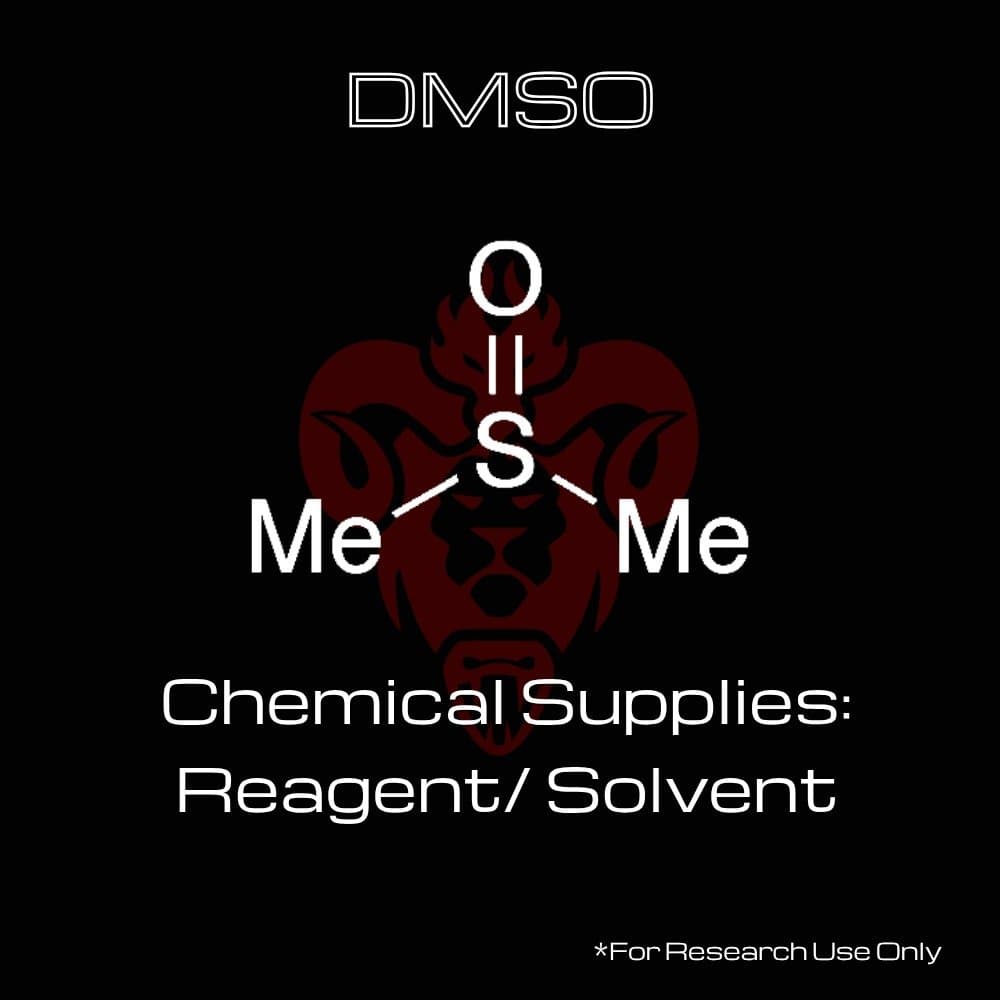
DMSO is a small dipolar aprotic molecule: a strongly polarised sulfur to oxygen bond flanked by two methyl groups. It accepts hydrogen bonds strongly and donates none of its own, which is exactly what separates it from water and from ethanol. That combination lets it mix with water in all proportions and with most organic liquids at the same time, and it is why one solvent can take up solutes that are too polar for an oil and too greasy for water. In the published survey of solubilizing excipients used in commercially available oral and injectable formulations, dimethylsulfoxide sits in the water-soluble organic solvent group with polyethylene glycol 300 and 400, ethanol, propylene glycol, glycerin and dimethylacetamide, clearly separated from the water-insoluble lipids, which include castor, corn, olive, soybean and medium-chain triglyceride oils [13]. That grouping is the practical divide for anyone choosing a carrier: DMSO, PEG-400 and ethanol are the polar options for compounds water will not take, and MCT oil is the fat for compounds only a fat will take.
How it gets through skin is less settled than the reputation suggests, and the honest version matters because it changes what a dilute preparation should be expected to do. Against model bilayer membranes, DMSO increased membrane fluidity and diffusivity, dehydrated the lipid headgroup region and weakened the hydrogen bonding between headgroups and water, with faster solvation dynamics as a result [2]. But against stratum corneum lipid models at 10% and 30%, the concentrations described in that work as pharmaceutically and cosmetically relevant, no specific interaction was detectable: no additional water uptake in the headgroup region and no loosening of lipid chain packing density [1]. The authors leave the question open as to whether the enhancement arises from the lipid matrix at all or from effects inside the corneocytes. The practical reading is that the effect is concentration-dependent and that a low-percentage DMSO preparation is not simply a weaker version of a strong one; it may not be doing the same thing.
What is not in doubt is that the enhancement is real at the concentrations real products use. DMSO is the penetration enhancer in an approved topical diclofenac sodium solution for osteoarthritis and in an approved topical idoxuridine solution for herpes zoster, and it facilitates transdermal delivery of hydrophilic and medications alike rather than one class only [3]. A formulation study made the same point from the other direction: liposomes modified with DMSO carried finasteride deeper into skin than conventional liposomes or an alcoholic solution of the same drug, measured as follicular density and anagen to telogen ratio in a rat model of testosterone-induced alopecia [12].
Its other job has nothing to do with skin. DMSO penetrates cells and has been the cryoprotectant of choice for most animal cell systems since the beginning of cryobiology; the entire practice of banking bone marrow and blood cells until they are needed rests on it [9].
receptor fingerprint
Stratum corneum barrierRaises skin permeability enough to carry hydrophilic and lipophilic drugs across alike, though at 10% and 30% no disordering of stratum corneum lipid models was measurable, so the mechanism is concentration-dependent and not fully settled
Lipid bilayer membranesIncreases membrane fluidity and diffusivity, dehydrates the lipid headgroup region and weakens hydrogen bonding between headgroups and water
Solute hydrogen-bond networkAccepts hydrogen bonds strongly and donates none, so it mixes with water and most organics and takes up polar and non-polar solutes alike
Intracellular ice formationPenetrates cells and protects them through freezing and thawing; the cryoprotectant of choice for most animal cell systems since the field began
Dosingtypical ranges, not medical advice
interested in protocols and clinical dosages? make an account to see them! ^_^
Safetyrisks and cautions, not medical advice
The single most important fact about DMSO is that it does not stay where it is put, and it does not go alone. It crosses skin, and it carries dissolved solutes with it. That turns ordinary handling mistakes into routes of exposure. A contaminated glove becomes a dose. An impure compound delivers its impurities as well as itself. A container the solvent is quietly attacking contributes whatever leaches out of it. A splash that would be trivial with water is not trivial here. When a published assessment modelled the worst case for topical DMSO in a cell-therapy product, the assumption it used was 100% transdermal absorption [11]; that is the posture the material earns.
The corollary is that grade and purity stop being a quality question and become a safety question. Only pharmaceutical grade carries a specification for what else is in the bottle. DMSO is also strongly hygroscopic, so a container left open takes up water from the air and is no longer the solvent on the label, and it attacks many plastics and elastomers, which is why glass is the default container and why glove material should be checked against the supplier's compatibility data rather than assumed. Treat any compound of unknown identity or purity as unsuitable for dissolving in it, because DMSO removes the barrier that would otherwise have limited the mistake.
Systemic DMSO has a measured tolerability record, but it comes from supervised cell therapy rather than from casual use. Across 1173 patients given cryopreserved mesenchymal stromal cell products intravenously, the DMSO delivered was 2.5 to 30 times lower than the amount typically accepted in haematopoietic stem cell transplantation, and with adequate premedication only isolated infusion-related reactions were reported [11]. The field has nonetheless been working to use less of it: a systematic review and meta-analysis of controlled clinical studies found that stem cell products frozen with 5% DMSO gave better post-thaw viability of CD34 positive cells and lower rates of adverse effects in patients than 10%, with little difference in engraftment [10]. A review of the same question frames it as an open balance between efficacy and toxicity rather than a settled one, and as the reason the search for less cytotoxic cryoprotectants continues [9].
On the mucosal route there is controlled human evidence, and it is specific to one use. Intravesical instillation of a 50% solution for interstitial cystitis produced adverse drug reactions described as mild to moderate and manageable in a multicentre randomised double-blind placebo-controlled trial [4], and an earlier controlled crossover trial in 33 patients reported no significant side effects [8]. That is a clinician-administered, single-organ, supervised procedure, and it does not generalise to putting the same solution on skin.
A garlic-like odour on the breath and a similar taste in the mouth is the characteristic sign that DMSO has gone systemic by any route. It is not itself harmful, but it is a standing reminder that a topical application is not a local one. Local effects at the site are irritation, redness, burning, stinging and dryness. None of this argues against using the solvent. It argues for deciding deliberately what is dissolved in it before any of it touches skin.
Dilutionarithmetic only, not dosing advice
dilute a stock solution
C1 x V1 = C2 x V2. Concentrations must share a unit and volumes must share a unit; nothing here converts between them.
Make up to the final volume rather than adding the two numbers together: mixed liquids do not always occupy the sum of their volumes, and ethanol with water measurably contracts.
History
DMSO was first prepared in the nineteenth century and spent most of its early life as an ordinary industrial solvent, recovered as a by-product of wood pulp processing, which is why it has always been cheap and available in bulk.
Its two careers began at almost the same time. It entered cryobiology at the very beginning of that field and has been the cryoprotectant of choice for most animal cell systems ever since, used in many thousands of cell transplants; stable storage of bone marrow and blood cells until they are needed depends on it [9]. In the 1960s a second use, as a topical agent and a carrier, drew an enormous amount of public enthusiasm in the United States. Clinical work was halted in 1965 after lens changes were reported in laboratory animals given high doses, and that episode is the reason DMSO never became a general-purpose approved drug despite the interest it had generated.
What survived the halt was narrow and specific. Intravesical 50% DMSO, sold as Rimso-50, was approved for interstitial cystitis [7], and a controlled crossover trial published in 1988 found it superior to saline placebo on both objective and subjective measures, with 53% of DMSO-treated patients markedly improved against 18% on placebo [8]. Separately, and much later, its role as a penetration enhancer was rebuilt on formulation science rather than on the earlier enthusiasm; three decades of data now sit behind its use in approved topical diclofenac and idoxuridine solutions [3].
Reputation
DMSO has two reputations and they barely overlap. In laboratories it is unremarkable: the default solvent for compound stocks, the default cryoprotectant, in constant use and rarely discussed. Outside them it carries a much larger folk reputation as a suppressed topical remedy for pain and inflammation, sold in horse liniment bottles and hardware shops as readily as in pharmacies.
The evidence sorts the two apart cleanly. As a penetration enhancer it does what is claimed, supported by three decades of formulation data and by approved products built on it [3]. As a treatment in its own right it has one controlled indication. For interstitial cystitis and bladder pain syndrome, a systematic review and meta-analysis pooling 5 randomised trials and 9 single-arm or cohort studies across 554 patients reported improvements in symptom index, problem index and pain score after treatment [5]; those headline numbers are before-and-after comparisons rather than comparisons against placebo, which is a weaker design than the summary suggests. The controlled evidence is thinner and more modest: a difference of 1.8 points on the O'Leary-Sant symptom index against placebo at 12 weeks in the Japanese trial [4], and a Cochrane review of intravesical treatments for the same condition describing success rates across the whole category as generally modest with little consensus on the best option [6]. Nothing in that record supports the broader claims made for the solvent.
The practical consequence of the folk reputation is a supply problem. Material sold for veterinary or industrial use is not made to a pharmaceutical specification, and with a solvent that carries its contents through skin, the specification is the safety margin.
Where to buy
Suppliers
Vendors carrying DMSO, with live product details and codes. Links are affiliate links that support the wiki at no cost to you.
Kimera Chems
DMSO
Research
- 1987first citedIntravesical 50% dimethyl sulfoxide (Rimso-50) in treatment of interstitial cystitis.
- 2025most recentThe Efficacy and Safety of Dimethyl Sulfoxide Into the Bladder for the Treatment of Interstitia…
- 1.The effect of hydrophilic penetration/diffusion enhancer on stratum corneum lipid models: Part II*: DMSO.
- 2.A Comparative Study on DMSO-Induced Modulation of the Structural and Dynamical Properties of Model Bilayer Membranes.
- 3.Dimethyl sulfoxide: an effective penetration enhancer for topical administration of NSAIDs.
- 4.Efficacy and safety of intravesical instillation of KRP-116D (50% dimethyl sulfoxide solution) for interstitial cystitis/bladder pain syndrome in Japanese patients: A multicenter, randomized, double-blind, placebo-controlled, clinical study.
- 5.The Efficacy and Safety of Dimethyl Sulfoxide Into the Bladder for the Treatment of Interstitial Cystitis/Bladder Pain Syndrome: A Systematic Review and Meta-Analysis.
- 6.Intravesical treatments for painful bladder syndrome/ interstitial cystitis.
- 7.Intravesical 50% dimethyl sulfoxide (Rimso-50) in treatment of interstitial cystitis.
- 8.A controlled study of dimethyl sulfoxide in interstitial cystitis.
- 9.Dimethyl sulfoxide: a central player since the dawn of cryobiology, is efficacy balanced by toxicity?
- 10.Impact of lower concentrations of dimethyl sulfoxide on cryopreservation of autologous hematopoietic stem cells: a systematic review and meta-analysis of controlled clinical studies.
- 11.Dimethyl sulfoxide in cryopreserved mesenchymal stromal cell therapy products: is there a safety risk to patients?
- 12.Enhanced skin penetration of Finasteride loaded DMSO-liposomes for the treatment of androgenic alopecia: comparison with conventional liposomes.
13 listed here; entry last updated August 2026
Reviews
My notesprivate to this device
FAQ
Is DMSO safe to put on my skin?
The solvent itself has a long tolerability record in pharmaceutical use, and irritation, redness, stinging and dryness at the site are the usual local effects. The real risk is not the DMSO; it is everything else. DMSO carries dissolved solutes through skin, so a contaminated glove, an impure compound or a container the solvent is attacking all become systemic exposure. A published worst-case assessment of topical DMSO assumed complete transdermal absorption [11]. Decide what is in it before it touches skin, use pharmaceutical grade, and keep it in glass.
Will DMSO dissolve my compound?
There is no way to answer that from a general rule, and guessing is how people end up with an undissolved compound sitting in a solvent that crosses skin. DMSO takes up an unusually wide range of solutes because it accepts hydrogen bonds without donating any, so both polar and non-polar compounds often go into it, and a survey of marketed formulations places it among the water-soluble organic solvents alongside PEG-400, ethanol and propylene glycol [13]. What decides the answer for a particular compound is that compound's own polarity and partition coefficient, and the only reliable test is the one run on the actual material.
Which carrier should I use if my compound will not dissolve in water?
That depends on the compound, not on the carrier. If it is fat-soluble, an oil such as MCT is the natural fit and sits on the opposite side of the polarity line from everything else here [13]. If it is not fat-soluble, the polar solvents are the group to look at: PEG-400 and ethanol are the better characterised first choices, and DMSO takes up the widest range but is also the one that changes where the compound ends up rather than only whether it dissolves.
Is DMSO the same thing as MSM?
No. MSM is methylsulfonylmethane, DMSO's oxidised form. It is a solid, it is sold as an oral supplement, and it does not behave as a solvent. Buying one when the other was wanted is a common and consequential mix-up.
Why did my DMSO turn solid in the bottle?
Its freezing point sits just below normal room temperature, so a cool room or a cold shipment will set it into a clear solid. Warming it gently returns it with no harm done. What does harm it is being left open: DMSO pulls water out of the air, and a bottle that has taken up moisture is no longer the solvent described on the label.
Can I use the DMSO sold at a hardware or farm store?
Not for anything going on a person. Industrial and veterinary grades are made to a different specification, and with a solvent that carries whatever is in it through skin, the specification is the entire safety margin. Pharmaceutical grade costs more for exactly this reason.
Does DMSO treat anything by itself?
One thing, under supervision. A 50% solution instilled into the bladder is approved for interstitial cystitis and has controlled evidence behind it [7] [8] [4], although the pooled data are largely before-and-after rather than placebo-controlled [5] and a Cochrane review found success rates across intravesical treatments generally modest [6]. Outside that indication, the case for DMSO as a treatment rather than as a carrier is not made.
Limitations of the evidence
- No source establishes that any particular compound dissolves in DMSO; solubility is a property of the pair and has to be measured on the actual material
- The mechanism of skin penetration enhancement is unsettled: at 10% and 30% no interaction with stratum corneum lipid models was detectable, leaving open whether the effect comes from the lipid matrix or from inside the corneocytes
- The controlled human evidence for DMSO as a treatment covers one route and one condition only, a 50% solution instilled into the bladder for interstitial cystitis
- Most of the pooled intravesical data are before-and-after comparisons rather than placebo-controlled, so the effect size reads larger than the controlled trials support
- No study addresses long-term repeated topical use of DMSO as a carrier in healthy people
- The systemic tolerability record comes from cryopreserved cell infusions given under medical supervision with premedication, not from self-applied topical use
- No pharmacokinetic half-life for DMSO by any route appears in the sources banked for this entry
Adverse effects
- Skin irritation, redness, burning or stinging at the site of application
- Skin dryness and scaling with repeated application
- Garlic-like odour on the breath and a similar taste in the mouth after exposure by any route
- Infusion-related reactions when delivered intravenously with cryopreserved cell products
- Mild to moderate adverse drug reactions during intravesical instillation
Notes and cautions
- Whatever is dissolved in it, on the glove, or leaching from the container goes through skin with it; that is the defining hazard and it is not a theoretical one
- Freezing point sits just below normal room temperature, so it solidifies in a cool room and needs gentle warming
- Strongly hygroscopic; an open bottle takes up atmospheric water and stops being the solvent on the label
- Attacks many plastics and elastomers, so glass is the default container and glove material should be checked against supplier compatibility data
- Not the same substance as MSM (methylsulfonylmethane), which is DMSO's oxidised form and behaves nothing like a solvent
- MCT oil is the lipophilic carrier in this catalogue; DMSO, PEG-400 and ethanol are the polar ones, and a compound belongs on one side of that line or the other