
spec sheet9 rows
PEG-400 is polyethylene glycol with an average molar mass near 400, a clear viscous liquid that mixes with water in all proportions and dissolves many compounds water alone will not take. It is one of the most widely used solubilizing excipients in marketed oral and injectable medicines. It is not inert. At sufficient concentration it shortens small intestinal transit and changes how much of a co-administered drug is absorbed, and the direction of that change flips depending on how much is used. It is also the carrier where raising the concentration to dissolve more can leave less of the compound able to cross the gut wall.
- Keeps poorly water soluble compounds in solution
- Mixes with water in all proportions
- One of the most widely used solubilizing excipients
- Present in oral and injectable medicines people take daily
- Low volatility, so a prepared solution holds its concentration
- Costs little and neither stings nor evaporates
- Osmotic laxative effect, loose stools and abdominal cramping at larger oral amounts
- Shortened small intestinal transit, which changes the absorption of anything taken with it
- Injection site injury when a PEG-400 containing vehicle is given intravenously at volume
Mechanism
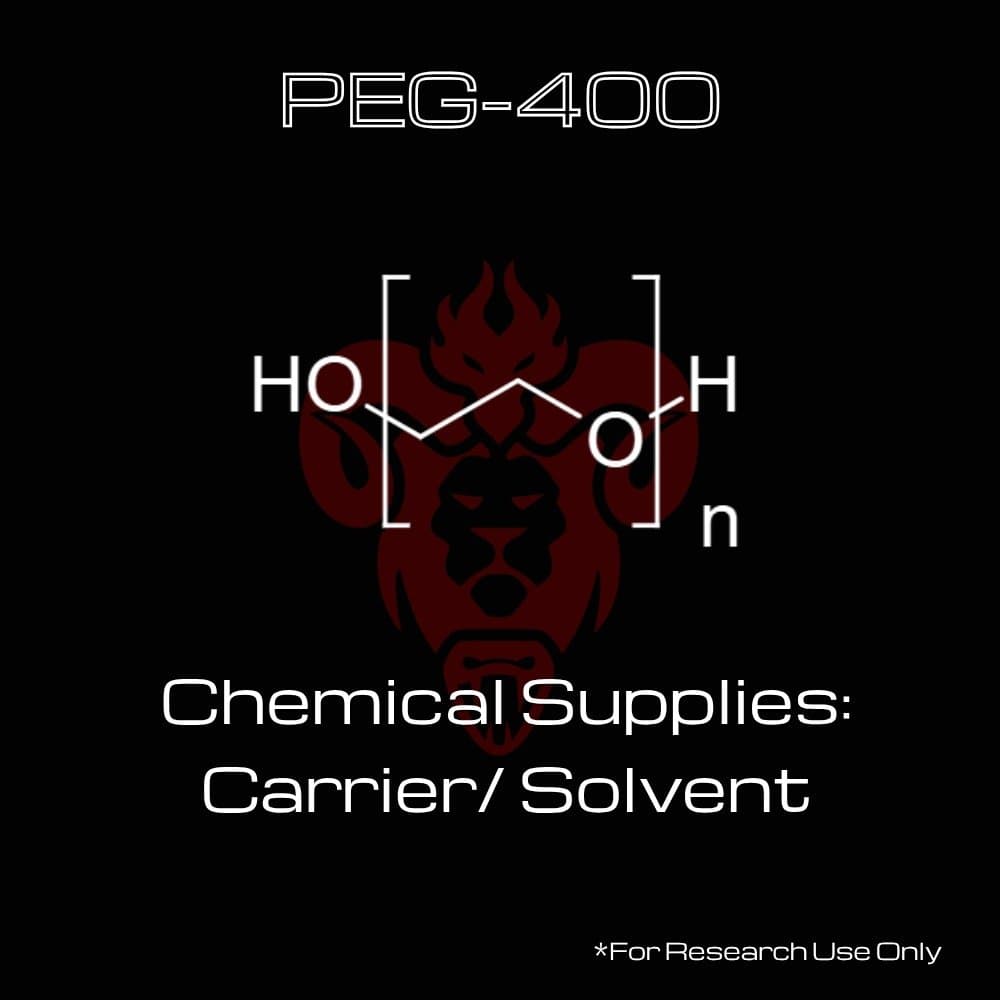
PEG-400 is a short chain of ethylene oxide units with a hydroxyl group at each end, averaging a molar mass near 400. It is a clear viscous liquid at room temperature, miscible with water in all proportions, and the ether oxygens strung along the chain accept hydrogen bonds, which is what lets it hold compounds water alone rejects. In the published survey of solubilizing excipients used in commercially available oral and injectable solutions it sits in the water-soluble organic solvent group with PEG-300, ethanol, propylene glycol, glycerin, dimethylacetamide and dimethylsulfoxide, distinctly separate from the water-insoluble lipids such as castor, corn, olive, soybean and medium-chain triglyceride oils [1]. That grouping is the practical divide for anyone choosing a carrier: PEG-400, ethanol and DMSO are the polar options, and MCT oil is the fat.
A cosolvent works by making the aqueous phase less polar, so the solubility of a poorly soluble solute rises roughly log-linearly with the cosolvent fraction; phenytoin followed that model across ethanol, PEG-400 and dimethylacetamide, with glycerol as the exception [14]. How much a given cosolvent buys is not a constant. Solubilization power varies between cosolvents, with dioxane ahead of ethanol and ethanol ahead of PEG-400 in one head-to-head ranking, and it tracks the solute's own logarithm of partition coefficient linearly, which is why the same cosolvent transforms one compound and barely moves another [13].
The cost is the part that gets missed. Solubility and permeability move in opposite directions, because only the free unbound fraction drives transport across a membrane. Etoposide formulated with hydroxypropyl-beta-cyclodextrin, with sodium lauryl sulfate and with PEG-400 all showed higher apparent solubility and a proportional decrease in permeability that could be modelled directly from the solubility gained; only an amorphous solid dispersion escaped the tradeoff [6]. Carbamazepine made the same point inside an animal: formulated at 20%, 60% and 100% PEG-400, the strongest formulation gave the best solubility and the worst permeability, the weakest gave the reverse and crashed out of solution soon after dosing, and the best systemic exposure came from the middle formulation [5]. More cosolvent is not better, and neither is less.
Dilution is where a cosolvent formulation is most fragile. A solution that is clear in the vial meets aqueous gut contents and can precipitate out of it. In bile duct cannulated rats, halofantrine dosed in nearly pure PEG-400 gave lower than in animals with bile present, and adding enough polysorbate 80 removed the difference, which points at precipitation on dilution as the mechanism and at an individual's own bile as a source of variability between people [7].
PEG-400 also acts on the gut itself, which is the part that separates it from an inert diluent. In ten healthy volunteers, 10 g of PEG-400 taken with ranitidine shortened small intestinal liquid transit by 37% and cut the drug's absolute by 31% [2]. A follow-up in six volunteers showed the effect is concentration-dependent and not one-directional: 1 g raised ranitidine absorption by 41%, while 2.5 g and 5 g reduced it by 38%, with mean small intestinal transit falling by 9%, 20% and 23% at the three amounts [3]. In beagle dogs given an amount equivalent to 1 g, neither transit nor changed meaningfully [4], which is the same dose-response seen at its low end rather than a contradiction of it.
receptor fingerprint
Aqueous phase polarityLowers the polarity of the water it is mixed into, so the solubility of a poorly soluble solute rises roughly log-linearly with the cosolvent fraction
Free (unbound) solute fractionHolds the solute in solution, reducing the free fraction that drives membrane transport; measured permeability falls in direct proportion to the apparent solubility gained
Small intestinal transit timeShortens small intestinal transit in humans in a concentration-dependent way, by 9% to 37% across the amounts studied
Intestinal membrane barrierCompared against eleven other solubilizing agents in rats, PEG-400 was not among those that markedly raised marker permeability or damaged the membrane; a bile salt and two surfactants were
Dosingtypical ranges, not medical advice
interested in protocols and clinical dosages? make an account to see them! ^_^
Safetyrisks and cautions, not medical advice
PEG-400 is in medicines people take every day, and that record is real. It is a record for defined concentrations inside finished products, though, not for the neat liquid used as a general-purpose carrier.
The clearest safety-relevant fact is that it is not pharmacologically inert. In healthy volunteers it shortened small intestinal transit and moved the absorption of a co-administered drug by roughly a third, downward at larger amounts and upward at the smallest tested [2] [3]. For anyone dissolving something in it, that means the vehicle is an interaction rather than a blank, and it means an inconsistent amount of vehicle between doses will look like an inconsistent compound. At larger volumes the same osmotic behaviour is what makes polyethylene glycols laxative.
Given intravenously, the vehicle alone has a toxic dose. A repeated-dose study in rats using a combination vehicle of 5% N-methyl-2-pyrrolidone, 45% propylene glycol and 50% PEG-400 produced tremors, convulsions and death at 5 mL/kg, injection site injury without systemic toxicity at 2 mL/kg, and no discomfort or injury across 28 days of once-daily dosing at 1 mL/kg [10]. Marketed parenteral products built on PEG-400 do exist; busulfan for high-dose chemotherapy is solubilized in dimethylacetamide, PEG-400 and water, and that formulation came with hemolysis testing, tonicity work and accelerated stability data behind it [9]. A home preparation has none of that, and with an injected cosolvent the vehicle volume is what causes harm first.
On the intestinal barrier the news is better than expected. When twelve common solubilizing agents were compared in rats for their effects on intestinal membrane barrier function and membrane toxicity, the agents that markedly increased permeability of a marker compound were the bile salt sodium taurocholate and the surfactants Labrasol and Transcutol P; PEG-400 was not among them [11]. That is affirmative evidence that PEG-400 is gentler on the gut lining than surfactant-based solubilizers, which is a different claim from it being harmless.
Two practical hazards remain. PEG hypersensitivity is uncommon but clinically recognised, and anyone with a known polyethylene glycol allergy should treat PEG-400 as the same chemistry regardless of chain length. And grade matters more here than sentiment suggests: glycol solvents are the class in which contamination has historically killed people, so pharmaceutical grade with a certificate of analysis is the only sensible purchase.
Dilutionarithmetic only, not dosing advice
dilute a stock solution
C1 x V1 = C2 x V2. Concentrations must share a unit and volumes must share a unit; nothing here converts between them.
Make up to the final volume rather than adding the two numbers together: mixed liquids do not always occupy the sum of their volumes, and ethanol with water measurably contracts.
History
Polyethylene glycols have been pharmaceutical excipients for most of a century, sold under the name macrogol in Europe and numbered by average molar mass. That number is the whole distinction inside the family. PEG-200 through PEG-600 are liquids and are used as solvents, while PEG-3350 and above are waxy solids used as ointment bases and, taken orally, as osmotic laxatives. PEG-400 sits at the useful middle of the liquid range, viscous but pourable and miscible with water in all proportions.
Its place in modern medicine is documented rather than assumed. The survey of what commercially available oral and injectable solution formulations actually contain lists PEG-400 alongside PEG-300, ethanol, propylene glycol and glycerin as one of the standard water-soluble organic solvents used to get poorly soluble drugs into solution [1], and it turns up inside real parenteral products such as the dimethylacetamide, PEG-400 and water vehicle developed for intravenous busulfan [9].
The glycol family also carries the most important cautionary tale in the history of pharmaceutical carriers. In 1937 a sulfanilamide preparation was dissolved in diethylene glycol, a different and toxic glycol, and more than a hundred people died. The drug was fine; the solvent killed them. That episode produced the 1938 Food, Drug, and Cosmetic Act and the modern requirement to establish that a product is safe before selling it, and diethylene glycol contamination of glycerin and propylene glycol has caused mass poisonings repeatedly since. The lesson belongs on this page specifically: the carrier is not the safe part of a preparation, and its supply chain deserves the same scrutiny as the active compound's.
Reputation
Among people who formulate things themselves, PEG-400 has a reputation as the safe, boring option: not flammable, not volatile, not stinging, present in medicines everyone has taken. Most of that is fair. What is not fair is the assumption that follows, which is that adding PEG-400 to a preparation changes only whether the compound dissolves.
The published record contradicts that in two ways. Cosolvent formulations trade permeability for solubility in direct proportion, so the amount of PEG-400 in a preparation partly determines how much of the compound ever gets in [6] [5]. And PEG-400 acts on the gut directly, shortening small intestinal transit and moving a co-administered drug's absorption by roughly a third in healthy people, upward at a small amount and downward at larger ones [2] [3].
Set against the other carriers here, its position is clear enough. It is the least aggressive of the three polar solvents toward gut lining, and it was not among the agents that damaged the intestinal membrane when twelve solubilizers were compared [11]. It is also the weakest solubilizer of the common cosolvents in at least one direct ranking, behind ethanol [13]. And it is the one most likely to be quietly doing something to absorption that gets mistaken for the compound working or not working. MCT oil is not a rival to it at all; that is a fat, on the other side of the polarity line entirely.
Where to buy
Suppliers
Vendors carrying PEG-400, with live product details and codes. Links are affiliate links that support the wiki at no cost to you.
Kimera Chems
PEG-400
Research
- 1991first citedOptimization of cosolvent concentration and excipient composition in a topical corticosteroid s…
- 2017most recentStriking the Optimal Solubility-Permeability Balance in Oral Formulation Development for Lipoph…
- 1.Solubilizing excipients in oral and injectable formulations.
- 2.Influence of polyethylene glycol 400 on the gastrointestinal absorption of ranitidine.
- 3.Concentration-dependent effects of polyethylene glycol 400 on gastrointestinal transit and drug absorption.
- 4.Excipient effects on gastrointestinal transit and drug absorption in beagle dogs.
- 5.Striking the Optimal Solubility-Permeability Balance in Oral Formulation Development for Lipophilic Drugs: Maximizing Carbamazepine Blood Levels.
- 6.Head-To-Head Comparison of Different Solubility-Enabling Formulations of Etoposide and Their Consequent Solubility-Permeability Interplay.
- 7.Effect of bile on the oral absorption of halofantrine in polyethylene glycol 400 and polysorbate 80 formulations dosed to bile duct cannulated rats.
- 8.The impact of co-solvents and the composition of experimental formulations on the pump rate of the ALZET osmotic pump.
- 9.Formulation and stability of busulfan for intravenous administration in high-dose chemotherapy.
- 10.Assessment of toxicity and tolerability of a combination vehicle; 5% Pharmasolve, 45% Propylene glycol and 50% Polyethylene glycol 400 in rats following repeated intravenous administration.
- 11.The effects of common solubilizing agents on the intestinal membrane barrier functions and membrane toxicity in rats.
- 12.Optimization of cosolvent concentration and excipient composition in a topical corticosteroid solution.
14 listed here; entry last updated August 2026
Reviews
My notesprivate to this device
FAQ
Does PEG-400 do anything on its own?
Yes, and that is the surprise. In ten healthy volunteers, PEG-400 taken with ranitidine shortened small intestinal transit by 37% and cut the drug's absolute bioavailability by 31% [2]. A follow-up found the effect flips direction with amount: the smallest quantity tested raised ranitidine absorption by 41%, while larger ones cut it by 38% [3]. Treat the vehicle as part of the experiment rather than as a blank.
Which carrier do I use for a compound that will not dissolve in water?
Start from what the compound is rather than from the carrier. A fat-soluble compound belongs in an oil, and MCT oil is the one in this catalogue; a survey of marketed formulations puts the oils and the water-soluble organic solvents in two separate groups for exactly this reason [1]. Anything that is not fat-soluble belongs with the polar solvents, and among those PEG-400 and ethanol are the better characterised choices while DMSO takes up the widest range and also changes where the compound ends up. Cosolvent power scales linearly with the solute's own partition coefficient [13], so the answer is a property of the pair and has to be tested on the actual material.
Why does my solution go cloudy in the fridge?
Usually because it was closer to saturation than it looked. A cosolvent holds a compound above its water solubility, cooling lowers that ceiling, and the compound comes out. PEG-400 compounds the problem because its own freezing range sits close to refrigerator temperature and it thickens sharply as it cools. There is a third possibility worth knowing: what precipitates is not always the compound. In one topical corticosteroid solution the material that came out on storage was a salt formed between two of the excipients, and the fix was lowering the PEG-400 concentration and changing the buffering agent [12]. Whichever it is, a cloudy solution is no longer at the concentration it was made at.
Can I just add more PEG-400 until it dissolves?
It does not work the way it sounds. Raising the cosolvent fraction raises apparent solubility and lowers permeability in proportion, because only the free unbound fraction crosses a membrane [6]. Carbamazepine formulated at 20%, 60% and 100% PEG-400 performed best in a living animal at 60%, not at 100% [5]. The target is the lowest concentration that keeps the compound dissolved all the way through dilution.
Is PEG-400 the same as the PEG in a laxative?
Same chemistry, very different molecule. Laxative products use PEG-3350, a long chain that is a waxy solid and is very poorly absorbed, so it stays in the gut and holds water there. PEG-400 is a short liquid chain used as a solvent. They are not interchangeable, and a laxative effect from PEG-400 is a sign of using far too much of it.
Can I inject something dissolved in PEG-400?
PEG-400 is used in marketed injectable products; busulfan for high-dose chemotherapy is solubilized in a dimethylacetamide, PEG-400 and water mixture [9]. That is not a precedent for doing it at home. Those products carry hemolysis testing, tonicity data and stability studies, and the vehicle itself has a toxic dose: a combination vehicle containing 50% PEG-400 given intravenously to rats caused tremors, convulsions and death at 5 mL/kg, injection site injury at 2 mL/kg, and was tolerated for 28 days only at 1 mL/kg [10]. Sterility, pyrogens and volume are all problems a solvent does not solve.
Will PEG-400 dissolve my compound?
The determining property is the compound's own partition coefficient rather than anything about the PEG; solubilization power scales linearly with logP, and PEG-400 ranked behind ethanol in one direct comparison of cosolvent power [13]. Solubility in a water and cosolvent mixture follows a roughly log-linear relationship with the cosolvent fraction [14], which makes the behaviour predictable once it has been measured, and unknowable before that. Test the actual material.
Limitations of the evidence
- No source establishes whether any specific compound dissolves in PEG-400; that is a property of the pair and has to be tested
- The human transit and absorption data come from one drug, ranitidine, in groups of six and ten volunteers
- The solubility-permeability work is in rats and in artificial membrane assays, not in people
- The intravenous toxicity data come from a combination vehicle containing propylene glycol and N-methyl-2-pyrrolidone as well as PEG-400, so the contribution of PEG-400 alone is not isolated
- No study covers repeated long-term use of PEG-400 as a home carrier
- PEG hypersensitivity is clinically recognised, but no source banked here characterises how common it is or at what exposure
- No pharmacokinetic half-life for PEG-400 appears in the sources banked for this entry
Adverse effects
- Osmotic laxative effect, loose stools and abdominal cramping at larger oral amounts
- Shortened small intestinal transit, which changes the absorption of anything taken with it
- Injection site injury when a PEG-400 containing vehicle is given intravenously at volume
- Tremors, convulsions and death at high intravenous vehicle volumes in rats
- Hypersensitivity reactions in people allergic to polyethylene glycols
Notes and cautions
- The vehicle is part of the dose: a small amount raised a co-administered drug's absorption in humans and larger amounts cut it, so vehicle quantity must be held constant
- More cosolvent is not better; the best in vivo result in the carbamazepine work came from the middle concentration, not the strongest
- Viscous enough to change a delivery device's output; neat PEG-400 significantly slowed an osmotic pump while PEG-400 and water mixtures did not
- Its freezing range sits near refrigerator temperature, so cold storage thickens it and can bring a solute out of solution
- Not the same as PEG-3350, the high molecular weight waxy solid used as an osmotic laxative
- Pharmaceutical grade with a certificate of analysis is the only sensible purchase; the glycol family's history of lethal contamination is why
- MCT oil is the lipophilic carrier in this catalogue; PEG-400, ethanol and DMSO are the polar ones, and a compound belongs on one side of that line or the other