
spec sheet7 rows
Corvalol is a Soviet era household sedative combining a small dose of phenobarbital with ethyl bromisovalerate and peppermint oil, sold without prescription in Russia for anxiety, palpitations and difficulty sleeping.
- Soviet era household sedative, familiar to millions
- Sold without prescription in Russia for anxiety and palpitations
- Phenobarbital, ethyl bromisovalerate and peppermint oil together
- Also taken for difficulty sleeping
- Generations grew up with the smell of it
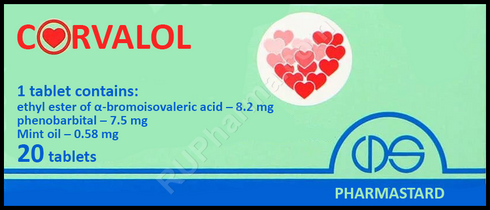
- Corvalol contains PHENOBARBITAL. That is the single most important fact about it, and it is the reason Corvalol and its German counterpart Valocordin are controlled or prohibited in many countries including Lithuania, Latvia, Estonia, Poland, the Czech Republic, the United States and much of the Gulf; travellers have been arrested for carrying it.
- The full composition is phenobarbital, ethyl alpha-bromoisovalerate, peppermint oil and roughly 58% ethanol; it is sold over the counter in Russia and several post-Soviet states as a 'heart drops' remedy.
- It has no cardiac action whatsoever. It is widely taken for palpitations and chest discomfort, but nothing in the formulation treats arrhythmia, angina or heart failure; the perceived benefit is sedation masking symptoms, which delays real diagnosis.
- There is essentially no indexed clinical evidence for Corvalol. A PubMed search returns two on-topic records: a 1987 Russian case report of fixed bullous erythema [2] and a 2018 series of 61 elderly patients with acute phenobarbital poisoning explicitly attributed to Corvalol and Valocordin [1]. There is no efficacy trial of any kind.
- The one substantive clinical paper is a poisoning series: acute phenobarbital poisoning in elderly and senile patients was accompanied by frequent CNS, respiratory (hospital pneumonia) and cardiovascular complications, producing a more severe course and higher risk of adverse outcome [1].
- Phenobarbital is a potent CAR-mediated inducer of CYP2B6, CYP3A4 and CYP2C9, so chronic Corvalol use silently lowers plasma levels of warfarin, direct oral anticoagulants, oral contraceptives, statins, antiretrovirals, ciclosporin and many antiepileptics.
Mechanism
Phenobarbital prolongs the opening of the -A chloride channel, which is the sedative effect and, with daily use, the dependence. Ethyl alpha-bromoisovalerate is a mild sedative related to valerian chemistry whose bromine is released slowly and accumulates, and the peppermint oil is a reflex vasodilator and antispasmodic. Nothing in the mixture acts on the heart directly, despite the cardiac framing it is sold with.
receptor fingerprint
-A receptor, barbiturate site on the beta subunit (phenobarbital constituent)Positive allosteric modulator; prolongs chloride channel mean open time and at higher concentrations directly gates the channel
Constitutive androstane receptor (CAR / NR1I3), driving CYP2B6, CYP3A4 and CYP2C9 inductionPotent enzyme induction by phenobarbital
and kainate receptors (phenobarbital constituent)Inhibition of excitatory neurotransmission
Peppermint oil (menthol), TRPM8 Local cooling and mild reflex spasmolytic effect on smooth muscle
Ethyl alpha-bromoisovalerateSedative and spasmolytic constituent related to bromisoval; mechanism not characterised in the indexed literature
Safetyrisks and cautions, not medical advice
it contains phenobarbital, a barbiturate that is a controlled substance in most Western countries; chronic use produces barbiturate dependence and the bromine ester can cause bromism, and importing it into the United States is not lawful
Subjective profileweighing the evidence above
Sold as something for the heart, and nothing in it touches the heart; the calm people feel is phenobarbital, a barbiturate, and taking a barbiturate every evening is how dependence starts. The bromine ester compounds that by accumulating over weeks into bromism, which shows up as confusion, irritability and rash and is easy to miss because it resembles the anxiety the bottle was bought for. Familiarity is doing most of the work here, since several generations grew up with the smell of it, and familiarity is not evidence. Importing it into the United States is not lawful, and coming off a barbiturate habit is the dangerous kind of withdrawal.
Where to buy

Suppliers
Vendors carrying Corvalol, with live product details and codes. Links are affiliate links that support the wiki at no cost to you.
RUPharma🌐
Corvalol
Research
- 1.[Peculiarities of barbituric acid derivatives acute poisoning clinical picture in patients of elderly and senile age and their therapy.].
- 2.[Fixed bullous erythema after administration of corvalol].
2 listed here; entry last updated August 2026
Reviews
My notesprivate to this device
Notes and cautions
- Corvalol is a barbiturate product sold as a folk remedy, and the phenobarbital in it produces genuine physical dependence with daily use; abrupt withdrawal after chronic use can cause seizures and delirium and must be tapered under medical supervision, not stopped cold.
- It is a CNS depressant with a narrow margin in the elderly, and combining it with alcohol (it is already about 58% ethanol), benzodiazepines, opioids, Z-drugs or gabapentinoids causes additive respiratory depression; the published Russian series documents exactly this pattern of severe poisoning with pneumonia and cardiovascular complications in older patients [1].
- Chronic use also causes bromide accumulation from the bromisovalerate component, presenting as confusion, ataxia, rash and psychiatric symptoms.
- Because phenobarbital is a strong enzyme inducer, habitual users can lose therapeutic effect from anticoagulants, oral contraceptives, antiretrovirals and immunosuppressants without anyone connecting it to the 'heart drops'.
- It is a controlled substance in many jurisdictions and carrying it across borders has led to prosecution.