
spec sheet10 rows
ACE-031 (ramatercept) is a powerful myostatin-blocking biologic, a soluble decoy of the activin receptor type IIB that traps myostatin and related muscle-limiting proteins before they can signal. By lifting this natural brake on growth, a single dose produced measurable gains in lean muscle mass and thigh muscle volume in human trials. Originally developed as a therapy for muscular dystrophy, it remains one of the most sought-after experimental agents for dramatic, receptor-level muscle building.
- Cuts the brake on muscle growth
- Added lean mass in human trials
- Grew thigh muscle volume measurably
- Traps myostatin before it can signal
- Real strength signals in the data
- Muscle building at the receptor level
- Injection-site redness or irritation
Overview
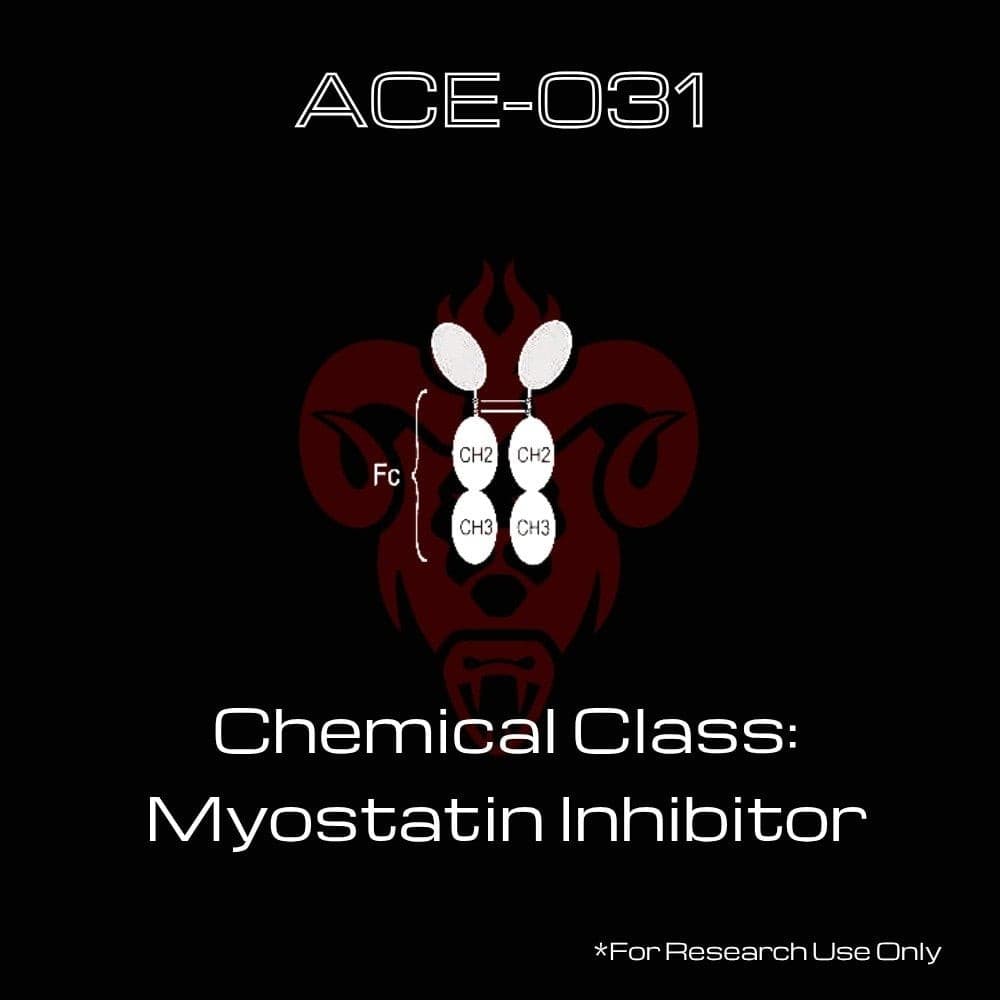
ACE-031, also known by the proposed generic name ramatercept, is a biologic drug rather than a small molecule; it is a soluble fusion protein created by joining the extracellular ligand-binding domain of the human activin receptor type IIB (ActRIIB) to the Fc region of an IgG1 antibody [1]. This construction turns the receptor into a circulating decoy, or ligand trap. Under normal physiology, myostatin (also called GDF-8) and related members of the transforming growth factor beta (TGF-beta) superfamily bind ActRIIB on muscle cells and signal the body to limit muscle growth. ACE-031 intercepts these ligands in the bloodstream before they can reach the true receptor, thereby releasing the brake on muscle development [2].
The compound was developed by Acceleron Pharma as a candidate therapy for muscle-wasting diseases, most prominently Duchenne muscular dystrophy (DMD). It reached human clinical testing; a phase I study in healthy postmenopausal women established its safety, long circulating half-life, and its ability to increase muscle mass after just a single subcutaneous dose [1], and a subsequent randomized, placebo-controlled trial evaluated it in ambulatory boys with DMD [2]. That pediatric trial was stopped early after some participants developed nosebleeds (epistaxis) and small dilated blood vessels (telangiectasias), non-muscle effects attributed to the trapping of additional ligands beyond myostatin [2].
Myostatin inhibition through decoy receptors like ACE-031 has been explored across a range of conditions, including various muscular dystrophies, muscle atrophy, and even metabolic disease, since myostatin also influences energy metabolism [3]. Related soluble ActRIIB-Fc molecules have been tested in other neuromuscular models such as spinal muscular atrophy [4]. As for regulatory status, ACE-031 is an investigational biologic that was never approved, and clinical development was discontinued. In performance and physique circles it circulates as a sought-after research compound, valued for its potent, receptor-level approach to building muscle, distinct from anabolic steroids or nutrient-based supplements.
- A single injection of ACE-031 raised total body lean mass by about 3.3 percent and thigh muscle volume by about 5.1 percent within roughly a month in a phase I trial.
- Its clinical development in Duchenne muscular dystrophy was stopped early after patients developed nosebleeds and small dilated blood vessels, a consequence of its broad ligand trapping.
Mechanism
ACE-031 works by neutralizing myostatin and its molecular relatives before they can act on muscle. Myostatin, a muscle-specific member of the TGF-beta superfamily, is one of the body's principal negative regulators of skeletal muscle; it restrains the proliferation and differentiation of muscle stem cells and limits protein accumulation in mature fibers, keeping muscle mass in check [3]. Myostatin and related ligands normally deliver this signal by binding the activin receptor type IIB (ActRIIB) on the muscle-cell surface. ACE-031 is a soluble copy of that receptor's -binding domain fused to an antibody Fc tail; circulating in the blood, it acts as a decoy that soaks up myostatin, activins, and GDF-11, preventing them from engaging the real receptors and thereby switching off the growth-limiting signal [1][2].
With the brake released, muscle anabolism increases, and the effect is measurable in humans. In a phase I trial, a single subcutaneous dose of ACE-031 significantly increased total body lean mass by about 3.3 percent and thigh muscle volume by about 5.1 percent within roughly a month, as measured by DXA and MRI, and it also shifted biomarkers of bone and fat metabolism [1]. Because it is a large protein with a long of roughly 10 to 15 days, a single injection continues to trap ligands for weeks [1].
The same broad -trapping that makes ACE-031 potent also explains its main liability. ActRIIB binds not only myostatin but ligands involved in blood-vessel regulation, and in the Duchenne trial this off-target trapping was linked to nosebleeds and telangiectasias, prompting early termination [2]. Beyond muscle, myostatin blockade has downstream effects on fat and bone, and it has been investigated for metabolic conditions as well as neuromuscular disease, though results in some models such as severe spinal muscular atrophy were disappointing [3][4]. The mechanism is therefore powerful and systemic, acting at the level of a master growth-regulating pathway rather than a single muscle.
receptor fingerprint
MyostatinSequestration
Activin receptor IIB ligandsDecoy binding
BMP9 / BMP10Off-target binding
Dosingtypical ranges, not medical advice
interested in protocols and clinical dosages? make an account to see them! ^_^
Safetyrisks and cautions, not medical advice
ACE-031 yielded the most lean mass of any anabolic modeled but carried extreme risk and was pulled from clinical trials for severe adverse effects. Unlike HGH, its myostatin inhibition is expected to amplify the anabolic effect of AR agonists, which cuts both ways.
History
ACE-031, also known as ramatercept, was developed by Acceleron Pharma of Cambridge, Massachusetts, as a soluble decoy built from the ligand-binding domain of the activin receptor type IIB fused to an antibody Fc region. The design goal was to trap myostatin and related muscle-limiting proteins in the circulation before they could signal, thereby releasing a natural brake on muscle growth. Its clearest human milestone came in a phase I study reported by Attie and colleagues in 2012, in which a single subcutaneous dose significantly increased total body lean mass and thigh muscle volume in healthy postmenopausal women within about a month. It was advanced, in partnership with Shire, toward Duchenne muscular dystrophy, but the clinical program was halted around 2011 after off-target vascular effects such as nosebleeds and small dilated blood vessels emerged.
Reputation
ACE-031 holds a notable reputation as one of the few experimental agents shown to build measurable muscle in humans at the level of a master growth-regulating pathway, which is precisely why it remains sought after and closely discussed. The phase I result is genuinely impressive; a single injection produced roughly a 3 percent gain in lean mass and a 5 percent increase in thigh muscle volume, and its long half-life means one dose keeps trapping ligands for weeks. Its appeal is inseparable from its cautionary tale, however, because the same broad ligand-trapping that makes it potent also engages ligands involved in blood-vessel regulation, and it was the resulting side effects that ended its development for muscular dystrophy. It is best understood as a powerful, systemic and unfinished biologic whose strengths and liabilities stem from the very same mechanism.
Subjective profileweighing the evidence above
The lean-mass data is real, and so is the reason this is not a medicine: its clinical development was halted for severe adverse effects, and nothing about that risk changed when it moved to the grey market. The most powerful muscle mechanism here is also the one to leave alone.
Where to buy

Suppliers
Vendors carrying ACE-031, with live product details and codes. Links are affiliate links that support the wiki at no cost to you.
RUO
ACE-031
Exceed Enhancement
ACE-031
Kimera Chems
ACE-031
Research
- 2009first citedInhibition of myostatin does not ameliorate disease features of severe spinal muscular atrophy…
- 2013controlled trialA single ascending-dose study of muscle regulator ACE-031 in healthy volunteers
- 2017most recentMyostatin inhibitor ACE-031 treatment of ambulatory boys with Duchenne muscular dystrophy: Resu…
- 1.A single ascending-dose study of muscle regulator ACE-031 in healthy volunteers
- 2.Myostatin inhibitor ACE-031 treatment of ambulatory boys with Duchenne muscular dystrophy: Results of a randomized, placebo-controlled clinical trial
- 3.Myostatin blockade therapy for muscular atrophy
- 4.Inhibition of myostatin does not ameliorate disease features of severe spinal muscular atrophy mice
4 listed here; entry last updated August 2026
Reviews
My notesprivate to this device
FAQ
Why was ACE-031 stopped?
It trapped BMP9 and BMP10 along with myostatin, and those proteins keep blood vessels healthy, so bleeding and telangiectasias showed up.
What does it do to muscle?
By decoying away myostatin it lets muscle grow, raising lean mass and volume in trials.
Is it available or approved?
No; the program was discontinued and it never reached approval.
Adverse effects
- Injection-site redness or irritation
Notes and cautions
- Nosebleeds (epistaxis) reported in clinical trials
- Small dilated blood vessels (telangiectasias) on the skin
- Broad ligand trapping can affect blood vessels beyond muscle
- An unapproved biologic; clinical development was halted on safety grounds