
spec sheet10 rows
IGF-1 DES, formally des(1-3)IGF-I, is a naturally occurring truncated form of insulin-like growth factor 1 that is roughly 10-fold more potent than standard IGF-1 at stimulating cell growth and proliferation [1][4]. The single change, removal of the first three amino acids from the N-terminus, sharply lowers its affinity for the IGF-binding proteins that normally restrain IGF-1, so more of the peptide reaches its receptor in active form [1][4]. This makes IGF-1 DES a potent anabolic research peptide with a distinctive, well-documented mechanism for escaping the body's own IGF buffering system [1][4].
- Roughly tenfold more potent than standard IGF-1
- Slips past the binding proteins that restrain IGF-1
- Powerful anabolic signal in muscle cell studies
- Pushes muscle precursor cells toward maturity
- A trusted research standard for IGF signaling
- Can lower blood sugar, sometimes causing hypoglycemia
- Its strong growth signaling raises theoretical concerns about unwanted tissue growth
- Injection site reactions are possible with subcutaneous use
Overview
IGF-1 DES is the common name for des(1-3)IGF-I, a truncated variant of human insulin-like growth factor 1 (IGF-1) in which the N-terminal tripeptide glycine-proline-glutamate (Gly-Pro-Glu) is absent, leaving a 67-amino-acid peptide rather than the full 70-residue hormone. It is not purely synthetic in origin: the molecule occurs naturally, having been isolated from bovine colostrum, human brain, and porcine uterus, where it is thought to arise from post-translational cleavage of intact IGF-1 [1].
The scientific significance of the deletion lies in what the missing glutamate at position 3 does to protein binding. In circulation and tissues, IGF-1 is largely bound by a family of six IGF-binding proteins (IGFBPs) that control its availability and restrain its activity. Because des(1-3)IGF-I binds these IGFBPs only weakly while retaining high affinity for the type 1 IGF receptor, far more of it remains free to signal, and it is generally about 10-fold more potent than intact IGF-1 at stimulating the hypertrophy and proliferation of cultured cells [1][6]. Studies across cell systems confirm the same theme, from potent suppression of IGFBP-1 secretion by liver cells [3] to enhanced steroidogenic responses in ovarian granulosa cells [4].
Because of this potency, des(1-3)IGF-I has been studied as a selective anabolic agent, with particularly evident effects on gut tissues; in animal models it improved absorptive function and promoted regrowth of the intestine after bowel resection, and it and related IGFBP-resistant variants produced more potent and prolonged metabolic effects than native IGF-1 [2][5]. Historically it has been of interest for catabolic and gastrointestinal conditions, although clinical applications were never established [1]. IGF-1 DES is not an approved medicine; it is handled as a research peptide.
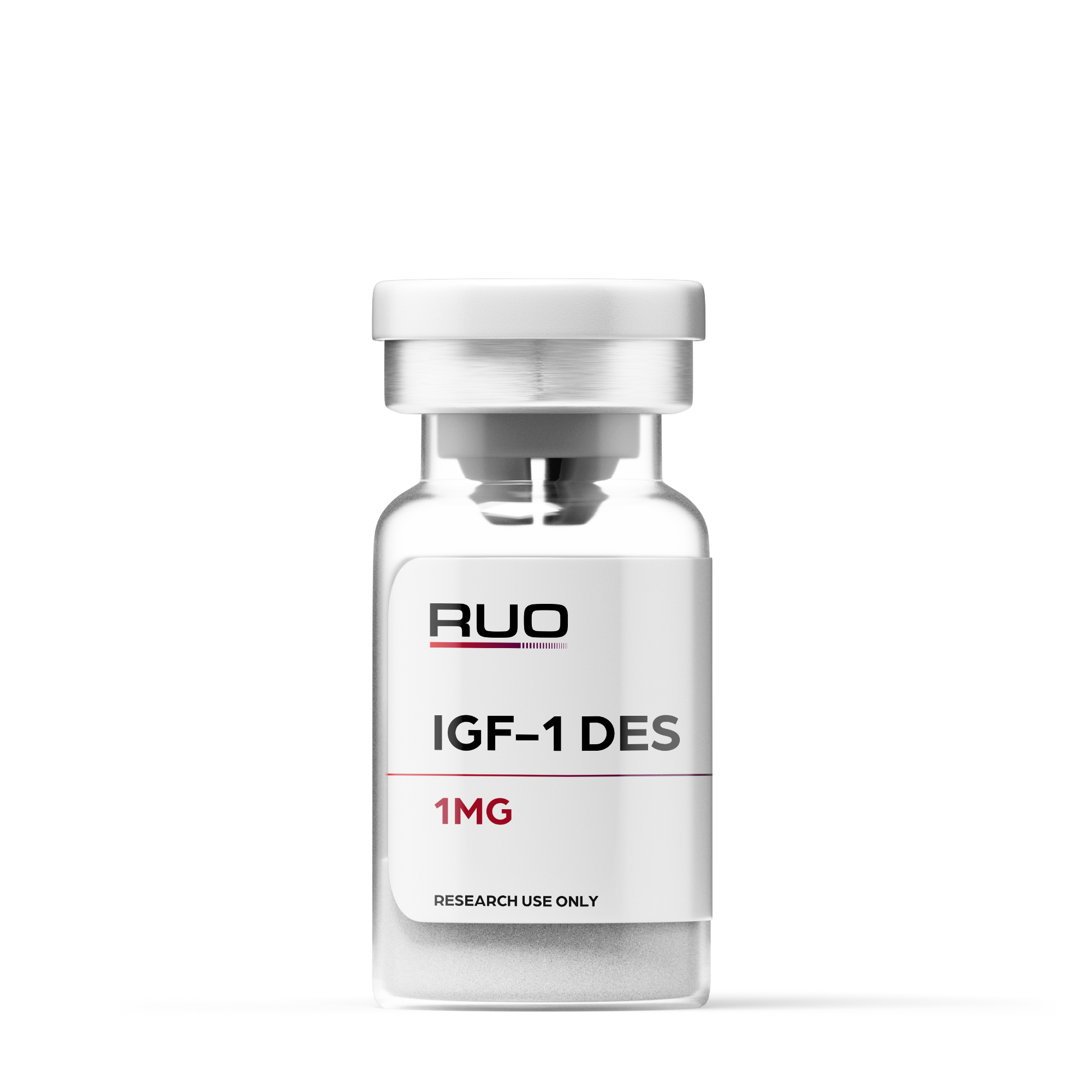
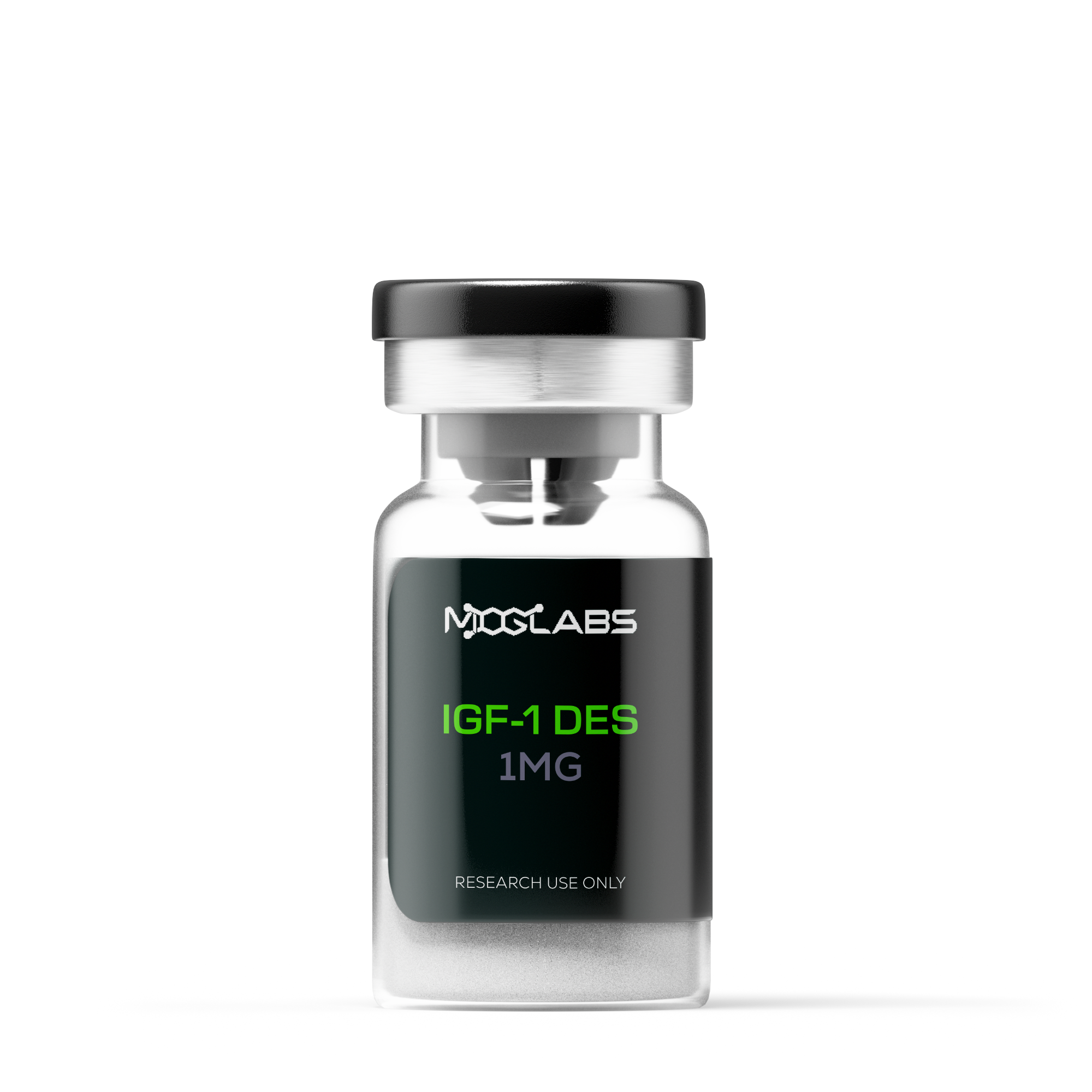
- IGF-1 DES differs from ordinary IGF-1 by just three amino acids removed from one end, yet that single change makes it about ten times more potent at driving cell growth in culture.
- It is not purely a synthetic invention; the truncated peptide occurs naturally and was first purified from bovine colostrum.
Mechanism
DES works through the same core pathway as intact IGF-1 but escapes the regulatory brake that normally limits it. Like the parent hormone, it binds and activates the type 1 IGF receptor (IGF-1R), a receptor tyrosine kinase that on activation triggers the / and RAS/MAPK signaling cascades, driving protein synthesis, cell proliferation, cell survival, and hypertrophy. What sets the DES variant apart is upstream of the receptor: removal of the N-terminal Gly-Pro-Glu tripeptide, and in particular the loss of the at position 3, drastically reduces its binding to the IGF-binding proteins (IGFBPs) that sequester circulating IGF-1 [1][6].
The consequence is a marked gain in effective potency. Across cultured cell systems, des(1-3)IGF-I is roughly 10-fold more potent than at stimulating hypertrophy and proliferation, a difference driven almost entirely by its evasion of IGFBPs [1]. The cleanest demonstration comes from granulosa cell experiments: under IGFBP-replete conditions des(1-3)IGF-I was about 10-fold more potent than intact , yet under IGFBP-deplete conditions the two were essentially equipotent, proving that the potency advantage is due to reduced IGFBP binding rather than any change at the receptor [4]. In liver-cell cultures the analogue suppressed IGFBP-1 far more strongly than or [3], and in whole animals IGFBP-resistant IGF variants including des(1-3)IGF-I produced 2 to 3 times greater and longer-lasting effects on blood glucose than native [2].
The functional benefits reflect this amplified, less-buffered IGF signaling: strong anabolic and proliferative effects on tissues, with animal studies showing selective growth of the gastrointestinal tract and improved gut absorptive function and regrowth after resection [5]. In short, DES is an IGF-1 that the body cannot easily hold in reserve, which is precisely why it is more potent and why it is studied as a concentrated anabolic tool [1][4].
receptor fingerprint
receptorPotent agonist of the anabolic IGF pathway
IGF-binding proteins (IGFBPs)Binds them weakly so more peptide stays active
/ signalingDownstream activation after receptor binding
Safetyrisks and cautions, not medical advice
IGF-1 DES is a potent IGF-1 variant; because IGF-1 has insulin-like activity it can cause hypoglycemia (low blood sugar), which may be significant, along with fluid retention and, with excess, tissue and organ overgrowth. Elevated IGF-1 signaling raises theoretical concern about promoting the growth of existing tumors. Human safety data for this variant are limited and it is unapproved, so it should be regarded as an experimental compound with real metabolic risks.
History
IGF-1 DES, formally des(1-3)IGF-I, is a naturally occurring truncated variant of insulin-like growth factor 1 that was first isolated in the 1980s from bovine colostrum and subsequently identified in human brain and porcine uterus, where it is thought to arise from post-translational cleavage of IGF-1. Foundational characterization by F. J. Ballard and colleagues established that removal of the N-terminal Gly-Pro-Glu tripeptide sharply lowers binding to the IGF-binding proteins, which makes the variant markedly more potent in cell culture. Because it is a defined fragment of a native hormone rather than a designed drug, it has been studied chiefly as a research tool for probing IGF signaling. It has not been developed as an approved medicine and circulates as a research peptide.
Reputation
IGF-1 DES is well regarded among researchers for its unusually clean and well-documented mechanism; it is essentially an IGF-1 that the body cannot easily hold in reserve. Its roughly tenfold potency advantage over intact IGF-1 under binding-protein-replete conditions is one of the tidiest demonstrations in growth-factor pharmacology, since the advantage disappears when the binding proteins are removed. This makes it a favorite illustration of how evasion of binding proteins, rather than any change at the receptor, can amplify a hormone's effect. Candidly, human clinical data are limited, and as a potent activator of the IGF and Akt/mTOR axis it warrants the same caution as any strong anabolic signal.
Subjective profileweighing the evidence above
Potent enough to be genuinely risky. Hypoglycemia is the near-term problem, and the strong growth signaling raises a real theoretical concern about feeding existing tumors, all with no human safety data behind it. The muscle payoff does not justify that trade.
Where to buy
1 other outlet
Suppliers
Vendors carrying IGF-1 DES, with live product details and codes. Links are affiliate links that support the wiki at no cost to you.
| supplier | size | price | $/mg |
|---|---|---|---|
| RUOlowest | 1mg | $26.00 | $26.00/mg |
| Moglabs | 1mg | $28.00 | $28.00/mg |
RUO
IGF-1 DES
Moglabs
IGF-1 DES
Research
- 1992first citedGranulosa cell-derived insulin-like growth factor (IGF) binding proteins are inhibitory to IGF-…
- 2002most recentCharacterization of pituitary IGF-I receptors: modulation of prolactin and growth hormone.
- 1.Des(1-3)IGF-I: a truncated form of insulin-like growth factor-I.
- 2.IGF-I variants which bind poorly to IGF-binding proteins show more potent and prolonged hypoglycaemic action than native IGF-I in pigs and marmoset monkeys.
- 3.Insulin-like growth factor binding protein-1 from Hep G2 cells is potently inhibited by the truncated IGF-I analogue des-(1-3) IGF-I.
- 4.Granulosa cell-derived insulin-like growth factor (IGF) binding proteins are inhibitory to IGF-I hormonal action. Evidence derived from the use of a truncated IGF-I analogue.
- 5.Treatment with IGF-I peptides improves function of the remnant gut following small bowel resection in rats.
- 6.Characterization of pituitary IGF-I receptors: modulation of prolactin and growth hormone.
6 listed here; entry last updated August 2026
Reviews
My notesprivate to this device
FAQ
Why is it stronger than regular IGF-1?
Removing the first three amino acids sharply weakens its binding to IGFBPs, so more of it stays free to activate the receptor.
Does it really cause site-specific growth?
That claim is popular but not backed by controlled human studies; its short half-life is the usual rationale given, not proven local hypertrophy.
Is it the same as IGF-1 LR3?
No; both resist binding proteins, but LR3 is a longer, more stable analog while DES is a short truncated form with a briefer action.
Adverse effects
- Can lower blood sugar, sometimes causing hypoglycemia
- Its strong growth signaling raises theoretical concerns about unwanted tissue growth
- Injection site reactions are possible with subcutaneous use
Notes and cautions
- Not an approved medicine, and human safety data are very limited
- Most evidence comes from animal and cell studies