
spec sheet12 rows
1,4-DMAA (1,4-dimethylamylamine) is an experimental aliphatic amine stimulant that emerged as a next-generation successor to the banned 1,3-DMAA, marketed for the same hard-hitting pre-workout energy and focus. As a positional isomer of the classic DMAA molecule, it gives formulators a structurally distinct route to intense adrenergic stimulation. It remains a rare, sought-after ingredient in a handful of underground sports and weight-loss products, appealing to enthusiasts chasing the original DMAA experience.
- Surging, clean energy that hits hard
- Tight, locked in mental focus
- Appetite control that actually holds
- Genuinely uplifted mood in the gym
- Bigger, fuller training pumps
- The rare successor to classic DMAA
- Presumed to raise blood pressure and vascular tone like related stimulants
- Overstimulation, jitteriness, and anxiety are plausible
Overview
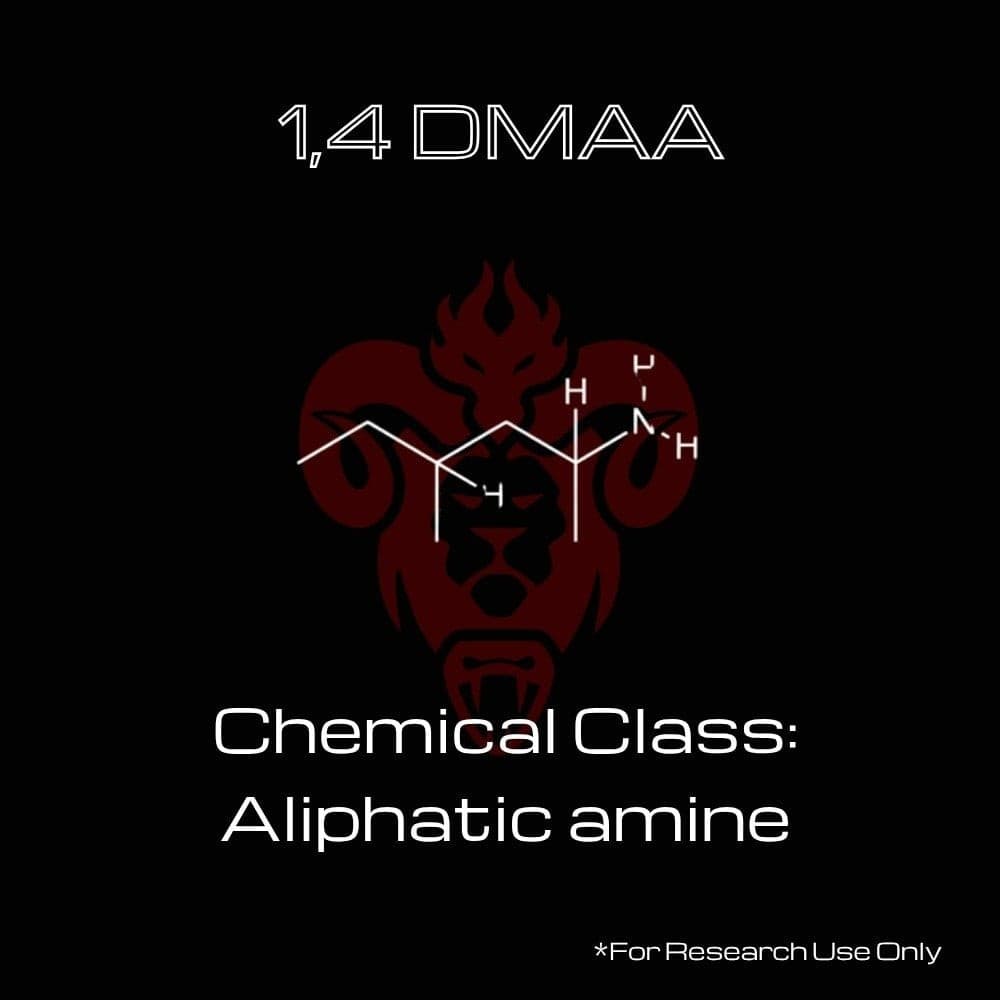
1,4-Dimethylamylamine (1,4-DMAA) is a synthetic aliphatic amine stimulant and a positional isomer of the better-known 1,3-dimethylamylamine (1,3-DMAA), differing only in the placement of a methyl group along the carbon chain. It belongs to the same family of simple branched alkylamines that act as central nervous system stimulants without the aromatic ring of the amphetamines. Unlike 1,3-DMAA, it has essentially no history of pharmaceutical development and has never been approved for human consumption, so its pharmacology and safety profile in people remain largely uncharacterized [1].
1,4-DMAA came to attention as a designer replacement ingredient after regulators moved against 1,3-DMAA. Analytical investigations of sports and weight-loss supplements sold in the United States identified 1,4-DMAA alongside other experimental stimulants such as octodrine and 1,3-dimethylbutylamine, sometimes stacked together in the same product [1][2]. In these surveys the compound was quantified across a wide range of amounts per serving, and in some cases it was present but not declared on the label [1][2][4]. It has also been detected as an undeclared adulterant in products marketed under novel botanical names [4].
Chemically, 1,4-DMAA is difficult to distinguish from related isomers such as 2-aminoheptane and methylhexaneamine, and specialized techniques including high-resolution gas chromatography with soft ionization and tandem mass spectrometry have been developed to separate and confirm it [5]. One analytical study reported detection of both 1,3-DMAA and 1,4-DMAA in geranium (Pelargonium graveolens) plant tissue at nanogram-per-gram concentrations, though the natural occurrence of these amines remains contested [3]. Regulators treat 1,4-DMAA as a prohibited, unapproved stimulant, and it is banned in competitive sport; it exists today almost exclusively as an underground supplement ingredient and an analyte of interest in toxicology and anti-doping laboratories [2][4].
- The original DMAA (1,3-DMAA) was patented by Eli Lilly in the 1940s as a nasal decongestant, long before it ever appeared in sports supplements.
- 1,4-DMAA is a positional isomer, meaning it shares the same atoms as 1,3-DMAA arranged differently on the carbon chain, a tweak used to create a structurally distinct stimulant.
Mechanism
Because 1,4-DMAA has never undergone formal pharmacological study in humans, its mechanism is inferred from its chemistry and from its close structural relationship to 1,3-DMAA and other aliphatic amine stimulants [1]. As a branched alkylamine, it is expected to act as an indirectly acting sympathomimetic, promoting release of the catecholamines and and dampening their reuptake, thereby raising sympathetic (fight-or-flight) tone. The anticipated downstream effects mirror those of the wider class; stimulation of alpha- and beta-adrenergic signaling, vasoconstriction, increased blood pressure, heightened alertness and drive, and appetite suppression, which is the basis for its use in energy and weight-loss formulas.
Direct quantitative data on 1,4-DMAA itself are limited to its measured content in adulterated products rather than its physiological effects; analyses have found it at amounts ranging from roughly 5 mg to nearly 95 mg per serving across different supplements [1][2]. For the physiological response, the most relevant benchmark is its isomer 1,3-DMAA, which in a controlled crossover trial in healthy adults raised systolic blood pressure by up to about 20 percent and diastolic blood pressure by up to about 17 percent within 60 minutes of ingestion, without a rise in heart rate [6]. Given the structural similarity, 1,4-DMAA is presumed to carry a comparable pressor, vasoconstrictive profile.
The central caveat is uncertainty. No study has established that 1,4-DMAA shares the exact potency, receptor selectivity, or metabolic fate of 1,3-DMAA, and its frequent combination with other experimental stimulants in real-world products compounds the unknown risk [1][2]. Regulators and toxicologists therefore treat it as an untested stimulant whose cardiovascular effects, while plausibly significant, have not been directly measured in people [1].
receptor fingerprint
/ releasestimulates
Blood pressure / heart rateraises (risk)
Sympathetic nervous systemactivates
Dosingtypical ranges, not medical advice
interested in protocols and clinical dosages? make an account to see them! ^_^
Safetyrisks and cautions, not medical advice
1,4-DMAA is a structural isomer of DMAA sold as a stimulant, but it has essentially no published human pharmacology or safety data; it is sold as a research chemical, so considerations are inferred from the sympathomimetic amine class. On that basis, plausible effects include elevated blood pressure, tachycardia, arrhythmia and cardiovascular strain, and the complete absence of study data means unrecognized hazards cannot be excluded.
Interactionsdocumented pairs only, not exhaustive
1,4-DMAA is an aliphatic amine sympathomimetic sold in some supplements, and specific human interaction studies are lacking; the relevant basis is the established pharmacology of indirect-acting sympathomimetic amines. Combining such amines with monoamine oxidase inhibitors is a recognized cause of hypertensive crisis, and this contraindication is generally extended to DMAA-type compounds. Additive cardiovascular stimulation with caffeine and other stimulants is a plausible concern that remains theoretical for this specific isomer, and regulators have flagged serious cardiovascular events (hypertension, arrhythmia) associated with DMAA-containing products. No characterized cytochrome P450 interaction data exist for 1,4-DMAA. This is research information, not medical advice.
Checking a whole stack? Run it through interactions + stacks.
History
The DMAA family traces back to 1,3-DMAA (methylhexanamine), a compound patented by Eli Lilly in the mid-1940s and marketed for a time as an inhaled nasal decongestant before it resurfaced decades later in pre-workout and weight-loss products. 1,4-DMAA is a positional isomer that appeared much more recently, promoted as a next-generation successor once 1,3-DMAA was banned or restricted in numerous countries. Unlike its better-known relative, 1,4-DMAA has no documented record of formal synthesis, discovery, or pharmacological development; it exists almost entirely as an ingredient identified during analyses of adulterated supplements. Its properties are inferred from its chemistry and from the well-studied 1,3-DMAA isomer rather than from any dedicated study of the molecule itself.
Reputation
1,4-DMAA holds a niche, almost cult reputation among enthusiasts who remember the intense, focused energy of the original DMAA era and seek to recreate it. It is talked about in hardcore pre-workout circles as a rare, hard-hitting stimulant, and that scarcity is a large part of its appeal. Honesty demands a clear caveat, however; because the isomer has never been studied in people, its potency, safety margin, and cardiovascular effects remain genuinely unknown, and it is frequently combined with other experimental stimulants in real-world products. Reviewers who value it still tend to frame it as an experimental ingredient for the informed and cautious rather than an everyday choice.
Subjective profileweighing the evidence above
Not worth it. This is an untested stand-in for a stimulant class the FDA pulled from supplements in 2013 after links to severe cardiovascular events and deaths, and swapping one carbon position does not make it safer. The energy is real; the margin is unknown.
Where to buy
Suppliers
Vendors carrying 1,4-DMAA, with live product details and codes. Links are affiliate links that support the wiki at no cost to you.
Kimera Chems
1,4-DMAA
Research
- 2011first citedEffects of 1,3-dimethylamylamine and caffeine alone or in combination on heart rate and blood p…
- 2025most recentPresence and quantity of ingredients in sports supplements purportedly containing the orchid Er…
- 1.Four experimental stimulants found in sports and weight loss supplements: 2-amino-6-methylheptane (octodrine), 1,4-dimethylamylamine (1,4-DMAA), 1,3-dimethylamylamine (1,3-DMAA) and 1,3-dimethylbutylamine (1,3-DMBA)
- 2.Nine prohibited stimulants found in sports and weight loss supplements: deterenol, phenpromethamine (Vonedrine), oxilofrine, octodrine, beta-methylphenylethylamine (BMPEA), 1,3-dimethylamylamine (1,3-DMAA), 1,4-dimethylamylamine (1,4-DMAA), 1,3-dimethylbutylamine (1,3-DMBA) and higenamine
- 3.Analysis and Confirmation of 1,3-DMAA and 1,4-DMAA in Geranium Plants Using High Performance Liquid Chromatography with Tandem Mass Spectrometry at ng/g Concentrations
- 4.Presence and quantity of ingredients in sports supplements purportedly containing the orchid Eria jarensis.
- 5.Identification of methylhexaneamine by GC high-resolution TOFMS and soft ionization
- 6.Effects of 1,3-dimethylamylamine and caffeine alone or in combination on heart rate and blood pressure in healthy men and women
- 7.Have prohibition policies made the wrong decision? A critical review of studies investigating the effects of DMAA
7 listed here; entry last updated August 2026
Reviews
My notesprivate to this device
FAQ
What is 1,4-DMAA used for?
It is a grey-market stimulant sold for energy, focus, and appetite suppression, similar in intent to DMAA.
How does 1,4-DMAA work?
As an isomer of DMAA, it acts as a sympathomimetic stimulant affecting norepinephrine signaling.
Is 1,4-DMAA well-researched?
Very little human safety data exists for this specific isomer, and it shares the cardiovascular concerns associated with DMAA.
What are the main side effects?
Reported concerns include raised blood pressure, fast heartbeat, jitteriness, and headache.
Limitations of the evidence
- Human safety data are essentially absent; effects are not well characterized
Adverse effects
- Presumed to raise blood pressure and vascular tone like related stimulants
- Overstimulation, jitteriness, and anxiety are plausible
Notes and cautions
- Often combined with other untested stimulants in products, adding risk
- Sleep disruption if taken later in the day