
spec sheet11 rows
1,3-DMAA (1,3-dimethylamylamine, methylhexanamine) is a potent aliphatic amine stimulant that defined the golden era of hardcore pre-workouts, prized for driving energy, appetite suppression, and razor focus. Originally patented in the 1940s as a nasal decongestant, it delivers an amphetamine-adjacent lift through indirect adrenergic stimulation and a distinctive vasoconstrictive edge. Its reputation as one of the most intense stimulants ever sold in sports nutrition kept demand high even as regulators moved to restrict it.
- Explosive, long-lasting training energy
- Razor-sharp laser focus
- Powerful appetite suppression
- Big lift in mood and drive
- Next-level workout intensity
- The legend behind hardcore pre-workouts
- Raises blood pressure and increases vascular tone
- Can cause a pounding or racing heartbeat sensation
- Overstimulation, jitteriness, and anxiety
Overview
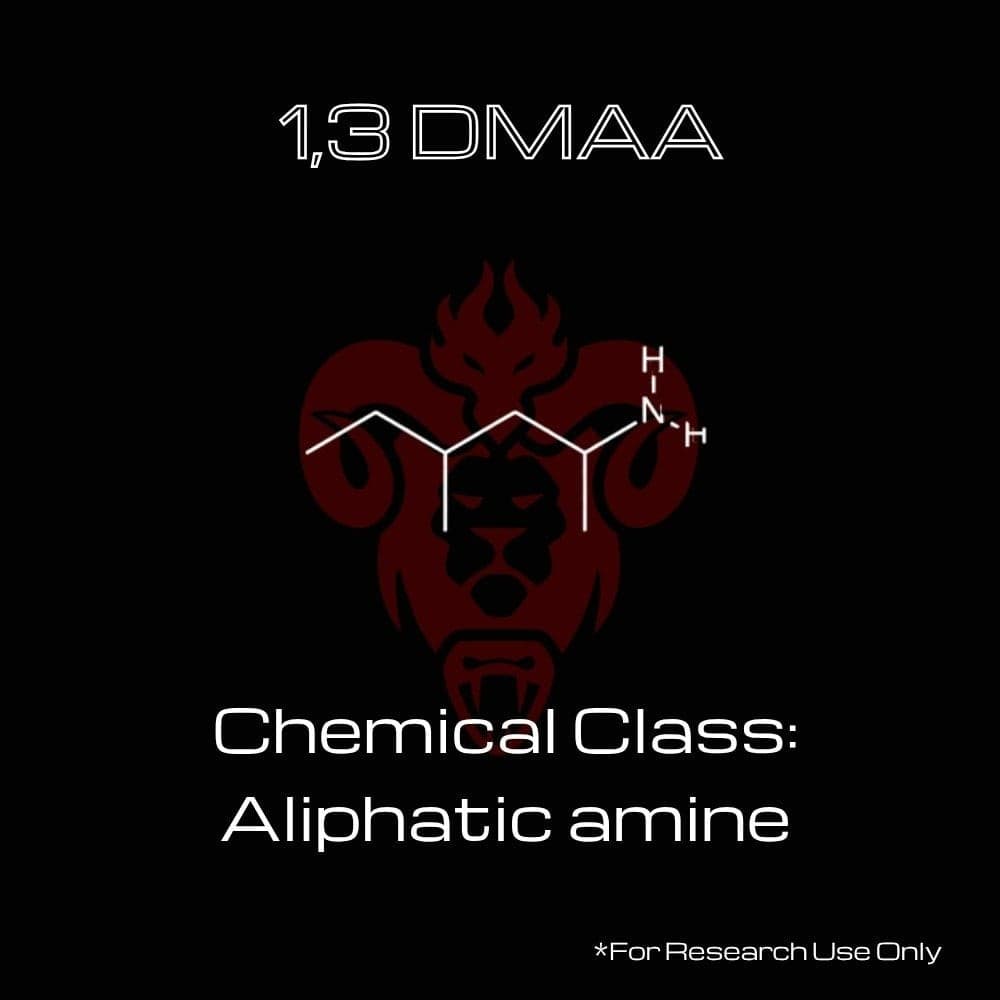
1,3-Dimethylamylamine (1,3-DMAA), also called methylhexanamine, methylhexaneamine, or by the trade name Geranamine, is a synthetic aliphatic amine with central nervous system stimulant activity. Chemically it is a simple branched alkylamine (4-methylhexan-2-amine) that lacks the aromatic ring of the amphetamines yet produces broadly sympathomimetic effects. It was first patented in the 1940s as a nasal decongestant and later resurfaced as a recreational and performance stimulant [3].
From the mid-2000s onward, DMAA became a headline ingredient in pre-workout and weight-loss supplements, where it was frequently marketed as a natural constituent of geranium (Pelargonium graveolens) oil under names such as Geranamine [2]. That claim triggered a prolonged scientific dispute. Independent analyses using gas chromatography, HPLC-MS, and related methods repeatedly failed to detect DMAA in authentic geranium plant material or oils sourced from multiple regions, concluding that supplement DMAA is synthetic rather than botanical [1][2]. The conflicting reports in the literature have been attributed largely to differences in source material and extraction methodology [1].
Commercially, DMAA appeared as the hydrochloride salt in capsules, powders, and pre-workout blends, very often paired with caffeine [6][7]. Analytical surveys documented highly variable content between products and confirmed its identity by NMR and mass spectrometry [8]. Regulators subsequently acted against it; authorities classified DMAA as an unapproved and unlawful ingredient rather than a legitimate food component, and it is banned in competitive sport as a doping agent [3][8]. Pharmacokinetic work in humans has since characterized its absorption and elimination, reporting a terminal half-life of roughly 8 hours after a single oral dose [5]. Today it is studied chiefly in analytical chemistry, toxicology, and anti-doping contexts.
- 1,3-DMAA began life as a prescription nasal decongestant, sold by Eli Lilly as Forthane in the 1940s, long before it ever appeared in a pre-workout tub.
- In controlled human dosing, DMAA raised systolic blood pressure by up to roughly 20 percent within an hour, yet circulating adrenaline and noradrenaline were not meaningfully elevated, suggesting a direct vascular and central action rather than measurable catecholamine spillover.
Mechanism
DMAA behaves as an indirectly acting sympathomimetic amine, meaning it drives the body's own (fight-or-flight) system rather than binding a single dedicated receptor. As a aliphatic amine structurally related to ephedrine and the amphetamines, it is thought to promote release of the catecholamines and and to hinder their reuptake, amplifying sympathetic tone. The downstream result is stimulation of alpha-adrenergic and beta-adrenergic pathways, producing vasoconstriction, elevated blood pressure, heightened alertness and drive, appetite suppression, and the subjective clean energy and focus that made it popular in pre-workout formulas; its original decongestant use reflected the same vasoconstrictive action on nasal mucosa.
The cardiovascular signature is the most consistently documented effect. In a double-blind, randomized crossover trial in healthy adults, acute oral DMAA, alone and combined with caffeine, raised systolic blood pressure by up to roughly 20 percent and diastolic blood pressure by up to roughly 17 percent at 60 minutes after ingestion, with the rate pressure product rising about 9 percent, while heart rate was essentially unchanged [4]. A separate study of DMAA-containing supplements reported acute increases in blood pressure and rate pressure product on the order of 5 to 15 percent [6]. Notably, circulating and epinephrine were not meaningfully elevated in these trials, suggesting the pressor effect is driven more by direct vascular and central action than by measurable spillover of catecholamines into plasma [4].
Pharmacokinetically, a single oral dose reaches peak plasma concentrations of roughly 70 ng/mL within several hours and is cleared with a terminal of about 8 hours [5]. Because this pressor, vasoconstrictive profile can become pronounced at higher intakes, and because case reports have linked heavy or combined use with events such as cerebral hemorrhage, DMAA is regarded as carrying meaningful cardiovascular risk even though it was tolerated at controlled low doses over several weeks in supervised trials [5][7].
receptor fingerprint
/ releasestimulates
Blood pressure / heart rateraises (risk)
substrate-like interaction
Dosingtypical ranges, not medical advice
interested in protocols and clinical dosages? make an account to see them! ^_^
Safetyrisks and cautions, not medical advice
1,3-DMAA (methylhexanamine) is a potent sympathomimetic stimulant that constricts blood vessels and raises heart rate and blood pressure. It has been linked to serious cardiovascular events including hypertensive crisis, arrhythmia, stroke, cerebral hemorrhage and deaths, especially during exertion or when combined with caffeine or other stimulants, and regulators including the US FDA have warned against its use in supplements. It may also trigger chest tightness, anxiety, and headaches and can produce positive athletic drug tests.
Interactionsdocumented pairs only, not exhaustive
1,3-DMAA (methylhexanamine) is an indirect sympathomimetic amine, and controlled dosing studies show it raises blood pressure, an effect that is additive when combined with caffeine, the pairing most common in the supplements that caused reported harms. Case reports link DMAA, frequently taken with caffeine or other stimulants, to hypertensive crises, hemorrhagic and ischemic stroke, myocardial infarction, and sudden death. Because it promotes catecholamine activity, combining it with monoamine oxidase inhibitors carries a pharmacologically expected risk of hypertensive crisis, and stacking it with other stimulants or sympathomimetic decongestants compounds cardiovascular strain. This is research information, not medical advice.
Checking a whole stack? Run it through interactions + stacks.
History
1,3-DMAA, chemically 1,3-dimethylamylamine or methylhexanamine, was introduced by the pharmaceutical company Eli Lilly in the 1940s and marketed under the trade name Forthane as an inhaled nasal decongestant, an application that reflected its vasoconstrictive action on nasal mucosa. It faded from pharmaceutical use for decades before being reintroduced in the mid-2000s as an ingredient in dietary supplements and pre-workout formulas, where it became one of the defining stimulants of the hardcore pre-workout era. Its rise prompted scrutiny from regulators and anti-doping authorities, who moved to restrict it amid case reports linking heavy or combined use to serious cardiovascular events. Controlled studies have characterized its pharmacokinetics and its pronounced pressor effect, cementing its profile as a potent but risk-laden sympathomimetic.
Reputation
1,3-DMAA earned an almost legendary reputation in sports nutrition as one of the most intense stimulants ever sold, prized for the clean energy, sharp focus, and appetite suppression it delivered in pre-workout formulas. That reputation is real, and controlled trials confirm its distinctive vasoconstrictive, adrenergic character. The candid counterweight is that the same pressor profile is its central liability: studies document meaningful acute increases in blood pressure, and case reports have associated heavy or stacked use with events such as cerebral hemorrhage, which is why regulators moved against it. It is fairly remembered as a powerful but genuinely risk-bearing compound whose intensity was inseparable from its cardiovascular effects.
Subjective profileweighing the evidence above
It works, and that is exactly the problem. This one is linked to hypertensive crisis, arrhythmia, stroke and deaths, especially during exertion or alongside caffeine, and regulators have warned against it. No pre-workout feeling is worth that trade.
Where to buy
Suppliers
Vendors carrying 1,3-DMAA, with live product details and codes. Links are affiliate links that support the wiki at no cost to you.
Kimera Chems
1,3-DMAA
Research
- 2011first citedEffects of 1,3-dimethylamylamine and caffeine alone or in combination on heart rate and blood p…
- 2013most active year3 papers
- 2014most recentAnalysis of 1,3 dimethylamylamine concentrations in Geraniaceae, geranium oil and dietary suppl…
- 1.1,3-Dimethylamylamine (DMAA) in supplements and geranium products: natural or synthetic?
- 2.Analysis of 1,3 dimethylamylamine concentrations in Geraniaceae, geranium oil and dietary supplements
- 3.Could 1,3 dimethylamylamine (DMAA) in food supplements have a natural origin?
- 4.Effects of 1,3-dimethylamylamine and caffeine alone or in combination on heart rate and blood pressure in healthy men and women
- 5.Physiological and pharmacokinetic effects of oral 1,3-dimethylamylamine administration in men
- 6.Hemodynamic and hematologic profile of healthy adults ingesting dietary supplements containing 1,3-dimethylamylamine and caffeine
- 7.Safety profile of caffeine and 1,3-dimethylamylamine supplementation in healthy men
- 8.Rapid assessment of the illegal presence of 1,3-dimethylamylamine (DMAA) in sports nutrition and dietary supplements using 1H NMR spectroscopy
8 listed here; entry last updated August 2026
Reviews
- reps and fatigue
dmaa managed to literally double my reps on compounds, hax squat 3-5 reps, deadlift, 2-4 reps.
0
My notesprivate to this device
FAQ
What is 1,3-DMAA used for?
It was widely used as a stimulant in pre-workout and fat-loss products for energy, focus, and appetite suppression. It has since been banned or restricted in many places over safety concerns.
How does 1,3-DMAA work?
It acts as a stimulant with effects on the sympathetic nervous system, releasing norepinephrine and constricting blood vessels.
Is 1,3-DMAA safe?
It carries real cardiovascular risk, including raised blood pressure and heart rate, and has been linked to serious adverse events. Many regulators have restricted it.
What are the main side effects?
Common concerns include elevated blood pressure, rapid heartbeat, anxiety, and headache.
Adverse effects
- Raises blood pressure and increases vascular tone
- Can cause a pounding or racing heartbeat sensation
- Overstimulation, jitteriness, and anxiety
- Sleep disruption if taken later in the day
- Linked in case reports to serious cardiovascular events at higher intakes