
spec sheet14 rows
Propranolol is a nonselective beta-adrenergic receptor antagonist, one of the first drugs of its kind and a mainstay of cardiovascular medicine. Developed by the British scientist James Black in the early 1960s, it blocks the actions of adrenaline and noradrenaline at both beta-1 and beta-2 receptors and is used for conditions ranging from hypertension, angina, and irregular heart rhythms to migraine prevention, essential tremor, and performance anxiety. It also became the first effective drug treatment for infantile hemangioma. Propranolol appears on the World Health Organization list of essential medicines and is available only by prescription.
- Blunts the adrenaline surge on demand
- Steadies a shaking hand
- Calm for performance anxiety and big moments
- Lowers blood pressure; a cardiology mainstay
- A WHO essential medicine, decades proven
- Common effects include tiredness, cold hands and feet, and a slow heart rate
- Because it is nonselective, it can trigger airway narrowing and is usually avoided in people with asthma
- It may cause dizziness or fainting from low blood pressure, along with vivid dreams or sleep disturbance
Overview
Propranolol is a nonselective beta blocker, meaning it competitively antagonizes both the beta-1 and beta-2 subtypes of the adrenergic receptor [1][2]. It is a lipophilic molecule that readily crosses the blood-brain barrier, reaching far higher concentrations in the brain than in the blood, which underlies several of its central nervous system effects [2]. The commercial drug is a racemic mixture of two mirror-image forms, of which the S enantiomer carries almost all of the beta-blocking activity [2]. It is usually supplied as the hydrochloride salt.
The drug was created by Sir James Black and colleagues at ICI Pharmaceuticals and reached the market in the mid-1960s, initially for angina pectoris [1]. It was the first beta blocker used successfully against angina and high blood pressure, and Black's insight that blocking beta-adrenergic receptors could ease the heart's workload was a landmark in rational drug design that contributed to his Nobel Prize in Physiology or Medicine [1]. In the decades that followed, a long series of further uses was uncovered, and new indications continue to emerge for what is now an inexpensive, off-patent medicine [1].
Propranolol is used across a broad range of conditions. In cardiovascular medicine it treats hypertension, angina, certain arrhythmias, and the aftermath of heart attack, and it lowers pressure in the portal vein to help prevent variceal bleeding [1]. It is a well-established preventive treatment for migraine; a Cochrane review of 58 trials involving more than five thousand participants concluded that propranolol is clearly more effective than placebo for short-term migraine prophylaxis and roughly as effective as several comparator drugs [3]. It is also used for essential tremor, overactive thyroid and thyroid storm, pheochromocytoma, and the physical symptoms of performance and situational anxiety, where it blunts the racing heart and tremor of the adrenaline response [1]. A striking modern application is infantile hemangioma: after the effect was noticed by chance, propranolol became the first-line drug for these common vascular birthmarks of infancy, largely displacing corticosteroids [4].
Propranolol is a prescription-only medicine in the United States, United Kingdom, European Union, and elsewhere, and it appears on the World Health Organization Model List of Essential Medicines [1][2]. It was first sold under the brand name Inderal and is now available generically and under many trade names, including a pediatric oral solution licensed specifically for infantile hemangioma [2][4]. Formulations include immediate-release and long-acting oral tablets and capsules as well as an intravenous preparation, and the drug is broken down in the liver by the enzymes CYP2D6, CYP1A2, and CYP2C19 [2].

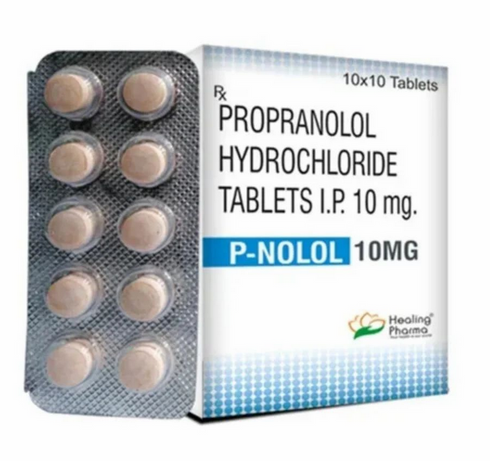
- Propranolol was the first successful beta-blocker, and its discovery earned James Black the 1988 Nobel Prize in Physiology or Medicine.
- Its use for infantile hemangioma was discovered entirely by accident in 2008, when doctors noticed the birthmarks of children treated with propranolol for the heart were shrinking.
- At clinically effective doses, the plasma concentration of propranolol is about 100 times higher than needed to fully block beta-adrenergic receptors, a clue that some of its effects work through other pathways.
Mechanism
Propranolol works by competitively blocking beta- receptors, preventing the catecholamines adrenaline and noradrenaline from binding [1][2]. At beta-1 receptors, which predominate in the heart, this blockade reduces receptor-driven activation of adenylate cyclase and the resulting production of cyclic AMP, so the heart beats more slowly and less forcefully and its oxygen demand falls; these actions account for the benefit in angina, hypertension, arrhythmias, and anxiety-related palpitations [1][2]. Because propranolol is nonselective, it also blocks beta-2 receptors in the airways and blood vessels, which explains why it can provoke bronchial constriction in people with asthma and is generally avoided in that setting [2].
Its nature lets it enter the central nervous system, contributing to effects on tremor, migraine, and the somatic features of anxiety [2]. In infantile hemangioma the mechanism is thought to differ from its cardiac action, involving constriction of blood vessels, suppression of pro-angiogenic signalling such as vascular endothelial growth factor, and promotion of programmed cell death in the proliferating tumour cells, so the lesions shrink [4]. At higher concentrations propranolol also shows a membrane-stabilizing, quinidine-like effect [1].
receptor fingerprint
Beta-1 / beta-2 receptorsnon-selective antagonist
Adrenaline (physical symptoms)blocks
Performance anxietyreduces
Dosingtypical ranges, not medical advice
interested in protocols and clinical dosages? make an account to see them! ^_^
Safetyrisks and cautions, not medical advice
Propranolol is a non-selective beta-blocker that slows heart rate and lowers blood pressure, causing fatigue, dizziness, and cold hands and feet, and it can provoke bronchospasm, making it contraindicated in asthma. It can mask the warning signs of low blood sugar in people with diabetes and should never be stopped abruptly, as rebound rises in heart rate and blood pressure can trigger angina or dangerous cardiac events. It is contraindicated in certain slow-heart-rate rhythms and decompensated heart failure and requires care in those with these conditions.
Interactionsdocumented pairs only, not exhaustive
Propranolol is metabolized by CYP2D6 and CYP1A2, so inhibitors such as fluoxetine, paroxetine or quinidine (CYP2D6) and fluvoxamine (CYP1A2) raise its plasma levels and can intensify bradycardia and hypotension. Combined with non-dihydropyridine calcium channel blockers such as verapamil or diltiazem, or with digoxin, it produces additive AV-nodal suppression and risk of heart block. As a non-selective beta-blocker it can provoke bronchospasm and is contraindicated in asthma, and it both masks the adrenergic warning signs of hypoglycemia and blunts recovery in patients on insulin or sulfonylureas. NSAIDs can attenuate its antihypertensive effect, and abrupt withdrawal alongside clonidine can precipitate rebound hypertension. This is research information, not medical advice.
Checking a whole stack? Run it through interactions + stacks.
History
Propranolol was created in the early 1960s by the British scientist James Black and colleagues at Imperial Chemical Industries, the culmination of a deliberate effort to design a drug that would block the actions of adrenaline on the heart. It was the first clinically successful beta-adrenergic receptor antagonist, a breakthrough that transformed the treatment of angina, hypertension and cardiac arrhythmias and for which Black was awarded the Nobel Prize in Physiology or Medicine in 1988.
In the decades that followed, its uses expanded far beyond the heart to include migraine prevention, essential tremor and the physical symptoms of performance anxiety. A striking new application emerged serendipitously in 2008, when French physicians led by Léauté-Labrèze observed that propranolol dramatically shrank infantile hemangiomas, an accidental discovery that quickly became the first effective drug therapy for these common vascular tumors. Propranolol appears on the World Health Organization list of essential medicines and remains a foundational cardiovascular drug.
Reputation
Propranolol is a landmark medicine, the original beta-blocker and one of the most influential drugs of the twentieth century, its inventor honored with a Nobel Prize. Physicians across many specialties rely on it, and patients appreciate its remarkable versatility, from steadying a racing heart and easing migraines to quieting the trembling hands and pounding pulse of stage fright. Its reputation was renewed dramatically when it became the first effective treatment for infantile hemangioma, sparing many children from surgery.
Modern reviews are candid that its benefits in hemangioma involve incomplete tumor suppression and off-target effects, and that as a nonselective agent it must be avoided in asthma and used carefully in certain patients. Even with these caveats, its inclusion on the WHO essential medicines list and its enduring place in cardiology, neurology and dermatology confirm its standing as a genuinely essential and trusted drug.
Subjective profileweighing the evidence above
One of the most useful drugs there is for the physical side of anxiety; it takes the tremor and pounding heart out of a performance without clouding your thinking, and it earns its keep in blood pressure and migraine too. Being nonselective it is avoided in asthma, and it should never be stopped abruptly.
Where to buy


Suppliers
Vendors carrying Propranolol, with live product details and codes. Links are affiliate links that support the wiki at no cost to you.
| supplier | size | price | $/mg |
|---|---|---|---|
| PCT.Zonelowest | 10MG | $1.00 | $0.100/mg |
| PCT.Zone | 20MG | $3.98 | $0.199/mg |
PCT.Zone
Propranolol
PCT.Zone
Propranolol
RUPharma🌐
Propranolol

RUPharma🌐
Propranolol
Research
- 1977first citedHyperthyroidism after propranolol withdrawal.
- 2016most active year4 papers
- 2024most recentRandomized controlled trial of propranolol on social communication and anxiety in children and…
- 1.Propranolol: A 50-Year Historical Perspective.
- 2.Clinical Pharmacokinetics of Propranolol Hydrochloride: A Review.
- 3.Propranolol for migraine prophylaxis.
- 4.Infantile hemangioma. Part 2: Management.
- 5.Propranolol Therapy in Infantile Hemangioma: It Is Not Just About the Beta.
- 6.Propranolol and venlafaxine for vestibular migraine prophylaxis: A randomized controlled trial.
- 7.TOP-PRO study: A randomized double-blind controlled trial of topiramate versus propranolol for prevention of chronic migraine.
- 8.Topiramate in migraine prophylaxis--results from a placebo-controlled trial with propranolol as an active control.
- 9.Medical treatment of essential tremor.
- 10.Treatment Patterns in Essential Tremor: A Retrospective Analysis.
- 11.Randomized controlled trial of propranolol on social communication and anxiety in children and young adults with autism spectrum disorder.
- 12.Beta-adrenergic blocking drugs in anxiety and stress.
23 listed here; entry last updated August 2026
Reviews
- works as advertised, would prefer XR over IR
works really well for physical CNS agitation or excitement though i would much prefer XR even if peak plasma content doesn't get as high just to mitigate peaks and dips within blood and the fact that you need to take it three times a day, if you aren't consistent you're just giving yourself cardio beta receptor oversensitization for no reason. tldr; go with XR if this is for anxiety or blood pressure.
dev · Aug 6, 20260

My notesprivate to this device
FAQ
What is propranolol?
It is a long-established beta blocker used for blood pressure and other conditions.
Why do people use it for performance anxiety?
It can blunt physical symptoms like a racing heart and shaky hands, which is why some use it before public speaking or performing.
Is it a prescription medication?
Yes, it is a prescription drug and should be used under medical supervision.
Who should be cautious with it?
People with asthma, certain heart conditions, or low blood pressure should be careful; consult a clinician.
Adverse effects
- Common effects include tiredness, cold hands and feet, and a slow heart rate
- Because it is nonselective, it can trigger airway narrowing and is usually avoided in people with asthma
- It may cause dizziness or fainting from low blood pressure, along with vivid dreams or sleep disturbance
Notes and cautions
- Stopping the drug abruptly after long-term use can cause a rebound rise in heart rate and blood pressure, so doses are usually tapered