
spec sheet12 rows
Bisoprolol is a highly beta-1 selective adrenergic receptor antagonist, among the most cardioselective of the beta-blockers, taken once daily for hypertension, angina, certain arrhythmias and chronic heart failure. Its strong preference for cardiac beta-1 over pulmonary beta-2 receptors improves tolerability and permits cautious use even in many patients with coexisting airway disease. In the landmark CIBIS-II trial it reduced all-cause mortality and sudden cardiac death in stable heart failure with reduced ejection fraction, and the later CIBIS-III trial showed that beginning treatment with bisoprolol before an ACE inhibitor is a viable strategy. Individual-patient meta-analyses confirm the survival benefit of beta-blockade in patients in sinus rhythm while indicating attenuated benefit when atrial fibrillation coexists; bisoprolol appears on the World Health Organization list of essential medicines.
- Among the most beta-1 selective blockers ever made
- The CIBIS-II trial showed fewer deaths in heart failure
- Lowers blood pressure with one tablet a day
- Fewer angina attacks; steadier heart rhythm
- Selectivity means many with airway disease still tolerate it
- WHO essential medicine with hard survival data behind it
- Common effects include tiredness, cold hands and feet, a slow heart rate, dizziness, and headache, reflecting reduced adrenaline signaling.
- Stopping it suddenly can trigger a rebound rise in heart rate or blood pressure, so it is usually tapered [1].
Overview
Bisoprolol is a synthetic beta-adrenergic receptor antagonist, commonly called a beta blocker, and is described as cardioselective because at usual doses it acts mainly on the beta-1 receptors that predominate in the heart rather than the beta-2 receptors of the airways and blood vessels [1]. By occupying beta-1 receptors it blunts the stimulating effect of adrenaline and related catecholamines on the heart, slowing the heart rate and reducing the force of its contractions. It is a long-acting agent, which allows once-daily dosing, and is usually supplied as bisoprolol fumarate in tablet form.
The drug is used across several cardiovascular conditions. It lowers blood pressure in hypertension, relieves the chest pain of angina by reducing the heart's workload and oxygen demand, and helps control the rate of certain fast or irregular heart rhythms [1]. One of its most significant roles is in chronic heart failure with reduced pumping function, where it is added to standard therapy and gradually increased to a target level over weeks [1]. It is also used to help protect the heart in people who have had a heart attack or who are at cardiovascular risk.
Bisoprolol is one of a small number of beta blockers with strong trial evidence in heart failure. The landmark CIBIS-II study, a large randomized, placebo-controlled trial, was stopped early when bisoprolol was found to significantly reduce all-cause mortality and sudden death in patients with stable, moderate-to-severe heart failure already receiving standard treatment [1]. A combined analysis of the earlier CIBIS and CIBIS-II trials confirmed a substantial reduction in death and hospitalization with a favorable balance of benefit and risk [2]. Broader meta-analysis found that the survival benefit of bisoprolol is similar to that of other proven heart-failure beta blockers such as carvedilol and metoprolol and applies across the range of disease severity [3]. Later work in older patients showed that the resting heart rate reached after gradual dose increase, rather than the dose itself, best predicted outcomes [4].
Bisoprolol was patented in the 1970s and introduced for medical use in the 1980s, reaching the United States market in the early 1990s. It is included on the World Health Organization's Model List of Essential Medicines and is widely available as an inexpensive generic, remaining among the more commonly prescribed cardiovascular drugs. It is sometimes combined in a single tablet with a diuretic such as hydrochlorothiazide for the treatment of high blood pressure.
In practice, treatment is usually started at a low level and increased slowly, since abrupt introduction of a strong dose or sudden withdrawal can be poorly tolerated in heart patients [1]. Its relative selectivity for beta-1 receptors makes it somewhat better suited than nonselective beta blockers to people with airway disease, although caution is still advised and the selectivity diminishes at higher doses. As with the class as a whole, it is generally stopped gradually rather than all at once to avoid a rebound worsening of heart symptoms.
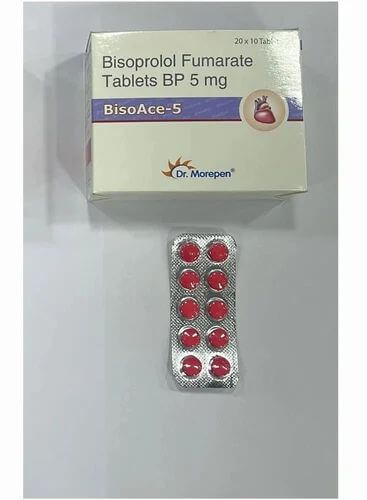
- The CIBIS-II trial was halted ahead of schedule because bisoprolol's survival benefit was already so clear that continuing the placebo group was no longer justified.
- CIBIS-III demonstrated that heart-failure treatment could reasonably begin with bisoprolol before adding an ACE inhibitor, challenging the traditional order of therapy.
Mechanism
Bisoprolol works by competitively blocking beta-1 receptors, which are concentrated in heart muscle and the heart's conduction system [1]. Normally, catecholamines such as adrenaline and noradrenaline bind these receptors to speed the heart and increase its force of contraction; by occupying the receptors, bisoprolol reduces heart rate, lessens the strength of each beat, and lowers the heart's demand for oxygen, which accounts for its usefulness in angina, hypertension, and rhythm control [1].
In heart failure, chronic overactivation of the sympathetic nervous system is harmful, and long-term beta-1 blockade is thought to protect the heart from this stress, improving survival when the drug is introduced carefully and increased in stepwise fashion [1][3]. Its preference for beta-1 over beta-2 receptors, so-called cardioselectivity, spares the airways and peripheral blood vessels relatively more than nonselective beta blockers, though this selectivity is only partial [1].
receptor fingerprint
Beta-1 receptorantagonist
Myocardial oxygen demandmodulates
Juxtaglomerular renin releaseinhibits
AV node conductionblocks
Beta-2 receptorantagonist
Dosingtypical ranges, not medical advice
interested in protocols and clinical dosages? make an account to see them! ^_^
Safetyrisks and cautions, not medical advice
Bisoprolol is a prescription medicine. Common side effects include tiredness, a slow heart rate, cold hands and feet, dizziness, low blood pressure, vivid dreams, and sometimes sexual difficulties. In heart failure the dose must be raised slowly, because starting too high or too fast can briefly worsen symptoms. It should never be stopped abruptly, since that can trigger a rebound in heart rate and chest pain. It is avoided in very slow heart rates, high-degree heart block, decompensated heart failure, and cardiogenic shock, and used cautiously in asthma; combining it with verapamil or diltiazem can slow the heart dangerously, and it can mask the warning signs of low blood sugar.
Interactionsdocumented pairs only, not exhaustive
Bisoprolol reduces the natriuretic effect of thiazide diuretics like hydrochlorothiazide, though the precise mechanism remains uncertain [13]. This is a pharmacodynamic interaction; bisoprolol does not alter thiazide levels (pharmacokinetic), but instead opposes the kidney's salt-wasting response to the diuretic through beta-adrenergic blockade. Unlike ACE inhibitors and angiotensin receptor blockers, which enhance thiazide natriuresis by interfering with tubuloglomerular feedback in the afferent arteriole, beta-blockers reduce natriuresis while preserving the normal tubuloglomerular feedback mechanism [13]. What remains unstudied: bisoprolol interactions with loop diuretics, potassium-sparing diuretics, or modern diuretic combinations; the magnitude of this effect in hypertensive patients on long-term therapy; and whether calcium channel blockers show the same blunting as beta-blockers.
Checking a whole stack? Run it through interactions + stacks.
History
Bisoprolol is a second-generation, highly beta-1 selective adrenergic blocker introduced by the German company E. Merck in the 1980s for hypertension and angina. Its most important chapter came through the Cardiac Insufficiency Bisoprolol Study program, whose second trial, CIBIS-II, was a large European placebo-controlled study of patients with chronic heart failure. CIBIS-II was stopped early after a planned interim analysis because bisoprolol produced a clear reduction in all-cause mortality and sudden death, helping to establish beta-blockade as standard heart-failure therapy. A later trial, CIBIS-III, showed that initiating treatment with bisoprolol before an ACE inhibitor is a viable strategy. Bisoprolol is now a generic medicine on the World Health Organization's List of Essential Medicines.
Reputation
Bisoprolol enjoys a strong reputation as one of the most cardioselective beta-blockers, a property that improves tolerability and permits cautious use in many patients who also have airway disease. It is one of only a few beta-blockers with robust randomized evidence for improving survival in heart failure with reduced ejection fraction, which places it among the guideline-preferred agents. Its once-daily dosing and predictable behavior make it a dependable choice for hypertension, angina, and rate control as well. Clinicians regard it as a well-validated, everyday cornerstone of cardiovascular care.
Subjective profileweighing the evidence above
One of the better beta-blockers, and one of the few drugs that genuinely improves survival in chronic heart failure. Its strong beta-1 selectivity makes it more tolerable than older options. Titrate up slowly in heart failure, expect fatigue and cold hands, and never stop it abruptly.
Where to buy

Suppliers
Vendors carrying Bisoprolol, with live product details and codes. Links are affiliate links that support the wiki at no cost to you.
PCT.Zone
Bisoprolol
Research
- 1995first citedBisoprolol: is this just another beta-blocker for hypertension or angina?
- 2002meta-analysisBisoprolol for the treatment of chronic heart failure: a meta-analysis on individual data of tw…
- 2014most active year3 papers
- 2024most recentSafety and tolerability of β-blockers: importance of cardioselectivity.
- 1.The Cardiac Insufficiency Bisoprolol Study II (CIBIS-II): a randomised trial.
- 2.Bisoprolol for the treatment of chronic heart failure: a meta-analysis on individual data of two placebo-controlled studies--CIBIS and CIBIS II. Cardiac Insufficiency Bisoprolol Study.
- 3.Beta-blocker benefit according to severity of heart failure.
- 4.Heart rate following short-term beta-blocker titration predicts all-cause mortality in elderly chronic heart failure patients: insights from the CIBIS-ELD trial.
- 5.Effect on survival and hospitalization of initiating treatment for chronic heart failure with bisoprolol followed by enalapril, as compared with the opposite sequence: results of the randomized Cardiac Insufficiency Bisoprolol Study (CIBIS) III.
- 6.Beta-blockers for heart failure with reduced, mid-range, and preserved ejection fraction: an individual patient-level analysis of double-blind randomized trials
- 7.Efficacy of β blockers in patients with heart failure plus atrial fibrillation: an individual-patient data meta-analysis.
- 8.Safety and tolerability of β-blockers: importance of cardioselectivity.
- 9.The large-scale placebo-controlled beta-blocker studies in systolic heart failure revisited: results from CIBIS-II, COPERNICUS and SENIORS-SHF compared with stratified subsets from MERIT-HF.
- 10.Effect of Digoxin vs Bisoprolol for Heart Rate Control in Atrial Fibrillation on Patient-Reported Quality of Life: The RATE-AF Randomized Clinical Trial
- 11.Initial treatment with a single pill containing quadruple combination of quarter doses of blood pressure medicines versus standard dose monotherapy in patients with hypertension (QUARTET): a phase 3, randomised, double-blind, active-controlled trial.
- 12.Bisoprolol: is this just another beta-blocker for hypertension or angina?
13 listed here; entry last updated August 2026
Reviews
My notesprivate to this device
FAQ
Is bisoprolol better than other beta blockers?
It is one of the most beta-1 selective, which can mean fewer airway effects, and it is proven to help in heart failure; the best choice still depends on the person.
Can I stop bisoprolol suddenly?
No; stopping abruptly can cause a rebound in heart rate and chest pain, so the dose is lowered gradually under medical guidance.
Does bisoprolol cause tiredness?
It can, especially early on, because it slows the heart; the fatigue often eases as your body adjusts over a few weeks.
Is bisoprolol safe if I have asthma?
It is used cautiously; its high heart selectivity helps, but at higher doses it can still affect the airways, so a doctor weighs the risks.
When should I take bisoprolol?
Usually once each morning at the same time; this keeps heart rate and blood pressure steady through the day.
Adverse effects
- Common effects include tiredness, cold hands and feet, a slow heart rate, dizziness, and headache, reflecting reduced adrenaline signaling.
- Stopping it suddenly can trigger a rebound rise in heart rate or blood pressure, so it is usually tapered [1].
Notes and cautions
- It can mask some warning signs of low blood sugar and, being only partially selective, may still affect breathing in susceptible people with asthma.
- In heart failure, doses are increased slowly because too rapid an increase can worsen symptoms before the benefit appears [1].