
spec sheet6 rows
Procaine is the original synthetic local anaesthetic, still stocked widely in Russian medicine as Novocaine for infiltration and regional anaesthesia despite being largely displaced elsewhere by the amide anaesthetics.
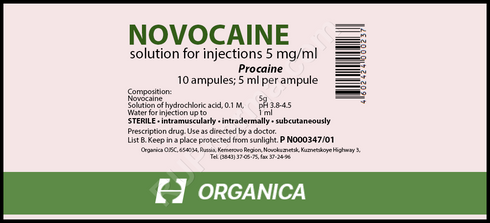
- Procaine (Novocain, 1905) was the first synthetic injectable local anaesthetic and the reference compound for the ester class; it is now largely displaced by amide agents such as lidocaine because of its short duration, poor tissue penetration and allergenicity.
- It is hydrolysed by plasma butyrylcholinesterase to para-aminobenzoic acid, and PABA is the usual antigen in true allergic reactions to ester local anaesthetics; genuine allergy is far more common with esters than with amides.
- In a randomised comparison for spinal anaesthesia, procaine produced fewer transient neurologic symptoms than lidocaine but at the cost of a higher rate of block failure [3], which is the practical reason it is rarely chosen.
- The long-standing European practice of infusing procaine for acute pancreatitis pain has been repeatedly refuted: procaine was inferior to buprenorphine [2], failed to relieve pain in a randomised trial [4], and was no better than placebo in a double-blind trial [5].
- The Gerovital H3 anti-ageing preparation is a buffered procaine formulation whose proposed rationale was weak reversible monoamine oxidase inhibition [1]; the anti-ageing and antidepressant claims have never been substantiated by modern controlled evidence.
- Procaine is still widely used as the depot partner in penicillin G procaine, where its role is to slow absorption rather than to anaesthetise.
Mechanism
It blocks voltage gated sodium channels in the nerve membrane so no action potential can form, but it penetrates tissue poorly and is hydrolysed quickly by plasma cholinesterase, which is why the block is short and weak. That rapid ester hydrolysis produces para-aminobenzoic acid, the source of most procaine allergy.
receptor fingerprint
Voltage-gated sodium channels (Nav1.7 and Nav1.8) in peripheral sensory neuronsOpen- and inactivated-state blocker, acting from the cytoplasmic face of the pore
Butyrylcholinesterase (plasma pseudocholinesterase)Substrate; hydrolysed to para-aminobenzoic acid and diethylaminoethanol
receptor channelOpen-channel blocker at higher concentrations
Monoamine oxidase (MAO)Weak reversible inhibitor
Cardiac sodium channel Nav1.5 and central nervous system sodium channelsBlocked at systemic concentrations
Safetyrisks and cautions, not medical advice
an injectable anaesthetic supplied in ampoules for infiltration, nerve block, epidural and spinal use; it is an ester anaesthetic broken down to para-aminobenzoic acid, the metabolite responsible for its comparatively high rate of true allergic reactions including anaphylaxis
Subjective profileweighing the evidence above
Historically important and now largely displaced, which is the honest summary: the amide anaesthetics penetrate better, last longer and cause far fewer true allergies. Procaine is hydrolysed to para-aminobenzoic acid, and that metabolite is behind a genuine allergic reaction rate the amides do not have. It comes as an injectable ampoule for infiltration, nerve block, epidural and spinal use, and anaphylaxis under a needle needs someone with an airway and resuscitation drugs already in the room, so the site documents it without naming anywhere to buy it.
Resources
No suppliers are provided for compounds like this. This entry is here for reference.
Research
- 1973first citedPossible rationale for procaine (Gerovital H3) therapy in geriatrics: inhibition of monoamine o…
- 2010most recentProcaine infusion for pain treatment of acute pancreatitis: a randomized, placebo-controlled do…
- 1.Possible rationale for procaine (Gerovital H3) therapy in geriatrics: inhibition of monoamine oxidase
- 2.Buprenorphine or procaine for pain relief in acute pancreatitis. A prospective randomized study
- 3.Procaine compared with lidocaine for incidence of transient neurologic symptoms
- 4.Procaine hydrochloride fails to relieve pain in patients with acute pancreatitis
- 5.Procaine infusion for pain treatment of acute pancreatitis: a randomized, placebo-controlled double-blind trial
5 listed here; entry last updated August 2026
Reviews
My notesprivate to this device
Notes and cautions
- Procaine hydrochloride itself has no boxed warning, but the combination products penicillin G procaine and Bicillin C-R carry prominent warnings that they are for deep intramuscular use only, because inadvertent intravascular injection has caused severe neurovascular damage, cardiac arrest and death, including the acute non-allergic Hoigne reaction of terror, hallucination and seizure attributed to procaine microemboli.
- Local anaesthetic systemic toxicity follows accidental intravascular injection or excessive dose and progresses from perioral numbness, tinnitus and metallic taste through seizure to cardiovascular collapse; intravenous lipid emulsion is the standard rescue.
- As an ester hydrolysed to para-aminobenzoic acid, procaine causes true allergic reactions far more often than amide anaesthetics, and patients with atypical or deficient plasma cholinesterase clear it slowly and are at increased risk.
- Methaemoglobinaemia has been reported with ester anaesthetics.
- There is no credible evidence supporting the Gerovital H3 anti-ageing use.